

A goal can feel clear in your imagination yet remain difficult to act on in daily life. NLP for goal setting in London uses structured techniques to help clarify what you want and turn it into practical steps. The focus is not just motivation, but also how your thinking and behaviour can support progress.
If you’ve set goals before, you may know that writing one down doesn’t always make the next step clear. That doesn’t mean you lack commitment. The goal may need to be more specific, meaningful and workable for you.
This article explains how NLP coaching approaches goal setting, what techniques may be used to support behaviour change, and how to think about choosing support in London. You’ll also find out what shapes the coaching process and when a goal-focused approach may be useful. The aim is to give you a grounded sense of what the work involves, so you can decide whether it fits the change you want to make.
Key Takeaways
- Clarify what you want to change, then turn the goal into practical steps you can review and adjust.
- NLP coaching may use reframing, anchoring and outcome-focused questions to explore habits and support new behaviours.
- Choose support that matches your goal, and understand how coaching differs from therapy when you need help with mental health concerns.
- The number of sessions depends on the goal, the progress you make and the work needed between appointments.
- Consider the limits of NLP and seek an appropriate form of support if your needs go beyond goal-focused coaching.
How does neuro-linguistic programming work?
Neuro-linguistic programming, or NLP, was developed in the 1970s by Richard Bandler and John Grinder. It examines how people think, communicate and act, then explores strategies associated with successful performance. For goal setting, the practical question is: what patterns help you move forward, and which ones repeatedly interrupt progress?
A coach can help turn a broad intention into a defined outcome and practical actions. For example, “be more confident at work” might become “contribute one idea in the next team meeting”. That gives you an observable step to practise and review, rather than an abstract standard to meet.
To see one approach to defining a goal, watch this explanation of well-formed outcomes:
In a coaching session, you might describe the result you want and the situation where it matters. The coach may ask what success would look, sound and feel like, and what could change when you achieve it. These questions connect personal or professional goals with daily behaviour. For example, preparing for a presentation could involve identifying the moments that trigger stress.
NLP also explores how language and mental patterns shape your responses. Reframing means considering an experience from a different perspective; anchoring aims to associate a chosen cue with a useful emotional state. These methods are practised in relation to a specific goal, not as a substitute for action. Before a difficult conversation, for instance, you could rehearse a calm opening and then try it in the real situation.
For personal development, the focus might be a habit, relationship or confidence goal. Professional development may centre on communication, leadership or performance. In either case, useful work links the desired change to steps you can take, observe and refine. NLP coaching supports this process through conversation and practice between sessions.
In London, consider whether in-person or online coaching better suits your routine, travel needs and preference for face-to-face conversation. Training has a different purpose: it teaches NLP concepts and techniques, while coaching focuses on applying them to an individual goal. Decide whether you want to learn the methods or work through a particular personal or professional challenge.
Therapy and coaching have different aims. Coaching generally focuses on future goals and progress, while therapy may address mental health concerns or distress within a therapeutic relationship. In-person and online therapy both provide ways to meet with a practitioner, with differences in privacy, travel and how the conversation takes place. Choose the type of support that fits what you want to work on.
Finding NLP counsellors and therapists in London
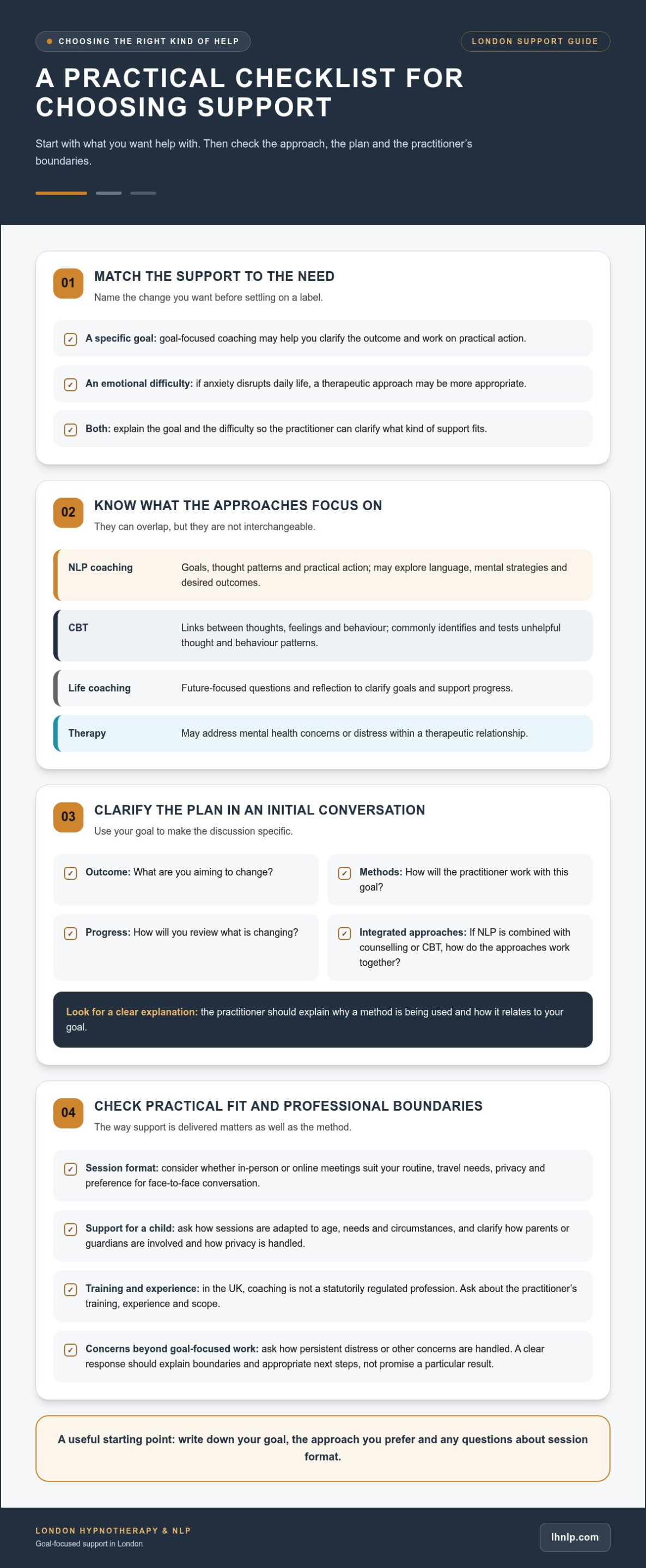
NLP coaching focuses on goals, thought patterns and practical action, while CBT examines links between thoughts, feelings and behaviour. Standard life coaching is also future-focused, using questions and reflection to clarify goals and support progress. The approaches can overlap, but they are not interchangeable.
In London, start by defining the support you need: help with a specific goal, an emotional difficulty, or both. Someone who wants to speak more confidently at work may seek goal-focused coaching. Someone whose anxiety disrupts daily life may need a therapeutic approach. Matching the support to the need matters more than choosing a label.
Ask how the practitioner will work with your particular goal. An initial conversation can clarify the intended outcome, the methods involved and how progress will be reviewed. If NLP is integrated with counselling or CBT, ask how the approaches work together. For example, sessions might explore communication patterns while identifying practical steps for a difficult relationship conversation.
CBT and NLP use different frameworks. CBT commonly focuses on identifying and testing unhelpful thought and behaviour patterns. NLP coaching may explore language, mental strategies and desired outcomes. If approaches are integrated, the practitioner should explain the distinction so you understand why a method is being used and how it relates to your goal.
Adults and children may seek counselling for different concerns. An adult might want help with anxiety affecting work, while a young person may need support with school or communication. The practitioner should explain how sessions are adapted to the person’s age, needs and circumstances. For a child, clarify how parents or guardians are involved and how privacy is handled.
Hypnotherapy and counselling are distinct forms of support, though a practitioner may use them alongside other approaches when appropriate. Counselling generally offers space to explore feelings, experiences and relationships through conversation. Hypnotherapy uses hypnosis as part of a planned intervention. If anxiety is the concern, discuss how the chosen method addresses it and what a session involves.
In the UK, coaching is not a statutorily regulated profession. Clear information about a practitioner’s training, experience and scope is therefore useful. Ask how they handle concerns beyond goal-focused work, such as persistent distress. A structured answer should explain professional boundaries and appropriate next steps, not promise a particular result.
Before choosing, note your goal, the approach you prefer, and any questions about session format. Then use those points to guide an initial discussion. You can explore goal-setting support as one way to consider structured help with personal change.
NLP techniques for goal setting and behaviour change
NLP goal work can combine outcome framing with techniques for examining beliefs and behaviour. A career goal, for example, becomes more useful when you identify an action to practise and a way to review it.
Techniques for Behaviour Change
An outcome frame helps define what you want, how you’ll recognise progress and which actions are within your control. For a career change, “find a better job” could become “update my CV and contact one relevant person”. This turns an intention into observable behaviour you can review and refine.
Reframing examines the meaning you attach to an experience. If you tell yourself, “I always fail interviews,” a coach might help you distinguish one difficult interview from your broader abilities. The aim is to consider a more useful interpretation, not deny what happened.
Anchoring uses a chosen cue to help recall a useful emotional state. You might practise steady breathing while remembering a moment of confidence, then use that cue before a presentation. Submodalities explore how you experience an internal image or sound, while the swish pattern is used to rehearse a different response to a trigger.
These techniques should connect to real-world practice. Choose a situation, rehearse a response, try it outside the session and note what happened. This helps you assess whether the method supports your particular goal.
Limits and Risks of NLP Goal Setting
NLP techniques are not a substitute for addressing every cause of distress. A goal-setting exercise may help someone prepare for a work conversation, but persistent anxiety or significant emotional difficulty may call for therapeutic support instead. The appropriate approach depends on the concern and its effect on daily life.
Goals can become unhelpful if they depend on perfection or external approval. “Never feel nervous again” is difficult to act on; “prepare and speak at the next team meeting” gives you behaviour to practise. Review whether the goal reflects your values, rather than pressure to meet someone else’s expectations.
In the UK, coaching is not a statutorily regulated profession. The word “accredited” alone doesn’t explain a practitioner’s training, approach or boundaries. Ask how a technique relates to your goal, how progress is reviewed, and when they would recommend support from a therapist or another mental health professional.
Keep your own observations central. After practising a technique, record the situation, what you tried and what changed. If it increases distress or doesn’t fit the problem, discuss your response and reconsider the plan rather than treating the method as a test of willpower.
How many NLP coaching sessions are typically needed to work on a goal?
There isn’t one fixed session count for every goal. A typical guide is 6-12 sessions, with meaningful progress often developing within that range. The work may be shorter for a clear, contained goal, while a goal involving several habits or situations may need more review and practice. Progress depends on what you want to change and how the work develops.
NLP coaching sessions typically last 60-90 minutes. That gives time to clarify the goal, explore what gets in the way, practise an approach and agree on an action between meetings. For example, someone aiming to speak up more at work could identify one upcoming meeting, rehearse a contribution, then review what happened next time.
A useful plan treats each appointment as part of a process, not a standalone promise. Early sessions can define the desired outcome and identify observable signs of progress. Later sessions can review what happened during practice, refine the approach and set a next step. For a regular exercise habit, for example, review consistency and obstacles, not just motivation.
Between-session practice matters because coaching conversations need to connect with everyday choices. After each appointment, note the agreed action, where you’ll try it and what you notice afterwards. Bring those observations to the next session. If the action felt too difficult, discuss why and break it into a more manageable step.
- At the outset: Describe the goal and how you’ll recognise movement towards it.
- After a session: Try one agreed action in a real situation.
- At the next review: Identify what helped, what interrupted progress, and what to adjust.
- As work continues: Revisit whether the original goal still reflects what matters to you.
Some coaches offer packages of 6-12 sessions at a reduced rate. A package may provide a planned structure, but the number of appointments should remain connected to the goal and the progress being reviewed. Consider what each session is intended to achieve, how actions between sessions will be discussed, and when you’ll pause to assess whether the work remains useful.
Rather than treating 6-12 as a guarantee or a target to complete, use it as a planning range. A clear outcome, regular practice and honest review help make the session count more purposeful. The important measure is whether the work is helping you take meaningful steps towards the goal you chose.
What are the limitations or risks of using NLP for goal setting?
NLP goal-setting techniques offer a structure for exploring thoughts and actions, but they can’t remove every obstacle. Someone planning a career change still faces practical factors such as time, finances and available opportunities. A coaching exercise can clarify a next step, but it cannot control those external conditions.
A goal can become counterproductive when it reflects pressure rather than personal values. Pursuing a promotion solely to satisfy family expectations, for example, may leave someone disconnected from what they actually want. Before committing, identify why the outcome matters and whether it fits your circumstances. Revisiting that reason can keep the goal flexible and meaningful.
Reframing can offer a different perspective, but it shouldn’t dismiss a genuine difficulty. If someone describes a distressing workplace experience, immediately calling it a “learning opportunity” can feel invalidating. A careful conversation first acknowledges what happened, then explores whether a new perspective or practical action might help.
Another limitation is treating a technique as a guaranteed shortcut. Rehearsing a confident response before a presentation, for instance, doesn’t remove every source of anxiety or ensure a particular audience reaction. Use techniques as practice tools, then assess what happened in the real situation. Adjust the plan based on your experience, rather than judging yourself for an outcome beyond your control.
- Check the goal: Ask whether it’s yours, specific and realistic in your current circumstances.
- Review the method: Understand what an exercise involves before using it with a sensitive experience.
- Notice your response: Record whether practice feels useful, uncomfortable or disconnected from the problem.
- Change direction: Revise the goal or approach when real-world experience shows a mismatch.
Goal-focused coaching has limits when the main issue is significant distress or a mental health concern. Someone struggling to manage daily life because of persistent anxiety, for example, needs support suited to that concern, rather than goal planning alone. A responsible practitioner explains the boundaries of coaching and when another form of professional help is appropriate.
Before starting, describe the outcome you want and ask how progress will be reviewed. A clear plan should allow for setbacks, changing priorities and feedback from everyday life. If an exercise increases distress, pause and raise that response instead of forcing yourself to continue. The method should support your wellbeing and chosen direction.
If you’re considering structured support for a personal goal, explore goal-focused support and consider whether its approach fits the change you want to make.
London Hypnotherapy & NLP: Hypnotherapy for Anxiety
London Hypnotherapy & NLP offers Hypnotherapy for Anxiety for people whose anxiety affects everyday situations and goals. When worry makes it harder to take an identified step, focused support can help you explore the challenge and work towards change. For goals involving habits or personal development, NLP Coaching offers a goal-oriented approach.
The right starting point depends on what you want help with. You might be working on anxiety, weight loss, smoking cessation or a specific goal through NLP. Consider which concern matters most and choose support that addresses it.
If you’d like to discuss a suitable next step, contact London Hypnotherapy & NLP.
Choose a Next Step That Fits Your Goal
Meaningful change often begins with a step small enough to take, yet important enough to hold your attention. Choose one action that reflects what matters to you, then consider what support could help you follow through. NLP for goal setting in London may suit you if you want structured help turning an intention into purposeful action.
Before you begin, name the change you want and the reason behind it. This simple reflection can help distinguish your priorities from expectations you’ve absorbed elsewhere. From there, you can approach support with a clearer idea of what you want to work on.
London Hypnotherapy & NLP offers NLP Coaching, Hypnotherapy for Anxiety, Hypnotherapy for Weight Loss and Hypnotherapy for Smoking Cessation. The right focus depends on the concern you want to address and the kind of change you’re seeking.
If you’re ready to explore your options, contact London Hypnotherapy & NLP. Take the next step at a pace that feels considered and your own.
Frequently Asked Questions
How Does NLP Coaching Actually Work?
NLP coaching uses structured conversation and exercises to connect a goal with your choices and actions. You might bring a recurring challenge, such as putting off an important task, and examine what happens just before you avoid it. The coach can help you identify a different response to practise. Reviewing what happens afterwards makes the process concrete and helps refine the plan.
How Much Does NLP Coaching Cost?
The cost depends on the practitioner, session format and the support involved. For this service, the price depends on your case and is given after a quote request. Before arranging sessions, clarify what the fee covers, whether appointments are charged individually, and how payment works. If considering a series, ask how you can review your progress and decide whether further sessions remain useful.
Is NLP Coaching Actually Effective?
Usefulness depends on your goal, your engagement with the process and how well the approach fits your needs. Rather than relying on broad claims, agree on a practical sign of progress, such as completing a task you usually avoid. Review that measure during coaching and consider whether the change carries into everyday life. NLP coaching doesn’t guarantee a particular outcome.
What Is NLP?
NLP stands for neuro-linguistic programming, an approach that explores connections between thought, language and behaviour. Richard Bandler and John Grinder developed it in the 1970s. In practical coaching, a practitioner may explore how you describe a challenge and how that description shapes your response. It’s useful to distinguish this approach from a clinical diagnosis or a medical treatment.
What Should You Look for in an NLP Coach?
Look for clear explanations of the coach’s training, approach and professional boundaries. In the UK, coaching is not statutorily regulated, so ask how they plan to work towards your goal and review progress. You could also ask what happens if the work reveals a concern outside coaching’s scope. A considered answer should explain the service’s limits and appropriate next steps.
What does NLP mean in goal setting?
NLP for goal setting in London means applying NLP ideas to clarify an outcome and examine responses that influence progress. If you want to contribute more in meetings, for example, identify what holds you back and define one contribution to practise. The goal is easier to assess when it reflects a choice you can make, rather than another person’s response.
How can NLP techniques help with setting and achieving goals?
NLP techniques can help you examine the language and assumptions around a goal, then choose a more workable action. If “I can’t make time to study” feels like a fixed rule, explore the demands shaping your week. You could then set aside a specific study period and review whether it worked. The value lies in testing a new behaviour in daily life.
What NLP goal-setting methods and exercises are commonly used?
Common methods include outcome framing, reframing, anchoring and the swish pattern. An outcome exercise asks you to describe what you want to achieve, how you’ll recognise progress and what first action you can take. Before a presentation, for instance, you could practise recalling a calm, focused state. Discuss how each exercise relates to your goal rather than using techniques without a clear purpose.