

What if learning how to feel comfortable in my own skin doesn’t begin with liking every part of myself? It can be hard to feel at ease when you compare your appearance or personality with idealised images, or repeat positive affirmations that don’t feel true. That doesn’t mean you’re failing. It may mean you need a more honest, compassionate way to relate to yourself.
Self-acceptance isn’t a demand to feel confident all the time. It can grow as you understand where self-criticism comes from and practise responding when it appears. You don’t have to force a change in how you feel overnight.
This guide looks at why feeling comfortable with yourself can be difficult, how to meet critical thoughts without treating them as facts, and how small steps can help you feel more grounded. It also explains when one-to-one support, such as confidence-building sessions using hypnotherapy or NLP, might be useful. Start with what feels manageable.
Key Takeaways
- Feeling at ease with yourself can include self-respect and authenticity, while leaving room to grow.
- Notice how comparison and absorbed criticism may influence the standards you set for yourself.
- Compassionate realism can feel more genuine than harsh self-judgement or forced affirmations.
- Try a flexible practice: notice a critical thought, name the feeling, then consider a kinder response.
- Explore how to feel comfortable in my own skin at your own pace, and consider personalised hypnotherapy or NLP support if you want to explore recurring patterns.
What Does It Mean to Feel Comfortable in Your Own Skin?
Feeling comfortable in your own skin means treating yourself with respect, expressing what feels authentic to you, and allowing yourself room to learn and change. It isn’t a permanent state of confidence, a demand to be perfect, or a requirement to like every part of yourself. You can feel uncertain about your appearance, personality or choices and still treat yourself fairly rather than with contempt.
Comparison can make your life seem like a test you’re always failing, especially when other people’s polished images or opinions become the standard you use to judge yourself. Repeated criticism, from others or from your own inner voice, can also shape what you notice and expect of yourself. For a helpful foundation, understanding self-esteem can clarify how your sense of personal worth relates to the way you see yourself.
To explore how criticism can affect this experience, watch Caroline Maguire’s video:
Self-acceptance is not the same as self-satisfaction
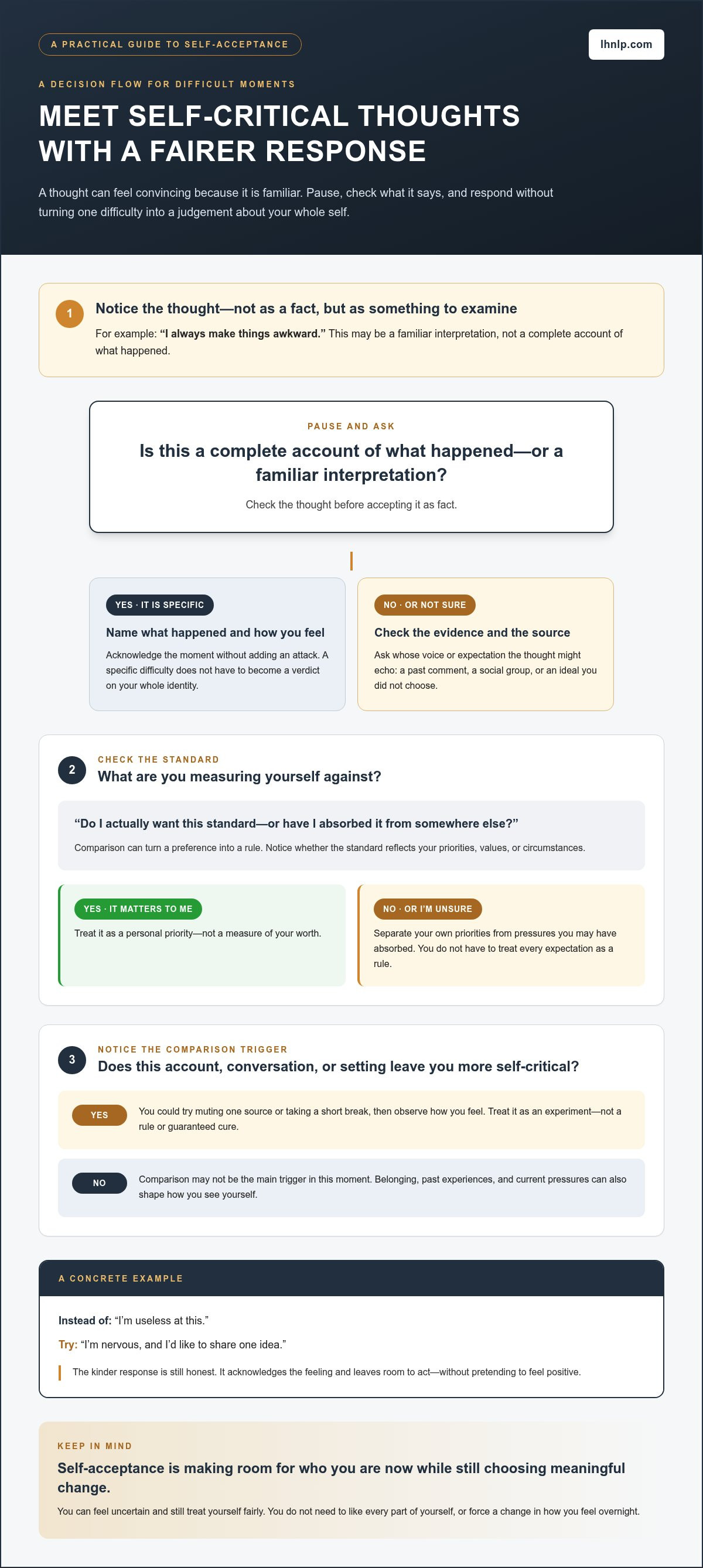
Accepting a feeling or trait doesn’t mean approving every behaviour or deciding nothing can change. It means recognising what’s happening without adding an attack. If you feel awkward speaking in a meeting, for instance, you might acknowledge, “I’m nervous, and I’d like to share one idea,” instead of concluding, “I’m useless at this.” The first response is honest and leaves room to act. It doesn’t require pretending to feel positive.
Self-acceptance means making room for who you are now while still choosing meaningful change. That distinction matters: self-respect can support growth more steadily than shame, which can turn a specific difficulty into a judgement about your whole identity.
Why the phrase can mean different things to different people
For one person, feeling more at ease may mean wearing clothes they enjoy without constant worry. For another, it may mean feeling secure in their identity, building more honest relationships or speaking up when something matters. There’s no single appearance standard or personality ideal everyone needs to meet. Ask yourself: what would I do differently if I felt a little more at home in myself?
Your answer can be modest and specific. Perhaps you’d stop apologising for a considered opinion, choose a social activity that suits you, or spend less time checking how you compare. These personal markers make how to feel comfortable in my own skin a meaningful question rather than another standard to perform. Begin by describing the ease you want, not by deciding what you think you should become.
Why Can It Feel So Difficult to Be Comfortable with Yourself?
Feeling at ease can be difficult when the standards you use to judge yourself keep shifting. You might compare your appearance with edited images, your career with someone else’s milestone, or your confidence with the ease another person seems to show. Each comparison can turn a preference into a rule you feel you must meet, even when it doesn’t reflect your values or circumstances.
Comparison shifts attention towards perceived shortcomings and away from the fuller picture of who you are. Belonging, past experiences and current pressures can shape that picture. Being criticised, excluded or expected to fit a particular role may leave you alert to signs that you’re falling short. A demanding period at work or strain in a relationship can also make familiar insecurities feel louder. These influences may help explain discomfort, but they don’t define your worth.
The effect of comparison and idealised images
Online images often show a carefully selected moment, while you experience the unedited texture of everyday life: tiredness, uncertainty and ordinary changes in appearance. Comparing the two can create an unfair contest. Notice which accounts, conversations or settings leave you more self-critical. You could try muting one source or taking a short break, then observe how you feel. Treat this as an experiment, not a rule or guaranteed cure.
Comparison can also happen offline. A family gathering, workplace or social group may bring old expectations into focus, particularly if approval has felt conditional. Ask yourself, “What standard am I measuring myself against, and do I actually want it?” That pause can help separate your priorities from pressures you’ve absorbed. Practising cultivating self-compassion can offer a gentler way to meet difficult feelings without dismissing them.
How self-critical thoughts can become familiar
A thought can feel convincing simply because you’ve heard it often. “I always make things awkward” may be a familiar interpretation, not a complete account of what happened. In everyday language, cognitive distortions are thinking habits that can make conclusions feel more certain or extreme than the evidence supports. Recognising one isn’t a diagnosis; it’s an invitation to check the thought before accepting it as fact.
Ask whose voice or expectations your inner critic might be echoing. Does the rule come from a past comment, a social group or an ideal you’ve never chosen for yourself? You don’t need to solve its whole history at once. If these patterns are difficult to explore alone, personalised confidence-building support can give you space to consider them with a practitioner.
Must You Love Everything to Feel More at Ease?
No. Self-acceptance doesn’t require constant self-love, finding every part of yourself wonderful, or turning difficult experiences into something positive. If you’re wondering how to feel comfortable in my own skin, set aside the idea that you must first feel enthusiastic about yourself. A more believable starting point is to recognise what you’re feeling without making it a verdict on your worth.
Forced affirmations can feel hollow when they’re far removed from your experience. If “I love everything about myself” doesn’t ring true, you don’t have to repeat it. Compassionate realism makes room for what’s hard now and what you may want to work towards. You can accept your present experience and still choose change.
Self-respect gives personal growth a steadier starting point than self-rejection.
What realistic self-compassion sounds like
Supportive self-talk doesn’t mean denying a setback or praising yourself in a way that feels implausible. It means describing what happened without turning it into an insult. After a difficult conversation, for example, “I wish I’d explained that more clearly, and I can try again” is both honest and constructive. “I’m hopeless with people” is a sweeping judgement; “I’m brilliant at everything” may feel just as disconnected from reality.
Ask what you’d say to someone you care about in the same situation. You might offer patience while helping them consider what to do next. You deserve that same balance: kindness without pretending, and accountability without humiliation.
When appearance is part of the struggle
Appearance concerns can weigh heavily, but they don’t explain every reason someone might feel uncomfortable with themselves. You may feel unsettled about your body and also be questioning your identity, struggling to belong, or finding it hard to express an opinion. Notice which parts of your experience relate to appearance and which may have different roots.
It’s understandable to want reassurance when you feel exposed or judged. Still, your worth doesn’t need to depend on approval of your looks, and reassurance may not answer the deeper question of whether you feel safe, accepted or able to be yourself. You don’t need to change your appearance to earn self-respect. Ask what care or support would feel useful today, without demanding that you love how you look first.
Progress can mean responding to yourself with less hostility, not reaching perfect confidence. If self-critical patterns feel difficult to shift alone, individual confidence-building support can offer space to explore them and consider the changes you want to make. It’s an option, not a requirement for accepting yourself.
How Can You Practise Feeling More Comfortable in Your Own Skin?
There isn’t one routine that suits everyone, and you don’t need to turn self-acceptance into another task to get right. If you’re exploring how to feel comfortable in my own skin, try a small, flexible practice when self-criticism appears. The aim isn’t to erase a difficult thought, but to create space before deciding what it means or how to respond.
A simple pause for self-critical moments
When you notice a sharp judgement, pause if it feels manageable. Write down what happened and the exact thought that followed. Naming the moment can help separate the event from the story your mind attached to it. Then ask what you know, what you’re assuming, and what remains uncertain. Choose a response that’s fair and believable, not artificially positive.
- Notice the situation. Was the thought prompted by a photograph, a conversation, a mistake or a particular setting? Describe the event plainly, without judging yourself for reacting.
- Name the feeling and thought. You might write, “I felt embarrassed after I stumbled over my words. I thought everyone must think I’m incompetent.” This makes the experience easier to examine.
- Check what the thought leaves out. What evidence supports it? What doesn’t fit? Perhaps one person looked distracted, but you can’t know what they thought. Uncertainty isn’t proof of the harshest interpretation.
- Offer a balanced reply. Try, “I felt awkward, but one hesitant moment doesn’t define how I communicate.” It doesn’t dismiss the feeling or insist you’re wonderful. It leaves room for a more complete view.
You may not feel reassured immediately, and that’s all right. The useful shift is noticing that a thought can be present without being the whole truth. If writing feels cumbersome, ask yourself these questions quietly instead.
Build small actions around your own values
Choose one value you’d like to express more often, such as honesty, curiosity, care or independence. Values are directions, not targets you either pass or fail. Ask what a small, low-pressure action might look like today: sharing a genuine preference about where to eat, asking for time before agreeing to a request, or speaking up once in a conversation.
Afterwards, reflect without giving yourself a score. What felt aligned with the person you want to be? What felt uncomfortable, and what might make a next step more manageable? Even if your feelings don’t change straight away, you’ve practised responding from your values rather than letting self-doubt make every choice.
Keep the practice adaptable. One day you might challenge a thought; another day, you might rest or ask someone you trust for support. There’s no fixed timeline for becoming more at ease, and you don’t need to force progress. If one-to-one guidance would help you explore confidence at your own pace, London Hypnotherapy & NLP offers confidence-building sessions using hypnotherapy and NLP.
When Can Personal Support Help You Feel More at Ease with Yourself?
Self-guided practices can be a useful starting point, but you don’t have to work through everything alone. Personal support may be worth considering if self-criticism keeps shaping everyday choices, makes it hard to speak up, or creates recurring tension in your relationships. That doesn’t mean you’ve failed or that support is essential for learning how to feel comfortable in my own skin. It offers another space to understand what’s happening and consider what you’d like to change.
In individual sessions, hypnotherapy and NLP can be used to explore patterns in a personalised way. The focus can be on your concerns and goals, rather than a prescribed idea of confidence or a promised outcome. Explore the available treatments to see how confidence-building support may fit alongside your own efforts.
What a supportive session can focus on
A supportive conversation can begin with what has been troubling you, what you hope might feel different, and what pace feels manageable. You might want to understand why you repeatedly doubt yourself at work, or practise responding differently when you feel judged. Confidence-building support can explore thought patterns and help you identify practical goals that matter in daily life.
There isn’t one method or number of sessions that suits everyone. The process can take account of your preferences and the concerns you bring, while leaving room to reflect as you go. You can ask questions, explain what feels comfortable, and decide what you’d like to focus on. Personal support is an option, not a requirement for self-acceptance.
Finding a format that feels approachable
Convenience and familiarity can make it easier to consider a first conversation. London Hypnotherapy & NLP offers in-person appointments at locations including Harley Street, Ealing and Tokenhouse Yard. If meeting remotely feels more suitable, virtual sessions are available via Zoom and Skype. Choosing a format that fits your circumstances can make the practical side feel less like another hurdle.
It may also help to understand the practitioner’s approach before deciding whether support feels right for you. The practice’s about page shares background that can help you get a sense of the person guiding the work. Take time to notice what you need from support, and remember that asking for help can sit alongside your own choices and strengths. The next step, if you choose to take one, can be small.
Take the Next Step at Your Own Pace
You don’t need to wait until you feel completely confident before treating yourself with care. Your next step might be noticing one moment when you feel more at ease, or choosing one small action that reflects what matters to you. Let that be enough for now. Learning how to feel comfortable in my own skin isn’t about reaching a flawless version of yourself; it’s about building a more understanding relationship with the person you already are.
If self-guided reflection feels difficult to sustain, personalised support can give you space to explore what you’re experiencing and what you’d like to work towards. Individual confidence-building sessions may draw on hypnotherapy and NLP, shaped around your concerns rather than a one-size-fits-all idea of change. There’s no need to commit to a particular pace or outcome. You can find out more and decide whether this feels like a helpful next step.
Explore one-to-one hypnotherapy and NLP treatments with London Hypnotherapy & NLP and consider what kind of guidance might feel right for you. Take it one step at a time. A gentler way of being with yourself can begin with a single choice to listen rather than criticise.
Frequently Asked Questions
Can you feel comfortable in your own skin without loving everything about yourself?
Yes. You can treat yourself with respect without feeling fond of every trait, choice or part of your life. For example, you might regret how you handled a disagreement and still recognise that one difficult conversation doesn’t make you undeserving of care. Separate what you want to learn from what you’re tempted to condemn. A fairer view can leave room for responsibility and self-respect at the same time.
How do I stop comparing myself to other people?
You may not be able to prevent every comparison, but you can change what you do with it. If someone’s confidence makes you feel inadequate, ask what quality you admire, such as preparation or openness, and whether there’s a small way to practise it yourself. This turns comparison into information about what matters to you, rather than a ranking of who is more worthy. Notice when this approach feels useful.
Is feeling uncomfortable with yourself always about your appearance?
No. Appearance may be one part of it, but discomfort can also relate to identity, social expectations, work, family roles or feeling unable to speak honestly. Consider whether the unease appears mainly in particular settings or with particular people. For instance, feeling at ease with close friends but guarded at work may point towards a relationship or environment issue, not simply dissatisfaction with how you look.
What can I do when positive affirmations feel fake?
Choose a statement that feels possible rather than insisting on one you don’t believe. If “I’m confident” feels false before a presentation, try “I can prepare my opening sentence” or “I can feel nervous and still take part.” You could also focus on a concrete action instead of a belief about yourself. The aim is to find language that helps you meet the moment, not force a particular mood.
Can hypnotherapy help with confidence and self-criticism?
Hypnotherapy may be one approach to exploring patterns connected with confidence and self-critical thinking. In individual sessions, hypnotherapy and NLP can focus on concerns and goals that matter to you, including how certain situations affect your confidence. Experiences and needs differ, so results can’t be promised, and hypnotherapy isn’t required for self-acceptance. London Hypnotherapy & NLP offers confidence-building sessions in London and online.
How long does it take to feel more comfortable with yourself?
There’s no set timeframe, because what you’re working through and what “more comfortable” means are personal. Instead of waiting for a permanent feeling, notice practical signs of change: perhaps you recover sooner after a mistake, make a choice with less reassurance, or say what you mean in a conversation. These moments can help you recognise movement without turning progress into a deadline or another standard to meet.
Can I have hypnotherapy online if I live outside London?
Yes. London Hypnotherapy & NLP offers virtual hypnotherapy sessions via Zoom and Skype, so you can attend remotely if you live outside London. The practice is based in London, and online consultations also support clients internationally. To make a session feel easier, choose a private space where you can speak comfortably and check your connection beforehand. Use the format that best fits your circumstances.