

What if difficulty using a public toilet isn’t a failure of willpower, but an anxiety pattern you can understand and work with? If you’re searching for fear of public toilets (shy bladder) treatment London, you may already know how quickly the worry can shape everyday choices, from waiting until you get home to planning journeys around private facilities.
Feeling tense when other people are nearby, or being unable to urinate despite needing to, can be distressing and isolating. It doesn’t mean you’re weak, and you don’t need to blame yourself. Support can help you explore what keeps the anxiety going and consider ways to respond with greater confidence.
This article explains how shy bladder can develop and offers practical ways to notice anxious thoughts and take gradual steps in public settings. It also outlines personalised, solution-focused support, including one-to-one hypnotherapy and NLP sessions in London or online. You can consider next steps at a pace that feels manageable.
Key Takeaways
- Shy bladder, also known as paruresis, can make urinating in certain public or social settings difficult. Experiences vary, and this description isn’t a diagnosis.
- Notice how anticipation, tension and avoidance may reinforce one another, then identify small, manageable steps that feel less pressured.
- Medical assessment and psychological support have different purposes: one can help investigate physical symptoms, while the other can address anxiety and distress.
- Approach public toilet situations with patience rather than treating each attempt as a test you have to pass.
- Learn what personalised support in London may involve, including one-to-one hypnotherapy and NLP sessions in person or online.
Fear of public toilets: what shy bladder can feel like
Needing to urinate but finding you can’t once other people are nearby can feel confusing and exposing. Shy bladder, also called paruresis, describes difficulty urinating in some social or public situations. The experience varies: one person may struggle in a busy shared toilet, while another may find it difficult only in unfamiliar places or where privacy feels limited. The term can help you describe a pattern, but it isn’t a diagnosis.
Put simply, paruresis is difficulty urinating in certain settings where the presence or perceived awareness of other people makes it harder to relax enough to go. For a wider overview of the term and related experiences, see Paruresis (shy bladder syndrome). A label can be useful, but it doesn’t replace an understanding of your individual experience.
Why public toilets can feel difficult
Shared facilities, queues, unfamiliar toilets and spaces with little privacy can all feel challenging. You might worry that someone will hear you, notice how long you’re taking, or hurry you along. Even before you arrive, a thought such as “What if I can’t go?” may increase tension and make the situation feel more pressured. This is a difficult response, not a personal failing or a choice.
The mind can begin preparing for discomfort well in advance. A journey, meeting or even passing a public toilet may prompt concern about whether you’ll be able to use it. Attention can then turn inward, monitoring whether urination has started and how much time is passing. That self-consciousness may make it harder to feel at ease, especially if you already expect to be observed or rushed.
Shy bladder and other urinary symptoms are not interchangeable
A pattern linked to particular settings may differ from symptoms that also occur when you’re alone or somewhere familiar. But that distinction alone can’t establish the cause. Anxiety may be part of someone’s experience, yet not every urinary symptom should be attributed to it.
If symptoms are new, painful, persistent or otherwise concerning, speak with your GP. A medical assessment can help investigate physical symptoms and consider appropriate support. Seeking advice isn’t an overreaction. It’s a sensible way to avoid assuming that every difficulty has the same explanation.
It can still help to notice the circumstances. You might observe whether difficulty is linked to a particular setting, other people being nearby, a queue or feeling short on time. You don’t need to test yourself or force an answer. The aim is to describe what happens without judgement, so any next steps reflect your actual experience.
If you’re exploring fear of public toilets (shy bladder) treatment London, start by understanding the pattern rather than expecting willpower alone to overcome it. Noticing the context can make the experience easier to discuss and help distinguish emotional distress from symptoms that deserve medical attention.
How anticipatory anxiety can reinforce shy bladder
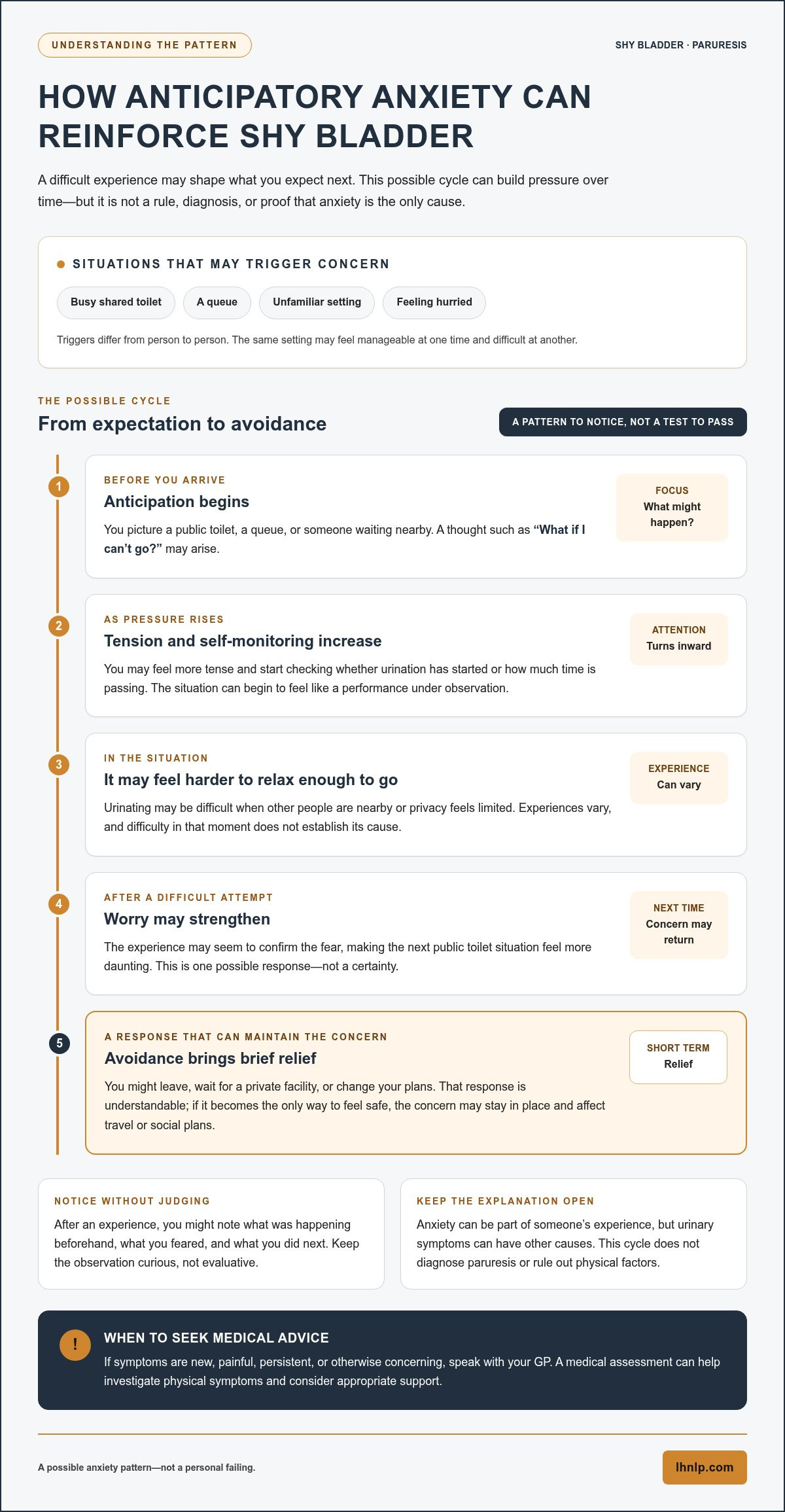
A difficult experience in a public toilet can linger after the moment itself. Before the next outing, you might picture a queue, a shared facility or someone waiting outside, then worry about whether you’ll be able to urinate. That expectation can bring tension before you even reach the toilet. If urination is difficult, the experience may seem to confirm the fear, making the next situation feel more daunting.
Anticipation can raise tension, difficulty can strengthen worry, and avoidance can bring brief relief while keeping the concern in place. This is one possible cycle, not a rule. It doesn’t prove that anxiety is the only cause or establish a formal diagnosis.
Triggers, thoughts, and the body’s stress response
Triggers differ from person to person. A busy shared toilet, a queue, an unfamiliar setting or feeling hurried may all contribute. Stress can affect how the body responds, but there isn’t one simple explanation that applies to everyone. Physical symptoms can have other causes, too.
Attention may also turn inward: “Is it happening yet?” or “How long have I been here?” Monitoring each moment can make the task feel like a performance under observation. You aren’t choosing this response. It may help to notice which situations and thoughts tend to appear together, without judging yourself or trying to force an immediate change.
When shy bladder overlaps with wider anxiety
Some people also experience social anxiety or other worries; others don’t. Feeling self-conscious in one toilet situation doesn’t, by itself, mean you have a wider anxiety problem. A practitioner can explore your experience and goals rather than assigning a label based on an article. For a related perspective on anxiety support, see this London anxiety therapy guide.
Avoiding a difficult toilet can bring immediate relief: you leave, wait for a private facility or change your plans. That response is understandable. But if it becomes the only way to feel safe, it may gradually affect travel, social plans or time away from home. Noticing this pattern isn’t a reason to blame yourself. It’s information about how the concern may be affecting your choices.
The cycle can look different for each person. You may manage in some public settings but struggle in others, or find that pressure and anticipation matter more than the toilet itself. A brief note after an experience can help you see what was happening beforehand, what you feared and what you did next. Keep it curious, not evaluative.
If you’re considering fear of public toilets (shy bladder) treatment London, personalised support can offer space to explore these patterns and consider steps that fit your circumstances. The International Paruresis Association (IPA) also provides information and resources about paruresis. For an overview of anxiety and phobia support, explore personalised hypnotherapy and NLP treatments.
Shy bladder treatment in London: compare support options carefully
There isn’t one route that suits everyone. A useful starting point depends partly on what you’re experiencing: physical symptoms may call for medical assessment, while distress linked to particular settings may be something you want to explore through psychological support. These options have different purposes and, where appropriate, can sit alongside one another.
| Support option | Main purpose | What it may involve |
|---|---|---|
| GP assessment | Explore physical symptoms and consider possible causes. | A conversation about what you’ve noticed and whether further medical assessment is appropriate. |
| Psychological support | Explore emotional distress, thoughts and patterns connected with public toilet situations. | Discussing your experience, goals and possible approaches with a practitioner. |
| Practical self-management | Build awareness of your own responses and try manageable adjustments. | Noticing which situations feel difficult and reflecting on what makes them more or less pressured. |
The table is a guide, not a ranking or a substitute for individual advice. An article or therapist can’t rule out physical causes. If you’re unsure where to begin, a GP can help you consider whether medical assessment is needed, particularly if urinary concerns are new, painful, sudden or persistent.
When to seek medical advice alongside psychological support
Consider speaking with your GP if you notice pain, a sudden change, difficulty urinating in private as well as public, or urinary concerns that persist. These details don’t establish a cause, but they’re useful to raise with a medical professional. If symptoms feel urgent or serious, seek appropriate medical advice through NHS services rather than relying on self-assessment or psychological support alone.
Psychological support has a different focus: it can provide space to explore the thoughts, feelings and situations associated with the difficulty. Medical and psychological perspectives aren’t competing explanations. Keeping both in view can help you avoid assuming every symptom is caused by anxiety.
What hypnotherapy and NLP may contribute
Personalised hypnotherapy and NLP sessions may explore how you respond to toilet-related situations, the thoughts or feelings you’d like to work with, and the changes that matter to you. The approach and goals should be discussed collaboratively, with attention to your circumstances rather than a standard script. Suitability is individual, outcomes vary, and no cure or fixed timeline can be promised.
For some people, the first useful step is medical advice; for others, it may be exploring the emotional pattern or trying a low-pressure practical adjustment. You don’t have to settle on a single explanation before asking for support. If you’re researching fear of public toilets (shy bladder) treatment London, consider what each option is intended to address and choose next steps that respect both your physical wellbeing and personal goals.
Practical ways to make public toilet situations feel more manageable
Small, thoughtful steps can help you understand what makes a situation harder without turning each visit into a test. The aim isn’t to force urination or prove you can manage every public toilet. It’s to approach your experience with curiosity, protect your comfort and notice what feels possible at your own pace.
A gradual, self-compassionate approach
Choose a step that feels manageable and personally meaningful, rather than starting with the situation you fear most. For example, you could notice how you feel near a familiar facility or choose a quieter time to visit a place you already know. These are examples, not a prescribed exposure plan; an approach that feels useful for one person may not suit another.
Progress may be uneven. One difficult visit doesn’t erase what you’ve learned, and one easier visit doesn’t mean you must immediately take on a bigger challenge. You can pause, adjust your next step or decide that a particular situation isn’t right for you that day. Patience leaves room for learning; pressure can make the moment feel like an exam.
What to notice before and after a difficult moment
A brief note can help you spot patterns without judging yourself. Before or after a situation, consider:
- The setting: Was it familiar, busy, shared or somewhere you felt hurried?
- Your thoughts: What were you expecting might happen?
- Your tension: What did you notice in your body or attention?
- What affected comfort: Did having more time, privacy or a quieter environment make any difference?
Use these questions to gather information, not to score the visit as a success or failure. You might notice that the journey there felt harder than being in the toilet, or that pressure eased when you stopped checking the time. A small observation can be useful even if the outcome wasn’t what you hoped for.
Planning for comfort can help you feel more prepared. You might find out where facilities are during a longer outing or allow enough time so you’re not rushing. At the same time, keep plans flexible. If access to a private toilet becomes the only condition for leaving home, your options may gradually shrink. Aim for practical reassurance, not a rule that makes other settings feel impossible.
Don’t force yourself to urinate or remain in a situation simply to prove something. If you feel overwhelmed, stepping away can be a reasonable choice. You can reflect later, when the pressure has passed, and decide whether you want to try a different, smaller step another time.
If urinary symptoms are new, painful, persistent or otherwise concerning, speak with your GP. For personalised support to explore anxiety and your goals, online hypnotherapy sessions offer a virtual format. This can be one way to discuss a next step at a manageable pace.
Getting shy bladder treatment in London with personalised support
Shy bladder can be difficult to talk about, particularly if you’ve hidden its impact or arranged daily life around private toilets. You don’t need to arrive with a diagnosis or a complete explanation. A first conversation can begin with what you’ve noticed and what you’d like to feel different.
London Hypnotherapy & NLP offers individual hypnotherapy and NLP sessions for anxiety and phobias. In a personalised, solution-focused setting, you can explore whether these approaches fit your concerns and goals. This isn’t a promise of a cure: suitability and progress vary, and there’s no fixed number of sessions that will work for everyone.
What a first conversation can cover
You might discuss which situations feel most challenging, such as using a shared facility, being aware of people waiting or needing a toilet while away from home. The conversation can also explore how the concern affects your routines and what you hope may change, such as feeling less restricted when planning journeys or social activities.
You can share at a pace that feels manageable. There’s no need to disclose more than you’re comfortable with or to describe the experience in perfect words. Together, you and the practitioner can consider your goals and whether hypnotherapy, NLP or a combination of approaches is suitable to explore. This discussion is not a psychiatric diagnosis and can’t rule out physical causes of urinary symptoms.
Sessions are one-to-one and typically last approximately 50 to 60 minutes. The focus can remain on your individual experience rather than assuming everyone’s shy bladder follows the same pattern. Goals can be reviewed as you go, with no guaranteed outcome or prescribed timeline.
Choosing an appointment format in London
In-person appointments are available across London, including Harley Street, Ealing and Tokenhouse Yard. You can consider which location feels comfortable and practical in light of your travel arrangements and preferences.
Virtual consultations via Zoom or Skype offer another way to access support if remote sessions suit you better. Speaking from a familiar environment may feel more comfortable for some people; others may prefer an in-person conversation. Choose the format that fits your circumstances and helps you take part openly.
If you’re looking into fear of public toilets (shy bladder) treatment London, you can begin with a straightforward conversation about your experience and what support might look like. You don’t need to have every next step mapped out before reaching out. If you feel ready, contact the practice to discuss taking a first step.
Take a considered first step towards greater ease
Change doesn’t have to begin with a dramatic challenge. It can start with recognising how you’d like daily life to feel, then choosing a next step that respects your pace. If fear has been shaping where you go or how you plan, you deserve support that treats the experience with care rather than judgement.
For those exploring fear of public toilets (shy bladder) treatment London, personalised one-to-one hypnotherapy and NLP sessions can provide space to discuss your goals and consider what feels appropriate. Support is available through in-person appointments in London and virtual consultations, giving you formats to consider based on comfort and practical access. Outcomes vary, but a thoughtful conversation can help you decide what you want to explore next.
You don’t need to have everything figured out before taking that step. Talk through your next step with London Hypnotherapy & NLP, and begin at a pace that feels manageable. Progress can start with a conversation.
Frequently Asked Questions
Is fear of public toilets the same as shy bladder or paruresis?
These terms are often used to describe difficulty urinating in certain public or social situations. Paruresis is another name for shy bladder, but people’s experiences can differ: one person may struggle only in busy facilities, while another may find unfamiliar settings difficult. The terms can help you explain what’s happening, but they don’t confirm a diagnosis or rule out other causes of urinary symptoms.
Can shy bladder be treated with hypnotherapy?
Hypnotherapy may be explored as a personalised way to work with anxiety-related thoughts, feelings and responses, but it can’t be presented as a guaranteed cure for shy bladder. Suitability and goals are best discussed individually, and outcomes vary. In London, one-to-one sessions can give you space to describe the situations that trouble you and consider whether hypnotherapy, NLP or another next step feels appropriate.
How can I urinate in a public toilet when I feel anxious?
Try reducing pressure rather than demanding that your body respond on cue. If it feels comfortable, choose a less busy time or a familiar facility, give yourself room to pause, and gently bring your attention to something neutral, such as the feel of your feet on the floor. If it doesn’t happen, you can leave and try another time. One visit isn’t a verdict on future progress.
What happens if I cannot urinate in public but can at home?
Being able to urinate at home but struggling in public may suggest that the setting or sense of being observed is relevant, but it doesn’t establish the cause. You could note whether difficulty appears in particular places, when others are nearby or when you feel rushed. If the problem starts happening in private too, changes suddenly or concerns you, speak with your GP rather than assuming it is only anxiety.
When should I speak to a GP about difficulty urinating?
Speak to your GP if difficulty urinating is new, painful, persistent, happens in private as well as public, or otherwise worries you. A doctor can assess physical symptoms and advise whether further medical investigation is appropriate. An online article or therapy conversation can’t rule out a physical cause. If symptoms feel urgent or serious, seek prompt medical help through the appropriate NHS service.
Can I get shy bladder treatment in London online?
Yes. London Hypnotherapy & NLP offers virtual consultations via Zoom and Skype, so you can access personalised support remotely from London or elsewhere. Online sessions may suit you if travel is difficult or you’d rather speak from a familiar setting. They provide a way to discuss your concerns and goals, though they don’t replace medical assessment when urinary symptoms need a GP’s attention.
How do I prepare for a first therapy session about shy bladder?
You don’t need a formal diagnosis or a polished explanation. Before a session, you might jot down a couple of situations that feel difficult, how they affect your routine and what you’d hope to change. You can also note questions about the approach. Share only what feels manageable; the conversation can help clarify your goals and whether personalised support feels right for you.