

What if trusting yourself doesn’t mean feeling certain, but learning to make a thoughtful choice even when doubt is still in the room? If you keep replaying decisions, imagining what you should have done, or waiting for someone else’s approval, it can be hard to know whether a worry is useful evidence or anxiety asking for reassurance. The question of how to trust my own judgment often begins there.
It makes sense to want certainty before you act. But confidence rarely arrives first; it tends to grow as you practise making manageable choices and notice what happens next. Your intuition can offer useful information, but it isn’t infallible. Pairing that inner signal with facts, experience and your values gives you a steadier basis for deciding.
This guide offers practical ways to assess choices, reduce everyday rumination and build self-trust through small, values-aligned steps. You’ll learn how to examine anxious thoughts alongside intuition, learn from past decisions without endlessly revisiting them, and recognise when personalised confidence-building support may help.
Key Takeaways
- Self-trust means making considered choices and learning from what follows, not expecting to be right every time.
- Perfectionism, past regret and competing expectations can affect confidence. Check whether you’re weighing facts or assumptions.
- Use a clear decision-making framework to separate what you know from what you fear or predict, so you can explore how to trust my own judgment without getting stuck in rumination.
- Practise with everyday, low-stakes choices and briefly record your reasons and what you learn from the outcome.
- If recurring self-doubt affects your wellbeing, personalised confidence-building support is one possible next step.
What Does It Mean to Trust Your Own Judgment?
You make a choice, then find yourself revisiting it on the journey home: Was that the right boundary to set? Should you have chosen a different plan? You may ask someone else what they think, hoping their answer will quiet the doubt. Yet even after reassurance, the question can return.
Learning how to trust my own judgment isn’t about becoming certain or refusing advice. It’s about developing considered confidence in your ability to notice what matters, make a choice and learn from the outcome. Self-confidence is often described as trust in oneself, but here that trust applies to the process of deciding, not to a belief that you’ll always be right.
For a closer look at how a lack of trust in your judgment can affect you, watch this video:
Self-trust is the considered confidence to notice, choose and learn, without needing certainty or assuming you’re always right. It leaves room for other people’s perspectives and new information. You can listen to a friend’s concerns, weigh relevant evidence and still make the final choice in a way that reflects your priorities. Self-trust is neither a guarantee nor a leap without thought. It’s a steadier relationship with your own decision-making.
How Is Self-Trust Different from Intuition?
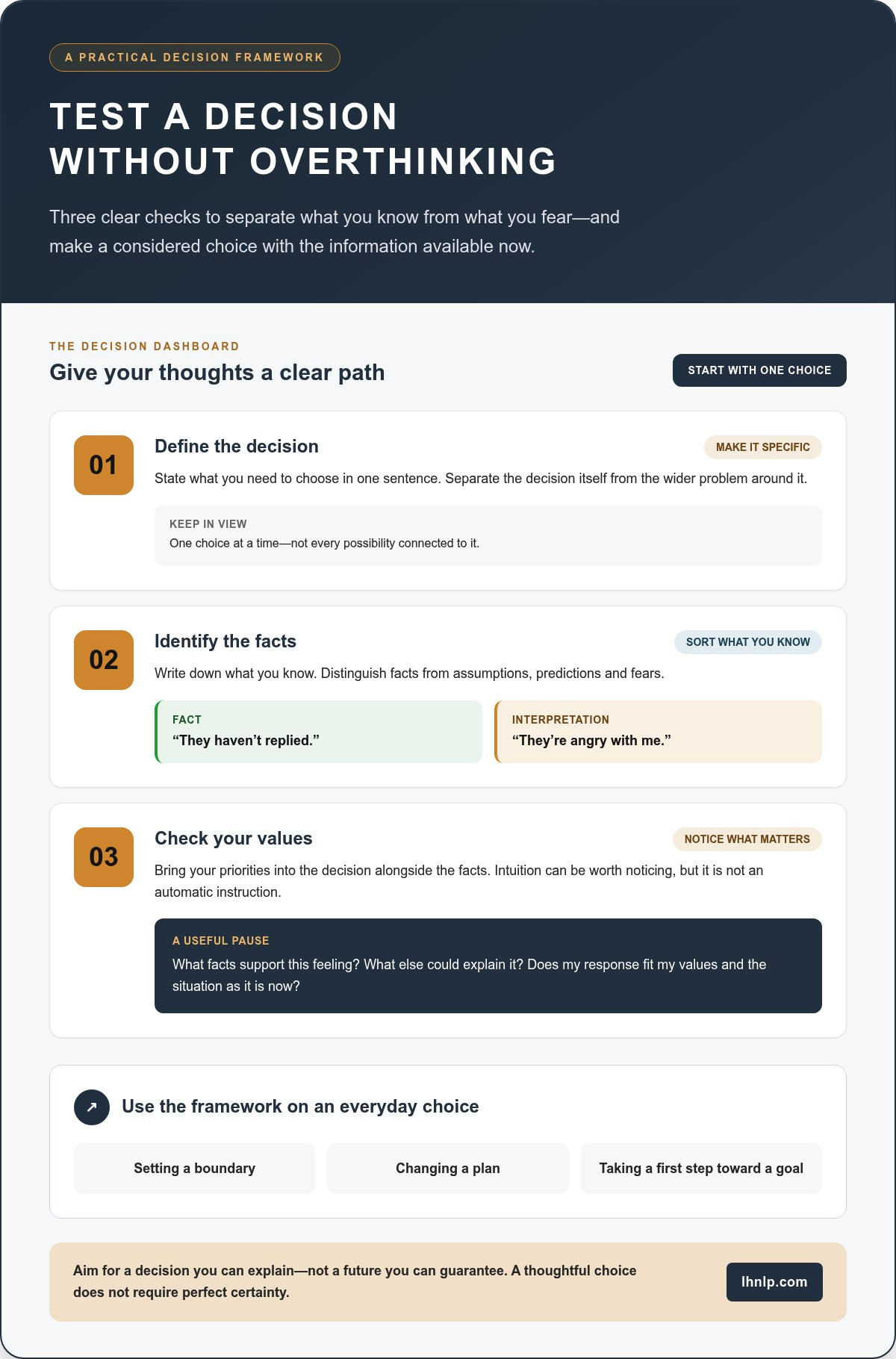
Intuition is an impression that may point to something worth noticing, not an automatic instruction to follow. It can draw on experience and familiar patterns, but current emotions and circumstances can shape it too. Strong unease, for example, might reflect a genuine concern or be intensified by stress. Pause and ask: What facts support this feeling? What else could explain it? Does my response fit my values and the situation as it is now? For those who also look to reflective frameworks or spiritual exploration to better understand their inner impressions, services like 12th House provide metaphysical intelligence and guidance alongside practical self-reflection.
Why Does Self-Doubt Make Decisions Feel So Difficult?
Fear of regret can turn an ordinary choice into a search for the option with no possible downside. You might compare plans repeatedly, ask several people for reassurance, or delay setting a boundary because you can’t predict how someone will react. But uncertainty is part of many decisions, not proof that your judgment is poor. You can choose a thoughtful next step without knowing exactly how it will unfold. Aim for a decision you can explain, not a future you can guarantee.
Why You Might Doubt Your Judgment, even When You Have Good Reasons
Self-doubt doesn’t always mean you lack information or good sense. Perfectionism can make a reasonable choice feel inadequate if it isn’t guaranteed to work. Past criticism may leave you bracing for disapproval, while competing expectations from family, friends or colleagues can make it difficult to hear your own priorities. The result may be too many inner voices competing to be heard, rather than a lack of judgment.
Confirmation bias can also play a part: we may give more attention to information that supports what we already fear or believe, while overlooking evidence that complicates the story. This is a common way of thinking, not a diagnosis. Ask what evidence might challenge your first interpretation, as well as what supports it.
Uncertainty alone can’t tell you whether a decision is sound; look at your reasons and the information available at the time. A useful review adds something: a fact you hadn’t considered, a value you want to honour, or a practical adjustment. Rumination tends to circle the same questions without producing new insight. If you’ve already weighed the relevant information, repeating the review may deepen doubt rather than improve your choice.
How Do Past Mistakes Affect Confidence in Future Choices?
A disappointing outcome can become a harsh lesson: “I chose badly, so I can’t trust myself.” But outcomes are shaped by factors you may not have been able to predict or control. A plan might have been sensible based on what you knew, even if circumstances later changed. Separate the decision-making process from the result: What did you know then? What would you adjust now? Reflection is useful when it helps you learn, not when it becomes a trial in which you’re both judge and defendant.
When Does Asking for Advice Become Reassurance-Seeking?
Advice can bring a fresh perspective, especially from someone who understands the situation. Notice what happens after you ask: do you have clearer options, or do you feel compelled to ask another person until someone offers certainty? If each answer briefly eases the worry but doesn’t help you decide, reassurance may be postponing the choice. Ask one focused question, take in the perspective, then return to your own reasons.
If anxiety and self-doubt overlap, reading our guide to anxiety may offer useful context. London Hypnotherapy & NLP also offers personalised confidence-building support to help you explore these patterns. Learn about confidence-building support.
How to Test a Decision Without Getting Stuck in Overthinking
A simple process can give your thoughts a clear path to follow without demanding perfect certainty. Try it with an everyday choice, such as setting a boundary, changing a plan or taking a first step towards a goal. The aim isn’t to analyse every possibility. It’s to make a considered choice using what you know now.
- Define the decision. State what you need to choose in one sentence. Separate the decision itself from the wider problem around it.
- Identify the facts. Write down what you know, then distinguish it from assumptions, predictions and fears. “They haven’t replied” is a fact; “they’re angry with me” may be an interpretation.
- Check your values. Ask what matters most here, such as honesty, rest, fairness or keeping a commitment. Consider which option best reflects those priorities.
- Choose and act. Weigh the realistic advantages and drawbacks, then select the option you can explain with the information available. If useful, seek one or two relevant perspectives, but treat them as input, not permission.
- Set a review point. Decide when you’ll assess how things are going and what you would need to learn or adjust. Until then, avoid reopening the choice without new information.
What Questions Can Help You Check Your Judgment?
Ask yourself: What matters most to me in this decision? What evidence supports each option, and what remains unknown? What am I predicting rather than knowing? If a trusted friend faced the same circumstances, what would I help them consider? Imagine likely outcomes realistically, including manageable downsides, rather than trying to predict every possibility. These questions can help you explore how to trust my own judgment while staying open to evidence.
How Can You Make a Choice When You Still Feel Unsure?
Consider how reversible the decision is. A low-impact choice you can change later may call for a small trial; a decision with lasting consequences may need more information and careful planning. If the whole choice feels too large, identify one useful next step, such as gathering a specific fact or having a necessary conversation. Then set a point to review it. Doubt may still be present, but it doesn’t need to steer the process.
Each time you use this framework, you practise making a reasoned choice without handing it over to someone else. If persistent self-doubt makes that difficult, London Hypnotherapy & NLP offers personalised confidence-building support. Read more about confidence-building support.
How to Build Self-Trust Through Small, Repeatable Decisions
Self-trust is built through practice, not a single moment of certainty. Start with low-stakes choices: how to organise your afternoon, which task to do first, or whether to accept a social invitation. Make a considered choice, then let it stand long enough to learn from it. These small repetitions show you that you can decide, respond to the result and adjust without needing someone else to take over.
A brief decision note can make that learning easier. Keep it simple: record the choice, your reasons, the relevant evidence and what you learned later. You’re not building a case for why you were right. You’re creating a fair record of how you made the decision, so hindsight doesn’t erase what you knew at the time. If you’re wondering how to trust my own judgment, this practice can help you notice the care and reasoning already present in your choices.
How Can You Learn from a Decision Without Judging Yourself?
Review the decision in context, not just through the lens of its outcome. Ask what information you had then, what part of your process served you well and what you might do differently next time. Use neutral descriptions: “I agreed to help before checking my schedule,” rather than “I’m hopeless at setting boundaries.” One describes an action you can learn from; the other turns it into a verdict about who you are.
The aim isn’t to stop doubting yourself altogether. Progress might mean noticing doubt without letting it trigger another round of checking, or making a choice and reviewing it at the time you planned. Confidence can develop gradually as you practise responding to uncertainty with care rather than criticism.
What Boundaries Help You Rely Less on Other People’s Approval?
Before seeking advice, consider who can offer a relevant, respectful perspective. One or two people who understand the situation may help you see a factor you missed; asking a wider circle can leave you with conflicting opinions and less clarity. After hearing feedback, take a pause before deciding whether it fits. You can value someone’s view without adopting it.
Try journalling this prompt: “If I weren’t trying to please anyone or avoid all possibility of regret, what would matter most to me here?” Let your answer guide your next step. If stress is making reflection harder, stress management support may be relevant. London Hypnotherapy & NLP offers personalised confidence-building sessions; learn more about confidence-building support.
When Self-Doubt Calls for Support, and What a First Step Can Look Like
It may be worth seeking support if self-doubt repeatedly makes everyday choices feel unmanageable, leads you to avoid decisions, or takes a toll on your wellbeing. You don’t need to label or diagnose yourself to notice a pattern. Ask gently: how often is this happening, what does it prevent me from doing, and what kind of help might feel useful? Support can offer space to understand the pattern without taking responsibility for your choices away from you.
Can Hypnotherapy or NLP Help Someone Explore Self-Doubt?
Personalised hypnotherapy or NLP sessions provide a setting to explore your goals, recurring thought patterns and possible next steps. What feels relevant differs from person to person, so there isn’t one approach that suits everyone or a promised result. Sessions can focus on understanding what makes decisions difficult and identifying practical ways to approach them with more confidence. If doubt is closely tied to anxiety, it may also help to explore how those experiences overlap.
Asking for support doesn’t mean you’ve failed to trust yourself. A thoughtful conversation can help you hear your own priorities more clearly, much like using a map to see your options without giving up the choice of direction.
What Could a Manageable First Step Be?
This week, try the decision framework from this guide with one low-stakes choice. Note what you know, what matters to you and what you decide. Afterwards, reflect briefly on what the process showed you. The aim isn’t to prove you made the perfect choice; it’s to practise making one with care.
If you’d like guided support, London Hypnotherapy & NLP offers individual confidence-building sessions personalised to your needs. Sessions are available in person across London and virtually. Explore the available treatments to learn more.
Learning how to trust my own judgment can include knowing when to work something through independently and when another perspective may help. Support and personal agency can sit side by side. You remain the person making your choices, with a little more space to understand them.
Take Your Next Step Towards Self-Trust
Trusting your judgment doesn’t require certainty or perfect decisions. It grows as you make considered choices, check them against the facts and your values, and learn without turning every outcome into a verdict on yourself. When you’re asking how to trust my own judgment, begin with one manageable decision and give yourself room to practise.
Remember, intuition can offer a useful signal, while evidence and personal priorities help you assess it. Advice can add perspective, too, without taking the decision out of your hands. If self-doubt keeps disrupting your choices or wellbeing, seeking support can be one way to explore what’s getting in the way.
London Hypnotherapy & NLP offers personalised one-to-one consultations with practitioner Kamal, with in-person sessions across London and virtual consultations. Explore personalised therapy and coaching support to consider working through confidence and recurring patterns with someone.
Self-trust is built one choice at a time. You don’t need to silence every doubt before you take the next thoughtful step.
Frequently Asked Questions
How do I start trusting my own judgment?
Start with a low-stakes decision and make it using the information you have, rather than waiting for complete certainty. Define the choice, note the facts, check what matters to you, then decide. Afterwards, review what you learned without judging yourself by the outcome alone. Repeating this process helps you build a fair record of your decision-making and practise how to trust my own judgment in everyday situations.
Why can’t I trust my own decisions?
Self-trust can be weakened by perfectionism, past criticism, regret or pressure to meet other people’s expectations. You might then treat uncertainty as a warning that you’re making the wrong choice, even when you have sound reasons. Consider whether you’re weighing new evidence or replaying the same fears. If doubt keeps disrupting daily choices or wellbeing, support may help you explore the pattern with compassion.
How can I tell the difference between intuition and anxiety?
There isn’t always a clear dividing line, but you can treat both as signals to examine rather than instructions to obey. Intuition may feel like a quick impression shaped by experience, while anxiety can involve repeated threat-focused thoughts and a strong need for certainty. Neither feeling is proof on its own. Pause, identify the facts, consider what remains unknown and check whether your response fits your values and the situation.
Can you learn to trust yourself after making a bad decision?
Yes. One disappointing result doesn’t prove that you’re incapable of making sound decisions. Look back at what you knew and what you could reasonably have anticipated at the time, while recognising that some outcomes depend on factors outside your control. Then name one part of your process that worked and one lesson for next time. Describe what you did, rather than labelling yourself as foolish or incapable.
What happens if I keep second-guessing every decision?
Repeatedly revisiting choices can make ordinary decisions feel draining, delay action and leave you more dependent on reassurance. It may also make it harder to learn from experience, because each choice is reopened before you can see what it taught you. Set a clear point to review a decision, and return to it earlier only if important new information appears. If this pattern regularly affects your wellbeing, consider seeking support.
Should I ask other people for advice if I want to trust my own judgment?
Yes, advice can be useful when it adds relevant information or a perspective you hadn’t considered. Choose one or two people who understand the situation and can respond respectfully. Before asking, decide what you want their input on; afterwards, pause and consider whether it fits your circumstances and priorities. Advice can inform your choice without becoming permission you need before acting.
Can hypnotherapy help with low confidence in my decisions?
Personalised hypnotherapy provides a space to explore confidence, recurring patterns and possible next steps, though experiences and needs differ, and no particular outcome can be guaranteed. London Hypnotherapy & NLP offers individual consultations with practitioner Kamal, in person across London and virtually via Zoom and Skype. Explore the treatments to find out more about individual support.