

What if switching off after work doesn’t require a perfect routine, only a clear signal that the working day is over? If deadlines and unfinished conversations keep replaying in your mind, you’re not alone in finding it hard to settle. Learning how to relax after a stressful day at work can feel like one more task when you’re already tired. The answer isn’t necessarily an elaborate ritual. It’s a small, repeatable pause between work and the rest of your life.
This guide will help you build a flexible after-work reset that fits your energy and circumstances. You’ll find practical ways to mark the end of work, choose manageable calming activities and recognise when ongoing stress may call for additional support. There’s no single routine that works for everyone. Start with one small change, and give yourself room to discover what genuinely helps you rest.
Key Takeaways
- Use a simple five-step reset to relax after a stressful day at work, shortening or adapting it to suit your evening.
- Compare quiet activities, movement, social connection and creative hobbies to find options that fit your energy and surroundings.
- Choose one dependable end-of-work cue and one recovery activity to make your routine easier to return to.
- Adjust your plan for different workdays, commutes and energy levels rather than expecting every evening to look the same.
- Notice when persistent or worsening stress affects daily life, and consider whether professional support could help.
How to relax after a stressful day at work starts with a transition
You arrive home, put your bag down and realise your thoughts are still in the office. An unfinished task, a notification or a conversation from earlier keeps replaying, even though the working day has ended. If you’re wondering how to relax after a stressful day at work, start by creating a clear boundary between work demands and personal time.
An after-work transition is a deliberate cue that marks the shift from work responsibilities to personal time. It doesn’t have to make you feel calm straight away or involve a perfect routine. Think of it as a doorway: a small action that helps you begin leaving the workday behind. Different approaches suit different people, as the overview of relaxation techniques also illustrates.
For a broader perspective on mental health at work, you can watch this TEDx talk:
Why can it feel difficult to switch off after work?
Work often leaves open loops: a message that needs a reply, a decision still to make or a conversation you’re turning over in your mind. Notifications can bring those demands into personal time, while working from home may blur the boundary between your desk and living space. Lingering alertness doesn’t mean you’re failing to unwind.
Some end-of-day tension eases as you move into other parts of your life. If stress persists, worsens or regularly interferes with daily activities, it may be worth seeking appropriate advice. You don’t need to diagnose yourself, and people respond differently to work pressure.
What does a useful work-to-home transition look like?
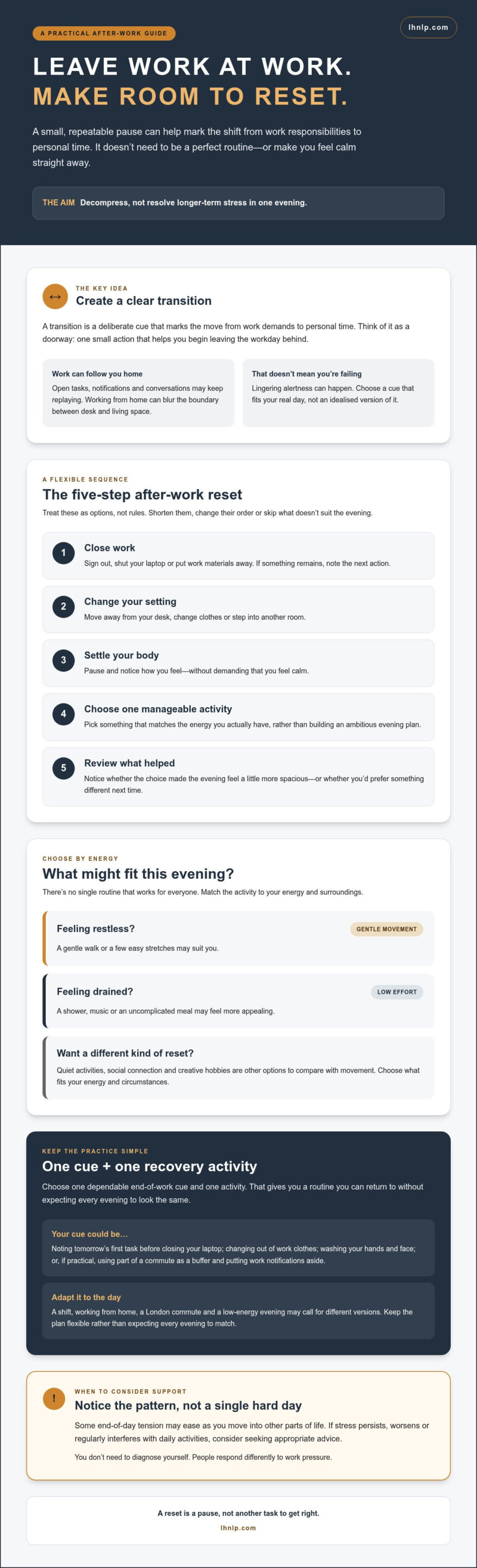
Keep the cue simple enough to use on an ordinary, tiring evening. Before closing your laptop, note tomorrow’s first task so you don’t have to rely on remembering it. Then change out of work clothes or wash your hands and face. The change in sensation can help mark the end of the working day.
If you commute across London, part of the journey might serve as a buffer, if practical. You could put work notifications aside and let the journey mark a change of pace. Choose a cue that fits your real day, not an idealised version of it.
A five-step reset to relax after work without adding another task
A useful reset isn’t another standard to meet. It’s a flexible sequence you can adapt to your energy, whether you’ve finished a shift, closed your laptop at home or arrived back after a London commute. The aim is to decompress, not to resolve longer-term stress in one evening.
A simple after-work reset is to close work, change your setting, settle your body, choose one manageable activity and briefly review what helped. Treat the steps as options, not rules. Shorten them, change their order or skip any that don’t suit the evening.
- Close work: Sign out, shut your laptop or put work materials away. If a task remains, make a note of the next action.
- Change setting: Move away from your desk, change clothes or step into another room.
- Settle your body: Pause and notice how you’re feeling without demanding that you feel calm.
- Choose an activity: Pick one thing that matches your energy instead of building an ambitious evening plan.
- Review: Notice whether your choice made the evening feel a little more spacious, or whether you’d prefer something different next time.
How can breathing and grounding help you settle?
Try breathing comfortably, without forcing a deep breath or following a particular count. If focusing on your breath feels unpleasant or uncomfortable, stop and choose another way to pause. You might instead notice a few things you can see, listen for nearby sounds and feel where your body meets the chair or floor. These observations can bring your attention back to the present. There’s no need to get them “right.”
If you’d like to explore other options, the steps to lower stress described by Mayo Clinic include approaches such as visualisation and progressive muscle relaxation. Choose what feels comfortable rather than assuming one method works for everyone.
Which low-effort activities can help you decompress?
Match the activity to the energy you actually have. A gentle walk or a few easy stretches may suit you if you feel restless. If you’re drained, a shower, music or an uncomplicated meal may feel more appealing. One choice is enough. You could also try putting your phone aside while you do it, without turning phone-free time into a strict rule.
Notice the pattern over time. An evening reset may offer a helpful pause, while stress that keeps returning or becomes difficult to manage may call for a different kind of support. If you’re considering personalised help, you can read about the practice’s stress management support as one possible option.
Which after-work relaxation techniques fit your needs?
The most useful way to relax after a stressful day at work depends on what you need in that moment. You might want less stimulation, a change of pace, company or something absorbing to focus on. Treat everyday activities as practical self-care, not clinical treatment. An activity may suit you one evening and not the next.
Use this comparison as a starting point. “Low effort” is personal, and access can depend on your surroundings, mobility, budget and available time.
| What you might need | Options to try | Accessibility considerations |
|---|---|---|
| Less stimulation | Listen to familiar music, read or sit quietly | Can be done at home. Choose a comfortable, quiet spot if available |
| A change of pace | Take a gentle walk or try easy movement | Choose a route or indoor alternative that feels manageable and suits your mobility |
| Connection | Have a low-key chat or share a meal | Match the amount of contact to your energy. Company needn’t mean a busy outing |
| Absorbing focus | Cook something simple, draw, knit or tend to a plant | Pick an activity that uses things you already have and doesn’t feel like a new obligation |
Is movement or stillness a better way to unwind?
Neither is the right choice for everyone. Gentle movement may feel welcome if you’ve been sitting for much of the day, while quiet rest may suit you better when you’re tired or overstimulated. Let your energy and preference guide you rather than treating exercise as something you must do to earn rest. If you have a health concern or physical limitation that affects what feels suitable, seek advice from an appropriate health professional.
How can you choose a calming activity when exhausted?
Make the first step small: listen to a song, sit outdoors if you have a comfortable and safe place, or spend a little time on a simple creative task. You don’t have to meditate or practise mindfulness. Try different options over several evenings and notice how each feels. Is it restorative, neutral or like extra effort? That observation is useful, even if you decide the activity isn’t for you.
These choices can support ordinary recovery, but they aren’t a substitute for personalised help if stress is persistent or increasingly difficult to manage. For now, choose one accessible option that meets tonight’s needs. You can adjust your choice tomorrow.
Build an after-work routine that protects your recovery time
A routine is most useful when it fits the life you actually have, including late finishes, a long commute or evenings when your energy is low. Choose one reliable cue that marks the end of work and one recovery activity you’re willing to do. For example, put your work bag away when you get home, then make tea and listen to music. Keep it simple enough to repeat, not perfect enough to perform.
How do you make a calming routine easier to repeat?
Attach your reset to something you already do, such as arriving home, changing clothes or putting the kettle on. If it helps, leave a book or comfortable clothes where you’ll see them. Preparation should make things easier, not become another task. After a week, ask yourself what felt supportive and what felt like effort. Keep, adapt or drop parts of the routine without judging yourself.
Your plan can have different versions. On a day with a straightforward commute, you might take a short walk before dinner. If you arrive home late or feel exhausted, changing clothes and sitting down may be enough. The intention is to protect some personal time, not to follow the same steps every evening.
What if work stress follows you into the evening?
If an unfinished task keeps circling in your mind, write it down alongside one realistic next action for tomorrow. A note such as “send the revised draft after checking the figures” gives the thought somewhere to land without requiring you to solve it tonight. You could also try muting work notifications or putting your phone out of reach during your chosen activity. Treat this as a boundary to test, not a rule you must always maintain.
Where practical and appropriate, discuss expectations around after-hours messages with your manager or team. Some work requires flexibility, but a clear conversation about priorities or response times may make your personal time easier to protect.
A routine can support everyday recovery, but it can’t resolve every source of ongoing pressure. If anxiety persists or begins to affect daily life, seeking professional advice is an option, not a requirement for ordinary workday stress. For personalised support, you can explore the practice’s stress management and anxiety treatment information.
When everyday relaxation is not enough: consider support
An after-work routine can create a useful pause, but it can’t always ease pressures that keep returning. If stress continues, feels more intense over time or begins to affect sleep, relationships, concentration or everyday responsibilities, it may be worth talking things through with an appropriate qualified professional. There’s no fixed threshold you have to meet before asking for advice, and seeking support doesn’t mean you’ve failed to manage on your own.
How can you tell when work stress deserves extra attention?
Notice the pattern rather than trying to label it. Are work worries regularly following you into the evening? Is it becoming harder to rest, focus on ordinary tasks or enjoy time away from work? These observations can help you explain what’s happening if you decide to speak with your GP or another suitable qualified professional. They aren’t a diagnosis, and occasional difficult days don’t automatically mean you need therapy.
It may also help to consider what you’ve already tried and whether anything changes the pressure, even slightly. If your wellbeing is affected or you’re concerned about your health, seek advice from an appropriate professional rather than relying on an evening routine alone.
What support options can a reader explore?
London Hypnotherapy & NLP offers one-to-one hypnotherapy, NLP and stress management support. These are options to explore if you’d like personalised help. They aren’t a requirement for ordinary workday stress, and no particular outcome can be guaranteed. You can read more about the available approaches on the practice’s treatment information page.
For some people, learning how to relax after a stressful day at work means adjusting an evening routine. For others, it may also involve getting advice or exploring support. Choose the next step that feels appropriate for you, at your own pace. Explore support options.
Make space for a more restful evening
Learning how to relax after a stressful day at work doesn’t mean finding one perfect technique. A clear cue to end work, followed by an activity that matches your energy, can help create a more deliberate shift into personal time. Keep the routine flexible, and notice which choices feel genuinely restorative rather than adding pressure to unwind.
If stress keeps returning or begins to affect everyday life, consider seeking appropriate professional advice. London Hypnotherapy & NLP offers one-to-one sessions that typically last approximately 50 to 60 minutes, with in-person appointments across London and virtual consultations. Confirm current appointment formats and availability directly with the practice.
If personalised support feels like a useful next step, explore support options at your own pace. For tonight, one small transition is enough. Let it be the first step towards reclaiming your time and making room for rest.
Frequently Asked Questions
How can I relax after a stressful day at work?
Start with a small sequence: close work by signing out or noting tomorrow’s first task, then change your setting by putting away your laptop or changing clothes. Choose one calming activity that fits your energy, such as listening to music, stretching gently or making a simple meal. Shorten or rearrange the steps as needed. The aim isn’t to feel instantly calm, but to create a clear shift into personal time.
What is the fastest way to calm down after work?
Try a brief grounding pause: notice a few things you can see, listen for nearby sounds and feel your feet on the floor. Or let your breathing remain comfortable and unforced for a few cycles. Stop if focusing on your breath feels uncomfortable. These simple exercises may help you settle, but people respond differently, and no technique guarantees an immediate change in how you feel.
Can a short walk help you unwind after work?
A short, gentle walk is one option if you have the energy and it feels accessible. It may offer a change of setting after a day indoors or give you space between work and home. You don’t need to walk briskly or cover a particular distance. If you’re tired, have mobility limitations or don’t feel comfortable going outside, choose a suitable alternative, such as stretching indoors or resting quietly.
Why can’t I switch off after work?
Unfinished tasks, incoming notifications or a conversation you’re replaying can keep work on your mind after the day ends. Working from home may also make the boundary between work and personal time less visible. There isn’t one cause that applies to everyone, and difficulty switching off doesn’t by itself mean something is wrong. A brief closing ritual, such as writing down tomorrow’s first task, may help contain work reminders.
What should I do if work stress is affecting my evenings every day?
Notice and record when the stress appears and how it affects your sleep, relationships or everyday activities. You could try practical boundaries, such as muting work notifications during personal time where appropriate, or writing down a next step for tomorrow. If the strain persists, worsens or affects your wellbeing, consider speaking with your GP or another appropriate qualified professional. Everyday work stress doesn’t automatically mean you need therapy.
Does hypnotherapy help with work-related stress?
Some people explore hypnotherapy as a personalised support option for work-related stress, but it isn’t a guaranteed solution and won’t be the right choice for everyone. London Hypnotherapy & NLP offers one-to-one hypnotherapy, NLP and stress management support in London, as well as virtual consultations. If you’re considering hypnotherapy, discuss your circumstances and whether it seems suitable with a practitioner. You can also seek advice from your GP about health concerns.
How do I create an after-work routine I can stick to?
Choose one transition cue you can repeat, such as putting away your work bag when you get home, and pair it with one manageable activity, such as listening to music or making tea. Keep a simpler version for demanding days or a long London commute. After trying it for a while, notice what feels helpful and adjust. A routine is a support, not another obligation to complete perfectly.