

What if the most profound shift in your life didn’t require more effort, but rather a gentle, guided descent into the quiet wisdom of your own subconscious? For many, the threshold of a therapy room feels daunting, shadowed by old myths of stage magic or the persistent worry that their mind is somehow “un-hypnotisable.” You might feel a tension between the desire for change and the fear of losing control, wondering if you’ll simply be sitting in a chair waiting for something that never happens. It’s a common starting point, and honestly, a sign of a healthy, analytical mind.
This guide is designed to dismantle those misconceptions and show you exactly what to expect from your first hypnotherapy session in 2026. Whether you’re visiting a clinic in Harley Street or connecting through a virtual session, you’ll discover that clinical hypnosis is a collaborative partnership rather than a passive experience. We’ll walk through the roadmap of your initial consultation, from the solution-focused dialogue to the moment you first experience that deep, restorative state of focused attention. By the time we finish, you’ll understand how this methodical process provides immediate relief from skepticism and sets the stage for lasting transformation.
Key Takeaways
- Discover why clinical hypnosis is a state of empowered, focused attention where you remain in complete control, far removed from the myths of stage performance.
- Learn exactly what to expect from your first hypnotherapy session, from the solution-focused intake to the collaborative setting of your personal success goals.
- Gain clarity on the physical sensations of induction, typically described as a pleasant, daydreamy relaxation where you remain acutely aware of your therapist’s guidance.
- Understand the immediate integration process and why most clients leave their first hour feeling energized and mentally clear rather than fatigued.
- Explore how personalized sessions in Harley Street or via Zoom provide a methodical, supportive roadmap for overcoming anxiety, stress, or unwanted habits.
Demystifying Clinical Hypnosis: What It Is and Isn’t
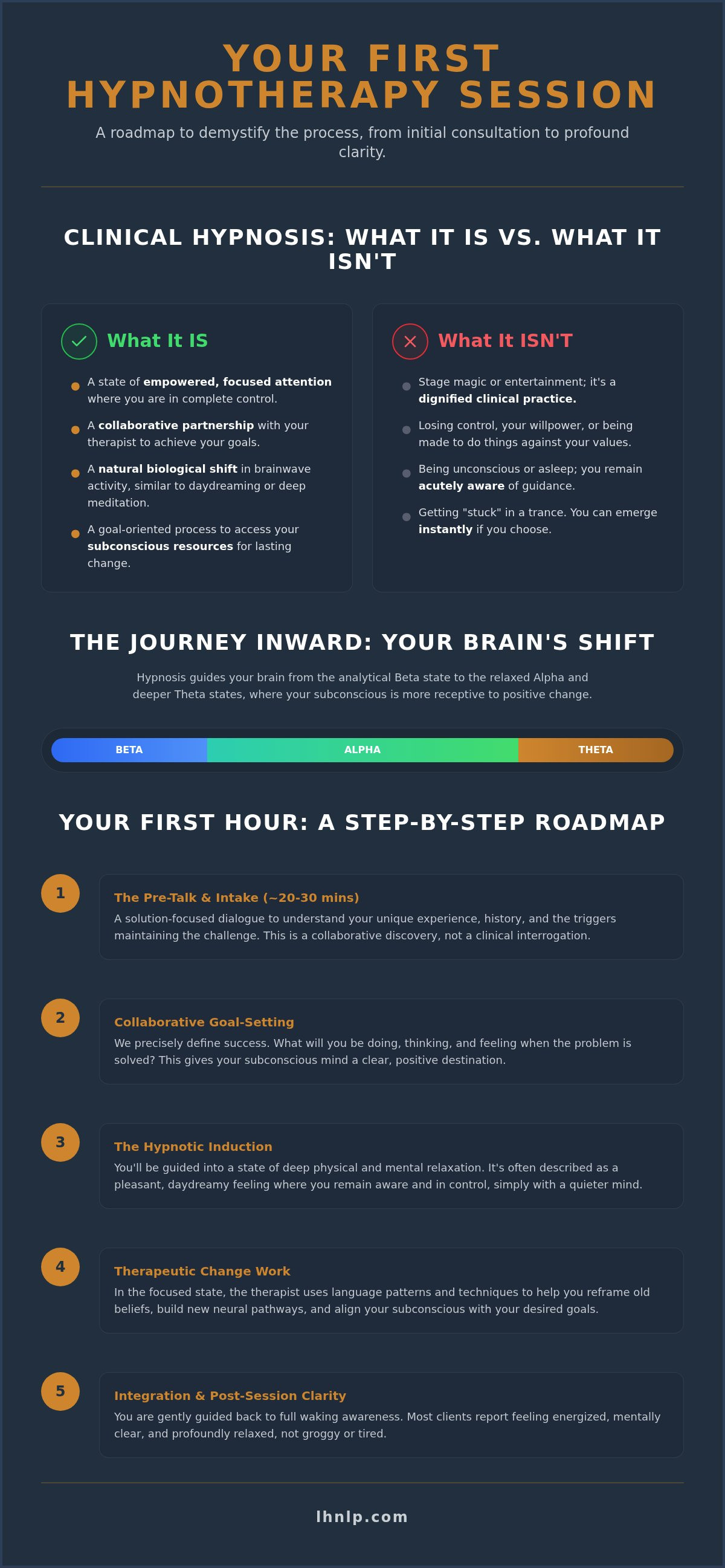
Before you step into a consulting room, it’s vital to peel back the layers of fiction that often surround this practice. Understanding exactly what to expect from your first hypnotherapy session begins with a clear definition: clinical hypnosis is a state of deeply focused attention and heightened suggestibility used specifically for therapeutic change. It’s a biological shift, not a mystical one. In this state, your brain moves from the alert, analytical Beta waves of daily life into the relaxed Alpha and deeper Theta states. This is where the mind becomes more receptive to positive, solution-focused suggestions. Clinical hypnotherapy is a collaborative tool for subconscious alignment.
Unlike the caricatures seen in stage magic, you won’t lose your willpower or find yourself clucking like a chicken. Clinical work is dignified and professional. It’s a method of empowering your own mind rather than overriding it. You’re always the one in the driver’s seat; the therapist simply provides the map and the directions. By quieting the loud, critical part of your conscious mind, you gain access to the vast library of your subconscious, where your habits and emotional responses are stored. It’s here that real, lasting change takes root.
The Difference Between Hypnosis and Hypnotherapy
It’s helpful to distinguish between the state of mind and the therapeutic application. Hypnosis is simply the natural, altered state of consciousness itself. You’ve likely experienced it while losing yourself in a compelling book or during a long, familiar drive. Hypnotherapy is the intentional use of that state to resolve specific challenges, such as anxiety, insomnia, or smoking cessation. While meditation often aims for a quiet, empty mind, hypnotherapy is active and goal-oriented. Your therapist acts as a skilled guide, helping you navigate your inner landscape to find resources you already possess. You can explore our range of specialised treatments to see how this application varies by goal.
Common Misconceptions About ‘Losing Control’
A frequent worry for many is the fear of revealing deep-seated secrets against their will. In reality, you remain entirely in control of your speech and your moral compass. You can’t be forced to say or do anything that contradicts your values. If a fire alarm sounded or you simply felt the need to stretch, you could emerge from the state instantly. Consider these facts about your autonomy:
- Speech Control: You only share what you choose to share.
- Awareness: You’re usually aware of the therapist’s voice throughout the session.
- Waking Up: It’s impossible to get “stuck” in hypnosis.
- Capability: Everyone can access this state; it’s a natural brain function, not a special talent.
Many fear they are un-hypnotisable. Because hypnosis relies on your own ability to imagine and focus, anyone who can follow simple instructions can enter the state. It’s not about being weak-willed. In fact, those with strong focus and high intelligence often find the process even more effective because they can engage more deeply with the mental rehearsals required for change.
The First Hour: A Roadmap of Your Consultation
When you walk into our Harley Street or Ealing rooms, or perhaps connect via a secure Zoom link, the first hour follows a deliberate and rhythmic structure designed to put you at ease. Understanding what to expect from your first hypnotherapy session begins with the realization that this isn’t a passive appointment. It’s a dynamic, solution-focused dialogue. The process starts with an initial intake, where we explore your history and the specific triggers that maintain your current challenges. This isn’t just about listing symptoms; it’s about understanding the unique internal logic of your experience.
We then move into a precise goal-setting phase. Defining success is more than just wanting a problem to disappear. We look for the presence of positive, tangible behaviours. What will you be doing differently when you’ve achieved your goal? How will your body feel? What will your internal dialogue sound like? By defining these markers, we give your subconscious mind a clear destination to move toward, ensuring the treatment is targeted with surgical precision.
The Importance of the Pre-Talk
The first 20 to 30 minutes of our meeting are often the most vital part of the entire process. This “pre-talk” allows me to understand your unique “map of the world.” We all perceive reality through different psychological filters, and by understanding yours, I can tailor every hypnotic suggestion to resonate with your specific mindset. Building this rapport is the foundation of our work together. It’s the bridge of trust that allows your subconscious to feel safe enough to engage with deep change. You can learn more about our solution-focused treatments to see how this rapport-building applies to your specific needs.
Integrating NLP into Your First Session
A unique aspect of the London Hypnotherapy & NLP approach is how we integrate Neuro-Linguistic Programming (NLP) from the very start. While many practitioners focus solely on the hypnotic state, we use NLP to map your mental patterns before any induction begins. NLP helps us identify the “language” of your problem. If you’re struggling with anxiety, we look at the specific internal images or “movies” you play in your mind that trigger that feeling. By decoding these structures in the first hour, we can “re-wire” them more effectively during the hypnosis that follows. This multi-disciplinary method often leads to faster, more sustainable results because we’re addressing the issue from both a conscious and subconscious level.
The final phase of the session is your first induction. This is a gentle, guided transition into the state of focused relaxation we discussed earlier. It’s a chance for you to experience the sensations of hypnosis firsthand, proving to your analytical mind that you’re always in control. If you’re ready to explore how this integrated approach can help you, you can get in touch with us here to begin your journey.
The Hypnotic Induction: What You’ll Actually Feel
One of the most frequent questions clients ask is whether they will “lose themselves” during the process. Understanding what to expect from your first hypnotherapy session involves moving past the cinematic idea of “going under” and embracing the sensory reality of the experience. Most people don’t feel “hypnotised” in the way they imagined. Instead, you’ll likely experience a profound sense of physical ease. This often manifests as a pleasant heaviness in your limbs, as if you’re sinking comfortably into the chair, or conversely, a feeling of light, tingly weightlessness. These are simply signs that your nervous system is shifting from a state of high alert into one of restorative calm.
Mentally, the state is best described as “daydreamy” yet acutely aware. You’ll hear the therapist’s voice throughout, and you might even hear distant sounds like a car passing outside or a clock ticking. This doesn’t mean the hypnosis isn’t working; it simply means your conscious mind is observing the process while your subconscious engages with the work. A fascinating phenomenon often reported is time distortion. Because your brain is operating in Alpha and Theta frequencies, your perception of time changes. A full 50-minute session might feel as though only 15 minutes have passed, leaving you with a sense of mental spaciousness that is rare in our busy daily lives.
The Process of Getting Into ‘Trance’
The transition into this state is a gradual, rhythmic process. In our London clinics, we often use a combination of guided imagery and progressive muscle relaxation to bridge the gap between the conscious and subconscious. I use specific tones and cadences to help quiet your analytical mind, allowing your internal focus to sharpen. If your mind happens to wander during the induction, don’t worry. It’s perfectly normal for the conscious mind to drift off onto other thoughts. Your subconscious remains attentive, and like a gentle current, the therapist’s voice will always bring your focus back to where it needs to be for your specific goal.
The Safety and Comfort of the Environment
Whether you’re visiting our professional spaces in Harley Street or Ealing, or engaging in virtual hypnotherapy sessions from your own home, your physical comfort is a priority. A supportive chair and a quiet environment are essential because they allow the body to let go of its physical “armour.” This physical safety signals to the mind that it’s okay to explore deeper layers of thought. Throughout the entire process, your subconscious mind acts as a protective gatekeeper. It’s an instinctive part of you that remains vigilant; if anything were said that didn’t align with your values or safety, this gatekeeper would immediately bring you back to full, alert consciousness. You’re never vulnerable; you’re simply deeply focused.
The “Aha!” moments that occur during this state feel incredibly natural. Rather than feeling like suggestions are being forced upon you, they often feel like your own realisations finally coming to the surface. It’s a moment of clarity where the solution to a long-standing problem suddenly feels obvious and achievable.
After the Session: Integration and the Shift
A common concern for those researching what to expect from your first hypnotherapy session is the fear of a “hypno-hangover.” You might worry about feeling groggy, confused, or unable to drive back through London traffic. In reality, the opposite is usually true. Because the Alpha and Theta brainwave states are deeply restorative, most clients emerge from the chair feeling remarkably energised and clear-headed. It’s similar to the mental “reset” you feel after a deep, dreamless sleep, but with an added sense of sharpened focus. You aren’t leaving a part of yourself behind; you’re returning to your day with more of your internal resources available to you.
The 24 hours following your visit are a vital window for subconscious processing. While you might feel an immediate shift in your perspective, the real work happens in the days after your appointment, as your subconscious mind naturally integrates these new patterns into your waking life. To support this, I often provide “homework” in the form of personalised audio recordings or specific NLP mental rehearsals. Listening to these tracks reinforces the suggestions made during our time together, acting as a gentle bridge that carries the therapeutic work from the clinic into your daily routine.
Recognising the Subtle Signs of Change
Change isn’t always a thunderclap. Often, it’s a whisper. In the days following your first hour, pay attention to the subtle shifts in your internal dialogue. You might find that a situation which previously triggered a sharp rise in cortisol now meets a calm, steady response that surprises you in its effortless arrival. Many clients also report a significant improvement in their sleep patterns immediately after their first session, as the nervous system learns how to let go of residual tension. For more specific advice on navigating these early days of change, you can read our FAQs for more post-session advice.
Planning Your Treatment Path
While you now know what to expect from your first hypnotherapy session, it’s vital to view it as the beginning of a methodical process. While “one-and-done” results can happen for specific goals like smoking cessation, most complex behavioural shifts require a series of 3 to 6 sessions to ensure the change is permanent. This treatment path allows us to layer the work, addressing different facets of a habit or emotional response until the new way of being feels entirely automatic. You can explore how we structure these long-term journeys in our Definitive Guide to Clinical Hypnosis & NLP in 2026.
If you’re ready to begin this integration and experience these shifts for yourself, you can book your initial consultation here to start your journey toward lasting change.
Beginning Your Journey at London Hypnotherapy & NLP
Choosing the right practitioner is just as important as understanding what to expect from your first hypnotherapy session. At London Hypnotherapy & NLP, we believe the environment where you begin your transformation should reflect the quality of the work itself. Whether you visit our prestigious rooms in Harley Street, our welcoming space in Ealing, or our central City location at Tokenhouse Yard, you’ll find a sanctuary designed for focus and calm. Led by Kamalyn Kaur, whose experience in behavioural change dates back to 2005, our practice operates with the philosophy that a therapist is more than a clinician; they are a mentor and a steady guide on your path to self-mastery.
Personalisation is the cornerstone of our methodology. Because your subconscious mind is a unique landscape shaped by your specific life experiences, we never use “cookie-cutter” scripts or generic protocols. No two sessions are ever identical. We weave together clinical hypnotherapy and Neuro-Linguistic Programming to create a bespoke strategy that speaks directly to your internal “map of the world.” This ensures that every suggestion and every mental rehearsal we undertake is perfectly aligned with your personal values and your specific vision of success.
In-Person vs. Online Consultations
The modern world requires flexibility, and we’ve refined our process to ensure that the depth of your experience remains consistent regardless of the medium. Many clients value the physical journey to a London clinic, finding that the transition from the busy streets to the quiet of Harley Street helps them mentally prepare for the work. Others find that the comfort and safety of their own home allows them to enter a hypnotic state more quickly. We achieve the same profound results via secure Zoom calls as we do in person, providing a global reach for those seeking professional change. If you’re looking for specialised support, you might explore our Anxiety Therapy London: A Modern Approach to Lasting Calm in 2026 for deeper insights into our specific anxiety protocols.
Taking the First Step
Preparing for your first visit is a simple process of internal alignment. When you contact us to book your initial assessment, it’s helpful to have a clear idea of the challenge you wish to resolve, but don’t worry if you don’t have all the answers yet. Part of our first hour together is dedicated to uncovering those deeper patterns. The most important ingredient you can bring is a genuine desire for transformation and a willingness to engage with the process. The first session is often the hardest part because it requires the courage to step into the unknown. Once that threshold is crossed, the rest of the journey becomes one of discovery, relief, and significant personal growth. We’re here to ensure that your experience is safe, methodical, and ultimately life-changing.
Embracing the Path to Lasting Change
You now possess a clear, grounded understanding of what to expect from your first hypnotherapy session. It’s not a loss of control, but a gain of insight. It’s a collaborative journey where your own analytical mind finally finds a partner in your subconscious wisdom. By bridging clinical hypnosis with Neuro-Linguistic Programming, we move beyond surface-level symptoms to re-pattern the very foundations of your habits and emotional responses. Whether you choose the professional sanctuary of our Harley Street rooms or the familiar comfort of an online consultation, the process remains methodical, safe, and deeply empowering.
With over 20 years of clinical experience, London Hypnotherapy & NLP provides the expert guidance needed to turn your initial skepticism into tangible momentum. This integrated approach ensures that your first hour is more than just a conversation; it’s the precise moment your internal world begins to align with your external goals. Are you ready to discover the resources you already carry within? You can book your first hypnotherapy session at our London clinic or online today. The hardest step is simply deciding to begin; the rest is a rewarding journey toward the person you are becoming.
Frequently Asked Questions
Will I be asleep during my first hypnotherapy session?
No, you aren’t asleep during any part of the process. Hypnosis is actually a state of heightened awareness and focused concentration. While your body might feel deeply relaxed, your mind remains alert and capable of following the therapist’s guidance. You’ll hear everything being said and remain in complete control throughout the hour. Think of it as a guided daydream where you are an active participant rather than a passive observer.
Can I drive home after my session?
Yes, you can absolutely drive home immediately after your appointment. Most clients leave our London clinics feeling mentally refreshed and more alert than when they arrived. We always ensure you are fully emerged and grounded before you leave the consulting room. This mental clarity is one of the most pleasant aspects of what to expect from your first hypnotherapy session, making it safe to navigate city traffic or return to work.
What if I can’t be hypnotised?
It’s a common myth that some people are un-hypnotisable, but the reality is that hypnosis is a natural capacity of the human brain. If you’ve ever lost track of time while reading or driving, you’ve already experienced a form of trance. As long as you can follow simple instructions and have a desire for change, you can access this state. We use a variety of techniques to find the specific induction method that works best for your unique mind.
How long does the first session usually last?
Your initial consultation and treatment session will typically last between 50 and 60 minutes. This timeframe allows us to conduct a thorough intake to understand your history and triggers, set specific goals, and still have ample time for your first hypnotic experience. We prioritise a solution-focused approach, ensuring that every minute of that hour is dedicated to building a roadmap for your personal transformation and providing immediate value from the very start.
Will I remember everything that happened while I was in trance?
Most clients remember the vast majority of their session quite clearly. While the experience can feel slightly dreamlike and some specific wording might fade from your conscious memory, you won’t experience a total blackout. Your conscious mind stays present as an observer, ensuring you feel safe and secure. It’s similar to remembering a movie you were deeply engrossed in; you know the plot and the key moments even if you don’t recall every single line of dialogue.
Do I need to do anything to prepare for my first appointment?
There’s no formal preparation required, though it’s helpful to spend a few moments thinking about what success looks like for you. Try to avoid excessive caffeine immediately before your visit to help your nervous system settle more easily. Bringing an open mind and a genuine commitment to change is the most effective preparation you can do. We’ll handle the technical aspects of the session, guiding you through every step once you arrive at the clinic.
Is hypnotherapy safe for people with high anxiety?
Hypnotherapy is not only safe but often highly effective for those struggling with high anxiety. The process itself induces a state of deep physiological relaxation that can provide immediate relief from the physical symptoms of stress. By working with your subconscious, we can address the root causes of your anxious thoughts in a gentle, supportive environment. It’s a methodical way to reclaim a sense of calm and control over your emotional responses without the need for invasive procedures.
How many sessions will I need to see a real difference?
The number of sessions varies depending on your specific challenge, but most clients begin to notice a significant difference within 3 to 6 appointments. While some issues like smoking cessation might be resolved more quickly, long-term habit change or complex anxiety typically requires a series of sessions to ensure the new patterns are fully integrated. We’ll discuss a personalised treatment plan during your first hour to give you a clear, achievable roadmap for your progress.