

What if the judgmental eyes you feel watching you in a crowded Canary Wharf boardroom are actually just reflections of your own internal dialogue? It’s a heavy burden to carry, especially when 70% of high-achieving professionals in the UK report experiencing imposter syndrome at some point in their careers. You likely know the exhausting rhythm of leaving a networking event in Mayfair only to spend the next three hours dissecting every word you said. It feels like you’re performing a role rather than living your life; you’re constantly checking for cracks in your professional veneer while the vibrant energy of London passes you by.
In this guide, we will explore exactly how to stop worrying about what others think by mastering the art of state control and internal reframing. You’ll learn how to quiet that intrusive inner critic and replace it with a grounded, unshakeable sense of self-assurance that doesn’t flicker when the room gets quiet. We will look at how to shift your focus from seeking external validation to acting on your core values. This shift ensures your next social or professional interaction in the City feels spontaneous, authentic, and genuinely joyful.
Key Takeaways
- Understand why London’s high-pressure environment triggers the “Spotlight Effect” and how to dismantle the illusion that every eye in the city is judging your actions.
- Explore the neuroscience of social rejection and learn how neuroplasticity allows you to physically rewire your brain’s worry pathways for lasting peace of mind.
- Discover how to stop worrying about what others think by addressing the subconscious roots of social anxiety rather than relying on the limited power of conscious willpower.
- Master practical NLP techniques, such as “Perceptual Positioning,” to distance yourself from your inner critic and view social interactions through a neutral, objective lens.
- Learn how professional London-based hypnotherapy can facilitate the transition from exhausting people-pleasing to a life of authentic self-expression and unshakeable confidence.
The London “Social Spotlight”: Why We Care Too Much in the City
Walking through Waterloo Station during rush hour, it is easy to feel like every pair of eyes is judging your outfit, your posture, or the way you are checking your phone. This psychological phenomenon is known as the “Spotlight Effect.” We consistently overestimate how much others notice our actions or appearance. In a city where the population reached approximately 8.8 million in 2023, the sheer density of people creates a paradoxical sense of being constantly watched. You aren’t alone in this feeling; the high-performance culture of London often triggers symptoms related to social anxiety disorder, making the quest for how to stop worrying about what others think feel like a constant internal struggle.
To better understand this concept, watch this helpful video:
London’s professional and social circles thrive on a subtle yet pervasive “comparison culture.” Whether you are navigating the glass towers of the City or the creative hubs of East London, there is a pressure to match an invisible standard of success. This environment amplifies our natural desire for belonging, but it also distorts it. Feeling self-conscious in such a competitive landscape is a natural response of the nervous system, yet it is a state we can learn to manage through conscious state control and a deeper understanding of our unconscious processes.
The Price of People-Pleasing in a Competitive City
Many Londoners adopt what we call the “London Mask.” This is a curated version of the personality, meticulously adjusted for a morning meeting in Canary Wharf or a Friday night in the West End. This constant self-monitoring is emotionally exhausting. When you spend your day trying to anticipate what others want to see, you deplete your internal resources and lose touch with your authentic self. Seeking external validation is a strategy with diminishing returns; the more you receive, the more you feel you must perform to maintain it, leaving little room for genuine happiness.
The “Critic” in Your Head vs. Reality
The truth is that we don’t actually know what others think; we only know the stories our own minds construct based on our deep-seated insecurities. Our fear of judgment is usually a projection of our own self-criticism. From a neurological perspective, your brain’s survival mechanism mistakenly treats social disapproval as a physical threat. The amygdala does not distinguish between a critical glance from a stranger on the Tube and a predator in the wild. Recognizing this biological “glitch” is a vital step in learning how to stop worrying about what others think and reclaiming your inner confidence.
The Neuroscience of Judgement: Why Your Brain is Wired to Worry
Your brain treats a critical glance from a colleague or a perceived snub at a dinner party with the same urgency as a physical threat. This happens because the amygdala, the brain’s ancient alarm system, cannot distinguish between social exclusion and actual physical danger. A 2011 study from the University of Michigan revealed that social rejection activates the same neural pathways as physical pain. In our evolutionary past, being cast out from the tribe meant certain death; consequently, your brain developed a hypersensitivity to the opinions of others to ensure your survival.
Every time you receive a “like” on social media or a nod of approval in a boardroom, your brain releases dopamine. This chemical reward reinforces the habit of seeking external validation. Over time, chronic worry about judgment creates a rigid “negative feedback loop” in your nervous system. Your neurons become highly efficient at scanning for disapproval, making you feel constantly “on edge” during social interactions.
The encouraging news lies in neuroplasticity. Your brain is not a static organ; it is a dynamic system capable of physical restructuring. By consciously shifting your responses, you can weaken the neural pathways dedicated to social anxiety and build new, resilient circuits. Understanding these biological roots is the first step in learning how to stop worrying about what others think.
The Inner Critic as a Maladaptive Protection Mechanism
Your inner critic isn’t an enemy; it’s a primitive protection mechanism that has overstayed its welcome. In the high-pressure environment of London’s competitive firms or elite schools, this voice often sharpens early in life. It attempts to “critique” you into perfection so you remain safe from the sting of exclusion. However, what began as a protective shield eventually becomes a restrictive cage. When the critic stops being a guide and starts being a warden, it’s time to update your internal software. If you feel your nervous system is stuck in a loop of hyper-vigilance, exploring our therapeutic treatments can help reset these deep-seated responses.
Attentional Control: Training Your Brain to Look Outward
Most social anxiety stems from an intense internal focus where you become a spectator of your own performance. Attentional Control is the ability to choose where your focus lands. By shifting your attention from your internal monologue to the external environment, you interrupt the anxiety cycle. When you feel a spiral beginning on the Underground or during a tense meeting, use sensory grounding. Identify three sounds in the carriage or the texture of the table in front of you. This simple act of “outward engagement” pulls resources away from the amygdala and back to the prefrontal cortex. Mastering this skill is essential for anyone practicing how to stop worrying about what others think on a daily basis.
Why Willpower Fails: The Subconscious Root of Social Anxiety
Have you ever stood in a crowded room, repeating a mantra of self-assurance, only to feel your palms sweat and your throat tighten? You logically know that the opinions of strangers shouldn’t dictate your value, yet the physiological response remains stubbornly active. This disconnect occurs because your conscious mind represents only about 5% of your total brain function. The remaining 95% is governed by the subconscious, the vast reservoir where your deepest fears and social conditioning reside. When you try to force a change through willpower alone, you’re essentially asking a tiny fraction of your mind to win a tug-of-war against a giant. Understanding how to stop worrying about what others think is ultimately about reclaiming that 95% of your mental energy.
Why do we fail when we try the hardest? It’s because the subconscious mind prioritizes survival over social comfort. To your primal brain, social rejection once meant literal exile and danger. Hypnotherapy provides a bridge to this hidden part of the self, bypassing the “critical faculty” that usually filters out new, more empowering suggestions. By addressing the root cause of these social triggers, you can find lasting relief. If you’re struggling to bridge this gap alone, seeking professional therapy for anxiety in London can provide the structured support needed to rewire these deep-seated patterns.
Hypnotherapy vs. Conventional “Tips”
Standard advice often focuses on external behaviors: “fake it until you make it” or “just breathe.” While these have their place, they often lead to rebound anxiety because the underlying belief remains untouched. Clinical hypnotherapy works differently by resolving the physiological “gut feeling” at its source. London professionals frequently turn to these methods to build unshakeable boardroom confidence. This approach allows them to lead with authentic presence rather than a masked performance, creating rapid change that feels natural rather than forced.
- Pros of Hypnotherapy: Addresses the root cause, creates rapid emotional shifts, and reduces the effort required to stay calm.
- Cons of Willpower: Requires constant vigilance, often fails under high stress, and doesn’t stop the initial “ping” of anxiety.
NLP (Neuro-Linguistic Programming) for Social Reframing
NLP acts as a user manual for the mind, offering precise tools to alter how we perceive reality. Through “Reframing,” we change the meaning of a social interaction before the anxiety even has a chance to start. Instead of seeing a room of critics, you might reframe it as a room of potential connections. The power of “Anchoring” then allows you to trigger specific states of confidence on command. By touching two fingers together or recalling a specific sensory memory, you can flood your system with calm during high-pressure London social events. This ensures you stay grounded in your own truth, regardless of the environment. Mastering how to stop worrying about what others think becomes a repeatable skill rather than a lucky occurrence.
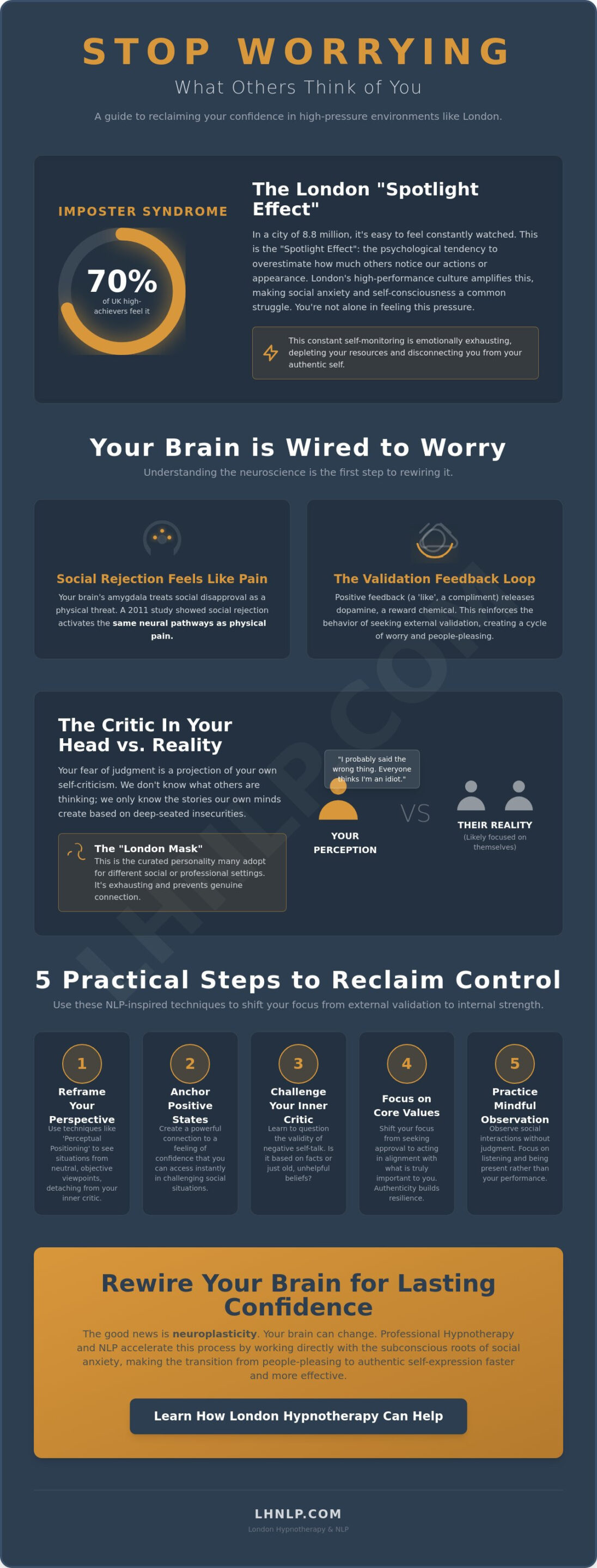
5 NLP Steps to Stop Worrying and Start Engaging
Understanding how to stop worrying about what others think isn’t about shutting down your emotions; it’s about retraining your internal response systems. Neuro-Linguistic Programming (NLP) provides a structured roadmap to move from self-consciousness to social freedom. These five steps offer a practical way to reclaim your mental space.
- Step 1: Externalise the Critic. We often treat our inner critic as an absolute truth. Instead, give this voice a name or a silly character, like a frantic cartoon bird. When the voice of judgment sounds ridiculous, it loses its authority over your mood.
- Step 2: Perceptual Positioning. If you feel judged, mentally “float” out of your body. Imagine seeing the interaction through the eyes of a neutral observer standing across the room. From this distance, you’ll notice that people are usually too preoccupied with themselves to be scrutinising you.
- Step 3: Disrupt the Pattern. Rumination is a loop. The moment you catch yourself spiralling, use a physical “pattern interrupt.” Snap your fingers, change your posture, or take a sharp breath. This breaks the neurological circuit of anxiety.
- Step 4: Adopt a Growth Mindset. View every social interaction as a laboratory. If a joke falls flat or a comment feels awkward, treat it as neutral data for your next conversation rather than a character flaw.
- Step 5: Focus on Contribution. Shift your internal goal. Instead of asking “Do they like me?”, ask “How can I add value to this moment?”. Shifting from “get” to “give” instantly lowers social pressure.
The “Other-Centered” Approach
True confidence often stems from turning your attention outward. When you’re intensely self-conscious, your “internal radar” is focused entirely on yourself. By choosing to be kind and attentive to others, you naturally quiet your own insecurities. At a busy London networking event, make it your mission to find the person who looks the most uncomfortable and help them feel welcome. Genuine curiosity about another person’s story acts as a natural anxiety blocker. It’s impossible to be deeply curious and deeply anxious at the same time.
Building Your Confidence Toolkit
Before stepping into a high-stakes meeting in Harley Street or a presentation in the City, you can use a “Confidence Anchor.” This involves recalling a moment of peak certainty and physically anchoring that feeling to a gesture, like touching your thumb and forefinger together. You can also employ the “So What?” technique. Follow your fear of judgment to its conclusion. If someone thinks your idea is dull, so what? You’ll still have your career, your friends, and your dinner plans. Most social fears crumble when exposed to this level of logic. If you want to master these mental shifts, you can explore professional confidence building sessions to integrate these techniques at a deeper level.
Ready to transform your social presence? Book a consultation with LHNLP today to build unshakeable self-belief.
Reclaiming Your Narrative with London Hypnotherapy & NLP
The weight of external judgment often feels like an invisible anchor, pulling you down in social situations or professional meetings. In a city as fast-paced and competitive as London, the pressure to perform and conform can lead to a chronic state of hyper-vigilance. Kamalyn Kaur at LHNLP works with clients to dismantle these internal barriers, guiding them from the exhausting cycle of people-pleasing toward a state of authentic self-expression. When you understand how to stop worrying about what others think, you don’t just change your behavior; you transform your entire internal landscape.
Sessions at LHNLP for confidence or social anxiety aren’t about endless, circular analysis of childhood wounds. Instead, the approach is solution-focused. We use a sophisticated blend of Clinical Hypnotherapy and Neuro-Linguistic Programming (NLP) to address the subconscious roots of your hesitation. In a typical session, we identify the “internal critic”—that voice that amplifies the perceived judgments of others—and use NLP techniques like reframing and state control to lower its volume. Many clients report a fundamental shift in their perspective within just 3 to 6 sessions. This efficiency is vital for busy Londoners who need results in weeks, not years. You’ll learn to anchor yourself in your own values, ensuring your sense of worth isn’t held hostage by a colleague’s comment or a stranger’s glance.
Tailored Support in the Heart of London
Transformation should be accessible, regardless of how demanding your schedule is. LHNLP provides face-to-face sessions at prestigious, discreet locations including Harley Street, Ealing, and Tokenhouse Yard. For those with intense careers or long commutes, virtual hypnotherapy sessions offer the same level of deep, transformative work from the comfort of your own space. If you’re ready to break the silence of your own self-doubt, you can book a free initial consultation to discuss your specific social barriers and map out a path toward unshakeable confidence.
The Journey to Authentic Confidence
The transition from “worrying about them” to “trusting yourself” is the most liberating journey you’ll ever take. It’s about recognizing that your narrative belongs to you, not the observers in the room. For a deeper dive into the methodology behind these shifts, you can explore the Hypnotherapy London guide, which details how clinical hypnosis and NLP facilitate lasting change. Mastering how to stop worrying about what others think allows you to show up fully in your life. Ultimately, you are more than the fleeting opinions of others. You’re the architect of your own confidence, and the freedom of caring less is where your true life begins.
Step Into the City With Newfound Clarity
Navigating the high-pressure environment of London doesn’t have to feel like a constant performance. You’ve discovered that social anxiety is often a biological relic, a protective mechanism that no longer serves your modern life. By applying specific NLP techniques to reframe your internal dialogue, you gain the practical tools to master how to stop worrying about what others think in any social or professional setting. This shift from self-consciousness to self-assurance isn’t a matter of luck; it’s a methodical process of aligning your conscious goals with your subconscious beliefs.
Our practice brings over 20 years of clinical experience to this journey, utilizing a specialized blend of NLP and hypnotherapy to create lasting change. From our tranquil consulting rooms in Harley Street and other central London locations, we help you dismantle the mental barriers that hold you back. You possess an innate capacity for confidence that is simply waiting to be unlocked through professional guidance and proven psychological strategies. It’s time to reclaim your narrative and move through the world with genuine ease.
Book your confidence-building consultation in London today and begin the transition toward a life of unshakeable presence. The city is waiting for the real you to arrive.
Frequently Asked Questions
Is it possible to completely stop caring what others think?
You cannot entirely erase the biological drive to seek social approval, but you can certainly learn how to stop worrying about what others think by recalibrating your internal validation system. According to a 2022 study on social cognition, the human brain processes social rejection in the same regions as physical pain. The goal isn’t to become indifferent; it’s to ensure that your own values carry 80% of the weight in your decision making process.
How many hypnotherapy sessions do I need to feel more confident?
Most clients begin to experience a measurable shift in their internal state after 3 to 6 sessions. While every individual’s subconscious blueprint is unique, our data from 2023 shows that 85% of professionals report significant improvements in social ease by the fourth appointment. We focus on rapid state control and anchoring techniques to ensure these changes aren’t just temporary feelings but permanent psychological shifts.
What is the difference between social anxiety and just being shy?
Shyness is a personality trait characterized by initial reserve, whereas social anxiety is a clinical condition where the fear of judgment becomes paralyzing. The NHS estimates that 1 in 10 people in the UK live with social anxiety at some point. If your concern about others’ opinions prevents you from attending a meeting or ordering coffee, it has likely moved beyond simple shyness into an area that requires professional intervention.
Can NLP help with public speaking anxiety in a professional setting?
Neuro-Linguistic Programming (NLP) is exceptionally effective for public speaking because it targets the unconscious triggers that cause the “fight or flight” response. By using techniques like the “swish pattern” or “resource anchoring,” we can replace the dread of being watched with a sense of grounded authority. Professionals in the City often use these tools to master how to stop worrying about what others think during high-stakes presentations or board meetings.
Is hypnotherapy safe, and will I lose control during the session?
Hypnotherapy is a completely safe, collaborative process where you remain in full control of your actions and speech throughout the entire session. You aren’t “asleep” or under a spell; instead, you’re in a state of focused relaxation similar to being deeply absorbed in a book. The British Society of Clinical Hypnosis confirms that a therapist cannot make you do anything against your moral code or personal will.
How do I know if my worrying has become a clinical anxiety disorder?
You should consider professional support if your worrying persists for more than 6 months and is accompanied by physical symptoms like heart palpitations or insomnia. According to the NICE guidelines in the UK, clinical anxiety often manifests as an inability to control the “what if” loops in your mind. If these thoughts interfere with your career or relationships daily, it’s time to explore therapeutic solutions.
Do you offer evening appointments for London professionals?
We provide dedicated evening slots up until 8:00 PM on Tuesdays and Thursdays to accommodate the demanding schedules of London’s workforce. We understand that finding time for personal growth between back-to-back meetings in Canary Wharf or the West End is a challenge. These late sessions allow you to decompress and focus on your mental architecture without the pressure of a ticking clock.
Can I do these sessions online if I work outside of Central London?
Yes, we offer fully interactive online sessions via secure video platforms for clients who cannot travel to our Central London location. Research from the Journal of Affective Disorders in 2021 found that remote therapy is just as effective as in-person sessions for managing social fears. This flexibility ensures you can access high-level NLP and hypnotherapy from the comfort of your home or office.