

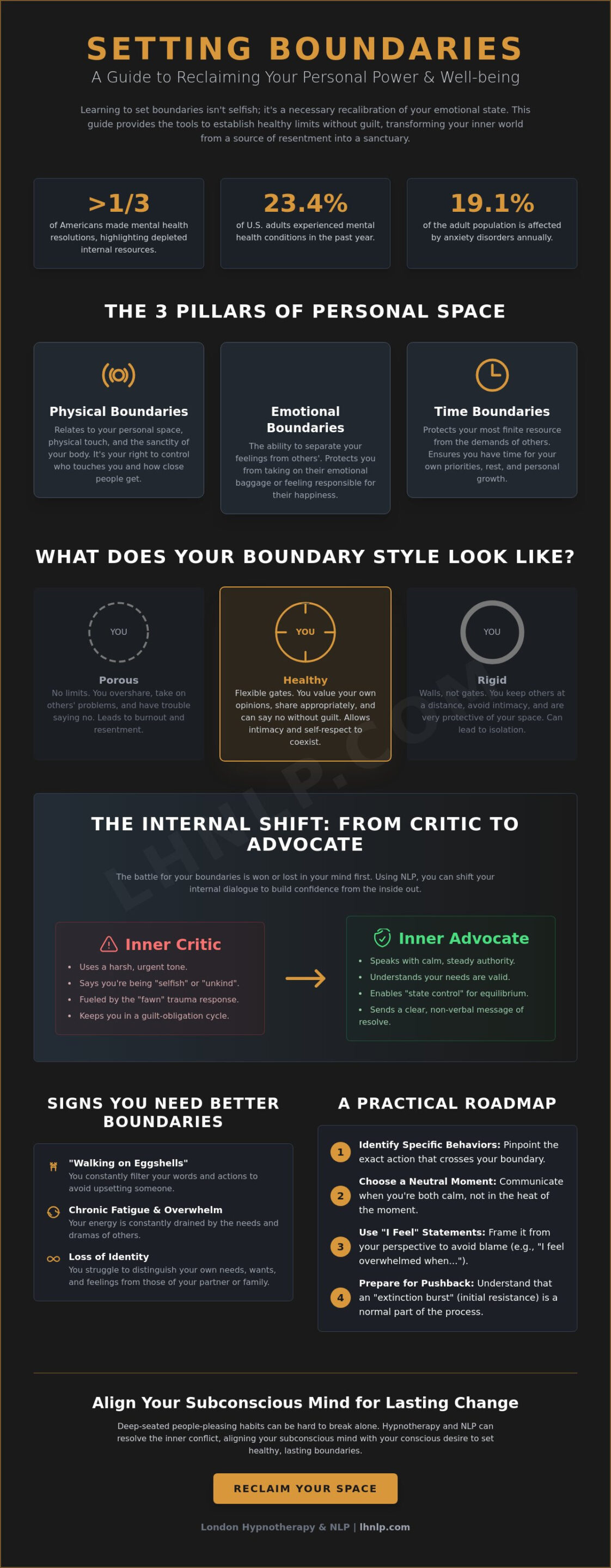
What if the exhaustion you feel isn’t from the work you do, but from the pieces of yourself you give away to keep others comfortable? Many people believe that being “good” means being available at all costs, yet with more than one-third of Americans making mental health resolutions in 2026, it’s clear that our internal resources are being depleted. Learning how to set boundaries in relationships isn’t an act of selfishness; it’s a necessary recalibration of your emotional state control and a vital step toward reclaiming your personal power.
You likely feel a heavy weight of responsibility for the emotions of those around you, fearing that a simple “no” might be perceived as unkind. This guide provides the psychological tools and practical scripts you need to establish healthy boundaries without the crushing weight of guilt. We’ll explore how to reframe your needs as strengths and provide a step-by-step roadmap to reclaim your space. By the end of this article, you’ll have the confidence to state your needs clearly, ensuring your inner world remains a sanctuary rather than a source of resentment.
Key Takeaways
- Gain clarity on the three essential pillars of personal space—physical, emotional, and time-based boundaries—to stop over-committing and prevent burnout.
- Transform your internal dialogue by shifting from an “Inner Critic” to an “Inner Advocate,” using NLP techniques to strengthen your sense of self-worth.
- Master the practical steps of how to set boundaries in relationships by identifying specific behaviors and choosing neutral moments for effective communication.
- Navigate the “Extinction Burst” and temporary guilt with resilience, understanding that initial pushback is a normal part of the growth process.
- Explore how hypnotherapy and parts therapy can align your subconscious mind, resolving the deep-seated conflict between people-pleasing habits and your true needs.
What Are Boundaries in Relationships and Why Do They Matter?
Imagine an invisible line that defines where your essence ends and the influence of another begins. This line is the foundation of personal boundaries. They aren’t barriers meant to isolate you; instead, they act as the architecture of a healthy connection. When you understand how to set boundaries in relationships, you’re essentially creating a map for others to follow so they can respect your space. Without this map, people often wander into your emotional territory without realizing the cost to your well-being. Boundaries generally fall into three distinct categories:
- Physical Boundaries: These relate to your personal space, physical touch, and the sanctity of your body.
- Emotional Boundaries: This is the ability to separate your feelings from the emotions of those around you.
- Time-based Boundaries: These protect your most finite resource from being hijacked by the constant demands of others.
Your emotions are sophisticated data points. If you feel a persistent sense of annoyance or “stuckness” after an interaction, listen to your “Resentment Compass.” This internal signal is a clear indicator that a limit has been breached. You might have “porous” boundaries where you have no limits at all, or “rigid” boundaries that act as walls to keep everyone out. The goal is to develop “healthy” boundaries. These are flexible gates that allow intimacy to flow while maintaining your self-respect. With 23.4% of U.S. adults experiencing mental health conditions in the past year, protecting your internal state is no longer a luxury. It’s a necessity.
The Psychology of Why We Struggle to Set Limits
Many of us operate from a “fawn” trauma response. This is a survival mechanism where we prioritize the needs of others to ensure our own safety or belonging. This often stems from childhood conditioning where saying “no” was met with withdrawal, guilt, or anger. You learned that your value was tied to your utility to others. The guilt-obligation cycle is a learned subconscious pattern that keeps you trapped in these old behaviors. Breaking this requires a deep understanding of how to set boundaries in relationships at a neurological level.
Signs Your Relationship Needs Better Boundaries
Do you feel like you’re constantly “walking on eggshells” to avoid upsetting your partner or family? Chronic fatigue, a lack of privacy, and a feeling that you’ve lost your own identity are hallmark symptoms of enmeshment. When you lose the ability to distinguish your needs from theirs, you experience significant emotional overwhelm. This state often mirrors clinical distress, making it helpful to seek Therapy for Anxiety in London to untangle these complex threads and reclaim your autonomy. You deserve to feel safe in your own life.
The Internal Shift: Using NLP to Reframe Your Self-Worth
Before you speak a single word to another person, the battle for your space is often won or lost within the confines of your own mind. Neuro-Linguistic Programming (NLP) introduces us to the concept of “Internal Representations,” which are the mental movies, images, and sounds we create to interpret our reality. If your internal map portrays you as small and the other person as an overwhelming force, any attempt at how to set boundaries in relationships will likely feel fragile. By consciously adjusting these mental submodalities—perhaps by making your own mental image larger or lowering the volume of a demanding voice—you begin to shift the power dynamic from the inside out.
This internal work requires you to distinguish between your “Inner Critic” and your “Inner Advocate.” The critic often uses a harsh, urgent tone to suggest that you’re being selfish or unkind. In contrast, the advocate speaks with the calm, steady authority of a mentor who understands that your needs are valid. Cultivating this advocate is essential for “state control,” the ability to maintain your emotional equilibrium even when others are reactive. With anxiety disorders affecting 19.1% of the adult population annually according to 2025 statistics, the skill of staying centered is a vital tool for mental health. When you are centered, your body language becomes congruent with your words, sending a clear, non-verbal message of resolve.
NLP Techniques for Boundary Confidence
One of the most effective ways to build this confidence is through “Anchoring.” Recall a specific moment in your life when you felt completely safe and in control. As you vividly relive that experience, press your thumb and forefinger together to create a physical “anchor.” You can trigger this anchor during difficult conversations to instantly flood your nervous system with that same sense of calm. Another powerful tool is “Reframing.” Instead of viewing a boundary as a rejection of someone else, reframe it as an act of integrity that preserves the relationship. As Láng Hugó often observes, when the map of your mind changes, the landscape of your life follows.
Identifying Your Core Values
Boundaries function as the silent guardians of your core values. If you value “autonomy” but allow others to dictate your schedule, you’re living in a state of internal conflict. Take a moment to identify your top three values; common examples include peace, honesty, and self-respect. When you understand that your “no” to an unreasonable request is actually a “yes” to your own peace, the act of setting a limit feels authentic rather than “mean.” For those who want to deepen this practice, Setting Healthy Boundaries in Relationships provides a foundational look at how these limits protect your identity. If you find that old patterns of people-pleasing are difficult to break, exploring NLP coaching can help you rewire these subconscious habits to better align with your true self.
A Step-by-Step Guide to Communicating Your Needs
The map is not the territory, but a clear map makes the journey possible. Once you’ve aligned your internal state, the next phase in how to set boundaries in relationships is the external expression of your needs. This isn’t about control; it’s about clarity. When you speak your truth with calm authority, you invite others to meet you in a space of mutual respect. Follow these five methodical steps to ensure your message is heard and integrated.
- Identify the specific behavior: Vague complaints like “you’re being disrespectful” are difficult to act upon. Instead, focus on the concrete action, such as “when you enter my home office without knocking.”
- Choose a neutral time: Never attempt to set a boundary in the heat of a conflict. Wait for a moment of calm when both parties are in a receptive state, ensuring your “state control” is firm.
- Utilize “I” statements: Own your experience. Saying “I feel distracted when there’s loud music during my work hours” is far more effective than “You’re always being too loud.”
- Be concise: Over-explaining is often a subconscious signal of guilt. You don’t need to justify your right to space; a simple, clear statement is more powerful than a ten-minute defense.
- Define the consequence: A boundary without a consequence is merely a suggestion. Clearly state what will happen if the limit is ignored, such as, “If you continue to call after 9 PM, I won’t be able to answer the phone until the morning.”
For those navigating particularly difficult dynamics, looking into tips for setting boundaries in unhealthy relationships can provide an extra layer of protection and tactical advice. Remember, the goal is to create a sustainable environment for your growth.
Adaptable Scripts for Every Relationship
Having a pre-prepared script can help you maintain your composure. For a partner, you might say: “I value our evening time together, but I need 30 minutes of quiet solitude when I first get home to decompress.” With a colleague, try: “I’m happy to help with this project, but I don’t check my Slack notifications after 6 PM to ensure I’m rested for tomorrow.” For family members who overstep, a kind but firm approach works best: “I love our visits, but I’m not comfortable discussing my personal finances, so let’s talk about something else.”
Navigating Work-Life Boundaries in London
London’s high-performance culture often demands an “always on” mentality, which can quickly lead to the burnout mentioned in the 2025 mental health statistics. With more than one-third of professionals making mental health resolutions for 2026, the need for digital boundaries has never been higher. Managing your notifications and setting clear expectations for response times is a vital part of how to set boundaries in relationships within the professional sphere. If you find the pressure of the city is beginning to erode your resilience, exploring Stress Management in London can provide the additional coaching needed to reclaim your calm and maintain your professional edge.
Managing the Aftermath: Guilt, Pushback, and Maintenance
Setting a boundary is like installing a new operating system; the old hardware often resists the update. This resistance is known as an “Extinction Burst.” When you stop playing your usual role, the other person may escalate their demands, emotional reactions, or even use guilt-tripping in an attempt to pull you back into the old dynamic. It is a psychological phenomenon where a behavior increases in intensity before it finally stops. It’s vital to stay consistent during this phase. If you yield under pressure, you inadvertently reinforce the idea that your limits are merely suggestions. Consistency is the anchor that allows the new dynamic to take root. Understanding how to set boundaries in relationships means accepting that the initial friction is actually a sign of progress rather than a mistake.
You might experience “Boundary Guilt,” a heavy sensation that suggests you’ve been unkind. Reframe this as the growing pains of your emerging self-worth. If someone chronically ignores your stated needs, utilize the “Broken Record” technique. Calmly repeat your boundary without adding new justifications or emotional bait. For example, if someone asks for a loan you already declined, simply state, “I understand you’re in a tough spot, but I’m not able to lend money.” By keeping your response neutral and repetitive, you deny the other person the chance to derail the conversation or manipulate your emotions. This maintains your state control and protects your internal resources.
Dealing with Difficult Personalities
When dealing with narcissistic or highly manipulative individuals, traditional communication often fails because they view boundaries as a challenge to their control. In these cases, the “Grey Rock” method is an effective tool. You become as uninteresting and unresponsive as a grey rock, providing no emotional fuel for the other person to use against you. However, you must remain vigilant. If a boundary violation escalates into a threat to your physical or emotional safety, the situation has moved beyond communication and requires immediate protective action. Your safety is the ultimate boundary that must never be compromised.
Self-Care After a Boundary Conversation
It’s common to experience a “Vulnerability Hangover” after being assertive. You might feel shaky, anxious, or exposed. Use grounding techniques, like focusing on the feeling of your feet on the floor or the rhythm of your breath, to settle your nervous system post-conversation. Self-compassion is your greatest ally here. If you find the emotional weight of these interactions overwhelming, booking relationship coaching can provide the professional support needed to navigate these shifts with grace and confidence. Remember, you’re not just protecting your space; you’re teaching others how to value you.
How Hypnotherapy and NLP Can Help You Set Lasting Boundaries
While mastering the external scripts for communication is vital, the true engine of change resides within your subconscious mind. This is where years of “people-pleasing” habits are stored as survival programs, often operating beneath your conscious awareness. Hypnotherapy allows us to bypass the critical faculty of the mind to access these outdated scripts and update them with your current adult needs. Through “parts therapy,” we can facilitate a profound dialogue between the part of you that is desperate to reclaim your space and the part that remains frozen by an old fear of abandonment. By resolving this internal conflict at its source, how to set boundaries in relationships becomes a natural expression of your self-worth rather than an exhausting uphill battle.
At LHNLP, Kamalyn Kaur and our team of specialists focus on helping Londoners find their authentic voice amidst the noise of high-pressure environments. We recognize that the 48% treatment gap among adults with mental health conditions often stems from a lack of access to practical, subconscious-level tools. Professional coaching and hypnotherapy accelerate the “unlearning” of these restrictive patterns, allowing you to move from a state of overwhelm to one of empowered clarity. You don’t have to navigate this transition alone; having a mentor can make the difference between a temporary fix and a permanent lifestyle shift.
Reprogramming the “Fear of Rejection”
Clinical hypnosis is exceptionally effective for desensitizing the physiological anxiety response that often accompanies saying “no.” By working in a trance state, we can rewire the nervous system to associate boundary-setting with safety rather than threat. We also utilize “Future Pacing,” a powerful NLP technique that allows you to mentally rehearse how to set boundaries in relationships in various future scenarios. This mental rehearsal builds the neural pathways necessary for these behaviors to feel second nature when they occur in real life. It’s essential to remember that hypnotherapy is not about a practitioner taking control, but about you regaining your own agency and internal sovereignty.
Booking Your Consultation in London
We provide a supportive environment for your transformation across several convenient London locations, including Harley Street, Ealing, and Tokenhouse Yard. These spaces are designed to offer a sanctuary where you can focus entirely on your internal growth and state control. For those living outside the city or who prefer the privacy of their own home, our Virtual Hypnotherapy Services deliver the same high-standard professional care through secure digital platforms. If you’re ready to stop the cycle of resentment and reclaim your emotional energy, we invite you to contact us today for a personalized strategy session. Your journey toward a more balanced and respectful life begins with a single, courageous step.
Reclaim Your Voice and Your Peace
Reclaiming your space is more than just a communication skill; it’s a fundamental shift in how you inhabit your own life. We’ve explored how identifying your core values and utilizing NLP state control can transform your daily interactions. You’ve learned that how to set boundaries in relationships is a methodical process of aligning your internal representation with your external voice. This alignment ensures that your “no” is as respected as your “yes.”
Whether you’re navigating the pressures of London’s high-performance culture or managing complex family dynamics, the tools of hypnotherapy and parts therapy offer a way to resolve deep-seated people-pleasing habits. You don’t have to carry the weight of others’ expectations anymore. With over 20 years of practitioner experience, we provide personalized NLP and hypnotherapy treatments designed to facilitate lasting change. You can visit us at our Harley Street or Ealing locations to begin your transformation. Ready to reclaim your time and energy? Book a consultation with London Hypnotherapy & NLP today.
Frequently Asked Questions
Is it selfish to set boundaries in a relationship?
Setting boundaries is not selfish; it’s a necessary practice for maintaining long-term emotional health. When you’re clear about your needs, you prevent the resentment that often destroys connections. It’s about being honest about your capacity. By honoring your own space, you actually become more present and available for the people you love. Think of it as protecting the garden of your relationship from being trampled by unintended neglect.
What happens if the other person refuses to respect my boundary?
If a boundary is ignored, you must follow through with the consequence you previously stated. A boundary without enforcement is just a request. You might need to physically remove yourself from the situation or limit communication for a set period. This isn’t about punishing the other person. It’s about protecting your own peace. If the disrespect continues, you may need to re-evaluate the closeness of that specific relationship for your own well-being.
How do I know if my boundaries are too rigid?
Rigid boundaries often feel like walls designed to keep everyone out rather than gates that allow for healthy exchange. You might notice you’re using limits to avoid vulnerability or genuine connection. If you feel chronically isolated or find it impossible to compromise even on small matters, your boundaries might be too stiff. Healthy boundaries are firm yet flexible, allowing you to stay safe while still experiencing the beauty of deep, authentic intimacy.
Can hypnotherapy really help with my fear of confrontation?
Hypnotherapy is highly effective because it addresses the subconscious root of your fear response. We work to desensitize the “threat” signal your brain sends during difficult conversations. By accessing the deeper mind, we can install new anchors of calm and confidence. This allows you to stay grounded when speaking your truth. Many clients find that after just a few sessions, the old paralyzing anxiety is replaced by a sense of quiet, inner strength.
How do I set boundaries without hurting the other person’s feelings?
You cannot control another person’s emotional reaction, but you can control your delivery. Focus on “I” statements that explain your needs rather than criticizing their behavior. Using a calm, neutral tone helps lower their defensiveness. Understanding how to set boundaries in relationships involves realizing that a temporary hurt feeling is often the price of a more honest, sustainable connection. Clarity is ultimately a form of kindness that prevents future misunderstandings and pain.
What is the difference between a boundary and an ultimatum?
A boundary is about your own behavior and what you’ll do to protect your peace. An ultimatum is an attempt to control or coerce the other person’s actions through threats. For example, a boundary is “I’ll leave the room if there’s shouting,” whereas an ultimatum is “If you don’t stop shouting, I’m breaking up with you.” Boundaries are internal protections, while ultimatums are external demands that often lack the foundation of self-respect.
How many sessions of NLP or Hypnotherapy are usually needed for confidence?
Most clients begin to experience a noticeable shift in their internal state within 3 to 6 sessions. The exact number depends on the depth of the subconscious patterns we’re addressing. NLP and hypnotherapy are designed for rapid results compared to traditional talk therapy. We focus on building your state control and creating new neural pathways for confidence. This accelerated approach helps you learn how to set boundaries in relationships with much greater ease and speed.
Can I set boundaries in a relationship that has never had them before?
It’s entirely possible to introduce boundaries into an established dynamic, though it requires patience. You should expect an extinction burst as the other person adjusts to the new rules. They might push back or act surprised because the old map of the relationship has changed. Start with smaller, less charged limits to build your confidence. Over time, the relationship will either evolve into a healthier version or reveal that it cannot sustain your growth.