

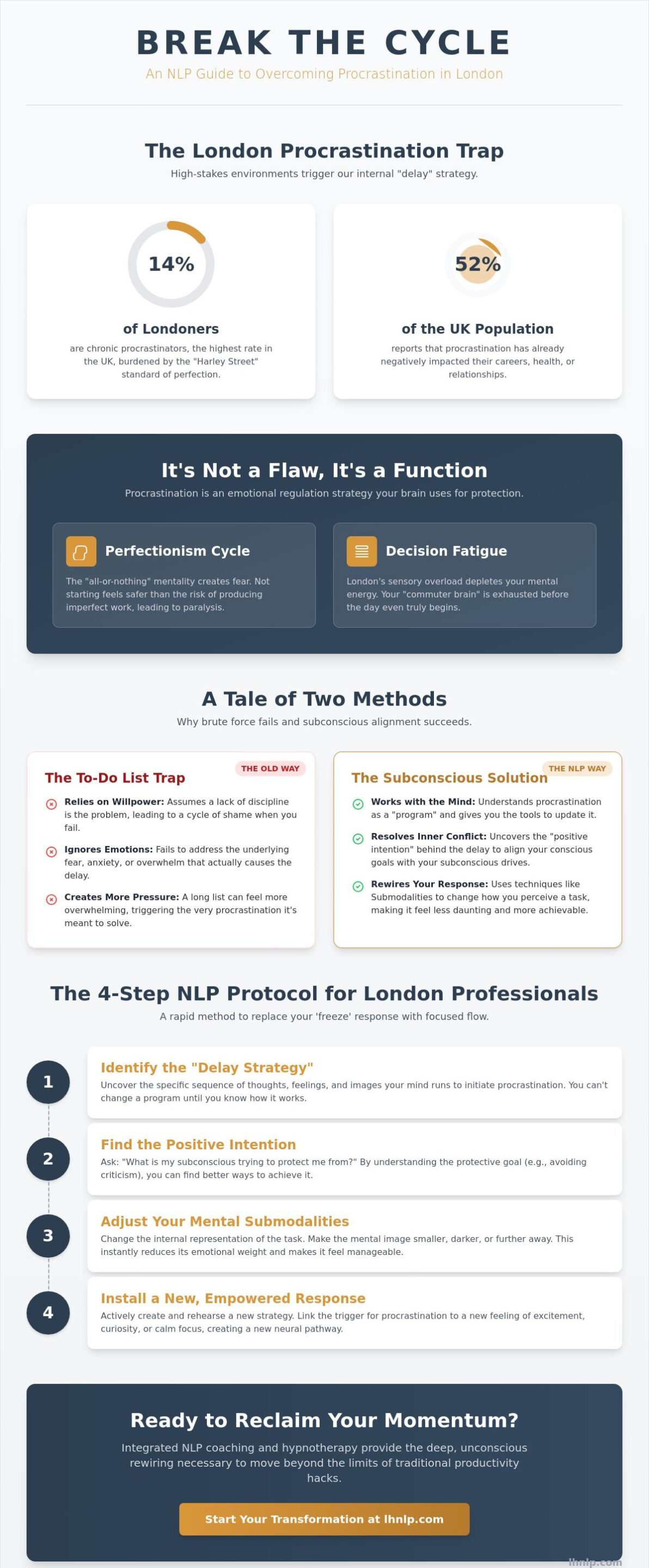
Did you know that London holds the highest rate of chronic procrastinators in the UK, reaching 14% of the population? You likely feel this statistic personally as you navigate a city where the “Harley Street” standard of perfection is the unspoken baseline. It’s a heavy burden to carry, especially when 52% of the British population reports that procrastination has already negatively impacted their lives. Have you ever wondered why your brain chooses to freeze even when the stakes are at their highest?
If you’ve felt the sting of self-shame after another missed deadline, you’re not failing; you’re simply using an outdated survival strategy. This guide explores how to stop procrastinating NLP London experts recommend, shifting the focus from “trying harder” to understanding how your subconscious creates these delay tactics. We’ll show you how Neuro-Linguistic Programming can rewire your internal response to pressure and provide immediate techniques to break the cycle. You’ll discover the root cause of your specific avoidance patterns and gain the tools to reclaim your productivity for long-term career goals. It’s time to transform your inner dialogue and move from hesitation to focused action.
Key Takeaways
- Reframe procrastination not as a failure of willpower, but as a sophisticated emotional regulation strategy designed to protect you from the city’s high-pressure expectations.
- Identify the “positive intention” behind your delay tactics to resolve internal conflicts and unlock a more authentic, sustainable drive for your career goals.
- Master the 4-step protocol on how to stop procrastinating NLP London experts use to rapidly replace your “freeze” response with a focused state of flow.
- Learn to adjust your mental submodalities, allowing you to shrink overwhelming tasks and visually transform them into manageable, inviting actions.
- Discover why integrated NLP coaching and hypnotherapy provide the deep, unconscious rewiring necessary to move beyond the limitations of traditional to-do lists and apps.
The London Procrastination Trap: Why High-Stakes Environments Trigger Delay
Procrastination is often misunderstood as a character flaw or a simple lack of discipline. For the 14% of Londoners who struggle with chronic procrastination, it’s actually a sophisticated emotional regulation strategy. Your brain isn’t being lazy; it’s actively trying to protect you from the perceived threat of failure or the discomfort of a high-stakes task. This internal “freeze” response is particularly prevalent in the UK, where 52% of adults admit that delaying tasks has negatively impacted their lives. When the stakes are high, your subconscious mind prioritizes immediate relief over long-term gain.
In the shadow of the “Harley Street” culture of excellence, the pressure to perform perfectly can lead to total paralysis. This is where Neuro-linguistic Programming (NLP) offers a different lens. Instead of judging the delay, we look at what your subconscious is trying to achieve through it. By understanding the mechanics of your mind, you can learn how to stop procrastinating NLP London style, transforming your relationship with city-life pressure into a source of focused power.
To better understand this concept, watch this helpful video:
The Perfectionism-Procrastination Cycle in the City
Within the competitive glass towers of Canary Wharf and the City’s finance sectors, an “all-or-nothing” mentality often takes root. You might feel that if a project isn’t flawless, it’s a failure. This fear amplifies the urge to delay because not starting feels safer than failing. NLP teaches us to shift from “outcome thinking,” where the weight of the final result crushes your motivation, to “process thinking.” By focusing on the immediate sensory experience of the task, you lower the emotional stakes and dissolve the paralysis that keeps you stuck.
Decision Fatigue and the “Commuter Brain”
London’s unique environment adds a layer of cognitive load that few other cities match. The sensory bombardment of a 45-minute Underground commute or the constant hum of city noise depletes your executive function before you even reach your desk. It’s no surprise that procrastination often peaks at 4 PM in London offices. Your brain has simply run out of the fuel needed for difficult decisions. Is it laziness, or is your nervous system simply exhausted? Understanding this depletion is the first step toward reclaiming your momentum through targeted treatments that address the root of the fatigue. When you learn how to stop procrastinating NLP London techniques provide the mental shortcuts to bypass this fatigue and stay on track.
The NLP Perspective: Understanding Your Mind’s “Delay Strategy”
Procrastination is not a chaotic accident; it is a meticulously structured sequence of internal images, sounds, and feelings. In the NLP framework, we view this as a “Strategy” that your brain runs with the precision of a computer program. When you explore how to stop procrastinating NLP London specialists focus on “Strategy Elicitation.” This process involves uncovering the exact mental steps you take to move from “I should do this” to “I’ll check my phone for a minute.” By slowing down this lightning-fast internal process, you gain the power to intervene before the delay begins. You aren’t lazy; you’re simply running a very effective “avoidance program” that needs an update.
Your internal critic often plays a leading role in this sequence. This voice, while frequently harsh, usually has a “Positive Intention.” It might be trying to protect you from the vulnerability of putting your work out there in a competitive city like London. Leading psychological research on procrastination confirms that we avoid tasks primarily to manage short-term moods, even if it hurts our long-term goals. NLP allows us to negotiate with this protective part of the mind, acknowledging its desire for safety while teaching it more productive ways to achieve it.
Mapping Across: Changing the Way You See the Task
Submodalities are the software settings of your internal experience. They are the fine details of your mental pictures: the brightness, the size, the distance, and the location. Most people who avoid a task represent it in their minds as a massive, dark, or looming image. Conversely, tasks they love are often bright, colorful, and close by. Through a technique called “Mapping Across,” you can literally move the mental image of a dreaded task into the “slot” where you keep tasks you find easy or enjoyable. If you can change the coding, you change the feeling. It’s a profound shift that bypasses the need for raw willpower.
The Power of Positive Intention
Internal conflict is the primary fuel for procrastination. One part of you wants the promotion, while another part desperately wants the safety of not being judged. Instead of fighting yourself, we use “Parts Integration” to help these two sides find a common goal. This level of deep, unconscious work is a cornerstone of the services at LHNLP, where we bridge the gap between your conscious desires and your unconscious fears. You can discover more about this methodology on the London Hypnotherapy & NLP About Us page, where Kamalyn Kaur’s background in professional coaching and therapeutic change is explained. If you’re ready to align your internal world, get in touch to discuss a tailored approach for your specific challenges.
NLP Techniques vs. Traditional Productivity: Why Your To-Do List Fails
Most Londoners react to a mounting pile of tasks by downloading a new productivity app or buying a sleek leather planner. While these external tools provide a temporary sense of control, they rarely address the internal friction that causes the delay. If you’ve ever found yourself staring at a perfectly organized to-do list while feeling completely unable to start the first item, you’ve experienced the gap between external structure and internal readiness. Traditional advice often misses the deeper reasons why we procrastinate, which are usually rooted in how our brains process threat and reward.
The standard “just push through it” approach is particularly taxing. In the high-pressure environment of the City, using force against your own mental resistance creates even more friction. It’s like driving with the handbrake on; you might move, but you’ll burn out the engine in the process. NLP offers a way to release that handbrake. Instead of relying on brute force, we look at the mental “software” running beneath the surface. When you understand how to stop procrastinating NLP London practitioners focus on aligning your unconscious drives with your conscious goals, making productivity feel like a natural flow rather than a daily battle.
Meta-Programs: Are You Motivated by Carrots or Sticks?
In NLP, we use “Meta-programs” to describe the filters through which you perceive the world. One of the most critical filters for productivity is the “Towards” versus “Away-From” motivation style. If you have a “Towards” orientation, you’re driven by goals, rewards, and the pleasure of achievement. However, many professionals in London’s competitive markets operate from an “Away-From” perspective. They’re motivated by the fear of the boss’s disapproval, the threat of a missed deadline, or the shame of falling behind. This “stick” motivation works, but it’s exhausting. It means you only feel the urge to act when the deadline is close enough to cause genuine anxiety. NLP helps you shift this internal coding, allowing you to move toward your desires rather than simply running away from your fears.
The Problem with “Willpower” in a City that Never Sleeps
Willpower is a finite biological resource. By the time you’ve navigated a delayed morning commute and sat through three back-to-back meetings, your cognitive energy is largely spent. This is why the average British employee spends over two hours a day procrastinating at work. In a city that demands constant attention, relying on willpower to stay focused is a losing strategy. We view NLP as a method of “automating” your focus. By setting up internal triggers and anchors, you can enter a productive state without needing to spend your precious mental energy. This approach is a vital part of stress management in London, as it reduces the constant internal shouting match between the part of you that wants to work and the part of you that’s simply too tired to care. When the “how to stop procrastinating NLP London” techniques are integrated into your daily routine, you reclaim the energy once lost to self-negotiation.
How to Stop Procrastinating: A 4-Step NLP Protocol for London Professionals
Moving from understanding the “why” to mastering the “how” requires a practical, repeatable method. This protocol isn’t a simple checklist; it’s a mental reconfiguration designed for the high-velocity London environment. To learn how to stop procrastinating NLP London practitioners first focus on “Eliciting the Strategy.” This means identifying the precise micro-moment your procrastination begins. Does it start with a heavy feeling in your chest when you see a specific name in your inbox? Or is it a mental image of a mountain of paperwork? By catching the trigger at the millisecond it occurs, you gain the power to interrupt the loop before it takes hold of your afternoon.
Step-by-Step: The Swish Pattern for Instant Momentum
The Swish Pattern is a classic Neuro-Linguistic Programming technique that functions like a software update for your brain. It works by rapidly replacing an unhelpful mental image with an empowering one. First, visualize your “cue” image. This is the visual trigger for your delay, perhaps the sight of your phone or the “minimized” window of a difficult project. Next, create a second image of your “desired self.” This is you in a state of calm, focused flow, completing tasks with ease. In your mind’s eye, place the small, dark cue image in the corner of the big, bright outcome image. Then, “swish” them. The cue image shrinks into a tiny dot and disappears, while the outcome image explodes into full size and vibrant color. Repeat this five times until your brain automatically jumps to the focused image whenever the trigger appears.
Anchoring Focus in a Busy Environment
In the sensory chaos of a City office or a crowded commute, an “Anchor” serves as a mental sanctuary. This technique involves creating a physical trigger for a specific emotional state. Think of a moment when you felt completely unstoppable and productive. As you relive that memory with full sensory detail, press your thumb and forefinger together firmly. By repeating this, you “stack” the anchor with your internal resources. You can then fire this anchor while standing on the Northern Line or just before a high-stakes presentation. It signals your nervous system to enter a productive state regardless of city-life distractions. Finally, use “Future Pacing” to mentally rehearse your day. See yourself at your desk, firing your anchor, and moving through your tasks with clarity. This pre-codes your nervous system for success before you even arrive at the office. If you’re ready to move beyond generic tips and want a personalized approach to mastering these techniques, explore our NLP treatments to begin your transformation.
Personalised NLP Coaching in London: Reclaiming Your Momentum at LHNLP
While mastering the Swish Pattern or Anchoring on your own is a powerful first step, applying these tools to the unique architecture of your own mind often requires a more nuanced approach. A self-help book can’t talk back to your internal critic or identify the subtle submodalities that are specific to your “freeze” response. This is where personalized coaching becomes transformative. At LHNLP, Kamalyn Kaur works with you to dismantle the specific delay strategies you’ve spent years perfecting. By integrating the logical precision of NLP with the deep, unconscious shifts of hypnotherapy, we address procrastination where it lives: in the subconscious.
Our first session is entirely solution-focused and free from judgment. We don’t look at your past to find blame; we look at your current mental programs to find solutions. You’ll learn how to stop procrastinating NLP London professionals recommend by identifying the positive intention of your delay and providing your mind with a more efficient way to feel safe and successful. It’s a methodical process that turns your internal world from a place of conflict into a source of aligned power.
Why a London NLP Practitioner Makes the Difference
London isn’t just any city; it’s a high-stakes environment where the pressure to excel is constant. A local practitioner understands the “Harley Street” expectation and the unique stressors of the City’s financial and creative hubs. Whether you’re navigating the competitive landscape of Tokenhouse Yard or managing a team in Canary Wharf, your procrastination is likely tied to these specific environmental pressures. This local insight allows for a more tailored experience than any generic online course could offer. Our work often overlaps with other areas of mental well-being, such as therapy for anxiety in London, ensuring that we address the emotional roots of your paralysis rather than just the symptoms of a missed deadline.
Book Your Consultation and Start Today
The cycle of “I’ll do it tomorrow” is perhaps the most expensive habit you can have, costing UK businesses an estimated £21 billion annually in lost productivity. More importantly, it costs you your peace of mind and self-trust. We offer flexible sessions at our Harley Street and Tokenhouse Yard locations, as well as virtual consultations for those with particularly demanding schedules. Taking the first step is often the hardest part of the process, but it’s also the most rewarding. Your potential is waiting on the other side of this habit. If you’re ready to learn how to stop procrastinating NLP London experts can guide you through the process of reclaiming your time and your career, contact us today to begin your journey toward lasting focus.
Step Into Your Future of Focused Action
Procrastination in a city like London isn’t a sign of weakness; it’s a signal that your internal strategy needs an update. You’ve seen how high-stakes environments can trigger a freeze response, and you now understand that your brain is simply trying to protect you from perceived failure. By shifting from external planners to internal rewiring through techniques like the Swish Pattern, you can finally bypass the exhaustion of decision fatigue. Learning how to stop procrastinating NLP London style means moving beyond the “all or nothing” mentality and embracing a sustainable flow of productivity.
With over 20 years of experience in clinical hypnotherapy and NLP, Kamalyn Kaur offers a solution-focused approach designed specifically for the modern professional. Whether you visit our convenient locations in Harley Street, Ealing, or the City of London, the focus is always on your unique mental architecture. Your career goals and personal peace shouldn’t be held hostage by an outdated delay strategy. Book your NLP consultation in London with Kamalyn Kaur today and begin the process of reclaiming your momentum. A life of clarity and consistent progress is closer than you think.
Frequently Asked Questions
How many NLP sessions do I need to stop procrastinating?
Most clients experience a significant shift in their productivity within 3 to 6 sessions. While every mind is unique, the goal is to provide you with a self-sustaining toolkit rather than a long-term dependency. At LHNLP, sessions are priced at £190, ensuring a focused, professional environment where we dismantle the “delay strategy” and replace it with a reliable “flow state.”
Is NLP for procrastination the same as life coaching?
Life coaching often focuses on what to do, whereas NLP focuses on how your brain processes the doing. While a coach might help you organize your diary, an NLP practitioner helps you change your internal representation of the tasks within that diary. It’s the difference between having a map and actually having the engine power to drive the car toward your goals.
Can NLP help with procrastination related to ADHD?
Yes, NLP is highly effective for managing the executive function challenges often associated with ADHD. By using “anchoring” and “state control,” you can create a mental environment that reduces the “noise” felt in a busy city. It provides the internal scaffolding needed to stay on track when your environment is demanding or overwhelming.
What is the difference between hypnotherapy and NLP for procrastination?
Hypnotherapy uses a trance state to communicate with the unconscious mind, while NLP analyzes the specific structure of your thoughts. At LHNLP, we often integrate both. This combination ensures that the logical how to stop procrastinating NLP London strategies are supported by the deep, emotional shifts that hypnotherapy facilitates for lasting change.
Will NLP work if I have been a procrastinator my whole life?
Do I need to come to Harley Street for my NLP sessions?
While our Harley Street office offers a prestigious and calm environment, it isn’t your only option. We also provide sessions at Tokenhouse Yard in the City and in Ealing. For those with a demanding schedule or a long commute, virtual sessions offer the same methodological depth from the comfort of your own home or office.
What is the “Positive Intention” behind putting things off?
The “Positive Intention” is the hidden benefit your brain gains from delaying a task. Often, it’s a desire for safety from judgment or a subconscious need for rest in a city where 40% of residents feel less motivated since the pandemic. Once we identify this intention, we can find healthier ways to meet that need without sacrificing your professional momentum.
Can I use NLP techniques at my London office desk?
Yes, techniques like “Anchoring” are designed specifically for use in real-time environments. You can fire a focus anchor with a simple physical gesture during a meeting or use a “mini-Swish” while looking at your computer screen. These tools allow you to maintain state control and learn how to stop procrastinating NLP London experts suggest, even amidst city office distractions.