

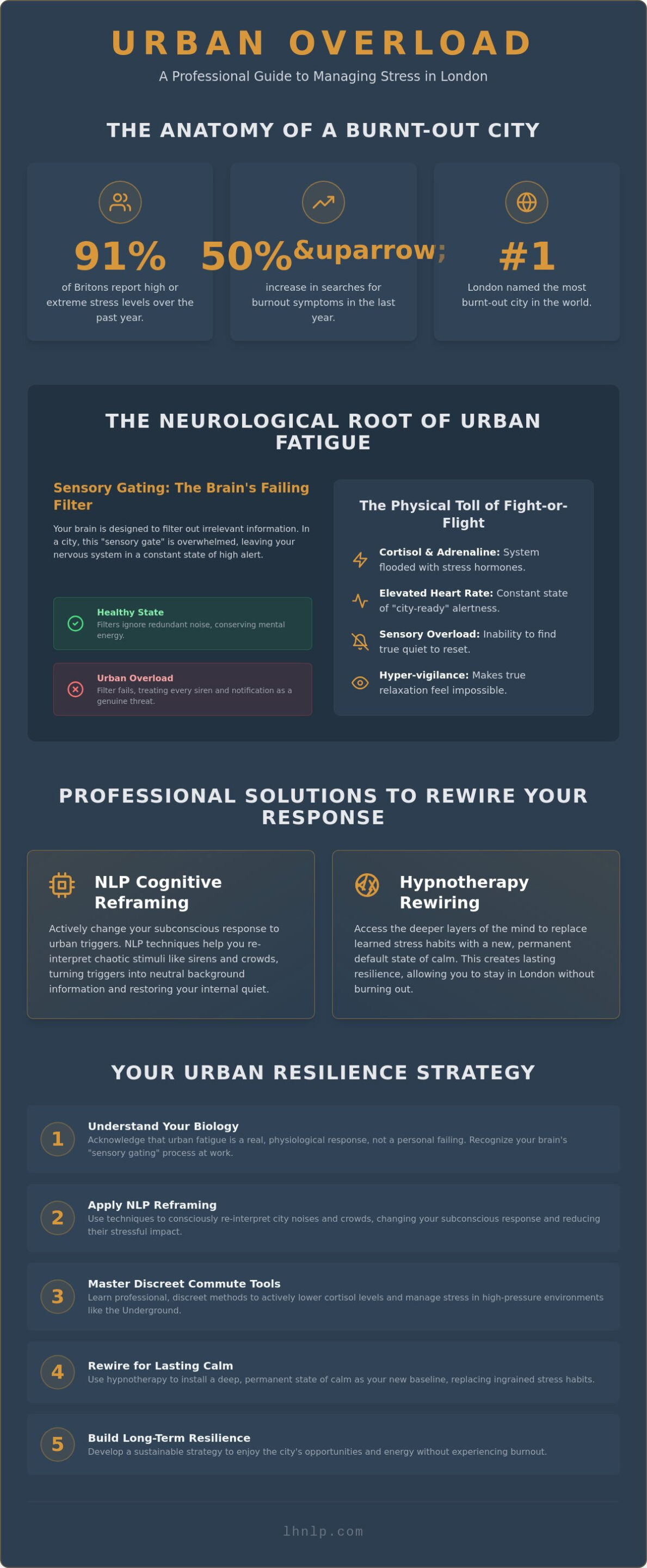
Did you know that London was recently named the most burnt-out city in the world? With 91% of Britons reporting high or extreme stress levels over the past year, and searches for burnout symptoms rising by 50% in 2025, many are desperately seeking how to manage city life stress before they reach a breaking point. You likely feel it every morning: the tightening in your chest as you step onto the Underground or the mental exhaustion of a sensory environment that never truly sleeps. It’s a struggle to stay present when the “always-on” culture demands every ounce of your attention, leaving you feeling isolated despite being surrounded by millions.
The truth is that urban fatigue isn’t just about the noise; it’s rooted in a neurological process called sensory gating. When this internal filter fails, your brain stays trapped in a perpetual state of fight-or-flight, reacting to every siren and notification as a genuine threat. This guide will show you how professional NLP and hypnotherapy techniques can restore your internal quiet and reclaim your peace in the heart of the city. We’ll explore immediate tools for your commute and a long-term strategy to ensure you stay in London without burning out.
Key Takeaways
- Understand the biological roots of urban fatigue and why your brain’s “sensory gating” filter often fails in high-density environments like London.
- Learn how to manage city life stress by applying NLP reframing techniques to change your subconscious response to noise and crowds.
- Discover five discreet, professional tools designed to lower your cortisol levels during the high-pressure environment of the daily commute.
- Explore how hypnotherapy can access the deeper layers of the mind to replace learned stress habits with a permanent, calm default state.
- Develop a long-term urban resilience strategy that allows you to enjoy the city’s opportunities without experiencing burnout.
Defining Urban Stress: The Biological Impact of the “Concrete Jungle”
Urban stress is far more than a simple reaction to a busy day; it is a chronic state of over-arousal rooted in the sheer density of our surroundings. Our biological systems were forged in wide, quiet spaces where a sudden noise usually meant a predator was near. Today, we navigate The Biological Impact of the “Concrete Jungle”, an environment where that same ancient alarm system is triggered every few seconds by sirens, flashing lights, and crowded platforms. This evolutionary mismatch creates a constant tension between our survival instincts and the 24/7 stimulation of 2026 London.
The “London pace” isn’t just a metaphor. It’s a physiological phenomenon driven by subconscious mimicry. When we walk through a crowded station, our nervous systems naturally sync with the frantic speed of those around us, leading to a collective state of burnout that feels inescapable. The city becomes a trigger-rich environment, where every unexpected shout keeps our internal systems on high alert. Learning how to manage city life stress begins with acknowledging that your body is working exactly as it was designed to; it’s simply reacting to a world it doesn’t yet understand. If you feel this tension is becoming unmanageable, exploring professional stress management can help recalibrate your internal response.
The Fight-or-Flight Response in a Modern Metropolis
When a siren wails or a crowd surges on the platform, your amygdala doesn’t distinguish between a modern inconvenience and a life-threatening predator. It interprets these stimuli as immediate threats, flooding your system with cortisol and adrenaline to maintain a state of “city-ready” alertness. This chemical cocktail keeps your heart rate elevated and your senses sharp, but it rarely subsides. You might notice the physical toll in the form of shallow breathing, persistent muscle tension in your shoulders, and a sense of hyper-vigilance that makes true relaxation feel like a distant memory.
Why the Amygdala Never Sleeps in the City
The Architecture of Overstimulation: How Your Subconscious Processes the City
Have you ever wondered why some days the hum of the city feels like background music, while on others, it feels like an assault on your senses? This difference lies in a neurological process called Sensory Gating. This is the brain’s innate ability to filter out redundant or irrelevant stimuli. In a balanced state, your mind ignores the distant rumble of the Jubilee line or the chatter in a crowded cafe. However, when you’re exploring how to manage city life stress, you must understand that urban living often forces this gate to stay wide open. Your mind isn’t merely a passive observer; it’s an active filter, constantly deciding what deserves your attention and what can be safely ignored.
Urban stress is essentially a breakdown of this subconscious filter. When the brain can no longer distinguish between a vital warning and the thousands of micro-decisions you make while navigating a busy pavement, it enters a state of cognitive overload. This “clutter” accumulates throughout the day. Every person you sidestep and every traffic light you monitor consumes a tiny portion of your mental energy. By the time you reach home, this cognitive residue remains active. This often creates a desperate need for specialized insomnia treatment, as the mind struggles to find the “off” switch amidst the lingering echoes of the day.
The Hidden Toll of Sensory Gating Failure
This failure manifests as more than just tiredness. It’s that pervasive brain fog that makes simple tasks feel monumental. Have you noticed yourself feeling irritable without a specific cause? It’s often not the person in front of you that’s the problem. Instead, it’s the cumulative weight of processed urban data. Your subconscious is attempting to protect you by raising your anxiety levels, keeping you hyper-aware of a threat that is actually just the city itself. Finding a Long-Term Resolution requires moving beyond surface-level relaxation to address these deeper processing habits.
Identifying Your Personal Urban Triggers
To reclaim your peace, you must audit your day. Is it the screech of the Tube brakes that spikes your pulse, or the social density of an open-plan office? Small irritations possess a stacking effect, where a minor delay at a ticket barrier can trigger a major stress response if your filter is already full. Try this brief exercise: next time you feel overwhelmed, pause and ask yourself if the noise is truly a threat or just data. Distinguishing between the external noise and your internal reaction is the first step toward urban resilience. If you find these triggers are becoming too heavy to carry alone, our team is here to guide your transition back to calm.
Cognitive Reframing: Using NLP to Change Your Relationship with the City
While many guides suggest temporary behavioral changes like deep breathing or taking sensory breaks, true urban resilience requires a shift in the very language your subconscious uses to describe your environment. Neuro-Linguistic Programming (NLP) offers a methodology for this internal restructuring. Instead of merely enduring the noise, you can learn how to manage city life stress by fundamentally changing the meaning you assign to urban stimuli. This isn’t about ignoring reality. It’s about choosing a perspective that preserves your nervous system. As an NLP practitioner London, Kamal helps clients move from a state of constant reaction to one of conscious response.
Research into The Impacts of City Living and Urbanization on Mental Health highlights how chronic environmental stress can alter our psychological baseline, making us more susceptible to anxiety. By using NLP, we address these biological shifts at the source. The goal is to move from a state of “reacting,” where the city dictates your mood, to “responding,” where you remain the architect of your internal state. When you change the internal map of your world, the world itself begins to feel different.
From “Crowded” to “Connected”: The Power of Perception
Consider the morning commute. Most see it as a personal affront or a barrier to their day. Through reframing, you can view a busy train as a shared human experience; a collective movement of millions of lives, each with their own stories. You can also use the NLP technique of “Dissociation.” Imagine stepping out of your body and watching the stressful scene from a distance, as if you’re a neutral observer behind a glass screen. This simple shift reduces the emotional intensity of the moment. Changing your internal dialogue from “I am trapped” to “I am surrounded by life” instantly alters how your amygdala processes the environment.
Anchoring Calm Amidst the Chaos
Anchoring is a powerful NLP tool that allows you to trigger a calm state on command, even in high-pressure zones like Waterloo or Victoria station. It works by associating a specific physical touch with a profound feeling of peace. To create your own calm anchor, follow these steps:
- Recall a memory where you felt completely safe and relaxed.
- Close your eyes and intensify the colors, sounds, and feelings of that memory.
- At the peak of that feeling, firmly press your thumb and forefinger together for five seconds.
- Release the touch and “break the state” by looking around the room.
- Repeat this process several times until the touch alone triggers the feeling of calm.
Once established, you can use this anchor discreetly whenever you feel the city’s pressure mounting. It acts as a lighthouse, guiding your nervous system back to safety when the waves of urban overstimulation become too high. Reclaiming your peace is not about leaving the city; it’s about carrying your own quiet space within you.
5 Essential Techniques to Manage Stress During the London Commute
The morning journey into the heart of London is often where the “Commuter Response” reaches its peak intensity. It’s a period of profound environmental pressure, where the screech of the tracks and the density of the crowd push the nervous system to its absolute limits. When you’re considering how to manage city life stress, the most effective tools are those that you can deploy in the heat of the moment. These micro-interventions require less than 60 seconds and are entirely discreet, allowing you to reclaim your internal space without drawing attention to yourself. For a deeper dive into long-term resilience, exploring professional stress management can provide the foundation these daily tools build upon.
Mastering the “Tube Anxiety” Response
The 4-7-8 breathing technique is a rapid way to activate your parasympathetic nervous system. Inhale for four counts, hold for seven, and exhale slowly for eight. This rhythmic pattern signals to your brain that the immediate threat has passed. Simultaneously, try the peripheral vision exercise. When we’re stressed, our vision narrows into a “foveal” lock, a literal tunnel vision that fuels the fight-or-flight response. By consciously widening your gaze to take in the edges of the carriage, you disrupt this neurological loop. Use your noise-cancelling technology as a sensory sanctuary rather than just a distraction; silence is often the most powerful medicine for a cluttered mind.
Mindful Walking and Sensory Grounding
Grounding techniques are essential when navigating high-density areas like Oxford Street or the walk to Canary Wharf. The “5-4-3-2-1” method involves identifying five things you see, four you can touch, three you hear, two you smell, and one you can taste. This forces the brain to process external data through the senses rather than through the filter of anxiety. Learning how to manage city life stress while on the move is about reclaiming the present. As you walk, shift your focus to the physical sensation of your feet hitting the pavement. This simple redirection of energy pulls you out of the mental loop of work-related rumination. Moving from internal rumination to external grounding creates an immediate physiological shift that anchors the mind in the present moment.
If you’re ready to move beyond temporary fixes and want to master these techniques with professional guidance, contact us today to book a session and start your journey toward urban calm.
Long-Term Resolution: How Hypnotherapy Rewires the Stress Response
For many Londoners, the constant tension of the capital has transitioned from a situational reaction into a deeply ingrained subconscious habit. Your mind, in its well-intentioned attempt to keep you safe, has learned to maintain a state of hyper-vigilance even when the immediate pressure of a crowded platform or a looming deadline has passed. This is why learning how to manage city life stress requires more than just temporary behavioral shifts; it demands a fundamental rewiring of your internal defaults. London Hypnotherapy & NLP serves as your partner in this transition, moving you from merely surviving the noise of the city to truly thriving within its vibrant energy.
Hypnotherapy allows us to bypass the critical conscious mind, which is often too exhausted to implement new changes, and speak directly to the subconscious. By accessing this deeper state, we can install new “calm defaults” that operate automatically, much like the stress response once did. Resolving these deep-seated patterns is ultimately how to manage city life stress in a way that lasts, ensuring your nervous system remains resilient against the city’s unique demands. It’s a methodical process of reclaiming your internal landscape from the external chaos.
Moving Beyond “Coping” to Emotional Resilience
Hypnotherapy addresses the root cause of the triggers we explored in previous sections, providing a lasting solution where surface-level fixes often falter. By entering a state of focused relaxation, we can resolve the underlying patterns that fuel the need for anxiety therapy london. One of the most effective tools in this process is “future pacing,” where you mentally rehearse upcoming stressful events while in a state of profound calm. This prepares your nervous system to remain regulated during your next commute or high-stakes meeting. Regular sessions don’t just solve immediate problems; they build a psychological buffer that protects you from the cumulative wear and tear of urban living.
Professional Support for Sustainable Urban Living
Whether you choose the quiet sanctuary of a one-to-one session near Harley Street or prefer the flexibility of online hypnotherapy services, professional support is a vital investment in your long-term success. In a city where searches for burnout symptoms rose by 50% in 2025, viewing mental health maintenance as a career asset is essential for sustainability. You don’t have to leave London to find the peace you crave; you simply need to change how you experience it. By updating your subconscious processing, you can enjoy the city’s opportunities while remaining anchored in your own internal quiet. Reclaiming your peace is a journey of self-mastery, and it begins the moment you decide that living in a state of perpetual alarm is no longer your only option.
Beyond Survival: Your Future in the City
Learning how to manage city life stress is ultimately about reclaiming your autonomy in the face of the capital’s unique demands. Kamal brings over 20 years of experience in clinical hypnotherapy and NLP to every session, offering tailored, solution-focused support for busy professionals. With convenient locations in Harley Street, Ealing, and Tokenhouse Yard, professional guidance is always accessible. You don’t have to leave the city to find your peace; you just need to change how you experience it.
Reclaim your calm in the city – book a consultation with Kamal today
Frequently Asked Questions
Is city life stress really different from normal stress?
City life stress is distinct because it involves a chronic state of environmental over-arousal. While normal stress might stem from a specific event, urban stress is a continuous failure of sensory gating. This means your brain stops filtering out irrelevant noise like sirens or crowds. Understanding this biological mismatch is the first step in learning how to manage city life stress effectively. It’s about recalibrating a nervous system that’s being bombarded 24/7.
How can I manage stress when I have a high-pressure job in London?
Managing stress in a high-pressure London career requires integrating micro-interventions into your daily transitions. You don’t need hours of meditation; you need 60-second resets between meetings or on the platform. Tools like peripheral vision widening can instantly lower cortisol levels. By partnering with a professional coach, you can also learn to decouple your internal sense of peace from your external professional performance in the City or Canary Wharf.
Can hypnotherapy help with the physical symptoms of urban stress like palpitations?
Hypnotherapy is highly effective at addressing physical symptoms like palpitations, shallow breathing, or muscle tension. These are often the outward signs of an overactive amygdala stuck in a survival loop. By accessing the subconscious mind, we can install new calm defaults that regulate the autonomic nervous system. This process helps your body realize that the hum of the city is not a genuine threat to your safety.
How many NLP sessions do I need to see a difference in my stress levels?
Most clients begin to notice a significant shift in their internal state within three to six sessions. While everyone’s journey is unique, the initial sessions often focus on immediate relief through cognitive reframing. This allows you to start changing your relationship with the city right away. Over time, these sessions build a resilient buffer that prevents the cumulative effects of urban living from leading to burnout or exhaustion.
What is the quickest way to calm down during a stressful commute?
The quickest way to stabilize your system during a commute is to widen your visual field. When we feel anxious, our vision narrows into a foveal lock, which further signals danger to the brain. By consciously taking in the edges of your vision, you tell your nervous system it’s safe to relax. This is a practical, discreet way how to manage city life stress when you’re trapped on a crowded Central Line train.
Is it possible to be “immune” to the noise and crowds of the city?
It’s not about becoming immune, but rather becoming resilient through improved sensory filtering. You can train your brain to stop interpreting every urban sound as a priority. This gating allows you to exist in a crowded space like Waterloo without your pulse rising. You’re still aware of the environment, but it no longer has the power to drain your emotional energy or trigger a fight-or-flight response.
Can virtual hypnotherapy be as effective as in-person sessions for stress?
Virtual hypnotherapy is just as effective as in-person sessions because the work happens entirely within your own mind. Many professionals find that being in their own home or office helps them enter a deeper state of relaxation more quickly. Digital sessions also remove the stress of traveling to an appointment, making it a seamless addition to a busy London schedule. It’s a modern solution for a modern urban challenge.
How does NLP help with the feeling of being “overwhelmed” by city life?
NLP helps by breaking down the wall of noise into individual, manageable perceptions. When you feel overwhelmed, your brain is usually generalizing thousands of stimuli into one giant threat. NLP techniques like Dissociation allow you to step back and view these stimuli as neutral data points. This shift in perspective prevents the emotional hijacking that leads to that familiar feeling of being trapped or isolated by the city’s density.