

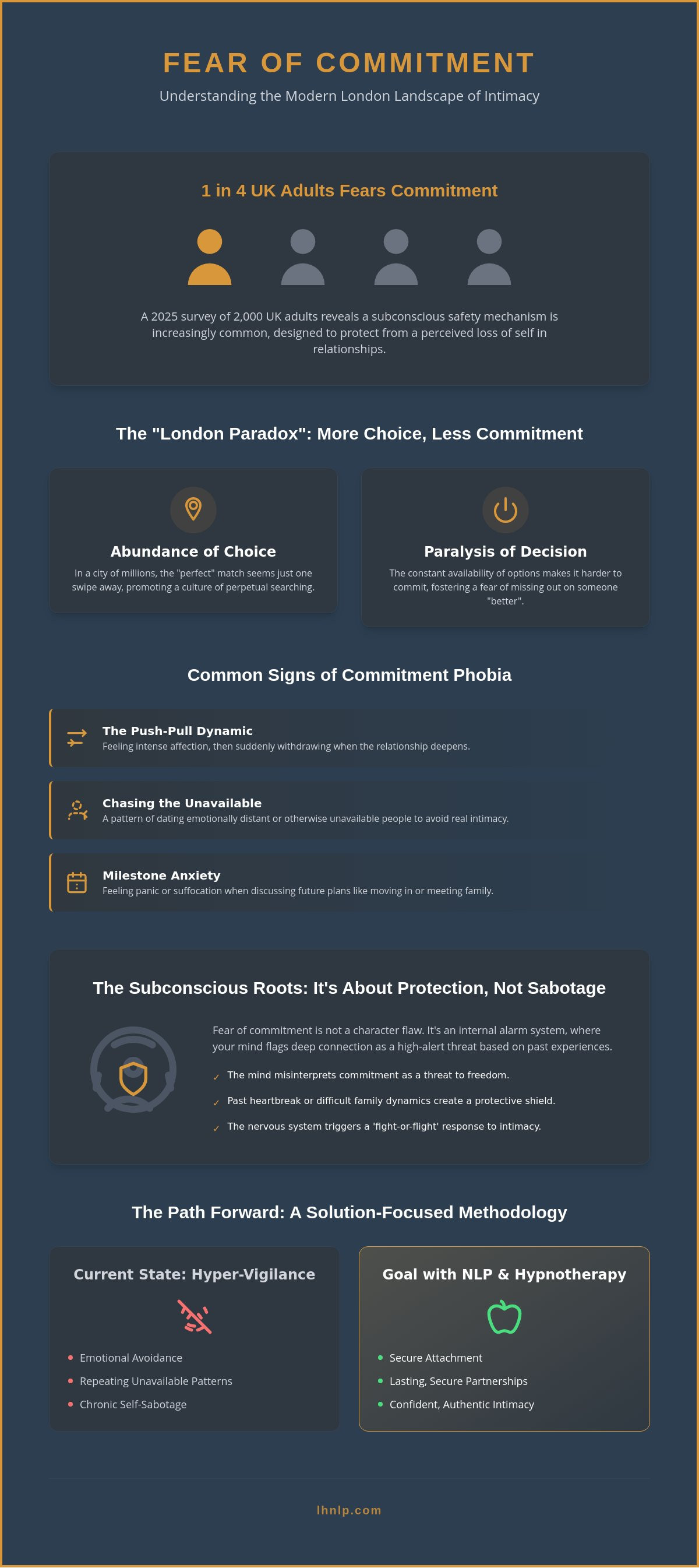
A 2025 survey of 2,000 UK adults revealed that one in four people admit to being scared of commitment, a statistic that reflects a growing struggle in our modern dating landscape. In a city like ours, where the pressure of milestone anxiety often clashes with the fear of losing one’s independence, it’s easy to feel trapped in a cycle of emotional avoidance. If you find yourself sabotaging deep connections or feeling a sudden surge of panic the moment a relationship feels real, you aren’t cold or incapable of love. Instead, you’re likely navigating a subconscious safety mechanism designed to protect you from a perceived loss of self. Seeking specialized fear of commitment therapy London offers a professional way to decode these internal alarms and transform your approach to intimacy.
It’s deeply painful to feel lonely yet terrified of the very thing that could end that loneliness. You want to be seen, but the vulnerability required feels like a threat to your hard-won autonomy. I promise that by exploring the psychological roots of your anxiety, you can shift from a state of hyper-vigilance to one of secure attachment. This article explores how the fusion of clinical hypnotherapy and NLP can help you re-pattern your relationship with closeness. We will look at how you can move past repeating unavailable patterns and finally begin building the secure, lasting connections you truly desire.
Key Takeaways
- Uncover how the unique “London Paradox” and the pressure of milestone anxiety fuel the subconscious urge to retreat from deep emotional connections.
- Identify whether your relationship patterns are rooted in an avoidant attachment style and how your mind misinterprets commitment as a threat to your personal freedom.
- Discover why specialized fear of commitment therapy London uses NLP and hypnotherapy to create rapid, lasting shifts in your emotional responses.
- Learn to distinguish between temporary “cold feet” and the chronic self-sabotage that prevents you from experiencing a truly secure and lasting partnership.
- Gain insight into a solution-focused methodology that prioritizes moving beyond past heartbreak and toward a future of confident, authentic intimacy.
What is Fear of Commitment and Why is it Prevalent in London?
We often think of commitment as a conscious choice, yet for many, it feels like an invisible cage. This visceral reaction, often referred to as fear of commitment or Gamophobia, isn’t a character flaw or a lack of desire for love. It’s a complex psychological state where the prospect of a long-term bond triggers an intense fight-or-flight response deep within the nervous system. While it’s natural to feel a healthy level of caution when entering a new partnership, a debilitating fear can stall your personal evolution and leave you stranded in a cycle of isolation. Commitment phobia is a protective subconscious response to perceived emotional risk.
Living in a global hub brings a unique set of psychological challenges to our emotional lives. In a city of nearly nine million people, we’re constantly told that the “perfect” match is just one swipe away. This creates a psychological trap known as the London Paradox, where the abundance of choice leads to a paralysis of decision. Why commit to the person in front of you when someone “better” might appear in your feed tomorrow? Seeking fear of commitment therapy London helps you navigate this urban maze, moving from a state of perpetual searching to one of meaningful, grounded settling.
To better understand the mechanics of why we often hesitate to choose a partner, watch this insightful video:
The Symptoms of Commitment Phobia
- The Push-Pull Dynamic: You might feel an intense rush of affection in the early stages, only to experience a sudden “coldness” or a need to withdraw as soon as the relationship becomes “serious.”
- Chasing the Unavailable: A recurring pattern of dating people who are emotionally distant, married, or living abroad. This allows you to experience the high of romance without the “threat” of actual intimacy.
- Milestone Anxiety: Feeling a sense of suffocating panic when discussing future plans, moving in together, or meeting family members.
The “London Lifestyle” Factor
The fast-paced career culture of London often prioritises autonomy and “hustle” over the slow, vulnerable work of building a relationship. In high-stakes environments like the City or Canary Wharf, vulnerability is often viewed as a liability. This professional conditioning bleeds into our private lives, making us view commitment as a threat to our hard-won independence. Furthermore, the “swipe culture” of modern dating apps has commodified connection, making it easier to replace a partner than to resolve a conflict. Breaking this cycle requires a shift in how your subconscious perceives safety and success.
The Subconscious Roots: Why Your Mind Avoids Commitment
To understand why you pull away just as things are getting good, we must look beneath the surface of your conscious thoughts. Your mind isn’t trying to sabotage your happiness. It’s actually trying to keep you safe. For those seeking fear of commitment therapy London, the journey often begins by recognizing that the subconscious mind views intimacy through the lens of past survival. If your earliest experiences of closeness were intertwined with a loss of autonomy or emotional pain, your nervous system will naturally flag a deepening relationship as a high-alert threat. This internal alarm system is why you might feel a sudden, inexplicable urge to “bolt” the moment a partner expresses a desire for more consistency.
This protective stance often manifests as an “imprint” on the nervous system. When you’re faced with the prospect of a lasting bond, your brain doesn’t see a future of shared joy. Instead, it sees the potential for trapped energy or the eventual agony of being left behind. Exploring therapy for commitment issues can reveal how these imprints dictate your current choices. It’s a way of acknowledging that your avoidance isn’t a lack of love, but a deeply ingrained habit of self-preservation that has outlived its usefulness.
Attachment Styles and Relationship Patterns
The blueprint for how we relate to others is often drawn in our earliest years. Those with an avoidant attachment style frequently experience commitment as a loss of self. You might value your independence so fiercely that any request for your time feels like an intrusion. This often leads to the “anxious-avoidant trap,” where you find yourself drawn to partners who crave high levels of intimacy. Their pursuit triggers your need to retreat, creating a painful “push-pull” dynamic that reinforces your belief that relationships are exhausting. It’s vital to remember that these patterns are learned behaviors. Because they were learned, they can also be unlearned through a methodical and compassionate approach to change.
The Subconscious Protection Script
- The Logic Gap: You may consciously want a partner, yet feel a physical sensation of panic when things progress. This is because the subconscious mind always wins a battle against logic until the underlying “script” is rewritten.
- Anxiety as a Compass: Your mind uses anxiety as a signal to run. It interprets the “serious” phase of dating as a cage rather than a sanctuary.
- Fear of Pain: The subconscious prioritizes the avoidance of pain over the pursuit of pleasure. To it, staying single feels “safe,” while committing feels like walking into a trap.
Understanding these deep-seated drivers is the first step toward reclaiming your emotional freedom. If you feel ready to examine the scripts that have been running your love life, you might find that relationship coaching offers the clarity needed to bridge the gap between your conscious desires and your subconscious fears.
Hypnotherapy vs. Traditional Therapy for Commitment Issues
Choosing the right path for fear of commitment therapy London often involves a delicate balance between understanding the past and actively transforming the future. Many people spend months, or even years, in traditional talk therapy, meticulously uncovering the childhood wounds or past heartbreaks that created their avoidant patterns. While this insight is valuable, there is often a frustrating gap between what the mind knows and what the body feels. You might intellectually understand why you push people away, yet find yourself powerless to stop the wave of panic that hits when a relationship deepens. This is because the fear isn’t stored in your logical, conscious mind; it’s anchored in your subconscious nervous system.
Solution-focused hypnotherapy and Neuro-Linguistic Programming (NLP) offer a different dynamic. Instead of merely revisiting the narrative of your life, these methods target the neurological “loop” that maintains the anxiety. While counselling provides the “why,” hypnotherapy provides the “how” to change. By working directly with the subconscious, we can begin to dissolve the visceral triggers that make intimacy feel like a threat, allowing you to respond to love with presence rather than an urge to retreat.
The Limitations of “Talking About It”
Intellectualising a fear doesn’t always stop the heart from racing. You may be able to explain your parents’ divorce or your history of “unavailable” partners with perfect clarity, yet still feel a suffocating sensation when someone asks about your weekend plans. This disconnect occurs because the analytical brain and the emotional brain speak different languages. Simply talking about the fear often reinforces the existing neural pathways rather than creating new ones. If you’ve found that traditional methods haven’t shifted the needle, exploring Therapy for Anxiety in London can provide a more direct route to emotional relief by addressing the root response.
How Hypnosis Re-patterns the Commitment Response
Clinical hypnosis serves as a bridge to the “protection script” we discussed earlier. In a state of deep relaxation, we can suggest new, more beneficial associations to the subconscious mind. NLP techniques then act as a precision tool to change your internal representations of closeness. If the idea of “forever” currently triggers a mental image of a cage or a sensation of being trapped, we can re-wire that signal. The goal is to build a new internal association where commitment equals safety, growth, and shared strength. This isn’t about “losing” your freedom, but about gaining the freedom to choose a lasting bond without the interference of outdated survival instincts. Through this methodical process, the “push-pull” dynamic begins to lose its power, replaced by a grounded sense of security.
Signs You Should Seek Commitment Therapy in London
Recognizing the threshold between healthy caution and a self-sabotaging pattern is often the most difficult step in any healing journey. It’s easy to convince ourselves that we’re simply being discerning or protective of our time, yet when your dating history resembles a series of abrupt endings just as intimacy begins to bloom, it’s time to look closer. Seeking fear of commitment therapy London isn’t about admitting a character flaw. It’s about acknowledging that your current strategy for self-protection has become a barrier to the very connection you consciously desire. How do you know when your “independence” has crossed the line into a chronic avoidance that limits your life?
A common objection many people raise is the belief that they “just haven’t met the right person yet.” While compatibility is essential, if you find that every partner eventually becomes the “wrong” person the moment they ask for more of your time, the issue likely resides within your subconscious script rather than your choice of partner. This chronic pattern sabotages happiness by ensuring you never stay long enough to build a secure foundation, leaving you in a state of perpetual emotional transit.
The Commitment Phobia Checklist
- The Suffocation Signal: Do you feel a physical sense of panic or a need to escape when a partner stays over for several nights or suggests planning a holiday months in advance?
- The Flaw-Finding Mission: Do you find yourself suddenly focusing on minor, insignificant flaws in a partner as soon as the relationship feels secure or “serious”?
- The Exit Strategy: Are you constantly scanning for reasons to leave, keeping one foot out the door even when things are going well, to ensure you’re the one who ends it first?
The Cost of Delaying Treatment
The emotional exhaustion of the “dating merry-go-round” in London can be profound. The city’s fast pace and infinite options make it easy to hide behind a busy social calendar, but the underlying sense of loneliness often remains unaddressed. Over time, this chronic relationship stress doesn’t just affect your romantic life; it can bleed into overall health anxiety, impacting your sleep patterns, professional focus, and general sense of well-being. Addressing these patterns now, before they impact your long-term life goals or future family aspirations, is an act of profound self-respect and courage. If you’re ready to break the cycle and move toward a future of secure, authentic connection, you can book a session today to begin exploring your path forward.
Overcoming the Fear: The London Hypnotherapy & NLP Approach
Breaking the cycle of relationship anxiety is a methodical process of reclaiming your power from outdated survival mechanisms. Kamalyn Kaur’s approach to fear of commitment therapy London is rooted in the belief that while your past may have shaped your current patterns, it doesn’t have to dictate your future. By combining the precision of Neuro-Linguistic Programming with the profound depth of clinical hypnotherapy, this methodology focuses on moving you from an avoidant state to a secure, grounded way of relating. This transition isn’t about changing who you are; it’s about removing the subconscious barriers that prevent your authentic self from showing up in a partnership.
For those who prefer in-person sessions, Kamalyn offers breakthroughs at her practices in Harley Street and Ealing. These locations provide a professional yet deeply supportive environment where you can focus entirely on your internal shifts. If you’re based outside Central London or simply prefer the comfort of your own environment, Virtual Hypnotherapy Sessions are also available. This ensures that geographical distance or a busy London schedule is never a barrier to your emotional growth.
What to Expect in Your Sessions
Entering therapy for commitment issues can feel like a significant act of vulnerability in itself. Because of this, the sessions are designed to be a safe, non-judgmental sanctuary where your experiences are met with empathy and professional insight. You won’t just be talking about your problems. You’ll be actively learning how to manage them through a solution-focused lens. You will receive practical NLP tools that you can use in real-time the moment you feel the urge to “run” or sabotage a connection. Each plan is entirely tailored to your specific relationship goals, ensuring that every session brings you closer to the secure connection you desire.
Starting Your Journey to Secure Connection
The success of this process often rests on the therapeutic alliance between you and your guide. Kamalyn acts as a mentor and an experienced companion, understanding the intricate architecture of the human mind while providing the rational, intuitive support needed for lasting change. Taking the first step toward emotional freedom is often the most courageous part of the process. It’s a commitment to yourself that precedes your commitment to anyone else. If you’re ready to explore a different way of being in a relationship, you can contact Kamalyn Kaur today to discuss your path to secure commitment and begin the work of building a life filled with lasting, meaningful connections.
Your Path Toward Lasting Intimacy
Moving beyond the cycle of relationship anxiety requires more than just intellectual understanding; it demands a fundamental shift in how your subconscious perceives closeness. By addressing the protective scripts that have long governed your dating life, you can finally trade the exhaustion of avoidance for the peace of a secure connection. Whether you’re navigating the unique pressures of the city or untangling long-standing patterns of withdrawal, specialized support is available to guide you through this transition.
With over 20 years of experience in clinical hypnotherapy and a solution-focused approach that blends NLP with deep subconscious work, Kamalyn Kaur provides a clear pathway to emotional freedom. From her clinics in Harley Street and Ealing, she helps individuals rewrite their internal narratives of fear into ones of safety and growth. If you’re ready to stop running and start building the lasting bond you deserve, fear of commitment therapy London offers the tools to transform your inner world. You don’t have to navigate this journey alone. Take the first step toward a more fulfilling future and book a session with Kamalyn Kaur to overcome your fear of commitment. A life of deeper, more authentic intimacy is within your reach.
Frequently Asked Questions
Is fear of commitment a mental health disorder?
Fear of commitment is not classified as a clinical mental health disorder in the DSM-5, but it is a significant psychological barrier that impacts your quality of life. It’s best understood as an overactive survival instinct that views emotional intimacy as a direct threat to your safety or autonomy. While it isn’t a medical diagnosis, the distress it causes is real and often requires a methodical approach to resolve.
How many sessions of hypnotherapy are needed for fear of commitment?
The number of sessions required depends on the depth of the subconscious script, though many clients experience a shift in their visceral response within three to six sessions. Unlike traditional talk therapy which can span months, this solution-focused approach aims for efficient breakthroughs. We focus on re-patterning the immediate anxiety response to ensure you can navigate your relationships with greater presence and less panic.
Can NLP really help me stay in a relationship?
NLP helps you stay in a relationship by providing the tools to manage the “urge to run” before it becomes an action. By changing your internal representations of closeness, you move from a place of reactive fear to one of conscious choice. It allows you to recognize anxiety as a signal from the past rather than a directive for your current partnership.
What is the difference between commitment phobia and just not being ready?
“Not being ready” is often a conscious, temporary decision based on external circumstances, whereas commitment phobia is a chronic, subconscious pattern of avoidance. If you consistently sabotage connections with people you truly care for, you are likely dealing with a deeper phobic response. Seeking specialized fear of commitment therapy London can help you distinguish between a temporary phase and a chronic cycle of self-sabotage.
Will therapy change my personality or make me “soft”?
Therapy will not change your core personality; it simply removes the layer of fear that currently limits your emotional choices. You will retain your independence and strength, but you’ll no longer be a prisoner to your anxiety. True strength lies in the ability to be vulnerable and secure, rather than needing to stay distant just to feel safe.
Do you offer fear of commitment therapy in Harley Street?
Yes, in-person sessions are available at the Harley Street clinic in Central London. This location provides a professional and private setting for those who prefer the focus of a face-to-face breakthrough. Many clients find that the dedicated space helps them commit more deeply to their internal transformation while providing a sanctuary away from their daily London routine.
Can I do these sessions online via Zoom?
Virtual sessions are fully available and are just as effective as in-person appointments for relationship anxiety. This option is ideal for those with demanding schedules or those living outside the city who still wish to access specialized hypnotherapy and NLP. You can experience the same deep relaxation and re-patterning from the comfort and privacy of your own home.
What if my partner is the one with the fear of commitment?
While you cannot force another person into therapy, you can focus on your own responses and boundaries within the relationship. Relationship coaching can help you understand the “push-pull” dynamic and determine if the current partnership is healthy for your own growth. Sometimes, your own shift toward a more secure attachment style can positively influence the dynamic and inspire your partner to change.