

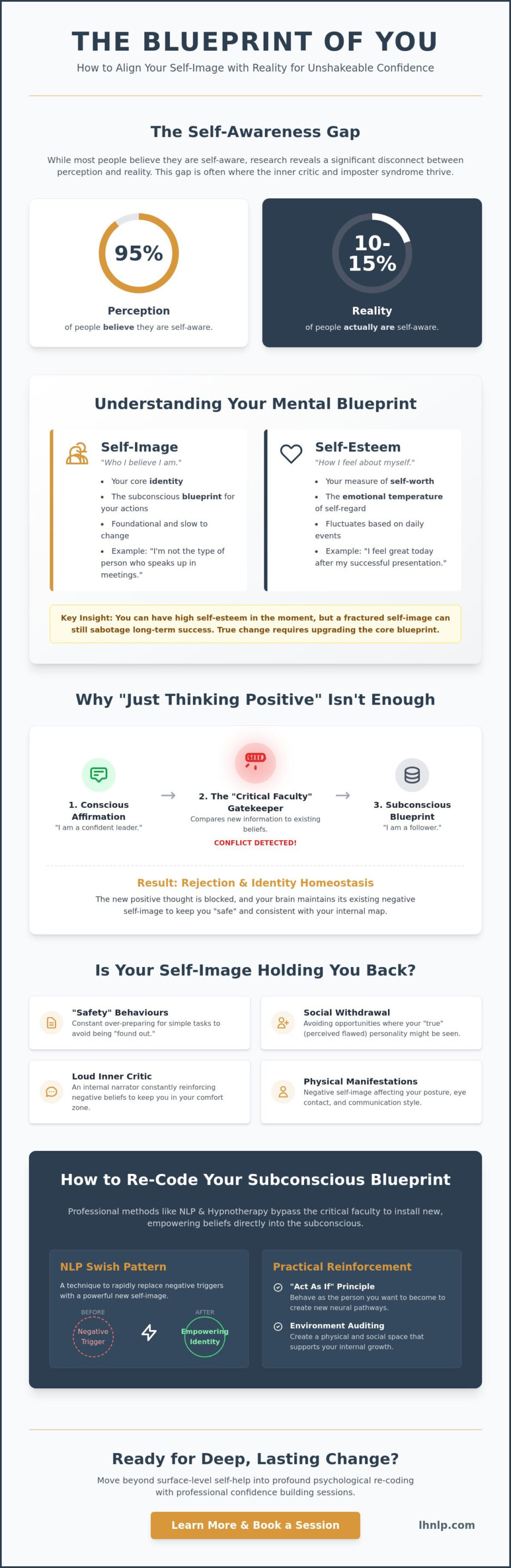
Did you know that while 95% of people believe they are self-aware, research suggests only 10 to 15% actually possess that clarity? This disconnect often manifests as a persistent inner critic or a heavy sense of imposter syndrome that masks your true personality in professional settings. You might spend hours wondering how to improve my self-image, only to find that surface-level tips offer little relief from the weight of social anxiety. It’s a quiet, internal battle where your perceived limitations prevent you from stepping into the light of your own achievements.
Real change begins when we stop polishing the surface and start re-coding the subconscious blueprint that dictates our behavior. By utilizing the precise tools of NLP coaching and hypnotherapy, it’s possible to move beyond temporary fixes and establish an unshakeable sense of internal confidence. This guide will walk you through the professional methods used to align your self-perception with reality, freeing you from the cycles of self-sabotage. You’ll discover how to reclaim your mental space and cultivate a presence that feels both authentic and powerful.
Key Takeaways
- Understand the distinction between self-esteem and self-image to identify the specific mental blueprint that governs your daily reactions and choices.
- Learn why standard positive affirmations often fail and how to address the subconscious roots where your self-perception is actually stored.
- Explore the NLP Swish Pattern as a practical method for how to improve my self-image by replacing restrictive mental triggers with empowering new identities.
- Discover the “Act As If” principle and environment auditing to create a physical and social space that supports your internal growth.
- Identify the benefits of professional confidence building sessions for those ready to move beyond self-help into deep, lasting psychological re-coding.
Understanding the Mental Blueprint: What is Self-Image?
Imagine your mind as a vast, private library where every experience has been meticulously cataloged into an internal dictionary. This collection isn’t just a record of facts; it is the definitive guide to who you believe you are at your core. When people ask What is Self-Image?, they are often looking at the surface of their personality. However, a professional psychological perspective views it as the subconscious blueprint that dictates every action, reaction, and boundary you set for yourself. It’s the silent narrator that decides if you are “the type of person” who succeeds or “the type of person” who stays in the shadows.
There is a vital distinction to make between how we feel and who we believe we are. Self-esteem is a measure of your worth, it’s the emotional temperature of your self-regard in a given moment. Self-image is far more foundational; it is your identity. You can have high self-esteem after a successful presentation but still possess a fractured self-image that whispers you don’t belong in the boardroom. This is particularly prevalent in high-pressure professional hubs like London, where high-achievers often suffer from a “London Imposter” syndrome. Despite the accolades and the titles, their internal blueprint hasn’t caught up to their external reality. This creates a glass ceiling for personal growth, where you subconsciously sabotage your success because it doesn’t align with your hidden, smaller self-perception.
To better understand this concept, watch this helpful video:
The Mirror vs. The Mind
External validation rarely fixes a fractured internal self-image. You might receive a dozen compliments, but if your internal filter is set to “inadequate”, those words simply bounce off. This is the conflict between the “ideal self”, who you wish to be, and the “perceived self”, who you truly believe you are. Essentially, your self-image acts as a subconscious filter that dictates behaviour, ensuring your actions always match your internal map. If you are searching for how to improve my self-image, you must realize that the mirror is not the problem; the mind is.
Signs Your Self-Image Needs an Upgrade
Identifying a misaligned self-image requires honest self-reflection. You might notice “safety behaviours” such as over-preparing for simple tasks to avoid being “found out”, or withdrawing from social opportunities where your true personality might be seen. The inner critic plays a starring role here, constantly reinforcing the old, negative blueprint to keep you “safe” within your comfort zone. This internal state eventually leaks into your physical presence, affecting your posture, your eye contact, and the very rhythm of your communication style. When you learn how to improve my self-image, you aren’t just changing a thought; you’re updating the entire operating system of your life.
The Subconscious Roots: Why ‘Thinking Positive’ Often Fails
Many people searching for how to improve my self-image begin with the best of intentions, often turning to positive affirmations or motivational quotes. You might stand before a mirror and repeat phrases of confidence, yet feel a hollow ache of insincerity in your chest. This happens because your subconscious mind acts as a sophisticated storage facility for every emotional impression and “truth” you’ve accepted since childhood. If your internal blueprint is etched with the belief that you’re inadequate, the conscious mind’s attempt to “think positive” is met with immediate, silent rejection. It feels like trying to paint a beautiful mural on a wall that’s crumbling from within; the surface may look different for a moment, but the structural integrity remains unchanged.
This rejection is managed by what psychologists call the ‘Critical Faculty’. Think of this as a mental gatekeeper that guards the entrance to your subconscious. Its primary job is to compare any new information against your existing beliefs. If you try to tell yourself you’re a natural leader while your blueprint says you’re a follower, the gatekeeper simply blocks the thought. This creates a ‘Homeostasis of Identity’. Your brain actively fights to keep you feeling the same because, in the world of the subconscious, the familiar is safe. Even if your current self-image is painful, your brain prefers the known discomfort over the perceived threat of a new identity.
Early Imprinting and the ‘Not Good Enough’ Script
Most of our internal scripts are written before we reach the age of seven, a time when our minds are most porous to the opinions of authority figures and peers. These early impressions form the bedrock of who we think we are. In a high-stakes, competitive environment like London, these “not good enough” scripts are often reinforced by the relentless pressure to perform and compare. We develop a powerful confirmation bias, subconsciously scanning our daily lives for any small mistake that proves our negative self-image is “correct”. While you can find 5 Practical Steps for a Positive Self-Image to help manage your daily outlook, shifting the foundational script requires a more direct approach to the subconscious mind.
Hypnotherapy as a Tool for Subconscious Realignment
This is where clinical hypnotherapy becomes a transformative ally. By inducing a state of focused relaxation, we can temporarily quiet the Critical Faculty and bypass the typical resistance of the analytical mind. This process utilizes the science of neuroplasticity, allowing us to communicate directly with the subconscious to plant new, empowering seeds of identity. It’s the vital shift from merely “knowing” you are capable at an intellectual level to having a deep, unshakable “emotional conviction” of your worth. If you’re ready to stop fighting your own mind and start working with it, exploring hypnotherapy London can be the catalyst for this profound internal realignment.
NLP Techniques to Re-Code Your Inner Dialogue
If your mind were a complex piece of software, Neuro-Linguistic Programming (NLP) would be the user manual that explains how the code was written. Most people struggle with how to improve my self-image because they try to change the output without addressing the underlying programming. NLP moves beyond the “why” of your feelings and focuses on the “how” of your internal processing. It provides a structured framework to dismantle limiting beliefs and replace them with a self-perception that supports your highest ambitions. By mastering these mental tools, you transition from being a passive observer of your thoughts to becoming the active architect of your reality.
One of the most potent tools in this manual is the ‘Swish Pattern’. This technique involves identifying the specific mental image that triggers a negative self-perception and rapidly replacing it with a compelling, idealized version of yourself. It’s like a mental “delete and replace” function that trains your brain to automatically move toward a more empowered state. Combined with reframing, where you consciously change the meaning of past “failures” to see them as valuable feedback, you begin to strip away the emotional weight of old scripts. This shift allows you to follow professional steps to improve self-esteem with a sense of genuine momentum rather than constant internal friction.
Dissociation: Viewing Your Inner Critic Objectively
To break the grip of a negative self-image, you must learn to view your thoughts with detachment. Dissociation is the process of “stepping out” of a painful memory or thought and observing it as if it were a movie playing on a distant, tiny screen. You can then manipulate the “submodalities” of this mental image to reduce its impact. Try making the picture black and white, shrinking its size, or moving it further into the distance. To strip the inner critic of its authority, imagine its voice speaking as a high-pitched cartoon character. This simple shift breaks the emotional loop, making it far easier to understand how to improve my self-image through objective observation.
Anchoring Confidence
Anchoring is the process of creating a physical trigger for a state of high self-worth. It’s a reliable mental shortcut that you can use whenever you need to feel unshakeable. During NLP Coaching, you are guided to recall a moment of intense confidence, making the sensory details—the sights, sounds, and feelings—as vivid and rich as possible. At the peak of this experience, you apply a physical anchor, such as pressing two fingers together. With repetition, this anchor becomes a powerful tool that you can fire before high-stakes London meetings or social events to instantly access your internal resources.
The language you use after the words “I am” acts as a direct command to your subconscious. These aren’t just descriptions; they are the building blocks of your reality. When you audit your internal dialogue and replace “I am struggling” with “I am evolving,” you signal a profound shift in your identity. This linguistic precision ensures your daily self-talk aligns with the unshakeable confidence you are cultivating.
5 Practical Steps to Shift Your Self-Perception Daily
The journey of internal re-coding is not a one-time event but a series of intentional, daily choices that reinforce your new identity. While NLP and hypnotherapy provide the structural changes, your daily habits act as the cement that holds the new blueprint in place. Many people ask how to improve my self-image while remaining in environments that constantly trigger their old, smaller selves. To truly transform, you must become a conscious gatekeeper of your own reality, ensuring that every input, from the people you see to the way you stand, aligns with the version of yourself you are currently building.
Consider these five professional strategies to maintain your mental momentum:
- Audit Your Environment: Take a cold, hard look at who you spend your time with. Are they people who celebrate your growth, or do they thrive on your old insecurities? In the fast-paced London professional scene, it’s easy to fall into circles that value competition over connection.
- The ‘Act As If’ Principle: This isn’t about “faking it.” It is about signaling to your brain that a new reality is already present. Ask yourself: “How would the version of me who already has unshakeable confidence handle this email?” Then, act accordingly.
- Build a ‘Success Journal’: Your brain has a natural negativity bias. By recording three “micro-wins” every evening, you provide your subconscious with concrete evidence of your competence, making it harder for the inner critic to argue against your progress.
- Strategic Self-Compassion: View self-compassion as a high-performance tool. When you slip up, a harsh inner critic triggers the stress response, which shuts down your creative problem-solving. Compassion keeps the “learning brain” online.
- Regular Mental Tune-ups: Just as you wouldn’t expect a car to run forever without a service, your mind benefits from professional maintenance to clear out any new limiting beliefs that may have surfaced.
Physicality and Presence
Your body and mind exist in a constant feedback loop. Research into “power posing” suggests that adopting an expansive posture for just two minutes can lower cortisol levels and increase testosterone, the hormone linked to confidence. Dressing for your “future self” also plays a significant role; when you wear clothes that reflect your desired identity, you subconsciously adopt the traits associated with that image. If you feel anxiety rising, use a simple “box breathing” technique: inhale for four counts, hold for four, exhale for four, and hold for four. This physical intervention shifts your nervous system from “fight or flight” back into a state of calm presence.
The Power of Intentional Social Circles
Low self-esteem often acts as a magnet for toxic relationships that reinforce your feelings of inadequacy. To break this cycle, you must actively seek out support networks that mirror your aspirations. Finding a community in London that values emotional intelligence and professional growth is essential for long-term change. Many find that Confidence Building Sessions provide a safe, structured space to practice these new social dynamics before taking them out into the wider world. By surrounding yourself with individuals who see your potential even when you don’t, you accelerate the re-coding process.
Ready to take the next step in your transformation? Explore our Confidence Building Sessions in London to begin your professional re-coding today.
Professional Support: Confidence Building in London
At London Hypnotherapy & NLP, the approach is rooted in the belief that you already possess the resources for change; they are simply waiting to be unlocked. The Kamalyn Kaur approach blends clinical expertise with a deeply empathetic, intuitive understanding of the human condition. We focus on transitioning you from a “wounded” self-image, which reacts to the world from a place of perceived lack, to a “resilient” one that operates from a position of unshakeable internal worth. This isn’t about temporary motivation. It’s about a methodical re-coding of your psychological foundation.
Bespoke Treatment Plans for Lasting Change
London is a city of immense opportunity, but its high-stakes environment demands a specific type of mental agility. Our sessions are never “off-the-shelf.” We create bespoke treatment plans that integrate NLP coaching, clinical hypnotherapy, and strategic stress management to address the specific pressures you face. This multi-layered approach ensures that change doesn’t just happen at an intellectual level but takes root in your emotional convictions. You can explore the philosophy behind these methods and learn more about Kamal’s extensive background on our About Us page. We understand the nuances of the “London Imposter” and provide the tools to dismantle it once and for all.
Your Journey Starts with a Conversation
Taking the first step toward a new identity is often the most significant act of self-leadership you can perform. We make this transition as seamless as possible, offering both virtual hypnotherapy sessions and in-person consultations in the heart of the city. This is your invitation to move beyond the limitations of your past and step into the clarity of your future self. Why wait for a “better time” when the tools for transformation are already within reach? Your mind is the most powerful asset you own; it’s time to ensure its blueprint matches your highest potential. Book your consultation to improve your self-image today and begin the rewarding process of professional mental re-coding.
Embrace the Evolution of Your Identity
Updating your internal blueprint is more than a simple exercise in optimism; it is a methodical journey of reclaiming your mental space. You’ve explored how the subconscious mind holds onto early imprinting and how professional tools like NLP and hypnotherapy can bypass the critical faculty to install a more resilient identity. Understanding how to improve my self-image isn’t just about feeling better in the moment. It’s about aligning your deepest beliefs with the reality of your achievements, allowing you to move through the world with unshakeable internal freedom.
With over 20 years of clinical experience, we provide a bespoke integration of NLP and hypnotherapy tailored to your unique psychological landscape. Whether you visit us at our Harley Street or Ealing locations, you’ll find a supportive environment dedicated to your growth. This process doesn’t just change how you think; it changes who you are at your core. Take the first step toward unshakeable confidence; book your session today. Your future self is waiting for you to begin.
Frequently Asked Questions
Can hypnotherapy really change my self-image?
Hypnotherapy is highly effective because it bypasses the analytical gatekeeper of the mind to reach the subconscious blueprint where your identity is stored. By planting new, empowering suggestions while you’re in a deeply relaxed state, we can dismantle the old scripts that keep you stuck. This direct communication allows for a more profound realignment than traditional talk therapy alone.
How many NLP sessions do I need to see an improvement?
While every individual’s journey is unique, many clients begin to experience a shift in their internal dialogue within three to six sessions. NLP is designed for rapid intervention; it focuses on the “how” of your mental processes rather than dwelling indefinitely on the past. This efficiency makes it a preferred choice for those looking for how to improve my self-image in a structured, results-oriented way.
Is low self-image the same as clinical depression?
Low self-image is not the same as clinical depression, although they frequently coexist and influence one another. Self-image refers to the internal picture you hold of your identity and capabilities; it’s your mental map. Clinical depression is a complex condition involving persistent low mood and physical symptoms. If you’re concerned about your mental health, you should check with a medical professional for a formal diagnosis.
Can I improve my self-image if I’ve felt this way since childhood?
You can absolutely transform your self-perception regardless of how long you’ve held certain limiting beliefs. The brain’s neuroplasticity means it’s never too late to re-code the neural pathways that support your identity. Even scripts rooted in early childhood experiences can be updated using targeted techniques like the Swish Pattern or clinical hypnotherapy to create a new, resilient blueprint.
Do you offer online sessions for self-confidence?
Yes, we offer Virtual Hypnotherapy Sessions for those who prefer the comfort of their own environment or live outside of London. These sessions are just as effective as in-person appointments for building unshakeable self-confidence. They provide a flexible and private way to access professional support without the added pressure of travel or scheduling conflicts.
What is the difference between self-esteem and self-image?
Self-esteem is a measure of your emotional worth, while self-image is the actual blueprint of your identity. You might feel a temporary boost in self-esteem after a professional win, but if your self-image is “I am a fraud,” you’ll eventually return to that baseline. Learning how to improve my self-image involves changing that fundamental internal map so your confidence becomes permanent.
How does stress in a city like London affect my self-perception?
The competitive nature of London often creates a “social comparison” trap that can severely distort your self-perception. High-pressure professional environments can trigger imposter syndrome even in the most successful individuals. Constant exposure to the city’s “hustle culture” often reinforces the idea that your value is tied solely to your output, which eventually fractures your internal sense of self.
Is NLP a scientifically proven method for building confidence?
NLP is a widely recognized methodology used by elite performers and professional coaches worldwide to create lasting behavioral change. It’s built on the principles of cognitive psychology and linguistics, focusing on how we represent the world internally to ourselves. While it’s categorized as a coaching tool, its success in building confidence is documented through decades of practical, clinical application.