

In 2024/25, an estimated 964,000 workers in Great Britain were experiencing work-related stress, depression or anxiety, according to the Health and Safety Executive. For a senior professional, the effects may show up as blurred concentration, restless nights, strained communication or less confidence in the room. What kind of executive stress management London support could help you function more clearly at work?
It’s understandable to look for a solution that fits the demands of your role. The right support depends less on your job title than on the change you want: practical tools for pressure, space to explore emotional patterns, or a considered blend of both. Concerns about executive presence may overlap with stress through confidence, focus or public speaking, but they aren’t the same thing.
This guide explains what executive stress support can involve and how to compare approaches against your needs, schedule and goals. You’ll also learn how London Hypnotherapy & NLP combines hypnotherapy, NLP, counselling and coaching, and how sessions take place at the Harley Street clinic or online. Start by identifying what’s affecting you, then choose support with care.
Key Takeaways
- Executive stress can affect wellbeing and everyday work, but a demanding period alone doesn’t mean something is wrong.
- Choose support by the change you want: coaching can focus on goals, counselling on thoughts and feelings, while an integrated approach can address both.
- Use four steps to assess fit: name the pressure, define a useful change, discuss your needs, then choose an in-person or online session format.
- Executive presence concerns may connect with confidence, focus or public speaking, but they are not the same as work-related stress.
- Explore how executive stress management London support from London Hypnotherapy & NLP can be tailored through individual sessions with Kamal, a registered Clinical Hypnotherapist and senior business psychologist with over 25 years of experience.
Executive stress management in London: when work pressure starts to follow you home
Senior roles can bring sustained responsibility, difficult decisions and the expectation of staying composed, even when demands compete for your attention. In London, that pressure may sit alongside a long commute, caring responsibilities or a tightly packed diary. A busy spell isn’t automatically harmful, and feeling stretched doesn’t mean you have a mental-health condition. The useful question is whether work pressure is beginning to affect your wellbeing or daily functioning.
Executive stress is sustained work-related pressure that affects a person’s wellbeing or everyday functioning; it describes an experience, not a clinical diagnosis. This distinction lets you notice what’s happening without rushing to label yourself. If you’re exploring executive stress management London, understanding the pressure and its impact is a practical starting point.
How can work pressure show up outside the office?
Sometimes the working day ends, but your attention stays at your desk. You might replay a difficult meeting on the journey home, find it harder to settle into rest or notice that a small decision takes more effort than usual. Perhaps you feel less assured in discussions, or your replies to colleagues and family become shorter because your mind is still occupied.
These experiences can have many explanations, and none alone proves stress is the cause. Look for patterns rather than diagnosing yourself: Is this happening repeatedly? Does it affect sleep, concentration, communication or time away from work? Does the pressure ease when a project passes, or continue across different situations?
Noticing the pattern is more useful than judging yourself for it. Make a brief note of the situation, what you noticed and what seemed to help. Broad stress management techniques offer different ways to respond to pressure, but the first step is understanding what your own experience calls for.
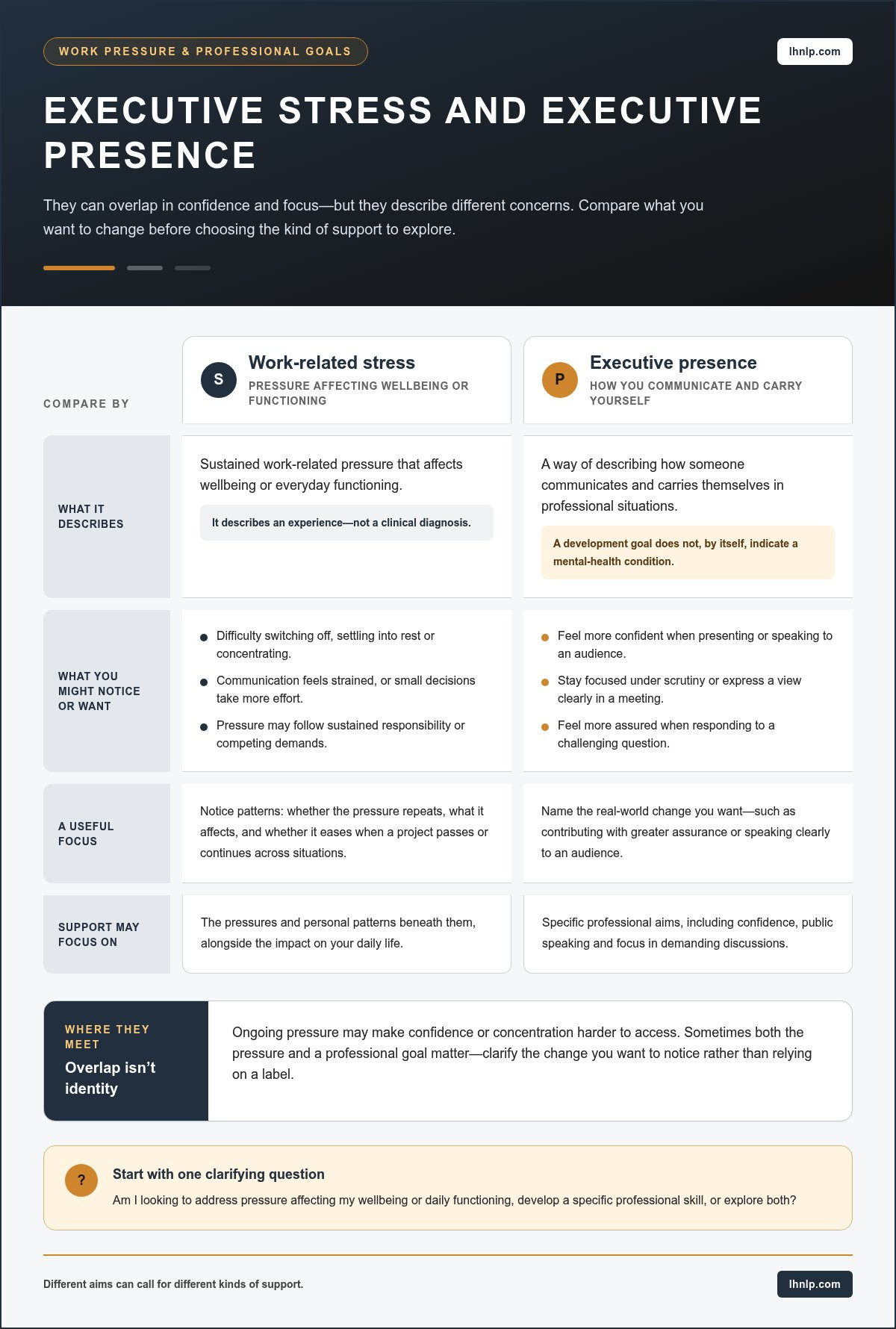
Executive stress and executive presence: related, but not identical
Executive presence is often used to describe how someone communicates and carries themselves in professional situations. You might want to feel more confident when presenting, stay focused under scrutiny or express a view clearly in a high-pressure meeting. These aims can overlap with stress: ongoing pressure may make confidence or concentration harder to access. But wanting to strengthen your presence does not, by itself, indicate a mental-health condition.
This distinction can help you clarify what you’re looking for. A search for executive presence coaching London may reflect a specific professional goal, such as speaking with greater assurance, rather than a wish to explore broader emotional pressures. Public speaking and confidence support can address those goals; work-related stress may call for attention to the pressures and personal patterns beneath them. Sometimes both matter. Start with the change you want to notice, not a label you feel obliged to adopt.
How executive stress support can address pressure, focus, and confidence
Work pressure rarely arrives as a single, neatly defined problem. A demanding project might be the immediate trigger, while difficulty switching off, self-doubt or a familiar response to conflict adds another layer. An individual session can help you sort through what’s happening at work, what you’d like to change and which thoughts, feelings or habits may be relevant. This gives the support a clear direction without assuming every professional needs the same method.
At London Hypnotherapy & NLP, support can integrate Clinical Hypnotherapy, Neuro-Linguistic Programming (NLP), counselling and psychology. The discussion can consider practical professional aims alongside personal patterns connected to them. Your plan is shaped around your circumstances and goals, rather than applying one fixed protocol to everyone.
What can hypnotherapy and NLP contribute to work-related goals?
Depending on the person and the goal, techniques used in the practice include guided visualisation, time-line therapy and progressive muscle relaxation. They may form part of work on relaxation, confidence or preparing for a challenging situation. For example, someone who feels tense before presenting might explore a calming exercise alongside the thoughts and expectations that arise around speaking.
Hypnosis doesn’t mean losing awareness or control. You remain fully aware and in control throughout. Techniques are considered in relation to your aims, and their suitability and usefulness vary from person to person. They don’t promise a particular result.
When might executive presence become part of the conversation?
Sometimes the central aim isn’t to reduce pressure, but to feel more assured when contributing, maintain focus during a demanding discussion or speak clearly to an audience. Motivation may also matter, particularly if a professional goal feels difficult to approach. These are individual development aims, not evidence of a leadership deficit. A session can clarify what you want to change in real situations, such as presenting an idea or responding to a challenging question.
For one person, confidence may be the priority; another may want to understand a recurring source of work-related strain. The approach can be tailored to those distinct aims, and the practice’s range of treatments and approaches gives context for how support may be shaped. If you’re considering executive stress management London, identify the situation where you most want greater ease or clarity. That gives the discussion something concrete to work with, without requiring you to have all the answers in advance.
Comparing executive stress support: coaching, counselling, and an integrated approach
Different forms of support can help you work towards different kinds of change. Coaching generally centres on goals and action; counselling offers space to explore thoughts and feelings. An integrated approach can bring more than one perspective into an individual plan. The useful comparison isn’t a ranking of methods, but a way to identify which conversation best fits the question you want to answer.
| Approach | Typical goal | Format and conversation focus |
|---|---|---|
| Coaching | Make progress towards a professional goal. | Goal-oriented conversations may focus on priorities, confidence, focus, communication or possible next steps. |
| Counselling | Explore thoughts and feelings connected with a concern. | Conversations may make space to consider emotional strain, stress, anxiety or patterns in how you respond to situations. |
| Integrated support | Consider professional goals alongside relevant personal patterns. | An individual plan may combine Clinical Hypnotherapy, NLP, counselling and psychology, depending on the person and their aims. |
Which kind of support fits the question you want to answer?
Start with the outcome you hope to work towards. If you want to prepare for a presentation, communicate with greater confidence or focus on a specific work goal, a practical, goal-oriented conversation may be a natural starting point. If you’re carrying emotional strain or want to understand how stress or anxiety connects with your experience, space to explore thoughts and feelings may be more relevant. These aims can overlap.
At London Hypnotherapy & NLP, Clinical Hypnotherapy, NLP, counselling and psychology can be integrated into an individual treatment plan. That means the discussion can account for both the professional situation and relevant personal concerns, rather than treating them as unrelated by default. Explore the practice’s treatments and approaches to understand this range.
What a comparison cannot promise
A method that seems suitable on paper won’t necessarily feel right in practice, and no approach can guarantee lasting change or work for everyone. Hypnotherapy doesn’t suit every person, and people may respond differently. It’s reasonable to discuss what a method involves and how it relates to your goals before deciding whether it feels appropriate.
Hypnotherapy is complementary or alternative support, not a replacement for conventional medical treatment. If you have a serious or urgent health concern, seek appropriate conventional care. Comparing approaches can help you frame your priorities, but it cannot assess your health or determine the right clinical care for you.
For executive stress management London, ask yourself: do you primarily want help moving towards a specific work goal, space to explore emotional strain, or support that can consider both? Your answer offers a grounded starting point for an individual discussion, without requiring you to adopt a label or assume one method is right for everyone.
How to decide whether executive stress support in London fits your needs
You don’t need a polished account of your work history before seeking support. A useful first session can begin with one or two situations that have stayed with you, such as a decision that feels unusually difficult or a meeting you’re preparing for. These four steps can help you decide what you want from support and make the conversation more focused.
- Name the pressure. What has changed at work or at home? Note the demands, situations or interactions that feel most difficult, without trying to explain everything at once.
- Define a useful change. What would you like to handle differently? Perhaps you want to feel calmer under pressure, regain focus, build confidence or communicate more clearly. A specific, realistic aim gives support a direction.
- Discuss the fit. Bring your examples and explain what matters to you. Mention any support already in place so the conversation can take your circumstances into account. This isn’t a request to change your medical care.
- Choose a session format. Consider what works practically for your schedule and where you’d feel comfortable talking. An in-person appointment or an online session may each suit different circumstances.
You don’t need to decide in advance which technique or approach is right. Begin with the concern you want to discuss and the change you hope to work towards.
Questions to clarify before taking a first step
Before a session, you might ask yourself: What feels different recently? Is the main concern stress, confidence, focus or communication, or do these overlap? What would I hope to do, feel or respond to differently in a particular situation? Jot down a few words rather than preparing a complete explanation. A short note about what you’ve already tried or what support is in place can also provide useful context.
Choosing an in-person or online conversation
London Hypnotherapy & NLP offers in-person appointments at 96 Harley St, London W1G 7HY, as well as remote sessions via Zoom or Skype. The choice may come down to practical considerations such as your working day, travel and the setting in which you feel at ease. If remote support suits your circumstances, explore the online hypnotherapy session format.
Support is tailored to the person and their goals; there isn’t a fixed session count for executive stress. The number of sessions may differ per person, depending on the concern and response. A session lasts 45 minutes to an hour, and costs £190 for one hour. The discussion is a chance to describe your situation and consider an individual plan, rather than commit to a predetermined course. For executive stress management London, that distinction matters: a useful next step should reflect your needs, not an assumed formula.
If you’re ready to consider what kind of support may fit, explore London Hypnotherapy & NLP’s treatment approaches and identify what feels relevant to your goals.
What to expect from executive stress support with London Hypnotherapy & NLP
You don’t need a complete explanation or a fixed goal to take a first step. A session can begin with what’s been happening at work, how it’s affecting you and what you’d like to handle differently. From there, support can be shaped around your circumstances rather than fitted to a standard programme.
A tailored session, not a fixed programme
Kamal is a registered Clinical Hypnotherapist and senior business psychologist with over 25 years of experience. His background informs an individual approach that can draw on Clinical Hypnotherapy, NLP, counselling and psychology, depending on what’s relevant to your concerns and aims. You can read more about Kamal’s experience and approach.
A session lasts 45 minutes to an hour. The discussion may explore a particular work situation, the response you’d like to develop and any personal patterns that seem connected. You don’t need to arrive with the “right” words; a concrete example or a question you’ve been considering is enough to start.
If hypnosis forms part of the work, you remain fully aware and in control throughout. You are aware and in control all along. The methods considered and the focus of your plan depend on your circumstances. There’s no fixed session count for executive stress, and no particular result can be guaranteed.
Taking the next step in London or online
Appointments are available in person at 96 Harley St, London W1G 7HY, or remotely via Zoom or Skype. Your working day, travel and preferred setting may help determine which format suits you. Either way, the first step is to discuss your situation and consider an approach tailored to your goals.
Executive stress management London can mean different things to different people. You may want to feel steadier during difficult conversations, regain focus on a demanding task or explore the emotional weight of sustained pressure. Describe what matters most to you; the discussion can help clarify whether the practice’s integrated approach suits your needs.
If you’d like to explore how support could relate to your personal goals, contact London Hypnotherapy & NLP to start a conversation. There’s no need to have everything worked out beforehand.
Make space for a more considered next step
You don’t have to wait until work feels unmanageable to take your experience seriously. A clear intention can be enough to begin: what would you like to approach with more steadiness, clarity or confidence? That question can help turn a vague sense of pressure into a direction you can explore.
The right support should make room for your circumstances, not ask you to fit a ready-made idea of what an executive ought to feel or do. If you’re considering executive stress management London, let your priorities guide the first conversation. Share what’s been weighing on you, ask questions and take time to decide what feels appropriate.
Discuss your goals with London Hypnotherapy & NLP and explore a thoughtful next step at your own pace. Change can begin with one honest conversation.
Frequently Asked Questions
Is executive stress the same as burnout?
No. They’re related ideas, but they aren’t interchangeable labels. Executive stress can describe pressure connected with senior work and its effect on everyday life; burnout is often used to describe a more persistent experience of work-related exhaustion or depletion. Neither term, by itself, establishes a diagnosis. If difficulties continue or interfere with daily functioning, consider discussing them with an appropriate health professional rather than relying on a label.
Can hypnotherapy help with executive stress?
It may be one part of support for exploring how you respond to work pressure and what you’d like to approach differently. For example, a person preparing for a high-stakes presentation might work on relaxation or confidence as part of an individual plan. Hypnotherapy won’t remove external demands, and it doesn’t work for everyone. Outcomes vary, so no particular change can be promised.
Will I lose control or awareness during hypnotherapy?
No. You remain fully aware and in control throughout hypnosis. You aren’t unconscious or handed control to someone else. You can hear what’s being said and remain involved in the session. If you feel uncertain, raise that concern beforehand so you can understand what the process involves and decide whether it feels comfortable for you.
How many sessions will I need for executive stress?
There isn’t a fixed number of sessions for executive stress. The number may differ per person, depending on your concerns and how you respond. Rather than relying on a standard timetable, discuss what you’d like help with and review whether the work feels relevant as it progresses. No specific duration or outcome can be guaranteed.
Can hypnotherapy replace medical or mental-health treatment?
No. Hypnotherapy is complementary or alternative support, not a substitute for conventional medical or mental-health care. If you’re receiving treatment, don’t stop or change it based on hypnotherapy; discuss care decisions with the health professional responsible for your treatment. For serious or urgent concerns, contact an appropriate health professional, such as your GP, so your needs can be assessed through conventional care.
Can I have executive stress sessions online from London?
Yes. London clients can have online sessions via Zoom or Skype, which may make it easier to fit a conversation around work or home commitments. For executive stress management London, choose a private, quiet space where you can speak without interruption. Consider whether that setting will help you feel settled and able to focus during the session.