

What if the persistent struggle to push the plate away isn’t a failure of character, but a simple communication breakdown between your nervous system and your subconscious mind? You might frequently find yourself trapped in a cycle where the high-pressure London lifestyle fuels a deep-seated need for comfort, leading to that all too familiar physical discomfort and the heavy shadow of guilt that follows a meal. If you have ever wondered why willpower alone never seems to be enough, it’s because your internal compass for fullness has been temporarily silenced by stress and habit. Exploring hypnosis for portion control London provides a gentle yet profound way to reconnect with your body’s innate wisdom, turning what once felt like a battle into a natural state of equilibrium.
I understand how exhausting the ‘all or nothing’ approach to eating can be, especially when every meal feels like a test you’re destined to fail. This article will show you how clinical hypnotherapy can help you regain control over your appetite and end the cycle of overeating without the constant, draining struggle of self-discipline. We’ll examine how recalibrating your satiety cues allows you to leave food on the plate effortlessly, recognize true hunger, and move toward sustainable weight management. It’s time to discover a path where nourishment and peace can finally coexist.
Key Takeaways
- Recognise that overeating is rarely a lack of willpower; it’s a subconscious habit often rooted in childhood conditioning that can be gently unlearned.
- Learn how hypnosis for portion control London bypasses the analytical mind to recalibrate your satiety signals and restore your natural relationship with food.
- Understand the ‘Restriction Paradox’ and why hypnotherapy succeeds where calorie counting fails by ending the brain’s obsession with forbidden foods.
- Gain practical tools for navigating London’s fast-paced dining scene, allowing you to enjoy social occasions without the pressure to overindulge.
- Discover Kamal’s professional, solution-focused approach at Harley Street or the City, where internal change becomes a methodical and supportive journey.
The Psychology of Overeating: Why Willpower Fails Portion Control
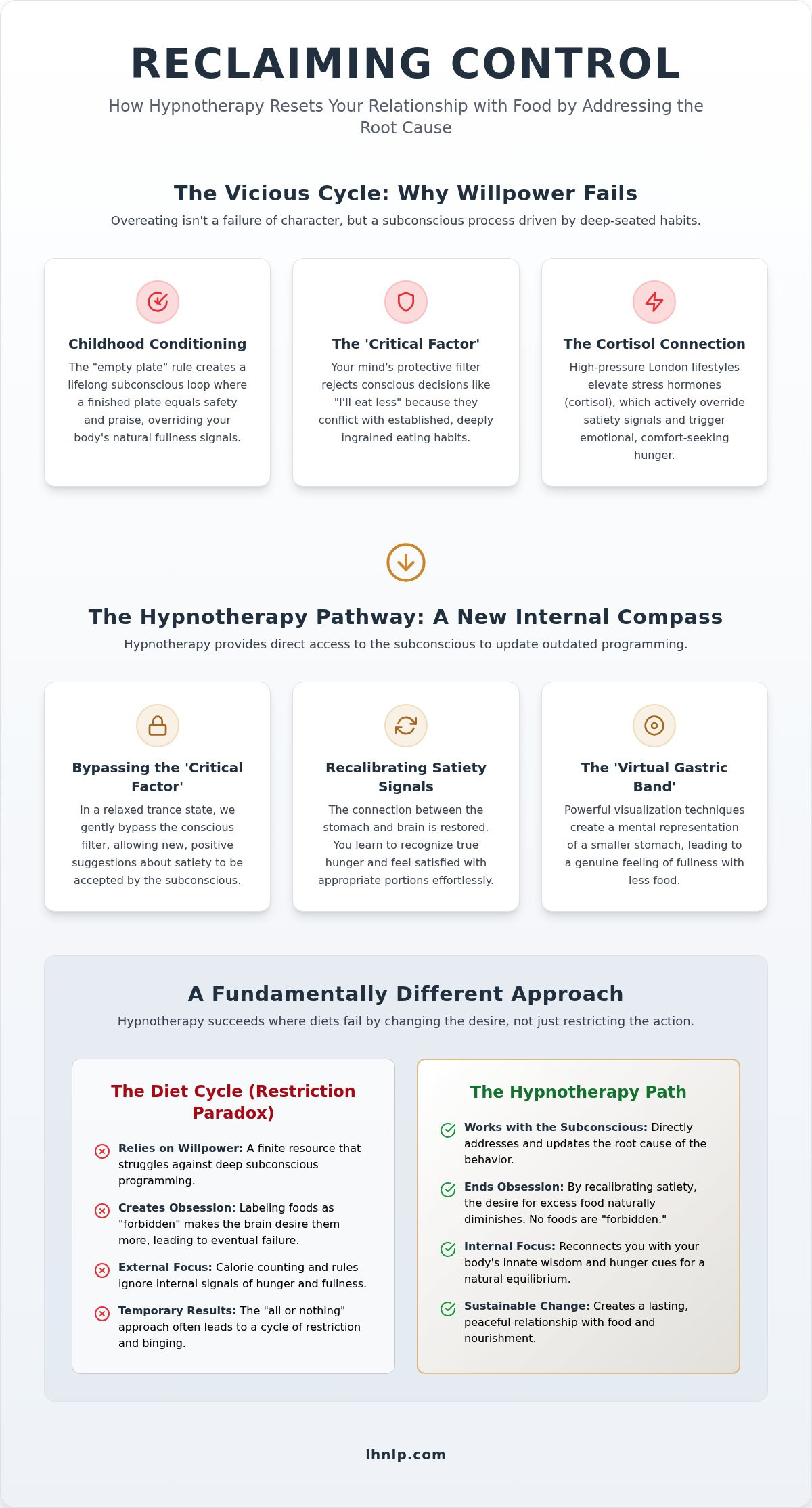
Many of my clients arrive at my London clinics feeling exhausted by a perceived lack of willpower. They describe a familiar scene: the meal is delicious, the stomach feels full, yet the hand continues to move the fork until the plate is bare. This isn’t a failure of character. It’s the result of automaticity. When we treat eating as a conscious choice, we ignore the fact that portioning is actually a subconscious habit. By the time your logical mind suggests you’ve had enough, your habit centre has already decided otherwise. To bridge this gap, hypnosis for portion control London offers a way to speak directly to the part of the mind where these scripts are written.
The reason logical dieting often fails is due to the ‘Critical Factor’. This is a metaphorical filter in the human mind that protects our existing beliefs and habits. When you tell yourself “I will only eat half of this,” the Critical Factor compares that statement to your deep-seated habits and rejects it as a threat to your established routine. Understanding What is Hypnotherapy? helps us see how we can temporarily relax this filter. By doing so, we can introduce new, healthier suggestions about satiety that the mind accepts as its new truth. It’s a methodical process of updating your internal software.
The ‘Empty Plate’ Conditioning and Modern Portions
For many, the compulsion to overeat began at the family dinner table. Perhaps you were rewarded for finishing every scrap, or told stories about less fortunate children to encourage you to clear your plate. These early emotional rewards create a lifelong loop where a finished plate equals safety and praise. In the context of London’s dining scene, where restaurant portions are often designed for visual impact rather than nutritional necessity, this childhood script becomes a liability. Your internal ‘normal’ gauge is being calibrated by external forces rather than internal needs. Subconscious eating is a protective but outdated survival mechanism that once ensured we had enough energy for lean times, but it now keeps us trapped in a cycle of discomfort.
Stress and the London Pace: The Cortisol Connection
The high-pressure environment of the City or Canary Wharf adds another layer of complexity to our eating behaviours. When you are constantly in ‘fight or flight’ mode, your body produces cortisol, a stress hormone that actively overrides satiety signals. This leads to emotional hunger, a sudden and specific craving used to soothe a frazzled nervous system, which is vastly different from slow-building biological hunger. When you’re eating on the go between meetings, your brain doesn’t register the food intake properly, leaving you feeling unsatisfied regardless of the volume consumed. Through specialised treatments, we can address these triggers, allowing you to find a sense of calm that makes portion control feel like a natural byproduct of a balanced mind rather than a daily chore.
How Hypnosis for Portion Control Works: Recalibrating Satiety
The process of hypnosis for portion control London is akin to fine-tuning a delicate instrument that has fallen out of pitch. While we previously explored why the conscious mind fails to regulate intake, we must now look at how the trance state provides a direct channel to the ‘habit centre’ of the brain. In this deeply relaxed yet highly focused state, we bypass the critical filter to access the subconscious blueprint where your eating patterns are stored. It’s here that we can recalibrate your natural satiety levels, ensuring that the signals sent from your stomach via the Vagus nerve are finally heard and respected. When this communication is restored, the urge to overeat simply fades away.
Visualisation plays a pivotal role in this neurological recalibration. One effective method involves the concept of a ‘Virtual Gastric Band’. Unlike a physical procedure, this technique uses the power of the mind to create a vivid mental representation of a smaller stomach capacity. By deeply imagining this change, your subconscious begins to react as if it were a physical reality, leading to a genuine feeling of satisfaction after consuming smaller, healthier portions. Positive suggestion then reinforces this shift. It transforms the act of leaving food on your plate from a perceived loss into a profound feeling of self-mastery and quiet victory. You aren’t giving anything up; you’re gaining freedom.
Accessing the Subconscious Blueprint
During our work together, I help you identify the specific emotional or situational triggers that prompt overindulgence. Many people carry a hidden ‘scarcity’ mindset, a subconscious fear that food must be consumed now because it might not be available later. Through hypnotherapy, we replace this with an ‘abundance’ mindset. You begin to feel, at a cellular level, that nourishment is always available and that you have the permission to stop whenever you choose. Post-hypnotic suggestions act as invisible guides, helping you maintain this new perspective when you’re actually sitting in a busy restaurant or facing a stressful day. These mental anchors ensure your new habits remain firm even when life becomes demanding.
NLP Techniques for Instant Habit Shifts
To complement the deep work of hypnosis, I integrate Neuro-Linguistic Programming (NLP) to provide you with practical, ‘on-the-spot’ tools. One such technique is ‘Anchoring’. By associating a specific physical gesture with a state of complete satisfaction, you can trigger that feeling of fullness even before your plate is empty. We also use the ‘Swish’ pattern, a mental exercise where you rapidly replace the old image of yourself overeating with a vibrant, compelling image of your new, balanced self. These methods ensure that the changes we initiate in my solution-focused sessions are both immediate and enduring, giving you back the lead in your own life.
Beyond Calorie Counting: Why Hypnotherapy Succeeds Where Diets Fail
Conventional dieting often feels like an endless negotiation with a part of yourself that isn’t interested in logic. Most weight management programmes in the city focus on external metrics like calorie tracking apps, smart scales, or rigid meal plans. While these tools provide data, they fail to address the core reason why portion control feels so difficult. They rely entirely on willpower, which is a finite resource easily depleted by a long day in the office or a stressful commute. Choosing hypnosis for portion control London allows you to step away from this exhausting cycle by shifting the focus from external rules to internal wisdom. Instead of fighting your appetite, you are teaching your mind to listen to your body’s natural hunger cues once again.
Some people wonder if hypnotherapy is merely a ‘quick fix’ or a temporary mental trick. In reality, it is a structural intervention for your behavioural patterns. Diets are temporary by nature; they are something you ‘go on’ and eventually ‘go off’. This creates the infamous ‘Yo-Yo’ cycle so prevalent in London’s fitness fads. Clinical hypnotherapy aims for a permanent recalibration. By addressing the psychological roots of overeating, we ensure that the changes you experience are sustainable because they no longer require constant conscious effort. You aren’t just eating less; you are becoming a person who naturally prefers smaller, more satisfying portions.
The Failure of the ‘Restriction Mindset’
The ‘Restriction Paradox’ explains why strict dieting often leads to the very behaviour it tries to prevent. When you label certain foods as ‘forbidden’ or strictly limit your intake, your brain’s survival mechanism flags those items as high-value resources. This creates a state of psychological deprivation, making you obsess over food far more than you did before the diet started. This tension eventually snaps, leading to a binge. By using Hypnotherapy for Weight Loss in London, we remove this sense of ‘missing out’. We replace the feeling of restriction with a sense of quiet abundance, where you feel completely satisfied by exactly what your body needs.
Sustainable Change: Rewiring the Reward System
Our sessions focus on shifting your dopamine response away from the volume of food and toward the quality of the experience. Many people have accidentally trained their brains to see large portions as a primary reward for surviving a difficult day. Through clinical suggestion, we can rewire this association, helping you view food as fuel and nourishment rather than an emotional sedative. This is made possible through neuroplasticity. Neuroplasticity is the physiological process through which the brain builds new pathways and strengthens healthier habits while allowing old, unhelpful patterns to wither away. By harnessing this natural ability, hypnosis for portion control London turns what was once a struggle into a peaceful, automatic way of living.
Practical Mindset Tools for Navigating London’s Dining Scene
Living in London means your environment is often meticulously designed to encourage consumption. From the artisan bakeries lining the streets of the City to the late-night business dinners in Mayfair, the temptation to overindulge is a constant background noise. While our clinical sessions do the heavy lifting at a subconscious level, having a set of practical, ‘at-the-table’ tools helps you navigate these daily challenges with grace. By integrating hypnosis for portion control London into your lifestyle, these techniques become second nature rather than a series of chores you have to remember.
The ’20-Minute Rule’ is perhaps the most vital physiological tool in your arsenal. It takes approximately 20 minutes for the hormone leptin to signal to your brain that you’ve had enough to eat. In a high-speed culture, you can easily consume twice your required portion before that signal arrives. Anchor this rule into your routine by consciously putting your cutlery down between bites. This isn’t about deprivation. It’s about giving your biology the necessary time to communicate with your mind.
Mindful Eating in a Fast-Paced City
Busy professionals often treat lunch as a task to be cleared rather than an experience to be savoured. If you’re eating while answering emails or rushing between Canary Wharf offices, your brain misses the ‘eating event’ entirely. Use the ‘Sensory Engagement’ method: take a brief moment to notice the aroma, texture, and colour of your food. This simple pause signals to your nervous system that nourishment is occurring, which significantly increases meal satisfaction. It’s vital to stop eating while distracted by screens, as this allows you to stay present with your body’s satiety signals.
Handling Social Pressure and Dining Out
Business dinners and social events often feature ‘Food Pushers’, those well-meaning colleagues or friends who insist you try every course or finish your plate. Navigating this without feeling awkward requires a firm internal boundary. Use mental rehearsal before you arrive: visualise yourself politely declining the bread basket or leaving the final third of a rich main course. By rehearsing this success in your mind, you reduce the social anxiety that often leads to stress-eating. Effective Stress Management in London is essential here, as it helps you distinguish between a genuine need for energy and a subconscious desire for a brief mental escape from your workload.
If you’re ready to stop the struggle and start your journey toward balanced eating, book a consultation at our Harley Street or City clinics today to see how we can help you regain control.
Your Path to Balance: Clinical Hypnotherapy in London with Kamal
Real change isn’t a sudden event but a methodically guided process that begins with a single, conscious decision to seek support. Choosing hypnosis for portion control London with an experienced practitioner ensures that your journey is grounded in clinical excellence and a deep understanding of the human mind’s complexities. At London Hypnotherapy & NLP, Kamal brings over 20 years of experience to every session, blending the deep investigative power of hypnotherapy with the practical, results-oriented tools of Neuro-Linguistic Programming. This multi-disciplinary approach allows us to address the root causes of overeating while simultaneously building the mental architecture needed for a future of effortless balance.
I believe that every individual possesses the internal resources required for transformation; my role is simply to act as your mentor and guide in mobilising those strengths. Whether you choose to visit our prestigious Harley Street clinic, our City location at Tokenhouse Yard, or our Ealing practice, you’ll find a sanctuary designed for focus and growth. For busy professionals or those living further afield, our virtual consultations provide the same high level of solution-focused care, ensuring that your location never becomes a barrier to your progress. It’s time to move beyond the cycle of guilt and rediscover the quiet confidence that comes from being in complete harmony with your body.
Personalised Sessions in Harley Street and Beyond
A bespoke approach is essential for permanent change because no two relationships with food are identical. Your triggers, history, and lifestyle are unique to you, which is why we never use ‘one-size-fits-all’ scripts. The professional atmosphere of our Harley Street clinic offers a space of quiet intellecutal elegance where you can feel secure in exploring your subconscious patterns. This environment of clinical excellence helps to foster the trust and focus necessary for deep work. To learn more about the philosophy behind our practice and Kamal’s extensive background in behavioural change, you can read more About Us and our commitment to your long-term success.
What to Expect from Your First Consultation
Your journey begins with a comprehensive initial assessment where we clearly define your goals and identify the specific barriers standing in your way. This is a collaborative process of discovery. I ensure a safe, empathetic, and strictly confidential environment where you can speak openly about your challenges without fear of judgment. We work together to map out a clear path forward, setting realistic milestones that celebrate your progress at every stage. This methodical structure provides the clarity and confidence needed to sustain your transformation long after you leave the clinic. If you are ready to end the struggle with willpower and recalibrate your natural satiety, contact Kamal today to discuss your portion control goals and take that first vital step toward a balanced life.
Reclaiming Your Natural Equilibrium
The journey to balanced eating doesn’t have to be a lifelong battle against your own biology. We’ve explored how overeating is often the result of outdated subconscious scripts and the high-pressure environment overriding your body’s natural signals. By addressing these root causes through clinical hypnosis for portion control London, you can finally move away from the exhausting cycle of restriction and rediscover the quiet satisfaction of eating exactly what your body needs. It’s possible to leave food on your plate without feeling deprived when your mind and body are in complete alignment.
With over 20 years of clinical experience, Kamal provides a professional, solution-focused partnership at our Harley Street and City clinics to help you achieve lasting change. You don’t have to rely on willpower alone when you can recalibrate your internal compass for satiety. Your path to a healthier, more intuitive relationship with food is ready to begin whenever you are. Experience the freedom of a mind that naturally chooses balance over excess.
Book Your Consultation for Hypnosis in London
Frequently Asked Questions
How many sessions of hypnosis are needed for portion control?
Most clients find that between three and six sessions provide the necessary foundation for lasting change. While some experience a profound shift after the very first meeting, others require more time to unravel complex childhood conditioning and stress-related triggers. This methodical process ensures that your new eating habits are deeply integrated into your daily life and become your new automatic response.
Can hypnosis help me stop overeating at night?
Yes, clinical hypnotherapy is highly effective at addressing the specific emotional triggers and stress-response patterns that drive night-time snacking. By recalibrating your satiety signals and addressing the cortisol-driven tension from a busy London workday, we can replace the urge to soothe yourself with food with a natural sense of evening calm and physical satisfaction.
Is hypnosis for weight control safe for everyone?
Hypnotherapy is a safe and non-invasive behavioural change technique that involves a state of focused relaxation rather than a loss of consciousness. However, it is generally not recommended for individuals with certain psychiatric diagnoses like schizophrenia or bipolar disorder. I always suggest an initial consultation to ensure that hypnosis for portion control London is the most appropriate path for your specific health history.
What is the difference between hypnosis and NLP for eating habits?
Hypnosis allows us to bypass the critical mind to reach the subconscious habit centre, while NLP focuses on the conscious structure of your thoughts and language. Kamal integrates both methods to ensure your internal change is supported by practical, real-world strategies. This combination helps you manage your reactions in high-pressure environments like business lunches or social events in the City.
Will I lose control or say things I don’t want to during hypnosis?
No, you remain in complete control throughout the session and cannot be made to say or do anything against your will. Hypnosis is a collaborative state where you remain aware of your surroundings and your own values. You possess the power to accept or reject any suggestion. Think of it as a deep, professional conversation where you are guided toward your own inner resources.
Can I do hypnosis sessions for portion control online?
Yes, virtual sessions are just as effective as in-person appointments at our Harley Street or City clinics. Many busy professionals prefer the flexibility of connecting from a quiet space at home or their office. As long as you have a stable internet connection, the clinical benefits and the depth of the subconscious work remain exactly the same as a face-to-face meeting.
Does hypnosis work if I am a ‘sceptical’ person?
Scepticism is often a sign of an analytical mind, which can actually be an asset during the therapy process. You don’t need to ‘believe’ in hypnosis for it to be effective; you only need a genuine desire for change and a willingness to engage with the process. The methodical and solution-focused nature of our work often provides the logical framework that helps even the most sceptical clients feel at ease.
What happens if I go back to my old habits after the sessions?
The goal of our work is to create a permanent neurological shift through neuroplasticity, meaning the changes are designed to last a lifetime. However, if a major life event or extreme stress temporarily disrupts your progress, a single ‘top-up’ session can quickly reinforce your original goals. We focus on giving you the resilience to navigate life’s challenges without returning to the outdated survival mechanisms of the past.