

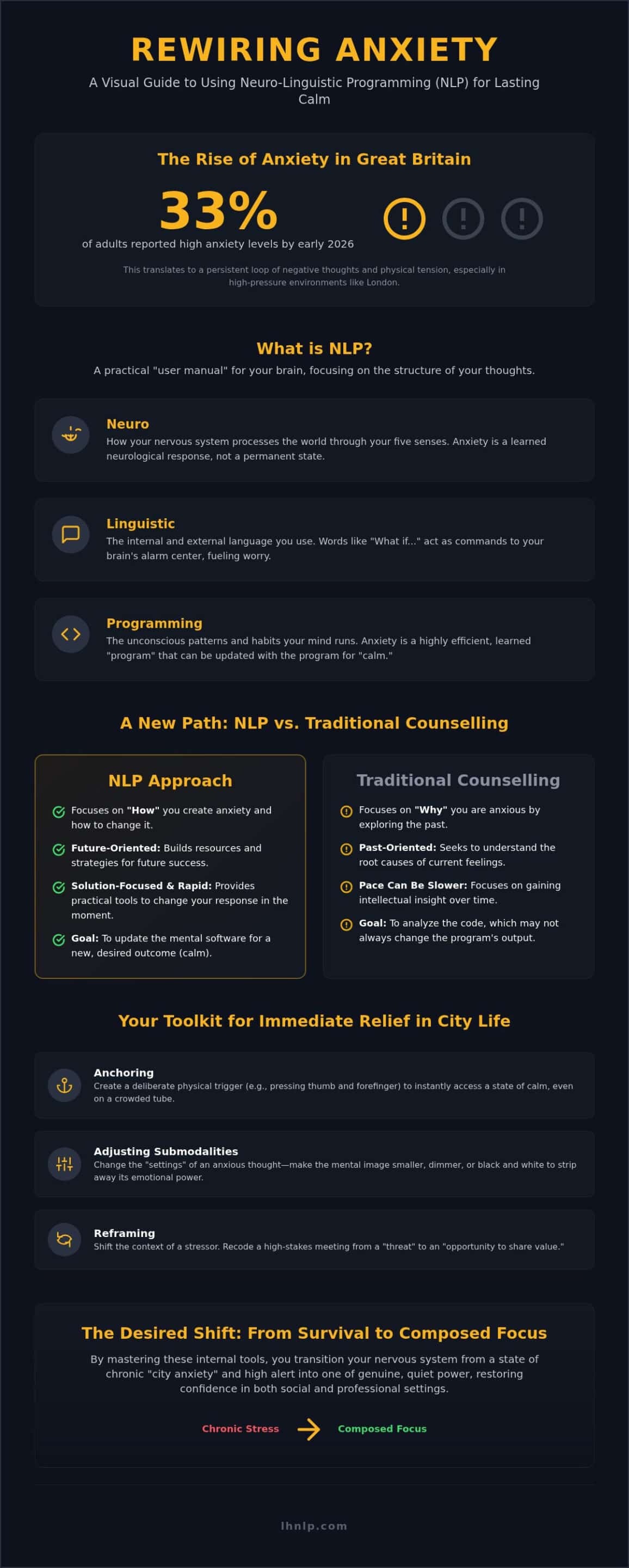
Did you know that by early 2026, 33% of adults in Great Britain reported high levels of anxiety? In the relentless, high-stakes pulse of the capital, this weight often manifests as a persistent loop of negative thoughts or physical tension that refuses to lift. If you’re searching for NLP for anxiety London, you likely understand that simply talking about the problem isn’t always enough to solve it. You might feel frustrated by the slow pace of traditional counselling; you want to feel like yourself again, without the palpitations or the constant mental fog.
I invite you to consider that your mind isn’t broken; it’s simply running an outdated program. By discovering how Neuro-Linguistic Programming can transform your relationship with these internal patterns, you can reclaim control of your life right here in the heart of the city. This article explores how to shift your internal dialogue for the long term while providing immediate techniques to manage panic. We’ll look at how this solution-focused approach restores your confidence in both social and professional settings, allowing you to move from a state of survival into one of genuine, quiet power.
Key Takeaways
- Understand how Neuro-Linguistic Programming acts as a practical “user manual” for your brain, allowing you to decode and rewrite the mental habits that fuel anxiety.
- Discover why choosing NLP for anxiety London provides a solution-focused, future-oriented path to relief that’s often faster and more intensive than traditional counselling.
- Learn specific techniques like anchoring and adjusting submodalities to create an immediate physical trigger for calm amidst the high-pressure environment of the capital.
- Explore how a bespoke, one-to-one approach helps you reclaim control over your internal dialogue and restore confidence in both professional and social settings.
- Identify the unique mechanics of “city anxiety” and how to transition your nervous system from a state of chronic stress into one of composed focus.
What is NLP for Anxiety? Decoding the Language of Your Mind
To understand how What is Neuro-Linguistic Programming (NLP) functions, it helps to view it as a practical user manual for the human brain. While many therapies focus on the content of your thoughts, NLP examines the structure of your excellence. It’s built upon a triad of influences that dictate how you experience the world:
- Neuro: How your nervous system processes information from the five senses.
- Linguistic: The verbal and non-verbal language you use to communicate with yourself.
- Programming: The habitual patterns and strategies you’ve developed to achieve specific results.
When you experience NLP for anxiety London, you begin to see that your anxiety isn’t a character flaw or a permanent state of being. Instead, it’s a programme that your mind has learned to run with incredible efficiency. Your brain is simply doing what it thinks is necessary to keep you safe, albeit in a way that currently feels restrictive. If your mind has the capacity to learn the complex programme of anxiety, it possesses the inherent ability to learn the programme of calm.
The ‘Linguistic’ Connection: How Your Words Fuel Worry
The words you whisper to yourself aren’t just idle thoughts; they’re commands that speak directly to your amygdala, the brain’s alarm centre. When you repeatedly ask, “What if everything goes wrong?”, you’re essentially telling your nervous system to prepare for a catastrophe that hasn’t happened. This creates a state of high alert. By shifting your internal dialogue to “How can I handle this?”, you move from a state of paralysis to a solution-oriented mindset. Internal coding is the subtle bridge that translates your abstract thoughts into tangible physical feelings.
Why Traditional Talk Therapy Often Stops Short
Many people arrive at our clinics feeling frustrated. They’ve spent months or years in traditional counselling, gaining a deep intellectual understanding of why they’re anxious. Yet, when the tube is crowded or a deadline looms, the panic still arrives. There’s a profound difference between understanding a problem and changing a response. While talk therapy often looks backward to find the “why”, NLP for anxiety London focuses on the “how”. It provides the practical tools to bridge the gap between knowing you shouldn’t be anxious and actually feeling calm in the moment. It’s about updating the software, not just analysing the code. You can find more about these solution-focused treatments and how they differ from standard approaches.
How NLP ‘Rewires’ the Anxious Response: The Mechanics of Change
If the mind is a high-speed computer, NLP provides the specific commands needed to update its operating system. When exploring NLP for anxiety London, we don’t just talk about the feeling of dread; we examine its precise structure. This involves working with ‘Submodalities’, which are the fine-grained building blocks of your mental experience. Is that anxious thought a large, bright, moving image right in front of your eyes? By consciously changing its size, making it black and white, or moving it into the distance, you strip away its emotional power. It’s a method supported by a review of clinical effectiveness, proving that how we represent our world internally dictates our physiological response.
Another vital tool is ‘Anchoring’. This allows you to create a deliberate physical trigger, like pressing your thumb and forefinger together, to instantly access a state of calm or resourcefulness. We also use ‘Reframing’ to shift the context of your stress. Instead of seeing a high-stakes meeting as a threat, we re-code it as an opportunity to share value. Crucially, these aren’t just treatments you receive passively. They’re skills you master during our work together, giving you a toolkit for life that stays with you long after you leave the clinic.
Interrupting the Pattern: Breaking the Panic Loop
Anxiety often feels like a runaway train, but every emotional state has a physical and mental pattern. NLP techniques ‘scramble’ the mental movie of a panic attack before it reaches its peak. If you change your posture, breathe into your belly, or look up at the ceiling, you physically interrupt the neural loop. It’s impossible for the brain to maintain a state of panic while the body is forced into a state of openness. By breaking the pattern early, you prevent the ‘fight or flight’ response from taking over your day.
Building New Neural Pathways for Confidence
Lasting change happens through the repetition of these mental exercises, creating a form of ‘muscle memory’ for your brain. We use ‘Future Pacing’ to mentally rehearse success in situations that used to trigger fear. By doing this, your mind learns that a different, more positive outcome is possible. This work often leads naturally into our Confidence Building Sessions, where we solidify these new habits. If you’re ready to start this process, you can explore our bespoke sessions to see how these mechanics apply to your unique story.
NLP vs. Counselling for Anxiety: Which Path is Right?
Choosing between therapeutic paths can feel overwhelming when you’re already drained by the weight of persistent stress. Traditional counselling often functions like archaeology; it digs deep into the layers of your past to uncover the root of your pain. While this historical perspective is valuable for some, many individuals seeking NLP for anxiety London find they’ve already spent years talking about their history without seeing a meaningful shift in their daily experience. NLP operates more like architecture. It focuses on the structure of your current thoughts and how to build a more resilient, calm future.
One of the most liberating aspects of this approach is its “content-free” nature. You don’t always have to recount every painful detail of a traumatic event to change how it affects you today. Because we focus on the process of how you’re thinking, rather than just the narrative of what happened, you can achieve profound shifts without feeling emotionally re-traumatised. This makes the process typically shorter and more intensive, providing a direct route to change for those who feel stuck in the “why” and are ready for the “how”.
When to Choose NLP for Rapid Relief
If you’re dealing with specific triggers like phobias, sudden panic attacks, or the paralyzing fear of public speaking, a solution-focused approach is often the most effective choice. These are structural issues in the mind that respond well to rapid reprogramming rather than months of open-ended talk. For those who need practical tools to use the moment they feel tension rising, NLP offers immediate, tangible results. For a deeper look at managing specific fears, our Phobia Treatment in London guide offers a comprehensive roadmap for overcoming these barriers.
Combining Hypnotherapy and NLP for Deep Change
While NLP provides the conscious tools to navigate your day, hypnotherapy speaks to the language of the subconscious. By bypassing the critical conscious filter, we can plant seeds of calm that grow naturally from within. The synergy between NLP’s structural changes and hypnotherapy’s subconscious suggestions creates a powerful environment for lasting behavioral change. This dual approach ensures that your logical mind and your deeper emotions are finally speaking the same language of peace. You can explore how these modalities work together in our Hypnotherapy London definitive guide.
Navigating London Stress: Practical NLP Tools for City Life
Living in London isn’t just a lifestyle choice; it’s a sensory marathon. The relentless pace of the Underground, the competitive atmosphere of the City, and the sheer volume of social interaction keep the nervous system in a state of chronic sympathetic arousal. This constant “fight or flight” mode is what many residents experience as a background hum of dread. When you seek NLP for anxiety London, you aren’t just looking for a theory. You’re looking for a way to turn down the volume of this urban noise. A local practitioner understands that your anxiety doesn’t happen in a vacuum. It happens at 8:30 AM on a delayed train or at 5:00 PM before a high-stakes board meeting.
We view Neuro-Linguistic Programming as a portable toolkit. These aren’t techniques that require a candle-lit room or an hour of silence to be effective. They’re subtle mental shifts you can perform while standing on a crowded platform or sitting in a boardroom. It’s about having the “user manual” for your brain accessible at all times, allowing you to regulate your state in real-time. By mastering these internal controls, you move from being a victim of your environment to being the architect of your own calm.
Managing Work-Related Stress in the Square Mile
After a high-pressure day in Tokenhouse Yard, your mind might still be racing with the day’s trades, emails, or missed deadlines. NLP helps you create a mental “airlock” that allows you to switch off the moment you leave the office. If you’re struggling with imposter syndrome, we work on changing the internal coding of that critical voice. Instead of a booming authority, we can transform it into something comical or distant, stripping away its power over your confidence. For more structured support, you can explore our Stress Management in London guide to begin reclaiming your evenings.
Social Anxiety and the London Social Scene
London can sometimes feel cold or indifferent, which often triggers a fear of being judged or rejected in social settings. We use reframing to help you see this perceived indifference as a canvas for your own confidence rather than a personal critique. If social gatherings cause physical symptoms like blushing or tension, NLP provides the physiological shifts to cool the system down instantly. This is particularly relevant for professional settings, where our Public Speaking Coaching helps you maintain composure and presence under the gaze of your peers. To start building your own urban toolkit, book a bespoke session in one of our central locations today.
Your Journey with London Hypnotherapy & NLP
Choosing NLP for anxiety London means entering a partnership with a guide who understands the intricate architecture of the human psyche. Kamalyn Kaur brings over 20 years of clinical experience to every session, blending deep empathy with a rigorous, solution-focused methodology. She acts as a bilingual translator between your conscious desires and your subconscious patterns, ensuring that change isn’t just a temporary relief but a fundamental shift in how you operate. Our philosophy rejects the idea of “one size fits all” scripts. Instead, we focus on bespoke, one-to-one clinical sessions that respect your unique history while prioritising your future freedom.
Our practice is designed to fit into the demanding schedules of London professionals. With locations in Harley Street, Ealing, and Tokenhouse Yard, support is always within reach. We don’t view you as a “patient” in need of fixing, but as an individual who currently lacks the right tools to manage their internal resources. As you progress through treatment, you’ll feel the transition from being overwhelmed by your thoughts to becoming the empowered director of your own mental state. You can learn more about our approach and the expertise behind it on our about us page.
What to Expect in Your First NLP Session
The first encounter is a vital foundation for your success. We dedicate this time to building rapport and clearly defining your goals; after all, your mind cannot hit a target it hasn’t identified. A typical session lasts between 50 and 60 minutes, moving rhythmically from deep insight into practical implementation. You’ll leave with “homework,” which consists of simple mental exercises designed to reinforce the new neural pathways we’ve initiated. These exercises ensure that the work continues to evolve between our meetings, turning the techniques into second nature.
Taking the First Step Toward Lasting Calm
If you’ve spent years feeling stuck in repetitive thought loops, it’s natural to feel a mix of hope and hesitation. We encourage you to listen to that quiet intuition suggesting that a different way of living is possible. For those who travel frequently or live outside the capital, we offer virtual hypnotherapy sessions via Zoom or Skype, providing the same clinical excellence from the comfort of your own space. Reclaiming your life from anxiety doesn’t have to be an endless struggle; it can be a methodical, supportive process of rediscovery. When you’re ready to begin, Book your consultation with London Hypnotherapy & NLP and take the first step toward a calmer, more confident version of yourself.
Step into a Life of Composed Focus
Anxiety often feels like an uninvited guest that has overstayed its welcome, but you possess the inherent power to change the internal locks. By choosing NLP for anxiety London, you move beyond the endless analysis of the past and into a practical, solution-focused future. You’ve discovered how the language of your mind can be updated to transform panic into presence, even amidst the relentless pace of the capital. Whether you’re navigating high-stakes meetings or the daily commute, these tools allow you to reclaim your internal landscape and restore your sense of agency.
With Kamalyn Kaur’s 20 plus years of clinical experience, our practice provides a highly personalised roadmap to change. From our central locations in Harley Street and Tokenhouse Yard, we offer the professional expertise needed to bridge the gap between where you are and where you wish to be. It’s time to trust your intuition and take that decisive step toward a quieter mind and a more confident life. Reclaim your calm—book a bespoke NLP session in London today. Your journey toward lasting internal peace is not just a possibility; it is a methodical process we are ready to begin together.
Frequently Asked Questions
Is NLP for anxiety safe and scientifically backed?
NLP is a safe, non-invasive approach that focuses on the mechanics of thought rather than medical intervention. While the profession is self-regulated in the UK, many practitioners adhere to strict ethical codes set by independent professional bodies. Clinical reviews have examined its effectiveness in treating various psychological barriers. It’s a supportive modality that empowers you to take charge of your mental processes without the side effects often associated with pharmaceutical options.
How many sessions of NLP will I need to see results for my anxiety?
Most individuals begin to experience a shift in their perspective within 1 to 3 sessions, though more complex anxiety patterns may require 6 to 10 meetings. The solution-focused nature of NLP for anxiety London means we don’t aim for years of talk therapy. Instead, we work intensively to install new mental habits. Your progress is monitored at every stage to ensure the techniques are becoming a natural part of your daily life.
Can NLP help with severe panic attacks or just general worry?
NLP is particularly effective for interrupting the physiological “runaway train” of a severe panic attack. By using pattern-interrupt techniques, you can stop the escalation of physical symptoms before they become overwhelming. For general worry, we focus on the linguistic loops that fuel chronic stress. Whether your anxiety is a sudden spike or a constant background hum, these structural tools provide a reliable way to restore internal balance and calm.
Do I need to stop taking my anxiety medication to start NLP therapy?
You don’t need to stop your medication to benefit from NLP. It’s a complementary approach that works alongside conventional medical treatments. However, it’s vital to remember that an NLP practitioner doesn’t provide psychiatric diagnoses or medical prescriptions. Any decisions regarding your medication should be made in close consultation with your GP or psychiatrist. NLP simply provides the mental skills to enhance your overall wellbeing while you manage your health.
What is the difference between NLP and CBT (Cognitive Behavioural Therapy)?
While both aim to change thought patterns, CBT primarily addresses the conscious relationship between thoughts, feelings, and behaviors. NLP goes a step further by working with the subconscious structure of your mental representations. We look at how your brain “codes” an experience, such as the size or brightness of a mental image. By changing these submodalities, we can often achieve faster shifts in your emotional response than through conscious logical reasoning alone.
Can NLP be done effectively over Zoom or Skype?
NLP is highly effective when conducted via Zoom or Skype, as the core of the work relies on language and sensory awareness. Kamalyn Kaur has extensive experience delivering virtual sessions to clients across the globe. As long as you have a quiet, private space where you won’t be interrupted, the techniques for NLP for anxiety London translate perfectly to a digital format. Many clients find they feel even more relaxed working from their own environment.
What if I can’t visualize things clearly; will NLP still work for me?
Visualization is only one of many tools we use, and the process will still work even if you don’t see clear mental images. NLP accounts for all sensory systems, including auditory and kinesthetic channels. If you’re more “feeling-based,” we’ll focus on the physical location of tension or the specific “voice” of your internal dialogue. We adapt every technique to match your unique way of processing information, ensuring the work remains deeply effective.
Is NLP therapy in London covered by private health insurance?
Coverage for NLP varies significantly between private health insurance providers in the UK. Some insurers will cover sessions if the practitioner is also a registered clinical hypnotherapist or a member of a recognized professional body. Since policies change frequently, it’s best to contact your insurance provider directly to check your specific level of cover. We can provide the necessary receipts and professional details to support your claim if your policy allows for it.