

What if the persistent noise in your mind isn’t a sign of failure, but an ancient survival mechanism that’s simply forgotten how to rest? When you lie awake at night with racing thoughts, it often feels as though you’ve lost the lead role in your own life story. With over 301 million people globally living with anxiety conditions in 2026, the search for mental clarity has never been more vital. Understanding how to stop worrying about the future requires more than just a fleeting desire for calm; it demands a methodically built bridge between your conscious intentions and your subconscious patterns.
It’s natural to feel overwhelmed when your brain fixates on potential threats as if they were present realities. You deserve a life defined by presence rather than a constant state of alert. We’ll explore why your mind creates these loops and provide professional techniques, from mindful grounding to subconscious retraining, to help you reclaim your peace of mind. This journey will offer you practical tools to stop a worry spiral and a deeper understanding of your internal landscape. You can move beyond the mental noise and step into a future where you feel grounded, capable, and finally free from the weight of anticipatory fear.
Key Takeaways
- Distinguish between productive preparation and the repetitive emotional dread of anticipatory anxiety to regain control over your mental energy.
- Understand your brain’s “Negative Prediction Engine” and why your subconscious mind mistakenly uses worry as a tool for survival.
- Master immediate sensory grounding techniques and the “Worry Window” method to learn how to stop worrying about the future during your daily routine.
- Discover how clinical hypnotherapy and NLP can bypass conscious resistance to update the mental “software” that triggers persistent fear.
- Identify the benefits of a personalised, solution-focused approach to reclaiming your presence through professional support in London.
Understanding Anticipatory Anxiety: Why Your Mind Fixates on the “What Ifs”
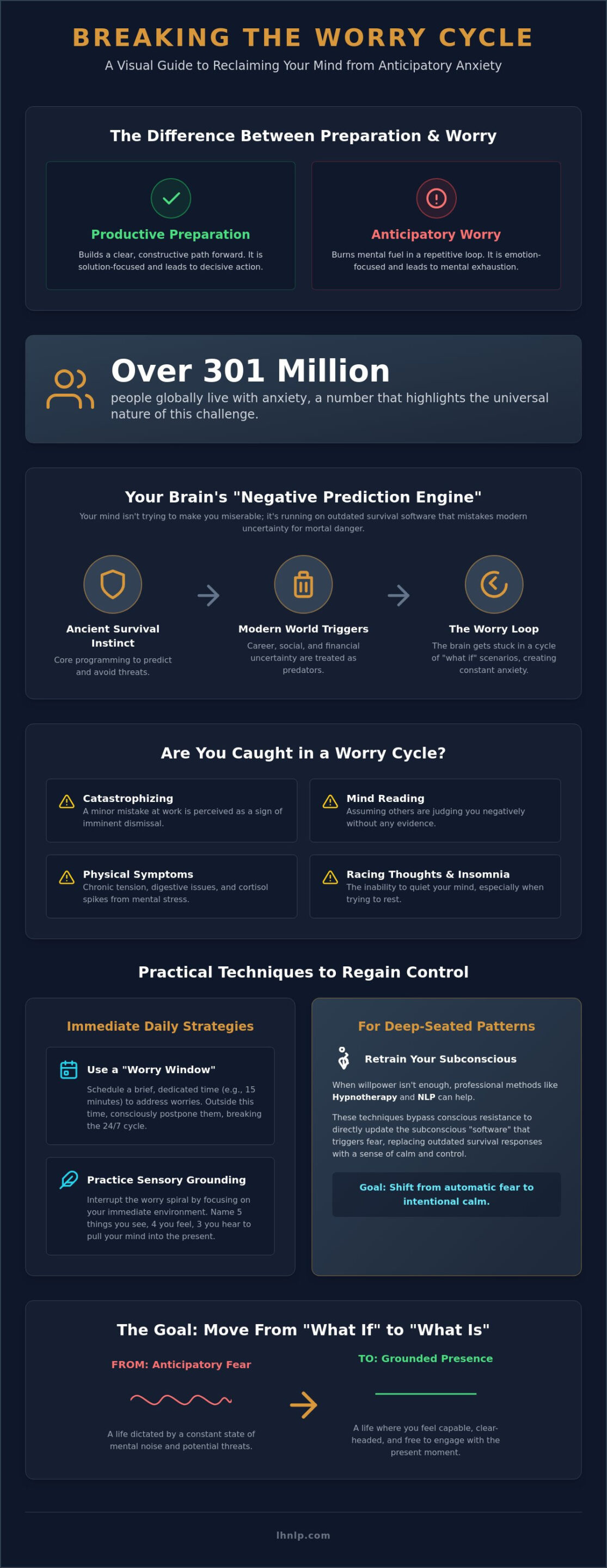
Anticipatory anxiety isn’t about what is happening in the present moment; it’s the emotional weight of a “maybe” that hasn’t yet arrived. While productive planning acts as a constructive map for the days ahead, worrying is like driving in a circle through thick fog. One builds a clear path; the other burns mental fuel without moving an inch. When you search for ways on how to stop worrying about the future, you’re essentially looking for a way to disengage the engine of this repetitive, exhausting mental rehearsal. It’s an attempt to find the “off” switch for a mind that has become a master of worst-case scenarios.
Our brains are essentially sophisticated prediction machines. In our ancestral past, predicting a predator’s movement or a change in the seasons saved lives. Today, that same ancient mechanism scans for modern threats like social rejection, financial instability, or career uncertainty. The modern world provides an endless stream of data for our survival instincts to misinterpret, leading to a state of constant, low-level alarm. Understanding Anticipatory Anxiety helps us realise that this dread isn’t a character flaw. It’s a biological process that’s simply lost its sense of proportion.
The Anatomy of a Future-Focused Fear
Future-focused fear thrives on loops. A single “what if” spawns a dozen branches, each leading to a darker conclusion than the last. While situational stress might appear before a specific event, chronic anticipatory anxiety is a pervasive background hum that colours every experience you have. It’s helpful to view it through this lens: anticipatory anxiety is a protective mechanism that has gone into overdrive, trying to solve problems that haven’t even occurred yet. This “pre-solving” rarely leads to solutions; it only leads to exhaustion.
Signs You Are Caught in a Worry Cycle
Do you find yourself “catastrophising,” where a minor misunderstanding at work becomes a sign of imminent dismissal? Perhaps you’re “mind reading,” assuming others are judging your every move before they’ve even spoken. These cognitive distortions aren’t just mental; they trigger real-world cortisol spikes that lead to physical tension, digestive issues, and the racing thoughts that cause insomnia. In the high-pressure environment of London, this cycle can quickly interfere with your ability to enjoy the very life you’re working so hard to secure. Recognising the point where your thoughts stop being helpful and start becoming a cage is the first step in learning how to stop worrying about the future effectively.
If you feel your mental noise has become unmanageable, exploring professional treatments can provide the clarity needed to break the cycle. The goal isn’t just to quiet the mind, but to retrain it to trust the present once again.
The Survival Mechanism: Why Your Brain Thinks Worrying Keeps You Safe
Your brain functions as a tireless architect of “worst-case” blueprints. It isn’t trying to make you miserable; it’s trying to ensure your survival through a process we call the Negative Prediction Engine. By attempting to pre-solve every possible problem, your mind believes it can shield you from the pain of surprise. This is why learning how to stop worrying about the future feels so difficult; you’re essentially asking your brain to stop doing what it thinks is its most vital job. It’s a protective reflex that has simply forgotten how to distinguish between a possibility and a probability.
To the subconscious mind, uncertainty is indistinguishable from a physical threat. It prefers a known negative outcome over an unknown possibility because the unknown cannot be defended against. This creates a seductive illusion of control. When you ruminate, it feels like you’re taking action. It feels like mental labor that might eventually produce a solution. In reality, this process only exhausts your internal resources, leaving you less prepared for the actual challenges of life. If you’re looking for practical steps on how to stop worrying, it begins with acknowledging that your mind is operating on outdated survival software.
The Amygdala and the Future
The amygdala, your brain’s primitive alarm system, is constantly scanning the horizon for predators. In our modern lives, these “predators” are often abstract, such as a difficult conversation or an uncertain financial outlook. Because the amygdala cannot distinguish between a vivid thought and a physical reality, it triggers a “false alarm” response. Your body reacts to a mental image of failure with the same intensity it would to a physical attack. This explains why logical reasoning often fails to quiet the storm; the alarm is sounding in a part of the brain that doesn’t speak the language of logic.
Why Willpower Alone Isn’t Enough
You’ve likely experienced the frustration of knowing a worry is irrational while still feeling the cold grip of fear in your chest. This happens because the prefrontal cortex, the seat of your conscious logic, has limited influence over the deeper, emotional regions of the brain during a perceived crisis. You can’t simply “will” an overactive survival instinct into silence. Instead of fighting your thoughts, the path to peace involves retraining the subconscious to recognise that uncertainty isn’t synonymous with danger. For those who find that self-help tools aren’t enough to break the cycle, professional Stress Management sessions can offer a structured way to recalibrate these deep-seated responses and help you discover how to stop worrying about the future for good.
Practical Daily Strategies to Quiet Future-Focused Fear
Shifting from a state of constant alert to a place of calm presence isn’t an overnight transformation, but a series of intentional, daily choices. While our previous discussion highlighted the biological roots of dread, the path forward involves implementing methods that bridge the gap between your anxious thoughts and your physical reality. One of the most effective ways to begin is through a “Control Audit.” This involves categorising your concerns into things you can directly influence and those you must learn to accept. By focusing your energy only on actionable items, you stop the leak of mental resources that fuels a worry spiral. Learning how to stop worrying about the future starts with this simple, yet profound, act of discernment.
Research from the American Psychological Association on anticipatory anxiety suggests that evidence-based coping strategies are essential for managing the cognitive roots of fear. These aren’t just mental exercises; they are tools that signal safety to your nervous system. For instance, using specific breathwork patterns can act as a physical anchor, slowing your heart rate and telling your primitive brain that there is no immediate predator to flee. When your body feels safe, your mind naturally follows.
Mastering the “Worry Window” Technique
Setting boundaries with your own mind can feel counterintuitive, yet it’s incredibly liberating. The “Worry Window” technique involves allocating a specific fifteen-minute block each day, perhaps at 5:00 PM, to engage with your fears. When a worry arises outside this time, acknowledge it and mentally “postpone” it to your window. Writing these thoughts down is crucial; it externalises the noise, moving it from the abstract space of your mind onto a tangible piece of paper. Once the window closes, pivot immediately into a productive or engaging activity. This prevents the fear from bleeding into your entire day and helps you master how to stop worrying about the future by containing the chaos.
Grounding Yourself in the Present Moment
When the mind wanders into a dark future, sensory grounding pulls it back to the “here and now.” The 5-4-3-2-1 technique is a powerful way to re-engage with reality: identify five things you see, four you can touch, three you hear, two you smell, and one you can taste. Beyond this, you can use NLP-based anchoring by touching a specific point on your wrist whenever you feel calm, eventually creating a physical trigger for peace. Movement also plays a vital role. A simple walk or a shift in posture can break a mental loop. If you find these daily practices challenging to maintain alone, our NLP Coaching can help you refine these techniques into permanent habits.
Beyond Willpower: Using Hypnotherapy and NLP to Retrain Your Subconscious
Willpower is a finite resource. If you’ve been struggling with how to stop worrying about the future, you’ve likely discovered that conscious effort alone often falls short. It’s like trying to hold back the tide with your hands; eventually, the waves of anxiety simply wash over your best intentions. This is because the habit of worry is stored in the subconscious, a part of the mind that operates far below the surface of logical thought. To achieve lasting peace, we must go beyond the “thinking” brain and address the “feeling” brain directly, using methods that speak its language of imagery and emotion.
Clinical Hypnotherapy and Neuro-Linguistic Programming (NLP) offer a sophisticated way to do exactly this. Instead of fighting your thoughts, these tools allow you to update the mental “software” that triggers the worry cycle. By working with a professional practitioner, you can replace the old “Negative Prediction” habit with a state of “Calm Readiness.” This shift doesn’t mean you ignore the future; it means you develop the inner confidence to handle whatever it brings, without the need for constant, exhausting mental rehearsal.
How Hypnosis Calms the Future-Focused Mind
Hypnosis is a state of relaxed, focused attention that allows the mind to become more receptive to positive change. It bypasses the “critical factor,” the mental filter that often rejects new ideas because they don’t match our existing fears. During a session, you remain in complete control; hypnosis is a collaborative process where you and the therapist work together to plant seeds of calm. For those who cannot visit our London clinics, Virtual Hypnotherapy Sessions provide the same level of professional support from the comfort of your own home, ensuring that distance is never a barrier to your progress.
NLP Techniques for Rapid Anxiety Relief
NLP serves as a manual for the mind, teaching you how to change the structure of your thoughts. One powerful tool is “Reframing,” which involves changing the meaning of uncertainty from a “danger” to a “possibility.” Another is the “Swish” pattern, a technique that trains the brain to automatically divert from a distressing worry image to a calm, resourceful one. These aren’t just temporary fixes; they are skills that build a long-term toolkit for the client. When you master these shifts, you finally understand how to stop worrying about the future by retraining your brain’s natural response to the unknown.
If you’re ready to move beyond the limitations of willpower and experience a deeper level of change, contact us today to discuss how a personalised plan can help you reclaim your peace of mind.
Reclaiming Your Present: Starting Your Journey with London Hypnotherapy & NLP
Reclaiming the present requires a decisive shift from theory to action. In a fast-paced city like London, the mental noise of anticipatory anxiety can feel amplified by the constant movement and high expectations of professional life. Generic advice often fails because it doesn’t account for these specific, high-pressure contexts. By choosing a personalised, solution-focused approach, you address your unique worry patterns rather than just managing the surface-level symptoms. Understanding how to stop worrying about the future becomes a practical reality when you have a dedicated partner to guide you through the methodical process of neurological change.
Kamalyn Kaur’s expertise lies in creating a bespoke therapeutic blend of NLP and Hypnotherapy. This isn’t a “one size fits all” model. Instead, it’s a rhythmic journey that respects your individual history and your specific goals for the future. By combining the cognitive restructuring of NLP with the deep relaxation and subconscious access of hypnotherapy, you can move from a state of constant dread to one of quiet empowerment. This partnership is built on trust and a mutual belief that belső change is not just possible, but inevitable when the right methods are applied.
Your Path to Relief in London
For busy professionals navigating the demands of the capital, convenience is as important as clinical excellence. We provide support through our London clinics located in Harley Street, Ealing, and Tokenhouse Yard, offering a sanctuary of calm within the heart of the city. If you’re ready to explore Therapy for Anxiety in London, the process starts with a simple, focused conversation. Booking an initial consultation allows us to map out your specific triggers and design a path that leads away from the “what ifs” and back to the “here and now.” This is where your narrative changes from one of fear to one of control.
A Future Without Constant Worry
Imagine waking up without the immediate weight of a racing mind. When you finally master how to stop worrying about the future, you gain more than just peace; you reclaim your sleep, your focus, and your emotional resilience. You can find out more About Us and Kamal’s extensive experience in helping clients navigate these complex internal landscapes. This journey is about moving beyond the noise to find the mental clarity that has always been within you. Don’t spend another day simply managing your symptoms. Address the cause, mobilise your inner resources, and step into a future defined by presence rather than apprehension.
Stepping Into a Future of Presence
The weight of a future that hasn’t happened yet can feel like an impossible burden to carry alone. We’ve explored how your brain’s survival instincts can misfire, creating a cycle of dread that willpower alone cannot break. By integrating practical daily grounding with the deep, subconscious shifts offered by NLP and clinical hypnotherapy, you can finally quiet the mental noise. Learning how to stop worrying about the future isn’t about ignoring life’s uncertainties; it’s about building the internal resilience to meet them with a clear and focused mind.
You don’t have to navigate this transition without support. With over 20 years of experience as an accredited NLP and hypnotherapy specialist, Kamalyn Kaur provides a methodically built bridge to your new narrative. Practising from prestigious London locations, including Harley Street, Ealing, and Tokenhouse Yard, we offer the expert guidance needed to move from a state of alert to a state of empowerment. Book a consultation to stop future-focused worry today and begin the journey toward a quieter, more present life. Your peace of mind is waiting.
Frequently Asked Questions
Is it possible to actually stop worrying about the future entirely?
It isn’t possible, nor is it desirable, to eliminate all thought of the future, as a certain level of anticipation is necessary for effective planning. However, you can certainly learn how to stop worrying about the future in a way that is destructive or paralysing. The goal is to move from chronic dread to a state of “calm readiness” where you can look ahead without being emotionally overwhelmed.
How is hypnotherapy different from just “positive thinking”?
Positive thinking is a conscious effort that often fails when faced with deep-seated subconscious fears. Hypnotherapy is a professional therapeutic method that bypasses the “critical factor” of the mind to speak directly to the subconscious. It allows for the retraining of automatic emotional responses rather than just layering optimistic thoughts over a foundation of persistent anxiety.
Can NLP help with physical symptoms of anxiety like a racing heart?
NLP can effectively address physical symptoms by identifying and changing the mental triggers that initiate the body’s fight-or-flight response. When you change how your mind perceives a future event, your nervous system no longer feels the need to signal danger through a racing heart or shallow breathing. These tools provide a way to physically “reset” your state in real-time.
How many sessions are usually needed to see a change in worry habits?
Most clients begin to notice significant shifts in their emotional resilience within three to six sessions. When learning how to stop worrying about the future through these methods, the focus is on creating rapid, sustainable change. This solution-focused approach is designed to provide you with a permanent toolkit rather than creating long-term dependency, allowing you to move forward with confidence.
Is worrying about the future a sign of a more serious anxiety disorder?
Can I do hypnotherapy for anxiety online or do I need to be in London?
You can absolutely experience the benefits of hypnotherapy through Virtual Hypnotherapy Sessions from anywhere in the world. While we have prestigious clinics in Harley Street and Ealing, the effectiveness of the treatment depends on the quality of the therapeutic relationship and the techniques used, not your physical location. Online sessions offer a convenient way to receive professional support in a familiar environment.
What is the difference between “normal” worry and anticipatory anxiety?
“Normal” worry is usually tied to a specific, solvable problem and often leads to a concrete action or a plan. Anticipatory anxiety, however, is a pervasive sense of dread about events that haven’t happened and may never happen. It tends to be repetitive and paralysing, focusing on the feeling of fear rather than the practicalities of the situation.
Is hypnotherapy safe for people who feel they need to stay in control?
Hypnotherapy is a safe and collaborative process where you remain in total control at all times. You cannot be made to do or say anything against your will; instead, the therapist acts as a guide to help you access your own inner resources. For many, the experience actually increases their sense of self-control by quieting the “autopilot” of anxious thoughts that previously felt unmanageable.