

A lift can feel threatening even when the journey is brief and familiar. Hypnosis for fear of lifts (elevators) in London can help you explore the response behind that fear and practise approaching lift-related thoughts with greater calm. An initial consultation helps shape a tailored approach and determine how many sessions may be appropriate.
Fear of lifts may be linked to claustrophobia, fear of heights, a distressing experience or a learned alarm response. The fear is real, even if other people do not understand it, and anxiety or physical sensations may arise before you reach the lift. Identifying what triggers your response is a useful starting point.
This article explains how phobias and fear of heights can contribute to lift anxiety, how imagined exposure in hypnosis can explore learned responses, and what an initial consultation may cover. Session planning is individual, allowing the process to reflect your experience and the changes you want to make.
Key Takeaways
- Recognise how earlier experiences, claustrophobia and learned alarm responses may shape lift anxiety, so its triggers are easier to discuss in a consultation.
- Understand how fear of heights can intensify lift-related distress, including through physical sensations that arise when a height is anticipated.
- Explore how hypnosis may use imagined, gradual exposure to help practise a calmer response to lifts in a safe setting.
- Learn why session planning is individual and how an initial consultation can help clarify your goals and the approach that may suit them.
Exploring underlying causes of phobias
Lift phobia can involve learned fear, past experience or another anxiety trigger. Understanding the pattern helps shape an approach relevant to you.
Possible Origins of Phobias
A phobia is an intense fear response linked to a particular object or situation, sometimes shaped by experience or anticipation. Fear is protective, but its alarm can outweigh attempts to reason it away. For example, a difficult lift journey may become associated with feeling trapped, even if later journeys go smoothly. Identifying that association helps clarify what the fear means to you and what a therapy approach could address.
Elevator Fear as a Phobia
Fear of elevators may be phobic when the lift itself, or even the thought of using one, causes intense distress or avoidance. The trigger might be an enclosed space, loss of control, being stuck or the height of a building. These concerns can overlap, but they are not identical: someone may fear lifts without fearing heights. Naming the specific trigger helps clarify your experience and focus therapy on situations that matter in daily life.
If you are considering hypnotherapy for phobias in London, an initial consultation can explore your triggers, previous experiences and the changes you want. This conversation helps determine how many sessions may be appropriate, so planning reflects your circumstances rather than a standard session count.
Hypnosis requires your willingness to pay attention and engage with the process. If you feel pressured, uneasy or overwhelmed during a session, say so and pause to discuss what feels manageable. Raise any concerns about suitability before beginning. An open conversation helps establish whether this approach feels right for you.
Fear of heights when using a lift
A lift can bring height anxiety into an enclosed space, particularly when you know it’s travelling above street level. Acrophobia means an extreme, persistent fear of heights and related situations. The lift may therefore trigger distress even without a view from a window: anticipation of rising can be enough to activate the fear.
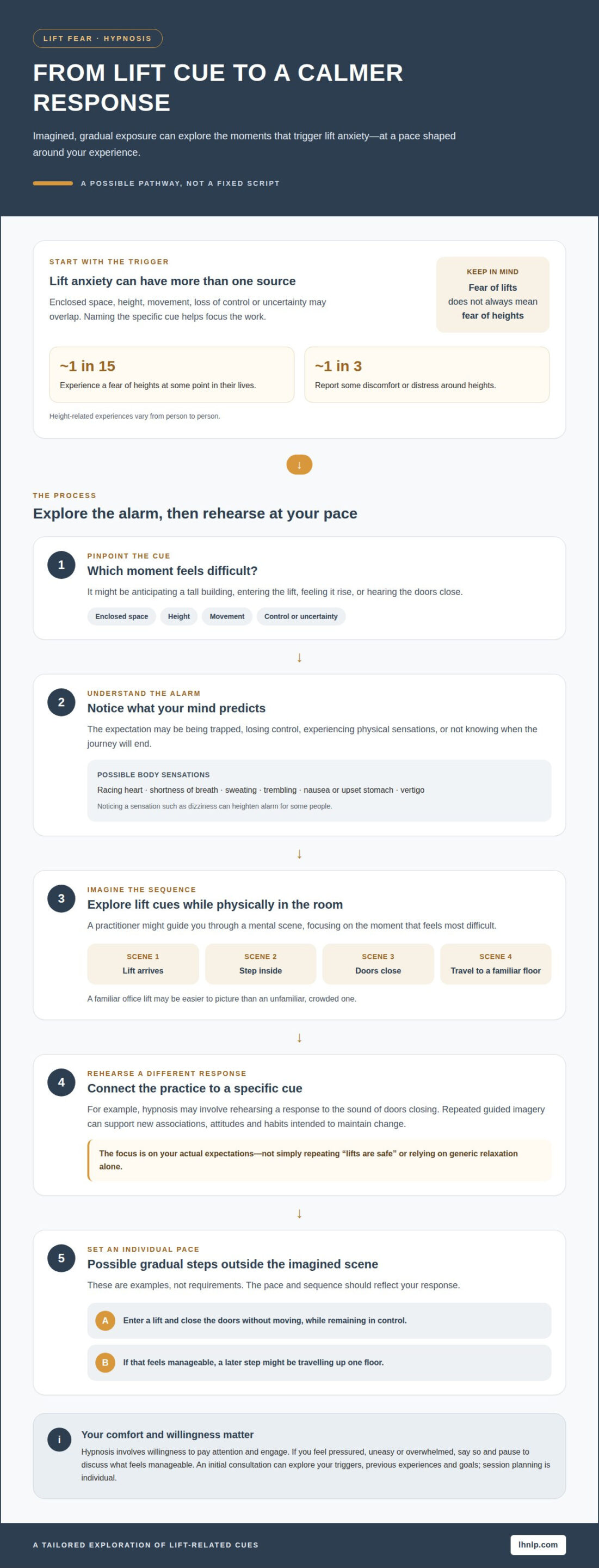
Height-related distress is not unusual. Roughly one in 15 people experience a fear of heights at some point in their lives, while about one in three report some discomfort or distress around heights. These experiences vary. For one person, a lift to a tall building feels manageable; for another, even anticipating that journey can make it difficult to enter.
When someone with acrophobia faces or anticipates heights, the sympathetic nervous system may respond as though the body is preparing for an emergency. Possible sensations include a racing heart, shortness of breath, sweating, trembling, nausea, an upset stomach or vertigo. In a lift, noticing one sensation, such as dizziness, can heighten alarm and make the journey feel harder.
A gradual approach can make a feared situation more specific and manageable. One possible first step is entering a lift and closing the doors without moving, while remaining in control. If that feels manageable, a later step might be travelling up one floor. These are examples, not requirements: the pace and sequence should reflect your response.
On a lift journey to a high floor, the trigger could be height, enclosed space, movement or uncertainty about control. Separating these concerns helps clarify what needs attention. Someone who fears looking down from a height may respond differently from someone whose distress centres on being inside a closed lift.
Discussing the exact situation, such as entering a lift, feeling it rise or anticipating a tall building, can help focus a professional conversation. Explore treatment approaches suited to the concerns you want to address.
Hypnosis and subconscious responses to elevators
Lift fear can begin as an automatic alarm: the doors close, movement starts and the mind anticipates danger before deliberate reasoning catches up. Hypnotherapy uses focused attention during hypnosis to explore that learned response. The aim is to help the subconscious associate elevator cues with a calmer pattern, rather than treating fear as a choice or personal failing.
Imagined gradual exposure offers one way to explore those cues in a consulting room. A practitioner might guide you to picture a lift arriving, stepping inside, hearing the doors close and travelling to a familiar floor. You remain physically in the room, while the mental sequence places the response in a safer context. The imagery can focus on the particular moment that feels difficult.
This process is not simply repeating “lifts are safe” until anxiety disappears. The useful detail is what your mind predicts: being trapped, losing control, experiencing physical sensations or not knowing when the journey will end. Exploring those expectations can help shape imagery around your experience. For example, a familiar office lift may be easier to picture than an unfamiliar, crowded one.
Hypnosis may also help you rehearse a different response to a specific cue, such as the sound of doors closing. Repeating a guided mental scene can support new associations, attitudes and habits intended to maintain change. If you are considering hypnosis in London for fear of lifts (elevators), this work can focus on the cues that matter to you. Some people notice a shift later, when using a lift without their usual anxious anticipation.
The practical point is that subconscious work should connect with real elevator triggers, not rely on generic relaxation alone. A plan for hypnosis in London for fear of lifts (elevators) can consider movement, enclosed space, destination and thoughts before entry. This makes the imagined sequence more personally relevant, while keeping the pace responsive to what you can engage with. Hypnosis works with attention and meaning, not by taking control away from you.
How effective is hypnotherapy for lift phobia, and what evidence supports it?
Assess effectiveness in terms of the change you want in a specific lift situation. Progress might mean entering a familiar lift, tolerating the doors closing or making a journey you previously avoided. These practical outcomes make the goal clearer than a vague aim to “feel better”. Hypnosis can be part of a personalised approach, but responses and session needs vary.
Hypnosis can pair focused attention with imagined exposure to a feared situation. A guided scene might rehearse entering a lift and travelling to a familiar floor while exploring the thoughts attached to that moment. This offers a way to practise a different response in the consulting room. It does not mean that everyone will respond or that improvement will happen immediately.
Phobia care also includes Cognitive Behavioural Therapy and systematic desensitisation. These approaches address fear through professional techniques, with desensitisation using gradual exposure in a safe, controlled environment. Neuro-Linguistic Programming is another professional technique that may help people overcome phobias. When comparing approaches, consider what each involves and whether it addresses your particular triggers.
A useful way to assess change is to discuss specific situations before and during the programme. Does anticipation still lead you to avoid a lift? Can you approach the doors with less distress? Has a journey become more manageable? These examples connect therapy goals with daily life, rather than relying only on a general impression after a session.
Consultation helps establish the goals and how many hypnosis sessions may be appropriate. Commitment to change, attention and willingness to follow the process also matter. Tools from a personalised programme can help establish habits, attitudes and beliefs intended to maintain results. For an informed discussion of your situation and goals, contact the practice about lift phobia.
London Hypnotherapy & NLP
London Hypnotherapy & NLP can help you explore the thoughts and responses connected with lift-related fear, then shape a focused approach around your experience. An initial consultation gives you space to discuss triggers, previous experiences and what you would like to change. It also helps determine how many hypnosis sessions may be appropriate.
Hypnotherapy for Anxiety may be relevant if lift distress is part of a wider pattern of anxiety. NLP Coaching can also support work on your personal responses and goals. The focus is practical: understand what makes lift journeys difficult and consider a suitable way forward, without assuming the same process fits everyone.
If you’re ready to discuss your concerns, contact London Hypnotherapy & NLP to arrange a conversation.
Choose a first step that feels meaningful
Progress can start with a clear personal aim, such as reaching a workplace meeting without avoiding the lift journey. That goal gives a future conversation direction: not simply “remove the fear”, but understand what greater freedom would look like in everyday life. For hypnosis for fear of lifts (elevators) in London, a useful starting point is an honest account of the situations you want to approach differently.
You do not need to arrive with a perfect explanation or a complete plan. A first conversation can help you put the concern into words and consider a suitable way forward, at a pace that respects your experience. Small, clearly defined intentions can make change feel more manageable.
If you’re ready to explore that next step, contact London Hypnotherapy & NLP and share what you’d like to change. A more comfortable relationship with lift journeys can start with one thoughtful conversation.
Frequently Asked Questions
Which hypnotherapists in London specialise in fear of lifts or elevator phobia?
In London, Kamal at London Hypnotherapy & NLP provides personalised support for phobias. The practice offers Phobia Treatment, making it relevant if lift journeys cause distress. Discuss how an initial consultation can explore your particular triggers, such as anticipating a journey or worrying about becoming stuck, and use those details to shape an approach suited to your goals.
How many hypnotherapy sessions are typically needed for fear of lifts?
There is no standard session count for lift phobia. An initial consultation helps determine an appropriate plan, taking account of your goals, the intensity of your fear and your response to the work. The guidance of three to six sessions applies to smoking cessation or mild anxiety, not specifically to lift phobia, so it is not an estimate for this concern.
What happens during hypnosis treatment for elevator phobia?
A session can begin by discussing the elevator situations you find difficult and what you want to approach differently. Guided hypnosis may then use focused attention and relevant imagery to explore your response. At London Hypnotherapy & NLP, individual clinical sessions last one hour. You remain fully aware and in control, can reject suggestions and can end the session at any time.
Can hypnotherapy be done online or in person in London for lift anxiety?
Yes. London Hypnotherapy & NLP offers in-person sessions at 96 Harley St, London W1G 7HY, and online consultations via Zoom or Skype. The practice states that online hypnotherapy can be as beneficial as face-to-face sessions. Consider which format feels more comfortable for discussing your lift anxiety and engaging with a tailored session.
What should clients consider when choosing and booking a reputable London hypnotherapist for fear of lifts?
Look for a practitioner who can discuss phobias, explain how sessions will be tailored, and respect your control throughout hypnosis. For an enquiry with London Hypnotherapy & NLP, call 020 3393 1094 or 07711 285 414, or email info@lhnlp.com. You can describe the lift situations affecting you and ask how an initial consultation can inform session planning.
What are the risks, side effects, or reasons to avoid hypnotherapy?
Hypnosis requires your willingness to engage. If you feel pressured, uneasy or overwhelmed, pause and discuss what feels manageable. Raise concerns about suitability before beginning.