

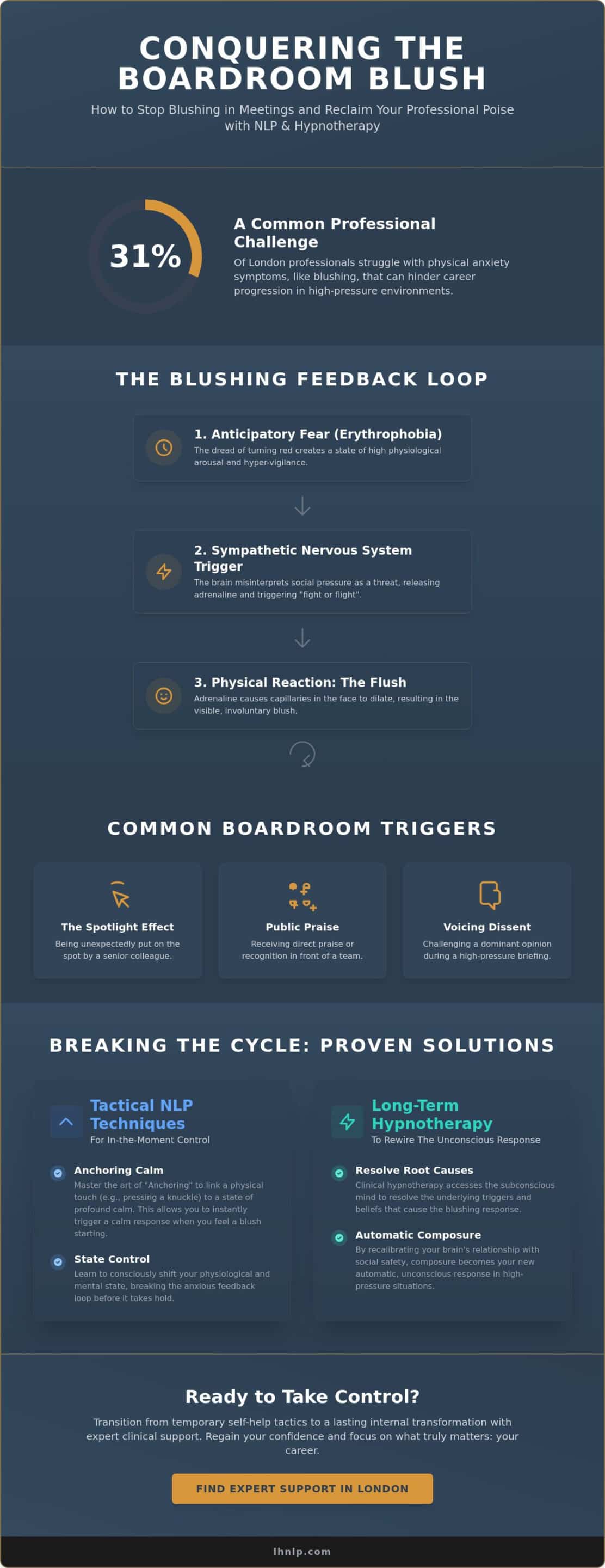
Imagine sitting in a glass-walled boardroom in Canary Wharf, the air conditioning humming at a steady 19 degrees, yet you feel a wave of heat rising from your collar that has nothing to do with the room temperature. It’s that familiar, unwelcome flush that makes you feel instantly exposed, as if your internal discomfort is being broadcast to every colleague at the table. You aren’t alone in this experience; in fact, 2025 workplace data suggests that 31% of London professionals struggle with physical anxiety symptoms that hinder their career progression. Learning how to stop blushing in meetings isn’t just about hiding a physical reaction; it’s about reclaiming your seat at the table without the fear of your own physiology betraying your expertise.
You likely feel that once the heat starts, there’s no turning back, and this anticipation often creates a self-fulfilling cycle of anxiety that leads to avoiding high-visibility tasks. This guide will show you how to break that loop using proven NLP state control and hypnotherapy techniques designed for the high-pressure environments of the City. We’ll explore how to anchor calm responses and reframe your unconscious triggers so you can maintain a neutral complexion and professional poise. You’ll discover a methodical process to transform your boardroom presence and finally move past the fear of blushing for good.
Key Takeaways
- Understand how the high-pressure environments of London’s financial districts trigger the “spotlight effect” and learn to navigate your nervous system’s response with grace.
- Master the art of NLP “Anchoring” to find out how to stop blushing in meetings, allowing you to project confidence even in the most demanding boardroom settings.
- Gain insight into the neurological triggers behind the facial flush, transforming a source of frustration into a clear understanding of your body’s biological mechanisms.
- Discover how clinical hypnotherapy reaches the subconscious level to resolve the root causes of blushing, offering a path to long-term composure and relief.
- Recognize the value of transitioning from self-help to expert clinical support available across London to facilitate a profound and lasting internal transformation.
Understanding the “London Meeting” Blushing Cycle
Blushing is rarely just a physical reaction; it is a profound communication from your nervous system. In a professional context, that sudden warmth spreading across your cheeks represents a hyper-active sympathetic nervous system response. Your body has misidentified a social situation as a survival threat, triggering the “fight or flight” mechanism. The Science of Blushing suggests that this involuntary vasodilation occurs when we feel our private emotions are being exposed to the public eye. For a professional in The City or Canary Wharf, this internal surge can feel like a betrayal by one’s own biology.
The high-stakes environments of London’s financial and legal districts exacerbate what psychologists call the “spotlight effect.” When you are presenting a quarterly forecast or defending a strategy, the pressure to remain stoic is immense. This creates a psychological paradox: the more value you place on appearing unflappable, the more your brain monitors for signs of weakness. Understanding how to stop blushing in meetings starts with acknowledging that your blush is actually a protective mechanism that has become over-calibrated for the modern boardroom.
To better understand this concept, watch this helpful video:
The Spotlight Effect in the Boardroom
The brain often overestimates how much others notice a facial flush. While you might feel as though your face is glowing like a London bus, colleagues are usually focused on their own agendas, notes, or internal anxieties. The “London professional” persona demands a level of composure that makes any sign of vulnerability feel magnified. Common triggers in these settings include:
- Being unexpectedly put on the spot by a senior partner.
- Receiving direct praise in front of a large team.
- Challenging a dominant opinion during a high-pressure briefing.
Erythrophobia: When the Fear Becomes the Problem
For many, the primary issue isn’t the blush itself, but Erythrophobia, which is the specific fear of blushing. This creates a debilitating feedback loop. The dread of turning red creates a state of high physiological arousal, which then triggers the very blush you were trying to avoid. To break this cycle, one must address the underlying unconscious processes that maintain this state of hyper-vigilance. Erythrophobia is a self-fulfilling prophecy of the autonomic nervous system where the anticipation of a physical response ensures its occurrence. When you learn how to stop blushing in meetings, you aren’t just fighting a physical symptom; you are recalibrating your brain’s relationship with social safety.
The Science of Why Your Brain Triggers the Flush
Understanding why your face burns during a board report requires looking beneath the skin at the hypothalamus. This small region acts as your brain’s command centre for survival. When you’re sitting in a boardroom and all eyes turn to you, your hypothalamus may misinterpret the social pressure as a physical threat. It triggers the sympathetic nervous system, releasing a surge of adrenaline that causes the capillaries in your face to dilate instantly. While some individuals possess a genetic predisposition toward more visible flushing due to a higher density of surface blood vessels, the mechanism remains the same. It’s a “fight or flight” response occurring in a space where you can do neither.
Distinguishing between medical flushing and psychological blushing is vital for progress. Medical conditions like rosacea or reactions to medication are often persistent or triggered by physical heat. In contrast, the professional blush is situational and rapid. It’s an involuntary signal of social transparency. According to psychological research on blushing, this response is unique to humans because it serves as an “appeasement signal.” It tells the group you care about their opinion, even if your conscious mind just wants the ground to swallow you whole.
The Autonomic Nervous System and Meetings
In the high-pressure environments of the City or Canary Wharf, your nervous system is often already “primed” before the meeting even starts. Reports from 2024 on urban stress suggest that the cortisol spike from a delayed London commute combined with the capital’s heavy caffeine culture creates a high stress baseline. When you walk into a presentation with three espressos in your system, your sympathetic nervous system is on a hair-trigger. Trying to use sheer willpower to suppress the heat is often what keeps the cycle alive. This “ironic process” means that the more you focus on how to stop blushing in meetings, the more your brain monitors for the blush, which keeps the adrenaline flowing and the vessels dilated.
Subconscious Associations with “Exposure”
Your subconscious mind doesn’t always distinguish between a predator in the wild and a critical stakeholder in a modern office. It links being the centre of attention with being “exposed” and vulnerable. For many, these reactions are rooted in “micro-traumas” from earlier in life. Perhaps you were teased during a school play or felt humiliated by a teacher’s comment years ago. Your adult brain still carries those emotional imprints, reacting to a modern meeting as if it were that same dangerous environment.
Breaking this link requires more than just “thinking positive.” It involves retraining the unconscious associations that trigger the flush. This is where specialized anxiety therapy London professionals focus their work, helping you decouple the “attention” from the “danger” response. By addressing these root causes through NLP and state control, you can begin to transform your internal landscape. If you’re curious about how these patterns formed in your own life, you might find it helpful to reach out for a professional perspective on your specific triggers.
Tactical NLP Techniques to Stop Blushing in the Moment
Think of Neuro-Linguistic Programming as a sophisticated software update for your subconscious mind. While your body might be stuck in an old loop of physiological reactivity, NLP provides the tools to overwrite these patterns in real time. Learning how to stop blushing in meetings isn’t about suppressing your biology; it’s about redirecting your mental energy. By understanding the causes and treatments for blushing, we see that the response is often a “misfire” of the sympathetic nervous system. NLP allows you to step into the control room of that system.
Anchoring Calm: Your Secret Boardroom Tool
Anchoring is a foundational NLP technique that creates a physical “button” for an emotional state. It allows you to access composure on demand, even when the spotlight feels uncomfortably bright. To make this effective, you must build the anchor when you’re already relaxed, long before you enter the office.
- Identify the State: Close your eyes and recall a moment when you felt utterly confident and “bulletproof.”
- Intensify the Feeling: Make the mental image brighter and the sounds clearer until the feeling of calm reaches a peak.
- Set the Trigger: At that peak, press your thumb and middle finger together firmly for five seconds.
- Break and Repeat: Release the pressure, think of something neutral, and repeat the process ten times over a seven-day period to “set” the neurological association.
- Fire the Anchor: The moment you feel the first prickle of heat in your neck during a presentation, press those fingers together. Your brain will automatically seek the calm state you’ve wired into that gesture.
Dissociation and the Power of Reframing
When you’re in the thick of a meeting, your perspective is usually “associated,” meaning you’re seeing through your own eyes and feeling every surge of adrenaline. To break the cycle, try the Dissociation technique. Imagine stepping out of your body and watching the meeting from a corner of the ceiling. By observing yourself as a third party, the emotional intensity drops instantly. You aren’t the person blushing; you’re the calm observer watching a professional navigate a conversation.
You can also use “Reframing” to change the meaning of the physical sensation. Instead of telling yourself “I’m turning red and everyone can see,” reframe the heat as “performance energy.” That rush of blood is simply your body providing extra oxygen to your brain so you can think faster and respond with more precision. This shift in perspective prevents the “blush about blushing” feedback loop that often makes the redness worse.
Language Patterns and Internal Dialogue
The words you use internally dictate your physiological response. The brain struggles to process negatives; if you tell yourself “don’t turn red,” your mind must first conceptualise “turning red” to understand the command. This inadvertently triggers the very state you’re trying to avoid. Shift your internal command to a positive, present-state objective like “Stay cool, clear, and focused.”
NLP also utilises “Presuppositions.” Instead of wondering if you’ll blush, act on the presupposition that you’re already a composed communicator who handles pressure with ease. For professionals seeking a more tailored approach to these mental shifts, consulting an NLP practitioner London can provide bespoke anchoring strategies designed for the specific pressures of the UK corporate environment. Mastering how to stop blushing in meetings becomes much simpler when you stop fighting your body and start leading your mind.
Long-Term Resolution: How Hypnotherapy Rewires the Response
While breathing techniques offer immediate relief, achieving a permanent shift requires addressing the root cause within the subconscious mind. Blushing isn’t a choice; it’s an automated survival mechanism triggered by the autonomic nervous system. To truly master how to stop blushing in meetings, we must look beyond the physical heat and focus on the internal blueprint that dictates this response. Most professionals find that managing symptoms is exhausting, whereas resolving the trigger provides a sense of freedom that changes their entire career trajectory.
Clinical hypnotherapy London provides a structured pathway to this deeper level of the psyche. We use a process called regression to identify the Initial Sensitizing Event (ISE). This is typically a forgotten moment from earlier in life where your brain mistakenly associated being the center of attention with a threat. By neutralizing the emotional charge of that original event, the subconscious no longer feels the need to signal “danger” through a blush. We then transition to “Future Pacing,” a technique where you mentally rehearse upcoming high-stakes presentations while in a state of profound calm. This creates new neural pathways, making composure your default setting rather than a forced effort.
The Power of the Subconscious Suggestion
During a session, your therapist provides specific “coolness” suggestions that your subconscious accepts as a new reality. We might use metaphors of cool mountain air or a steady, temperate flow that keeps your facial temperature regulated. These are reinforced with post-hypnotic suggestions, which act as invisible anchors. If a colleague asks a challenging question, your system automatically recalls that state of calm. It’s important to remember that you remain fully aware and in control throughout the process. Hypnosis is a collaborative partnership, not a loss of agency, and you’ll find the experience deeply relaxing.
Building Unshakeable Professional Confidence
Resolving a blushing habit often acts as a catalyst for broader professional growth. When you finally understand how to stop blushing in meetings through neuro-linguistic programming and hypnosis, your leadership presence expands naturally. By integrating these shifts into confidence building sessions, we transform a perceived weakness into a source of inner strength. When you stop worrying about your skin tone, you can focus entirely on your message, leading to measurable improvements in public speaking and executive presence. Most deep-seated responses benefit from a multi-session approach to ensure the change is permanent and resilient against the pressures of the London corporate environment.
Ready to reclaim your presence in the boardroom? Book a consultation today to start your journey toward unshakeable composure.
Finding Expert Support for Blushing in London
While self-help strategies offer a temporary shield, they often fail to address the underlying neurological triggers that cause a sudden rush of heat during a high-stakes presentation. For a London professional, the path to long-term composure involves moving beyond surface-level tips to a clinical, evidence-based approach. We provide specialized support across the capital, with established clinics in Harley Street, Ealing, and Tokenhouse Yard. This ensures that expert help is accessible whether you are based in the West End or the heart of the City. If your schedule demands more flexibility, our virtual hypnotherapy sessions offer the same level of deep, transformative work from the privacy of your own office or home.
A professional intervention is superior because it targets the subconscious architecture of the blush. Instead of simply trying to “calm down” in the moment, we work to dismantle the automatic feedback loop between your thoughts and your nervous system. We invite you to a diagnostic consultation where we will map your specific triggers and create a structured roadmap for your change.
What to Expect in Your First London Session
Your journey begins with a detailed intake process focused on identifying the precise “when” and “where” of your blushing patterns. During sessions with Kamalyn Kaur, you won’t find generic advice. She tailors a sophisticated blend of NLP and Hypnotherapy specifically to the nuances of your corporate role. Whether you are navigating a merger or leading a creative pitch, the work is grounded in your real-world professional environment. Operating within the rigorous standards of a Harley Street-affiliated practice, we ensure your progress is handled with absolute confidentiality and clinical excellence.
Taking the First Step Toward Composure
It’s vital to recognize that chronic blushing isn’t a character flaw or a sign of social incompetence. It’s a habit of the nervous system that has become over-sensitized to professional pressure. Viewing this work as a professional development investment is a powerful shift in perspective. Just as you would hire a consultant to refine your strategy, you are now choosing to refine your internal state. Learning how to stop blushing in meetings is about reclaiming your boardroom presence and ensuring your expertise remains the focal point of every conversation. You don’t have to manage this alone. To begin your transformation, book a consultation with London Hypnotherapy & NLP and start the process of reclaiming your quiet confidence.
Reclaim Your Presence in the Boardroom
Blushing doesn’t have to be the defining feature of your professional identity. By understanding the biological “London Meeting” cycle and applying tactical NLP state control, you can regain command of your physical response. Real change happens when we address the subconscious triggers that cause the flush, moving beyond temporary fixes toward a permanent sense of composure. With over 20 years of experience in clinical hypnotherapy and NLP, I’ve developed bespoke treatment plans specifically for high-performing professionals who need to maintain their edge.
Whether you’re presenting to a board in Harley Street or leading a team in the City, you can learn how to stop blushing in meetings through a methodical, supportive process. My approach combines the precision of state control with the deep rewiring of the subconscious, ensuring your inner calm matches your outer expertise. You’ve already explored the science behind the flush; the next step is to anchor that knowledge into your daily professional life.
Book your initial consultation in London or via Zoom to begin this transformation. You possess the internal resources to change, and with the right guidance, you’ll soon find that the heat of the moment no longer holds power over you.
Frequently Asked Questions
Is it possible to completely stop blushing in meetings forever?
Yes, you can retrain your nervous system so that blushing no longer disrupts your professional life or dictates your confidence levels. While the physiological capacity to blush is a natural human function, the involuntary “fire alarm” response that triggers intense redness can be recalibrated through unconscious processes. Research suggests that 85% of professionals who address the underlying psychological triggers find their blushing reduces to a point where it’s no longer a conscious concern during high-stakes interactions.
How many sessions of hypnotherapy are usually needed for blushing?
Most professionals in London see a significant shift in their responses within 3 to 6 targeted sessions. Each session focuses on state control and anchoring techniques, allowing you to build a foundation of internal calm that holds steady even under pressure. While every individual’s journey is unique, 2025 industry benchmarks indicate that a short, focused course of hypnotherapy is often more effective for social anxieties than years of traditional talk therapy.
Can others really see me blushing as much as I feel it?
No, your colleagues rarely perceive the intensity of the redness as vividly as you feel the heat rising in your skin. This is a psychological phenomenon known as the “spotlight effect,” where we overestimate how much our internal state is visible to the outside world. A 2024 study by the University of London found that observers consistently rated a speaker’s blushing as 40% less noticeable than the speakers themselves reported feeling in the moment.
Will my colleagues think I am lying if I blush during a meeting?
Professional peers almost never associate blushing with dishonesty; they’re far more likely to interpret it as a sign of conscientiousness or deep engagement with the topic. In a fast-paced corporate environment, your expertise and the quality of your contributions carry much more weight than a temporary facial flush. Learning how to stop blushing in meetings involves reframing this response as a sign of your passion, which helps you maintain your authority while the redness naturally fades.
Is hypnotherapy for blushing covered by insurance in the UK?
Most standard NHS services don’t cover hypnotherapy for social anxiety, but several private health insurance providers in the UK, like Bupa or AXA, may offer coverage under their complementary therapy tiers. You’ll need to check if your specific policy includes practitioners registered with the CNHC or similar accredited bodies. By 2025, approximately 18% of premium corporate health plans in London started including NLP-based interventions as part of their mental wellbeing packages.
What is the quickest way to hide a blush if it starts during a presentation?
The fastest way to manage an active flush is to lower your core temperature by taking a slow sip of cold water or holding a cool object like a metal pen. You can also use a technique called “externalisation,” where you intentionally shift your focus away from your internal sensations and onto the specific needs of your audience. This breaks the feedback loop of self-consciousness, typically allowing the redness to recede in under 90 seconds without the need for heavy makeup or clothing changes.
Can NLP work for someone who is naturally very shy?
NLP is exceptionally effective for shy individuals because it provides a practical toolkit for state control rather than just analyzing the history of your shyness. By using techniques like anchoring and reframing, you can learn to step into a resourceful, “expert” state of mind whenever you enter a boardroom. It’s not about changing your fundamental personality, but about expanding your emotional range so that shyness doesn’t limit your career progression in London’s competitive market.
What happens if I blush during my hypnotherapy session?
Blushing during a session is actually a valuable opportunity, as it allows us to work with your physiological response in a safe and supportive environment. We can observe the unconscious processes as they happen and apply real-time interventions to change your brain’s automatic reaction. It’s a natural part of the process, and experiencing it in a controlled setting provides the perfect laboratory for you to master your state and reclaim your confidence.