

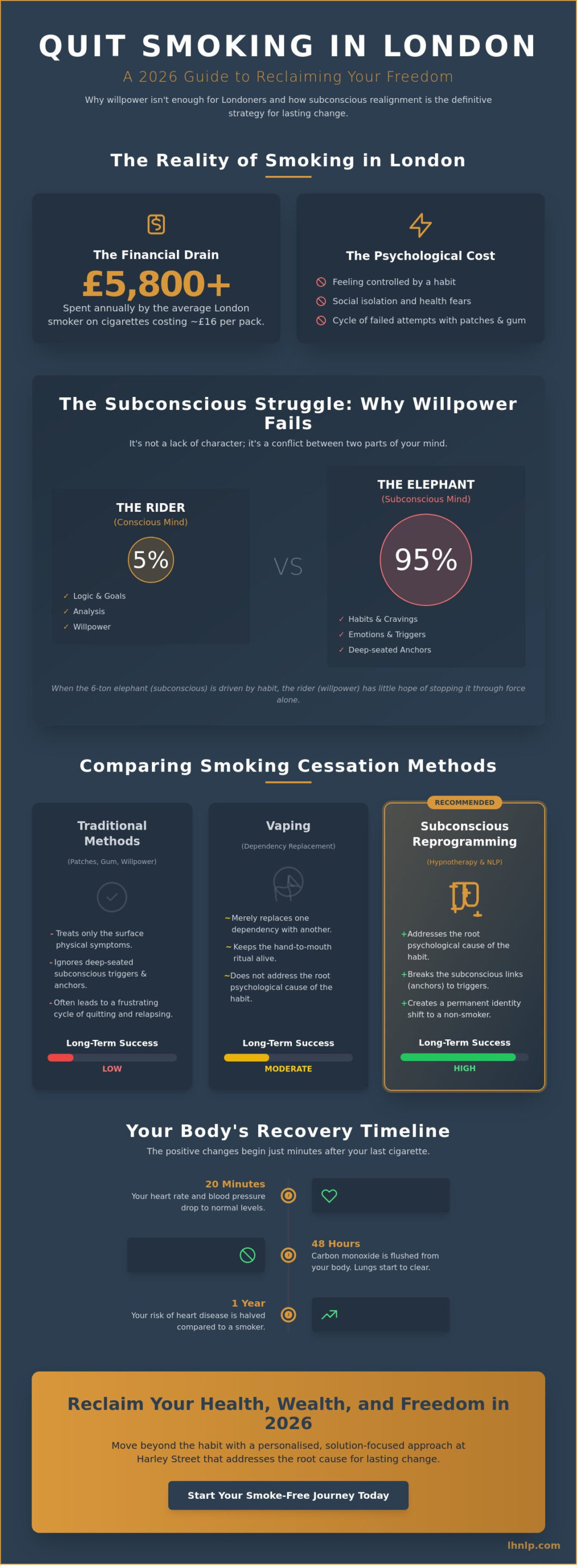
What if the reason you haven’t stopped yet isn’t a lack of willpower, but a simple misunderstanding of how your subconscious stores the habit? Standing in a London park or outside a smoke-free office, it’s easy to feel the weight of social isolation and the creeping fear of health decline. For many, the search for the best way to quit smoking 2026 leads to a cycle of patches and gums that only treat the surface. You’ve likely noticed that a pack of cigarettes now costs roughly £16, meaning the average London smoker spends over £5,800 annually just to feel controlled by a ritual they no longer enjoy. It’s frustrating to feel like a passenger in your own life, driven by a craving that ignores your logical desire for freedom.
I understand this struggle deeply, but I also know that lasting change happens when we stop fighting ourselves. This guide promises to show you why subconscious realignment is the definitive strategy for stopping smoking in London this year. We’ll explore how to shift your internal state so that stress management becomes a natural skill rather than a reason to reach for a lighter. By the end of this article, you’ll understand the exact framework for reclaiming your lung health and your financial independence through a systematic, empathetic approach to mental mastery.
Key Takeaways
- Understand why willpower alone often fails and how subconscious “anchors” link your smoking habit to daily rituals like your morning coffee or office breaks.
- Learn to navigate the unique environmental pressures of London, from high-stress City roles to the social triggers found in long commutes and urban socialising.
- Discover why addressing the psychological root through subconscious retraining is the best way to quit smoking 2026 for those seeking a permanent identity shift.
- Gain a practical roadmap for identifying your specific London-based triggers and restructuring your home and workspace to support a smoke-free lifestyle.
- Explore how solution-focused NLP and hypnotherapy at Harley Street can help you move beyond the habit and achieve lasting freedom with a personalised approach.
Navigating the Path to Stop Smoking in London for 2026
Finding the best way to quit smoking 2026 requires more than a simple patch or a fleeting New Year’s resolution. It demands a sophisticated, multi-layered approach that respects the connection between your physical health and your subconscious programming. For a Londoner, the challenge is unique. You aren’t just fighting an addiction; you’re navigating the high-pressure environment of the City, the social rituals of after-work drinks, and the grinding stress of a long commute from Ealing or North London. These daily triggers create deep-seated psychological anchors that willpower alone rarely breaks.
True freedom comes when you stop viewing quitting as a sacrifice and start seeing it as a reclamation of your personal power. In 2026, the trend is moving away from temporary substitutes like vaping, which often merely replace one dependency with another. Instead, residents are seeking professional support in established wellness hubs like Harley Street to address the root cause of the habit. By combining physical awareness with subconscious retraining, you can transform your identity from a smoker to someone who simply doesn’t smoke.
To better understand the neurological mechanisms behind this change, watch this expert analysis on how nicotine affects your brain and body:
The Evolution of Smoking Cessation in 2026
The social landscape of London has fundamentally shifted. Smoking in public spaces is no longer just a health concern; it’s increasingly met with social friction. Despite this, the fast-paced nature of the capital makes traditional “cold turkey” methods incredibly difficult to sustain. When your stress levels spike during a 45-minute Tube delay, your conscious mind often loses the battle to your habitual urges. This is why many are turning to clinical hypnotherapy and specialized treatments that target the unconscious mind. By evaluating various smoking cessation methods, it becomes clear that modern, evidence-based alternatives provide the mental resilience needed to stay smoke-free in a chaotic city.
Why 2026 is Your Year for a Smoke-Free Life
Choosing the best way to quit smoking 2026 is a profound act of self-leadership. The financial burden of smoking in London has never been higher, with the average smoker spending thousands of pounds annually that could otherwise fund a lifestyle of vitality. The biological rewards are even more compelling. According to the NHS timeline of recovery, your heart rate and blood pressure drop to normal levels just 20 minutes after your last cigarette. Within 48 hours, carbon monoxide is flushed from your body. This year, frame your decision not as a struggle, but as a deliberate step toward personal growth and long-term health. You aren’t just quitting a habit; you’re designing a new way of being.
The Subconscious Struggle: Why Willpower Often Fails
You decide to stop. You’ve analyzed the health data and calculated the financial cost. Yet, at 11:00 AM after a demanding meeting, your hand reaches for the pack almost automatically. This isn’t a failure of character; it’s a structural conflict within your mind. The conscious mind, which holds your goals and logic, acts like a rider atop a six-ton elephant, the subconscious. While the rider can see the path toward health, the elephant is driven by deep-seated patterns, emotions, and survival instincts. If the elephant decides to move toward a familiar comfort, the rider has little hope of stopping it through sheer force. This internal tug-of-war is why willpower alone feels so exhausting.
In Neuro-Linguistic Programming (NLP), we recognize these triggers as “anchors.” For a Londoner, smoking is often anchored to specific environmental cues that the subconscious has mapped out over years. It might be the specific sound of the kettle in a Shoreditch office or the feeling of relief when exiting a crowded tube station. These are neurological shortcuts. Your mind has learned to associate these moments with a chemical reward. Finding the best way to quit smoking 2026 requires more than just a nicotine patch; it requires uncoupling these anchors at their psychological source. We must also address “secondary gains,” which are the hidden benefits your mind thinks it’s receiving, such as a sense of belonging during a social break or a perceived moment of peace in a chaotic day.
The Psychology of Nicotine Addiction
Physical nicotine withdrawal actually peaks within 72 hours and is largely processed by the body within 14 days. The real challenge is the psychological architecture that remains. London’s high-pressure “hustle culture” creates a persistent belief that smoking is a necessary tool for survival. Many professionals view cigarettes as their only valid excuse to step away from a screen for five minutes. State control is the internal ability to shift your emotional landscape and manage stress without relying on any external substance. While NHS quit smoking support offers excellent resources for the physical journey, true freedom comes from mastering this internal state.
How Hypnotherapy Bridges the Gap
Clinical hypnosis doesn’t override your will. Instead, it creates a relaxed, receptive state where the rider and the elephant can finally communicate. We use this space to rewrite the outdated scripts that suggest smoking provides safety or relaxation. By reframing the habit as “legacy software” that no longer fits your current life, the subconscious stops fighting the change. You can explore how these techniques apply to various life shifts on our treatments page. This internal alignment is the foundation of the best way to quit smoking 2026. If you feel ready to align your inner resources with your conscious goals, a personal consultation can help illuminate the next steps in your journey.
Comparing Smoking Cessation Methods: What Actually Works?
Finding the best way to quit smoking 2026 requires looking beyond the surface of chemical addiction. Most smokers in London have already tried the standard route of patches or gum, only to find themselves back at the tobacconist within months. This happens because these methods treat the body as a machine while ignoring the mind as the operator. By 2026, the perspective on vaping has shifted significantly. Once seen as a miracle exit, it’s now recognized by many as a lateral move. You aren’t truly quitting; you’re simply changing the delivery system for the same dependency. To find lasting freedom, we must address the neurological blueprints that keep the habit alive.
The Pros and Cons of Traditional Aids
Nicotine Replacement Therapy (NRT) serves a purpose for initial withdrawal, but it often extends the timeline of dependence. While patches and gum address the physical craving, they do nothing to dismantle the hand-to-mouth ritual or the emotional triggers of a busy London life. Data from our stop smoking hypnotherapy pillar suggests that while NRT can dampen physical symptoms, it fails to address the psychological “why” behind the habit. The CDC’s guide to quitting smoking highlights various evidence-based strategies, yet many individuals find that NHS “Personal Quit Plans” lack the intensive, one-to-one psychological support needed to navigate high-stress environments. Without addressing the underlying identity, the risk of relapse remains high once the patches are removed.
The NLP Advantage for Habit Reversal
This is where Neuro-Linguistic Programming (NLP) and hypnotherapy create a fundamental shift. Instead of fighting a daily battle of willpower, we use “pattern interrupts” to break the automatic loop of reaching for a cigarette. Think of your smoking habit as a well-worn path in a forest; NLP allows us to block that path and pave a new one toward health. It’s about changing your internal identity from a “smoker trying to quit” to a “non-smoker.”
At LHNLP, we focus on the following core elements for a permanent transition:
- State Control: Learning how to manage stress without a chemical crutch.
- Anchoring: Building new, healthy triggers for relaxation that work in real-time.
- One-to-One Focus: Tailoring the session to your specific triggers, whether it’s the morning coffee or the post-work pint.
The best way to quit smoking 2026 isn’t found in a box of chemicals. It’s found in the quiet, decisive moment when your conscious and unconscious minds align. By choosing a method that prioritizes an identity shift, you don’t just stop smoking; you become someone who has no need for it. This psychological efficiency is why many now view professional NLP as the gold standard for those seeking more than just a temporary pause in their habit.
The Londoner’s Roadmap: Practical Steps to Quit for Good
The journey to freedom in a city as fast-paced as London requires more than a simple resolution; it demands a tactical shift in how you perceive your environment. If you’re searching for the best way to quit smoking 2026, you’ve likely realized that London itself is a collection of psychological triggers. To reclaim your autonomy, you must follow a roadmap that aligns with the unique rhythm of the capital.
- Identify London-specific triggers: Map out your daily geography. Is it the brisk walk to Waterloo Station or the 11 AM coffee break outside a City skyscraper? Recognizing these specific anchors is the first step to deconstructing the habit.
- Sanitize your environment: Your home in Hackney or your car needs to be a sanctuary. Remove every remnant of the habit, from old lighters to the smell of stale smoke, to signal a fresh start to your subconscious mind.
- The “Breathing Break”: Replace the toxic habit with a conscious pause. London boasts over 3,000 parks; use them. A five-minute walk through a local green space can reset your nervous system more effectively than nicotine ever could.
- Professional Consultation: Address the subconscious roots of the behavior. Habits are deep-seated patterns within the mind that often require expert guidance to untangle and replace with healthier alternatives.
- Identity Shift: Don’t wait for a three-month milestone to feel successful. Embrace the “non-smoker” identity the second you decide to quit. You aren’t “trying” to give something up; you’re reclaiming your natural state of health.
Managing City Stress Without a Cigarette
Commuting on the Tube or facing high-stakes presentations can spike cortisol levels. When a delay occurs on the Central Line, use an NLP “anchoring” technique: press your thumb and forefinger together while recalling a moment of absolute calm. This physical trigger can bypass the urge to smoke by shifting your internal state. If you feel anxious about the transition, explore our FAQs page to understand how the process works. Engaging in local activities, like a high-intensity fitness class in Ealing, also provides the dopamine hit your body craves without the tobacco.
Building a Support Network in the Capital
London’s social life often revolves around the pub, but you don’t have to feel deprived. Tell your colleagues about your new status immediately; true friends will respect your boundary and support your choice. For those with demanding schedules, virtual hypnotherapy sessions offer a flexible way to reinforce your resolve from your office or home. When you’re out in Shoreditch or Mayfair, focus on the quality of the conversation rather than the absence of a cigarette. You’re not losing a social outlet; you’re gaining the vitality to enjoy it more deeply.
Transforming Your Identity with London Hypnotherapy & NLP
Kamal offers a solution-focused path that moves beyond the exhausting struggle of white-knuckle willpower. Most people who try to stop smoking fail because they still identify as a smoker who is simply “trying” to quit. At LHNLP, the process is designed to facilitate a deep identity shift. By the time you leave our London clinics, the goal is for you to feel a sense of total indifference toward cigarettes. This isn’t about managing cravings; it’s about removing the psychological triggers that created them in the first place. When looking for the best way to quit smoking 2026, it becomes clear that addressing the subconscious mind is the only way to ensure the change is permanent.
What to Expect from Your Session
The atmosphere in our London clinics is professional, discreet, and deeply calming. You’ll find that you remain in complete control throughout the entire hypnotherapy process. It’s a common misconception that hypnosis involves a loss of agency; in reality, it’s a state of heightened focus where you’re more empowered than ever to make positive changes. Each session is a one-to-one deep dive into your habits. We look at the data of your life: the 20-minute morning ritual, the post-lunch cigarette, or the social triggers that usually lead to a relapse. By dismantling these patterns individually, we ensure that no “hidden” triggers remain. Research, including a 2023 analysis of therapeutic outcomes, suggests that personalized, one-to-one interventions are significantly more effective than group sessions or over-the-counter aids.
Taking the First Step Toward Freedom
It’s time to move from the state of “thinking about quitting” to actually taking decisive action. The best way to quit smoking 2026 is to stop treating the habit as a lifelong companion and start seeing it as an obsolete piece of software that needs an update. Reclaiming your life means reclaiming your time and your health. If you smoke a pack a day, you’re likely spending over 450 hours a year just on the act of smoking. Imagine what you could do with that time, not to mention the thousands of pounds saved annually. You can begin this transformation today by visiting our contact page to book your consultation. We’re here to help you step into a future where you no longer even think about smoking, let alone miss it.
Step Into Your Smoke-Free Identity
Real change doesn’t happen through struggle; it unfolds when your subconscious mind aligns with your conscious intentions. Since 2005, we’ve guided Londoners through this internal shift using a personalised NLP and hypnotherapy approach that goes deeper than surface-level habits. By addressing the psychological roots of the addiction, you move beyond the exhausting cycle of cravings. Whether you meet us at our clinics in Harley Street, Ealing, or the City, you’re choosing a methodology that values your unique mental landscape over one-size-fits-all solutions.
Finding the best way to quit smoking 2026 requires more than just a date on a calendar. It demands a transformation of your very identity. You don’t need to rely on the fragile strength of willpower when you can rewire the impulses that once held you back. Book your stop smoking consultation in London today and allow yourself the space to breathe freely again. Your journey toward lasting freedom is a path we’re ready to walk beside you, providing the expertise you need to reclaim your health and your future.
Frequently Asked Questions about Quitting Smoking in 2026
Is hypnotherapy the best way to quit smoking permanently in 2026?
Hypnotherapy is the most effective path because it transforms the subconscious patterns that drive your cravings. Research from the University of Washington School of Medicine indicates a 90.6% success rate for those using this method. It’s the best way to quit smoking 2026 because it moves beyond willpower. You aren’t just resisting a cigarette; you’re becoming a person who simply doesn’t want one anymore. This internal shift ensures your freedom lasts for the long term.
How many sessions of hypnotherapy are usually needed to stop smoking?
Most clients achieve complete freedom in just 1 to 3 sessions. Statistics from leading hypnotherapy clinics show that 95% of individuals reach their goal within this timeframe. We focus on quality over quantity, ensuring each session deeply addresses your specific triggers. You don’t need months of therapy when we target the root of the habit directly. This efficient approach allows your mind to reset its priorities quickly and effectively.
Will I gain weight if I quit smoking using hypnotherapy or NLP?
You won’t necessarily gain weight because NLP techniques prevent the common habit of oral substitution. While traditional quitters gain an average of 4.5kg, our method uses state control to manage stress without turning to food. We anchor new, healthy responses to your old triggers. By addressing the psychological “void” that smoking leaves behind, we ensure your metabolism and appetite remain balanced. You’ll feel more energized rather than hungry.
Can I quit smoking if I have been a heavy smoker for over 20 years?
Yes, your brain’s neuroplasticity allows you to break a 20 year habit just as easily as a 2 year one. A 2021 study in the Journal of Addictive Diseases confirmed that long term smokers respond exceptionally well to cognitive interventions. The duration of the habit doesn’t dictate your success; your readiness for change does. We use reframing to help you let go of that old identity. You’re never too far gone to reclaim your health.
What happens if I live with another smoker while I am trying to quit?
You can remain smoke free by using specific NLP anchors that make you indifferent to the smell and sight of cigarettes. While living with a smoker increases relapse risk by 30% for those using willpower alone, subconscious training creates a protective mental barrier. You’ll find that their habit no longer exerts any pull on your own choices. We’ll teach you how to maintain your own “state” regardless of what others are doing around you.
Is hypnotherapy safe, and will I be in control during the session?
Hypnotherapy is completely safe and you remain in full control of your mind and body throughout the entire process. It’s a state of focused relaxation similar to “highway hypnosis,” a phenomenon 100% of drivers have experienced. You can’t be made to do anything against your values or will. I act as a guide, but you’re the one navigating the journey. It’s a collaborative process where your conscious and subconscious minds finally start working together.
How much money can a Londoner save by quitting smoking this year?
A pack-a-day smoker in London will save over £5,800 every year by choosing to stop now. According to ONS data from late 2024, the average price for a pack of 20 cigarettes has climbed to £15.88. This financial drain adds up to a staggering £58,000 over a decade. Quitting isn’t just a health decision; it’s a massive pay rise. You can redirect those thousands of pounds toward your mortgage or a luxury holiday instead.
Do you offer stop smoking sessions online via Zoom or Skype?
Yes, digital sessions are highly effective and provide the same results as sitting in a physical office. A 2022 study confirmed there’s no statistical difference in success rates between remote and face-to-face hypnotherapy. Many clients find this the best way to quit smoking 2026 because they can relax in their own familiar environment. All you need is a stable internet connection and a quiet space. This convenience removes the stress of commuting through London traffic.