

Is it possible that your panic isn’t a flaw in your character, but rather a highly efficient, albeit misplaced, protective response from your subconscious mind? Imagine standing on a crowded Northern Line platform, feeling the familiar surge of adrenaline and the sudden, desperate need to escape before the doors even close. You’ve likely felt the physical exhaustion that follows a day of constant hyper-vigilance, where every high-pressure meeting feels like a threat to your autonomy. You probably agree that simply “trying to stay calm” is an insufficient tool when your nervous system has already sounded the alarm. Finding expert help for anxiety attacks London is the vital first step toward reclaiming your internal landscape.
This guide promises to show you how to deconstruct the subconscious triggers of panic and find lasting relief through specialized NLP and hypnotherapy. We’ll explore the methodical process of regaining state control, allowing you to commute and socialise with a sense of quiet confidence. By understanding the “why” behind the panic, you can move from a state of survival back into a life of genuine freedom.
Key Takeaways
- Gain clarity on how the unique pressures of the capital impact your nervous system, allowing you to distinguish between temporary stress and the acute physiological “freeze-fight-flight” response.
- Uncover the subconscious mechanisms of the amygdala to understand why your mind triggers “false alarms” and how to gently recalibrate this protective sentinel.
- Compare the benefits of solution-focused NLP and hypnotherapy against standard pathways to find the most effective help for anxiety attacks London.
- Acquire a practical “First Aid” protocol for immediate relief in public spaces and learn the importance of anchoring yourself in London’s quiet pockets.
- Explore how a bespoke therapeutic approach at prestigious locations like Harley Street can transform your internal landscape and provide a methodical path to lasting peace.
Understanding Anxiety Attacks in the Heart of London
Living in London isn’t just about the fast pace; it’s about a sensory landscape that greets you with relentless intensity the moment you step onto a platform at Oxford Circus or enter a high-stakes boardroom in Canary Wharf. For many, this environment isn’t merely stimulating, it’s overwhelming. When you’re searching for help for anxiety attacks London, you’re often looking for a way to reclaim your life from a city that feels like it’s closing in on you. It’s vital to recognize that an anxiety attack isn’t just “stressing out.” It’s a primitive, physiological hijacking of your nervous system known as the freeze-fight-flight response.
Have you ever felt your body react as if it’s facing a life-threatening predator while you’re simply standing in a queue for coffee? This disconnect between the external reality and your internal experience is what makes these episodes so terrifying. Telling someone to “just stay calm” during this state is like asking a person to stop the tide with their hands. The physiological response is already in motion, fueled by a surge of chemicals that demand action, not logic. Finding effective treatments starts with acknowledging that your body is trying to protect you, albeit in a misguided way.
To gain a deeper perspective on managing these intense moments, watch this expert guidance from a London-based specialist:
The Physical Reality of Panic Symptoms
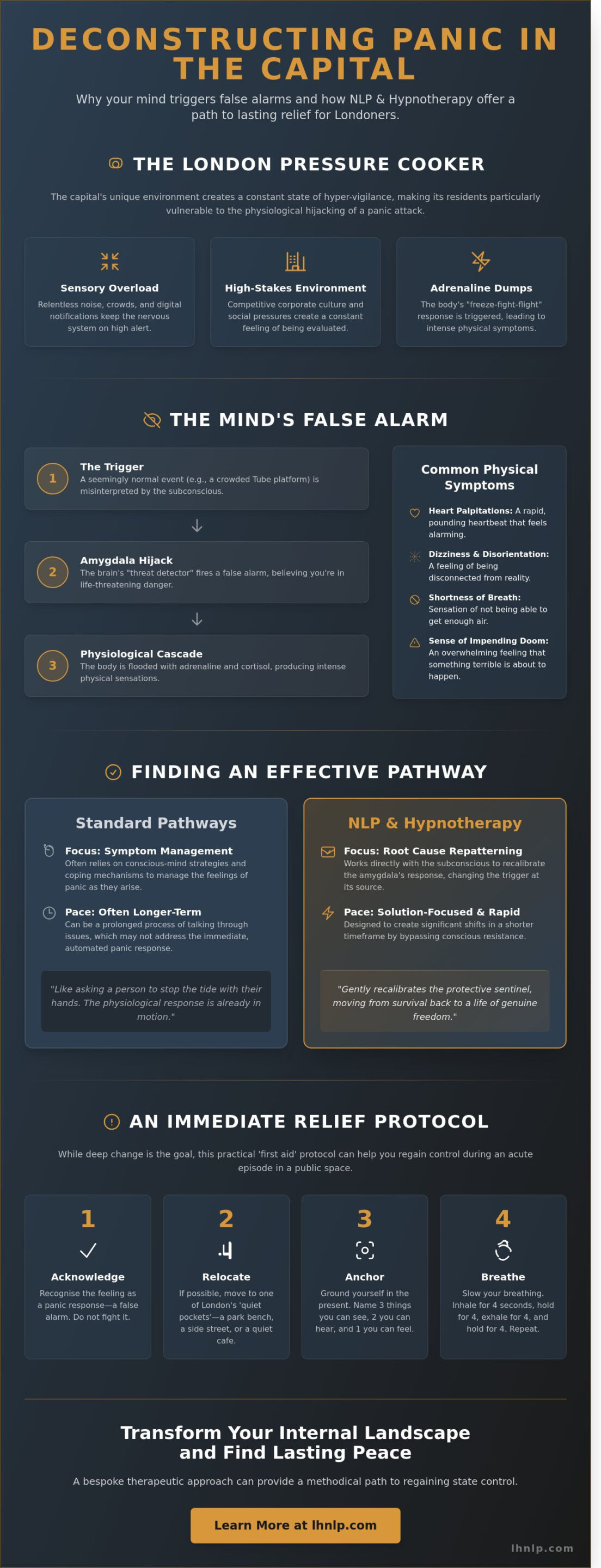
The sudden surge of adrenaline during an attack creates a cascade of physical sensations that can feel life-threatening. Common symptoms include heart palpitations that feel like a drum beating against your ribs, shortness of breath, and a disorienting dizziness. This “adrenaline dump” often triggers a profound sense of impending doom, leading many Londoners to seek emergency medical care. In fact, data from NHS England suggests that a significant percentage of A&E admissions for chest pains are actually manifestations of acute panic. Understanding Anxiety Attacks as a biological process rather than a medical emergency is the first step toward regaining state control.
Why Londoners are Particularly Vulnerable
The capital’s high-density living and “always-on” digital culture create a unique pressure cooker for the human psyche. We are constantly bombarded by micro-triggers, from the screech of the Tube to the competitive atmosphere of corporate performance reviews. Urban anxiety is a modern psychological phenomenon characterized by a persistent state of hyper-vigilance triggered by the relentless sensory input and social competition inherent in high-density metropolitan environments. Furthermore, the traditional British “stiff upper lip” mentality often prevents people from seeking help for anxiety attacks London until the symptoms become debilitating. We’re taught to push through, yet the unconscious mind doesn’t respond to willpower; it responds to safety and re-patterning. Is it possible that your mind is simply using an outdated map for a modern, complex landscape?
The Subconscious Mechanism: Why Your Mind Triggers “False Alarms”
Your subconscious mind functions as a tireless sentinel, dedicated entirely to your survival. It doesn’t process logic or time in the way your conscious mind does. Instead, it operates on patterns and protection. When you experience a panic attack, it’s not a sign of a broken system; it’s evidence of an over-vigilant one. This internal guardian has simply mistaken a psychological stressor for a life-threatening emergency.
The biological culprit behind this reaction is the amygdala. This small, almond-shaped structure in the brain serves as the master switch for your “fight or flight” response. When the amygdala perceives a threat, it floods your system with adrenaline and cortisol. For many seeking help for anxiety attacks London professionals observe that this alarm system has become hypersensitive. It begins to fire in response to everyday triggers, such as a crowded carriage on the Jubilee Line or a looming deadline at work, treating these situations as if they were physical predators.
A single “sensitising event” often creates the initial blueprint for this hyper-vigilance. This is a moment from your past where you felt overwhelmed, trapped, or out of control. Your subconscious recorded every sensory detail of that moment, from the temperature of the room to the specific tone of a voice. It then filed this data away as a “danger blueprint.” Now, whenever your current environment vaguely matches that old data, your mind triggers a false alarm to “save” you from a repeat experience. Hypnotherapy provides the direct access needed to update these outdated files.
Neuro-Linguistic Programming (NLP) and Pattern Breaking
NLP serves as a practical software manual for the human brain. It’s based on the understanding that our thoughts, language, and physical movements are all interconnected. By studying these patterns, we can identify the specific internal dialogue and mental imagery that precedes a panic attack. Most people aren’t aware of the lightning-fast “micro-strategies” their mind runs before the heart starts racing.
The process involves unlinking the trigger from the physical response. We use specific techniques to “scramble” the mental movies or internal voices that fuel the anxiety. By changing the sub-modalities of these thoughts, such as the brightness of a mental image or the volume of a self-critical voice, the emotional charge dissipates. It’s a methodical way to reclaim control over your internal state and stop the escalation before it begins.
Hypnotherapy: Communicating with the Protective Mind
Clinical hypnosis is often misunderstood. It’s not a state of being “under” or losing control; it’s a state of profound, focused relaxation. When Comparing Anxiety Treatments in London, it becomes clear that hypnotherapy is unique because it speaks the language of the subconscious. In this relaxed state, the critical conscious mind steps aside, allowing us to offer new, calmer instructions to the protective sentinel within.
During a trance, we can suggest new ways for your mind to handle old triggers. We don’t fight the subconscious; we acknowledge its positive intention to protect you and then provide it with better tools to do that job. When you view your mind as an ally that simply needs a software update, the path to recovery feels much more attainable. If you’re ready to begin this recalibration, exploring our specialist anxiety treatments can provide the structured support you need to find lasting peace.
Comparing Anxiety Treatments in London: Why Hypnotherapy and NLP?
Seeking help for anxiety attacks London often starts with a consultation at a GP surgery. While the NHS provides vital services like Cognitive Behavioural Therapy (CBT), the reality of the 18-week waiting time target often leaves individuals struggling in silence for months. Private specialist interventions offer a more immediate and tailored alternative. Unlike traditional talking therapies that may require 12 to 20 sessions to see a shift, NLP and hypnotherapy are fundamentally solution-focused. These methods don’t just analyze the problem; they aim to provide a practical exit strategy for the mind.
For professionals working in the City or Canary Wharf, time is a luxury. The speed of change is a primary reason many choose NLP. We often see clients achieve profound breakthroughs in 3 to 6 sessions because we work directly with the subconscious patterns that drive the panic. To accommodate the high-pressure lifestyle of the capital, we offer a flexible integration of online hypnotherapy services and in-person sessions. This ensures your progress remains consistent, whether you’re at home or travelling for business.
Counselling vs. Hypnotherapy for Panic
Traditional counselling often prioritizes the “exploration of the past,” digging into childhood roots to find the “why” behind the fear. While this insight is valuable, understanding a problem is not the same as solving it. Hypnotherapy focuses on the “reprogramming of the future.” We look at the neurological “how” of your anxiety. By changing how your brain processes triggers, we replace the old panic response with a new sense of calm. You can learn more about selecting the right approach in our guide on Therapy for Anxiety in London.
Natural Relief vs. Medication
Medication can serve as a helpful temporary bridge, but it typically manages the chemical symptoms rather than the cognitive root cause. NLP and hypnotherapy provide you with “internal tools” like state control and anchoring that stay with you forever. By mastering Immediate Relief and Long-Term Strategies, you transition from being a passive recipient of treatment to an active architect of your own mental wellness. In a fast-paced city, a holistic approach that balances the logical mind with the subconscious is the most sustainable way to regain your freedom.
Immediate Relief and Long-Term Strategies for Londoners
Managing your mental state in a city that moves at 100 miles per hour requires more than just willpower. It requires a toolkit of physiological and psychological interventions. According to the Office for National Statistics, Londoners consistently report higher levels of anxiety than the UK average, a fact that highlights the environmental pressure of capital life. When you’re seeking help for anxiety attacks London, you need techniques that work in the middle of a crowded platform at Oxford Circus or during a high-stakes board meeting in Canary Wharf.
If an attack begins in public, your immediate priority is finding a “quiet pocket.” London is full of hidden sanctuaries like Postman’s Park or the ruins of St Dunstan in the East. These spaces provide a necessary sensory reset. Once you’re there, focus on your breath; ensure your exhale is twice as long as your inhale to signal safety to your brain.
NLP Techniques You Can Use on the Tube
The London Underground is a common trigger for claustrophobia and panic. One of the most effective NLP tools for state control in these moments is the “Peripheral Vision” technique. Instead of tunneling your vision on the crowd or your phone, soften your gaze. Pick a point in front of you and slowly expand your awareness to the edges of your vision. This shift into a “Learning State” physiologically inhibits the fight-or-flight response, making it almost impossible to maintain a peak state of panic.
You can also use the “Stop” technique to interrupt catastrophic thought loops. When you notice your mind spiraling toward “what if” scenarios, mentally shout the word “STOP” and visualize a bright red sign. Immediately follow this by grounding yourself with this simple exercise:
- Acknowledge 3 things you can see: The texture of the seat, a specific advert, or the color of a passenger’s coat.
- Acknowledge 2 things you can feel: Your feet pressing into the floor and the fabric of your clothes.
- Acknowledge 1 thing you can hear: The rhythmic hum of the tracks.
Building a Lifestyle of Resilience
The London commute isn’t just a travel time; it’s a daily tax on your nervous system. Research suggests that commutes over 45 minutes can significantly increase cortisol levels. To counter this, regular “digital detoxes” are essential. Your brain needs periods where it isn’t processing notifications or blue light. By integrating these pauses, you allow your unconscious mind to process the day’s stressors rather than letting them accumulate. For those looking to integrate these habits into a broader framework, exploring Stress Management in London can provide the structural support needed for lasting change.
If you’re ready to move beyond temporary fixes and want professional help for anxiety attacks London, we’re here to guide your transformation. Book a consultation today to start your journey toward a calmer, more resilient life.
Personalised Anxiety Support at London Hypnotherapy & NLP
Kamalyn Kaur leads London Hypnotherapy & NLP with a philosophy that recognises the profound uniqueness of your internal world. When you seek help for anxiety attacks London offers various options, yet few prioritise the deep, unconscious shifts required for permanent relief. Kamalyn’s approach isn’t a one-size-fits-all template; it’s a bespoke therapeutic partnership designed to dismantle the specific neurological loops that keep you trapped in fear. By working with the mind’s natural ability to reorganise itself, we move beyond mere coping mechanisms toward genuine resolution.
We understand that accessibility is vital when you’re managing high levels of stress. That’s why our practice operates from three distinct, professional hubs across the capital. You can access support at our prestigious Harley Street (W1G) office, our quiet residential space in Ealing (W5), or our City location at Tokenhouse Yard (EC2R). Each setting adheres to the highest clinical standards, ensuring your sessions take place in a safe, confidential, and premium environment tailored for deep work.
Your journey begins with a detailed consultation where we map out your current challenges and define your desired emotional state. This isn’t just about symptom management. It’s about a structured progression from the first consultation to a place of lasting change. How would it feel to move through your daily life without the constant shadow of an impending attack? Our commitment to professional excellence means we use evidence-based protocols to ensure your progress is both measurable and sustainable.
Our Approach to Panic Attack Treatment
We integrate clinical hypnotherapy with advanced NLP protocols to address both the physical symptoms and the psychological root causes of your distress. By utilising techniques like state control and anchoring, we help you regain authority over your nervous system. We focus on the specific triggers unique to your life, whether they’re related to high-pressure professional environments or personal transitions. For those who require flexibility or live outside the capital, we provide online hypnotherapy services, delivering the same clinical expertise to your home or office. This ensures that expert help for anxiety attacks London based or global, is always within reach.
Booking Your Path to Calm
You don’t have to just live with it. Chronic anxiety is often a signal that your internal software needs an update, not a permanent defect in your character. Reaching out for a consultation is the first decisive step toward recalibrating your mind’s response to stress. The process is simple and discreet; once you get in touch, we’ll guide you through the next steps with empathy and clarity. Your mind has the inherent capacity to change, to heal, and to return to a state of equilibrium. Are you ready to begin that transformation today?
Step Into a Life Defined by Calm Rather Than Conflict
Living in a city that never pauses demands more than just temporary coping mechanisms. It requires a fundamental shift in how your subconscious processes stress. You’ve discovered that these “false alarms” are merely your mind’s misplaced attempt to protect you, even if the physical experience feels entirely different. By integrating the precision of NLP with the depth of clinical hypnotherapy, you move beyond simply managing symptoms to actually recalibrating the underlying scripts that trigger panic.
With over 20 years of experience navigating the unique psychological demands of high-pressure London professional environments, I provide a bespoke framework tailored to your specific subconscious triggers. Finding effective help for anxiety attacks London doesn’t have to be an endless search through generic treatments. It’s about finding a partner who understands the intricate dance between the rational mind and the intuitive self. You already possess the internal resources to stay grounded, even when the world outside feels chaotic.
Book your initial consultation for anxiety therapy in London today and begin the methodical process of returning to your natural state of confidence. Your journey toward a quieter, more resilient mind starts with a single, intentional step.
Frequently Asked Questions
How many sessions will I need to stop having anxiety attacks?
Most clients experience a profound shift in their emotional state within 4 to 6 sessions. This isn’t a vague estimate; it’s a structured process designed to identify and rewire the subconscious triggers that cause your distress. While every individual journey is unique, this timeframe allows us to move from immediate symptom management to long term neurological change.
Will I be “put under” or lose control during hypnotherapy for anxiety?
You stay fully conscious and in complete control of your mind and body throughout the entire session. Hypnotherapy isn’t a state of sleep or a loss of will; it’s a focused state of relaxation where your subconscious becomes more receptive to positive change. You’ll be able to hear everything said and can open your eyes or end the process at any moment you choose.
Can NLP help with the physical symptoms of a panic attack, like a racing heart?
NLP provides practical techniques like state control and anchoring that can interrupt the “fight or flight” response in seconds. When you seek help for anxiety attacks London specialists teach you how to change your internal mental pictures, which directly signals your nervous system to slow your heart rate. It’s a way of taking the steering wheel back from your body’s automatic stress reactions.
Is hypnotherapy in London covered by private health insurance?
Many major UK insurance providers, such as Bupa, AXA, and Vitality, may cover hypnotherapy if the practitioner is registered with a recognized professional body like the CNHC. You’ll need to check your specific policy details for “Complementary Therapies” or “Psychological Services.” Always contact your insurer first to see if they require a GP referral before you start your sessions.
What is the difference between a panic attack and an anxiety attack?
A panic attack is a sudden, intense surge of fear that usually peaks within 10 minutes, while an anxiety attack is a period of persistent, building apprehension. Panic attacks often happen without an obvious trigger and feel like a physical health emergency. Anxiety attacks are typically linked to a specific worry and can last for much longer periods, sometimes days or weeks.
Can I have my sessions virtually via Zoom or Skype?
Virtual sessions are a highly effective option and offer the same therapeutic results as meeting in a physical office. Research published in the Journal of Affective Disorders confirms that remote therapy for anxiety is just as impactful as face to face consultations. This allows you to stay in a comfortable, familiar environment while we work together on your transformation.
What should I do if I have an anxiety attack in a public place in London?
Use the “5-4-3-2-1” grounding technique to pull your focus away from the internal panic and back to the physical world. Identify five things you can see and four things you can touch, such as your coat or a nearby railing. Finding help for anxiety attacks London often involves mastering these portable tools so you can navigate the city’s busiest areas with a sense of safety.
How do I know if Kamalyn Kaur is the right therapist for me?
The right therapist is someone who makes you feel safe, understood, and professionally supported from the very first conversation. You’ll know Kamalyn is the right fit if her calm, methodical approach resonates with your desire for both empathy and practical results. Trust your intuition during the initial consultation; it’s the best guide for choosing a partner in your healing journey.