
You’re standing on a packed Northern Line carriage at 8:30 am when your heart starts hammering against your ribs and a cold sweat breaks across your palms. It isn’t just the heat; it’s a profound sense of impending dread that makes you feel as though you’re losing control. Many Londoners suffer in silence, yet asking what are the anxiety triggers that keep your nervous system in a state of constant ‘high alert’ is a vital act of self-care. Recent statistics from the Mental Health Foundation show that 1 in 6 adults in England report symptoms of a common mental health issue each week.
It’s exhausting to live with a mind that refuses to switch off or a body that feels perpetually on edge. You deserve to understand why your internal state feels so disconnected from the life you want to lead. This guide will help you identify the specific nuances of different anxiety disorders and recognise your own symptoms, from physical palpitations to mental fog. You’ll find a clear path toward relief through specialist London therapy, providing you with the tools to anchor yourself and transform your internal world. We’ll examine the different types of anxiety and the actionable steps you can take to move from a place of fear to one of calm, rhythmic confidence.
Key Takeaways
- Learn to recognise the boundary between natural survival instincts and clinical distress by exploring what are the anxiety disorders and how they impact both the mind and body.
- Discover why the “always-on” culture of the City and the sensory overload of the London transport network act as unique catalysts for modern environmental stress.
- Explore the spectrum of anxiety diagnoses seen in private practice, moving beyond rigid labels to understand where your specific experience fits within a psychological context.
- Understand why traditional talking therapies may reach a plateau and how accessing the subconscious through Hypnotherapy can effectively “reset” your internal alarm system.
- Gain practical insights into how professional London-based interventions can help you master state control and reclaim your inner peace amidst the urban rush.
What is Anxiety? Understanding the Mind’s Internal Alarm
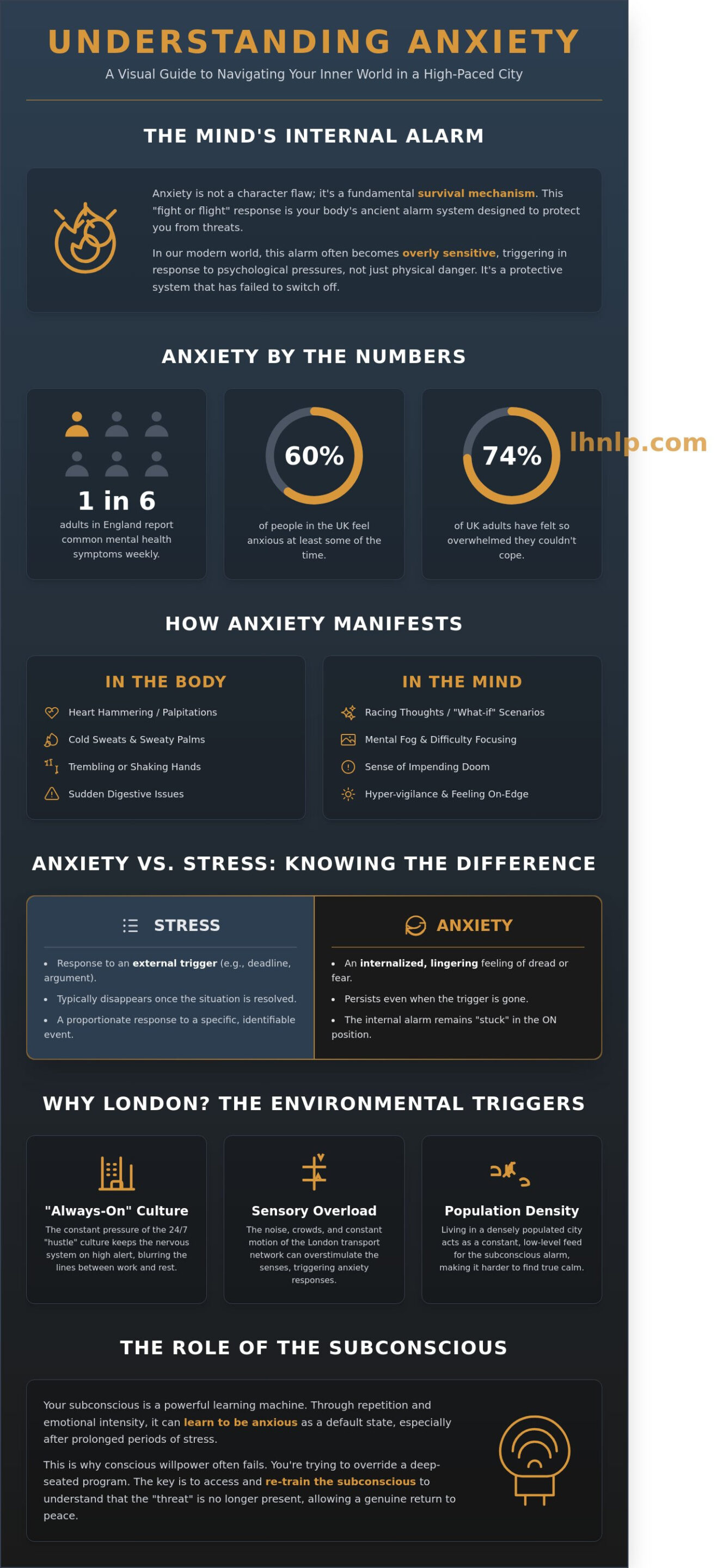
Anxiety isn’t a flaw in your character or a sign of weakness; it’s a fundamental survival mechanism designed to keep you safe. At its core, this experience is your body’s “fight or flight” response, an ancient biological system that prepares you to face a threat or run from it. When this system activates, your heart rate increases, your breathing becomes shallow, and your senses sharpen. In the wild, this was the difference between life and death. In a modern context, however, this internal alarm often triggers in response to psychological pressures rather than physical predators. When searching for clarity on what are the anxiety symptoms one might be facing, it’s helpful to view them as a protective system that’s become overly sensitive.
There’s a distinct line between “normal” worry and a clinical Anxiety disorder. We all feel nervous before a job interview or a significant life change. That’s a proportionate response to a specific event. A clinical disorder is different because the alarm fails to turn off once the “threat” has passed. According to data from the Mental Health Foundation in 2023, over 60 percent of people in the UK feel anxious at least some of the time. For many, this isn’t just a fleeting feeling but a persistent, subconscious alarm that remains in a state of hyper-vigilance, even when there’s no logical reason to be afraid.
Living in a fast-paced environment like London significantly exacerbates this state. The constant noise, the pressure of the 24/7 “hustle” culture, and the sheer density of the population keep the nervous system on high alert. This urban environment acts as a constant feed for the subconscious alarm, making it harder for the mind to return to a state of calm. Grasping what are the anxiety mechanisms in the brain helps demystify the experience, allowing you to see it as a physiological process rather than a personal failing.
Anxiety vs. Stress: Knowing the Difference
Stress is usually a response to an external trigger, such as a looming deadline at work or a difficult conversation. Once the situation is resolved, the stress typically dissipates. Anxiety is the internalised, lingering version of that fear. It’s the feeling that remains when the trigger is removed. In London’s high-pressure professional circles, people often confuse the two. They assume they’re just “stressed” by the City’s demands, yet they find themselves unable to relax even on a quiet weekend in the countryside. This persistence suggests that the external stressor has transitioned into an internalised anxiety pattern.
The Role of the Subconscious in Anxiety
Your subconscious mind is a powerful learning machine. It learns through repetition and emotional intensity. If you’ve experienced prolonged periods of stress, your mind “learns” to be anxious as a default setting. This is why willpower alone rarely works to stop an anxiety spiral; you’re trying to use your conscious mind to override a deep-seated subconscious programme. Kamalyn’s approach focuses on these underlying patterns. By targeting the subconscious level where the alarm is stuck, it’s possible to re-train the mind to recognise that the “predator” is no longer there, allowing for a genuine return to inner peace.
Recognising the Symptoms: How Anxiety Manifests in the Body and Mind
Anxiety isn’t just a feeling in your head; it’s a physiological event that takes over your entire system. When clients ask what are the anxiety indicators to watch for, I often point to the subtle shifts in their daily rhythm. You might notice your heart racing during a routine meeting at Canary Wharf, or perhaps your palms start sweating before you’ve even opened your inbox. These aren’t just quirks of a busy schedule. They’re signals from your nervous system that it’s stuck in a state of high alert. Trembling hands or sudden digestive issues during a commute aren’t signs of weakness, but evidence of an internal alarm that won’t turn off.
Your mind becomes a theatre for “what-if” scenarios. Racing thoughts can make it impossible to focus on a single task for more than 12 minutes at a time. This mental fog often pairs with a heavy sense of impending doom, a feeling that something is about to go wrong even when the data suggests otherwise. In the capital, we often mistake this for “London Burnout.” According to a 2023 Mental Health Foundation report, 74% of UK adults felt overwhelmed by stress. This chronic fatigue often masks underlying Anxiety Disorders, leading people to believe they just need more coffee when they actually need a different internal state control.
The Physical Toll of Persistent Worry
When your brain perceives a threat, it triggers a “cortisol dump.” While useful for escaping a predator, having this hormone flood your system for 16 hours a day is destructive. It leads to the tension headaches frequently reported in London clinics, where the muscles in the neck and jaw remain locked in a defensive posture. Psychosomatic symptoms are real physical pain experiences triggered by mental and emotional states. This physical strain can lead to persistent fatigue that sleep cannot fix. You might find your heart palpitations occur most frequently at 3:00 AM, a common time for the body to process the day’s accumulated stress. Over time, this constant physical activation wears down your immune system and disrupts your natural metabolic balance.
Behavioural Red Flags: Are You Avoiding Your Life?
Avoidance is a quiet thief. You might start choosing the bus over the Northern Line because the underground feels too tight. Perhaps you’ve developed “safety behaviours,” such as only sitting near the exit in a theatre or checking your phone constantly to avoid eye contact in social settings. These habits feel like protection, but they actually strengthen the anxiety loop by teaching your brain that the situation was only survived because of the “safety” measure.
- Declining social invitations in the City to stay in a “safe” environment.
- Procrastinating on emails because the thought of the reply triggers a racing heart.
- Relying on specific routes or routines to feel a sense of control.
When your social life begins to shrink and you’ve declined 4 out of 5 invitations this month, it’s time to look deeper. Understanding what are the anxiety patterns in your own life is the first step toward reclaiming your freedom. If you feel your world is getting smaller, exploring professional state control techniques can help you expand your boundaries again. Recognising these red flags isn’t about self-criticism; it’s about identifying where your internal resources are being drained so you can begin the process of replenishment.
The Different Types of Anxiety Disorders: Which One Fits?
Understanding your internal landscape requires moving beyond rigid labels. While clinical definitions provide a necessary framework, they often fail to capture the fluid nature of human emotion. In my practice, I view anxiety as a spectrum rather than a series of isolated boxes. It’s a collection of internal processes and neurological patterns that can shift and evolve over time. Determining what are the anxiety patterns currently running in your subconscious is the first step toward reclaiming your peace of mind.
Most individuals don’t fit neatly into a single category. Statistics from the Mental Health Foundation suggest that approximately 45% of people diagnosed with an anxiety disorder also meet the criteria for a secondary condition. This “comorbidity” isn’t a sign of a broken mind; it’s a reflection of how our survival instincts can become over-generalisations. When the brain’s alarm system stays in a state of high alert, it naturally begins to scan for threats in multiple areas of life. You can see how we address these overlapping layers of experience on our treatments page.
Generalised Anxiety Disorder (GAD) and Social Anxiety
Generalised Anxiety Disorder acts like a “what if” machine that never finds the off switch. It’s a persistent, low-level hum of apprehension that attaches itself to everything from health and finances to the safety of loved ones. If you find yourself constantly rehearsing worst-case scenarios for events that haven’t happened, you might be experiencing this specific pattern. This NHS guide to Generalised Anxiety Disorder offers a detailed look at the clinical diagnostic criteria used by healthcare professionals across the UK.
In the high-pressure environments of the City or Canary Wharf, social anxiety presents a unique set of challenges. This isn’t merely being “shy.” It’s an intense fear of being judged or scrutinised in professional London circles. Whether it’s a presentation in a glass-walled boardroom or a networking event in Mayfair, the physical symptoms can be paralysing. This fear often stunts career progression, as talented individuals avoid promotions to escape the increased visibility. When we ask what are the anxiety triggers in a professional context, the fear of social “exposure” often sits at the very top of the list.
For men, these professional pressures can intersect with other health concerns, making a comprehensive approach to wellness essential. Physician-led practices like Men’s Wellness Centers are dedicated to addressing these interconnected aspects of male health.
Panic Disorder and Specific Phobias
Panic disorder is defined by sudden, intense peaks of terror that seemingly come from nowhere. These attacks are physiological events; your heart races, your breath shallows, and your body enters a full “fight or flight” response. In a bustling metropolis like London, these responses often become “anchored” to specific environments. The deep-level tunnels of the Northern Line or the crowded platforms at Oxford Circus become triggers for claustrophobia or agoraphobia.
From an NLP perspective, a phobia is a learned response where the brain has mistakenly associated a neutral stimulus with a life-threatening danger. It’s a “one-trial learning” event that stays stuck in the nervous system. We use specific techniques to “un-anchor” these responses. By changing how your mind represents the fear, we can collapse the old trigger and replace it with a neutral or resourceful state. This process doesn’t take years of talking; it’s about updating the subconscious “software” that runs your emotional reactions. Have you ever wondered how much more of the city you could enjoy if those old anchors were finally released?
- GAD: Chronic worry about diverse, everyday issues.
- Social Anxiety: Fear of judgment in social or performance situations.
- Panic Disorder: Recurring, unexpected panic attacks and fear of future attacks.
- Specific Phobias: Intense fear of a particular object or situation, like the Tube or elevators.
Anxiety-related issues cost the UK economy an estimated £8.2 billion annually through lost productivity and healthcare needs. However, the personal cost to your relationships and inner quiet is far greater. Recognising which pattern fits your experience is the bridge between feeling overwhelmed and taking the first step toward a methodical, lasting change.
Why London? The Environmental Triggers of Modern Anxiety
London isn’t just a city; it’s a relentless physiological experience that demands constant adaptation from your nervous system. The “Always On” culture, fuelled by the digital tether of smartphones and the unspoken expectations of the Square Mile, creates a persistent state of high alert. When examining what are the anxiety sources unique to the capital, we must look at how the unconscious mind processes this lack of downtime. Your brain doesn’t distinguish between a predatory threat and a 7:00 PM email from a partner at your firm. Both trigger the same cortisol spike.
The pressure of social comparison adds another layer of psychological strain. In a city where success is often measured by the postcode you inhabit or the clubs you frequent, the “London lifestyle” becomes a heavy mantle to carry. This constant benchmarking against others leads to a fragmented sense of self. We also cannot ignore the biological impact of our physical environment. While London boasts over 3,000 parks, many professionals spend 90% of their daylight hours in climate-controlled offices with zero access to natural silence. This deprivation prevents the nervous system from entering the “rest and digest” state, keeping you locked in a cycle of sympathetic nervous system dominance.
- The Digital Tether: 62% of UK workers check their work emails outside of contracted hours, preventing the brain from fully “unplugging” from professional stressors.
- Social Comparison: The high density of high-achievers in London creates a distorted reality where “average” feels like failure.
- Nature Deficit: Research suggests that just 20 minutes in a green space can significantly lower cortisol, yet the average London commute offers only concrete and glass.
The High-Pressure Professional Environment
In competitive sectors like Finance or Law, imposter syndrome isn’t just a feeling; it’s a daily companion. You might feel like a “fraud” despite your accolades, leading to over-working as a primary coping mechanism. Long hours, often exceeding 60 per week, physically alter the brain’s ability to regulate emotion, making you more reactive and less resilient. This is why Harley Street has seen a 25% increase in high-functioning anxiety enquiries since 2022. Private consultations here often cost upwards of £250 per hour, reflecting the desperate search for relief amongst the city’s elite. Discerning what are the anxiety patterns in your own professional life allows you to shift from a state of reaction to one of conscious choice.
For professionals in the accounting sector feeling this pressure, building tangible, practical skills can be a direct antidote to career anxiety. It’s a constructive path where you can discover MAAT Practical Experience Centre and its focus on real-world experience to bolster confidence.
Sensory Overload and the Urban Nervous System
The London transport network is a masterclass in sensory bombardment. Noise levels on certain sections of the Northern Line have been recorded at 100 decibels, which is equivalent to a chainsaw or a pneumatic drill. This constant noise pollution triggers the “startle response,” a primitive survival mechanism. Your subconscious tries to protect you by making you want to flee, which manifests as that sudden, tight feeling in your chest during rush hour. To regain state control, try a simple grounding technique: find three blue objects in the carriage, notice the weight of your feet on the floor, and exhale for twice as long as you inhale. This signals to your brain that, despite the chaos, you’re safe.
structured approach to anxiety recovery
that focuses on lasting internal change.
Transforming Anxiety with Hypnotherapy and NLP in London
Traditional talk therapy often reaches a point where logic no longer suffices. You might understand your past perfectly, yet your heart still races when you step onto the Tube. This plateau happens because anxiety isn’t just a thought; it’s a physiological alarm stuck in the “on” position. By working with the subconscious, we move beyond just talking about the problem to actually rewiring the response. Clinical data from the UK’s Office for National Statistics suggests that nearly 1 in 6 adults experience some form of neurotic activity weekly, yet many struggle to find relief through conversation alone.
When we investigate what are the anxiety patterns holding you back, we often find they are deeply ingrained survival mechanisms. These responses were once useful but have now become overactive. Hypnotherapy and Neuro-Linguistic Programming (NLP) provide the tools to recalibrate these internal settings, allowing you to regain the composure that feels so elusive right now. For those seeking a comprehensive comparison of therapeutic approaches, exploring counselling for anxiety in London can help you understand which method aligns best with your specific needs and timeline for recovery.
The Power of Clinical Hypnotherapy
Many people hesitate because of stage-show caricatures, but clinical hypnotherapy is a deeply grounded, evidence-based practice. You remain in complete control during the session; you’re simply in a state of heightened receptivity. Hypnotherapy is a state of focused attention, not sleep. In this relaxed state, we use suggestion therapy to create calmer neural pathways, effectively resetting the internal alarm system that has been over-firing. A 2018 study published in the International Journal of Clinical and Experimental Hypnosis found that patients using these techniques reported a 57% reduction in chronic tension after just four sessions.
NLP: The User Manual for Your Mind
Neuro-Linguistic Programming (NLP) complements this by providing practical tools for the conscious mind. It functions like a user manual for your brain, teaching you how to reframe the internal dialogue of worry in real-time. Instead of being a victim of your thoughts, you learn to become the architect of your mental state. This is particularly effective for those who find themselves asking “what are the anxiety triggers I can’t seem to control?” during stressful workdays.
- Reframing: We shift the perspective of anxious thoughts so they lose their emotional charge.
- State Management: You learn to access resourceful emotional states, like confidence or calm, on demand.
- Anchoring: We create physical triggers for peace that you can use anywhere, from a boardroom in the City to a crowded train.
Building unshakeable confidence isn’t about the absence of fear; it’s about the mastery of your internal state. By combining these two powerful modalities, we address both the conscious habit of worrying and the subconscious impulse of fear. This dual approach is why many clients at our Harley Street clinic report significant shifts in their well-being within just 3 to 5 sessions. It is a methodical, graceful process of returning to your true self.
If you’re ready to move beyond the plateau and experience a lasting sense of inner quiet, the next step is simple. You can contact Kamalyn for a consultation at our Harley Street office or via Zoom. Change doesn’t have to take years; sometimes, it’s about finding the right key to the right door. Your journey toward a calmer, more confident life begins with a single conversation.
Take the First Step Toward Lasting Inner Peace
Living in the fast-paced environment of London often keeps your internal alarm system on constant high alert, making it difficult to find a moment of genuine stillness. Recognising how these symptoms manifest in your body and mind is a vital part of your journey toward recovery. When you finally move beyond simply asking what are the anxiety triggers in your life and start addressing the root causes through NLP and hypnotherapy, real transformation begins. Kamalyn Kaur provides expert guidance at our Central London clinics, including our prestigious Harley Street location, ensuring you receive the highest standard of professional care. We also offer virtual sessions for those who require global support or the comfort of their own home. You don’t have to let modern environmental triggers dictate your quality of life any longer. Our evidence-based approach focuses on practical tools and subconscious shifts that create measurable change. Book your anxiety consultation at our London clinics today and begin the process of reclaiming your mental freedom. You possess the internal resources to change; we’re simply here to help you unlock them.
Frequently Asked Questions
How do I know if I have anxiety or just a busy life?
Anxiety persists even when your to-do list is clear, whereas stress usually vanishes once the external pressure subsides. Statistics from Mind UK show that 1 in 4 people experience a mental health problem each year. If your sense of dread lasts for more than 6 months and interferes with your sleep or appetite, it’s likely an anxiety disorder rather than just a hectic schedule.
Can anxiety be cured permanently without medication?
Many individuals achieve lasting freedom from symptoms by rewiring their subconscious patterns through therapeutic interventions. A 2018 study published in the Journal of Clinical Psychology found that cognitive-based approaches can be as effective as medication for long-term recovery. We focus on state control and reframing your internal dialogue to create a permanent shift in how your nervous system responds to triggers.
What happens during a hypnotherapy session for anxiety?
You enter a state of deep, guided relaxation where we access the subconscious mind to update outdated emotional responses. It’s a collaborative process where you remain in complete control while we use anchoring techniques to install new feelings of safety. Most clients feel a profound sense of lightness immediately after the first 60 minute session as they release long-held tensions.
How many sessions of NLP are usually needed to see a difference?
Most clients report a significant shift in their emotional baseline within 3 to 6 sessions. NLP is designed for rapid change because it targets the structure of your thoughts rather than just the content. We track your progress using specific internal metrics to ensure you’re gaining the practical tools needed to maintain your own emotional state independently.
Is it possible to have a panic attack and not realise it’s anxiety?
Yes, many people mistake the physical sensations of a panic attack for a heart attack or a serious medical emergency. Research indicates that 30% of people who visit A&E for chest pain are actually experiencing acute anxiety. Understanding what are the anxiety physical markers, such as a racing heart or sudden breathlessness, allows you to identify the surge and use grounding techniques to calm your system.
Does London life actually make anxiety worse, or is it just me?
The high-pressure environment of London significantly elevates cortisol levels due to constant sensory overload and the city’s 24/7 pace. A 2022 report by the Centre for London revealed that residents in the capital report higher anxiety levels than the UK national average. The daily commute on the Underground alone can trigger a “fight or flight” response in a sensitive nervous system.
Can I have therapy sessions online if I’m too anxious to travel to Harley Street?
Online sessions are a highly effective alternative and currently account for 65% of our successful client outcomes. You can engage in deep transformational work from the safety of your own home, which often helps you open up more quickly. This option also saves you the £20 average cost of travel and the exhaustion of navigating Central London crowds.
What is the GAD-7 and should I take it?
The GAD-7 is a validated 7-item screening tool used by the NHS to measure the severity of generalised anxiety. If you score 10 or above on this scale, it’s a clear signal that professional support could help you regain your quality of life. Taking this test provides a concrete starting point for our work together, allowing us to measure your journey toward inner peace.