

What if your body begins to recover before you feel any different? The health improvements after quitting smoking timeline starts within minutes: NHS guidance says heart rate and blood pressure begin moving towards normal after 20 minutes. Yet cravings, irritability or a temporary cough can make those first days feel like a setback rather than progress.
Some milestones arrive quickly, while others take months or years, and your experience may not match a precise schedule. This guide explains common short- and long-term changes, factors that can affect recovery, and why coughing or cravings don’t automatically mean quitting isn’t helping. It also covers when symptoms deserve medical attention and where practical support may fit, including NHS stop-smoking help and personalised hypnotherapy as one possible option, not a substitute for medical care.
Think of recovery as a gradual process, not a test you have to pass by a deadline. There are meaningful milestones to look forward to, and support can help you stay smoke-free when the path feels difficult.
Key Takeaways
- Use the health improvements after quitting smoking timeline as a guide to common milestones, not a deadline for your personal recovery.
- Changes can unfold from the first hours and days to longer-term reductions in health risks.
- Cravings and withdrawal can occur alongside recovery. Track triggers and wellbeing without treating every symptom as a setback.
- Know when a cough or breathing change needs medical attention rather than assuming it is part of quitting.
- Personalised smoking-cessation hypnotherapy is one possible support option. Three to six sessions are advisable, though individual needs differ.
What happens to your health when you quit smoking?
Your body can begin responding soon after you stop smoking, even if you don’t notice an immediate difference. The health improvements after quitting smoking timeline describes general milestones, not a guaranteed schedule. For example, NHS guidance says heart rate and blood pressure begin moving towards normal after 20 minutes, while other changes take longer to emerge.
Some early shifts happen inside the body. Carbon monoxide levels in the blood fall over the following hours, while changes you can feel, such as easier breathing, more energy or a stronger sense of taste, may follow a different pace. The broader health benefits of quitting smoking accumulate over time, whether or not each change is immediately noticeable.
For a visual overview of how recovery may unfold, watch this short video:
Why benefits can begin before you feel different
Biological changes and noticeable sensations don’t always arrive together. Blood chemistry can respond as the body clears carbon monoxide, but that doesn’t mean your breathing will feel easier at the same moment. Taste, energy and exercise tolerance are influenced by several factors, so one person may notice a change sooner than another. You don’t need to feel an instant improvement for quitting to be worthwhile.
Measurable changes in the body can begin before you notice a difference in how you feel. This can be reassuring if the first days bring cravings or discomfort rather than a clear sense of progress. A lack of immediate sensation isn’t proof that your body hasn’t started responding.
What a smoking-cessation timeline can, and can’t, tell you
Published milestones are broad estimates based on patterns seen across groups of people, not a personal forecast. Your smoking history, general health and other individual factors can influence how recovery feels and unfolds. A timeline helps explain common stages, but it can’t tell you exactly when a particular benefit will appear or explain the cause of a symptom.
Use it as a map, not a measuring stick. If a listed milestone hasn’t happened on schedule, it doesn’t mean you’ve failed or that quitting has had no benefit. A timeline can’t diagnose a cough, breathing difficulty or other health concern either. Persistent, worsening or worrying symptoms deserve appropriate medical advice rather than being judged against a general guide.
Recovery is not a switch that flips from illness to health. It is a process that can continue long after the last cigarette. The next section sets out common milestones over time, while keeping this context in view: progress can be real even when it’s gradual, uneven or difficult to feel.
Health improvements after quitting smoking: key milestones over time
Recovery can start quickly, then continue across weeks, months and years. The milestones below reflect general timelines reported in public-health guidance, including the NHS and CDC. They describe common patterns across groups, not promises about what one person will feel on a particular day.
Quitting can bring measurable changes from the first hours onward, while noticeable progress varies from person to person and may unfold gradually.
Changes in the first hours and days
Some early milestones involve changes inside the body rather than sensations you can easily identify. A shift in blood chemistry, for instance, may not feel like a clear improvement in breathing or energy. Treat the time points as reference markers, not a symptom checklist.
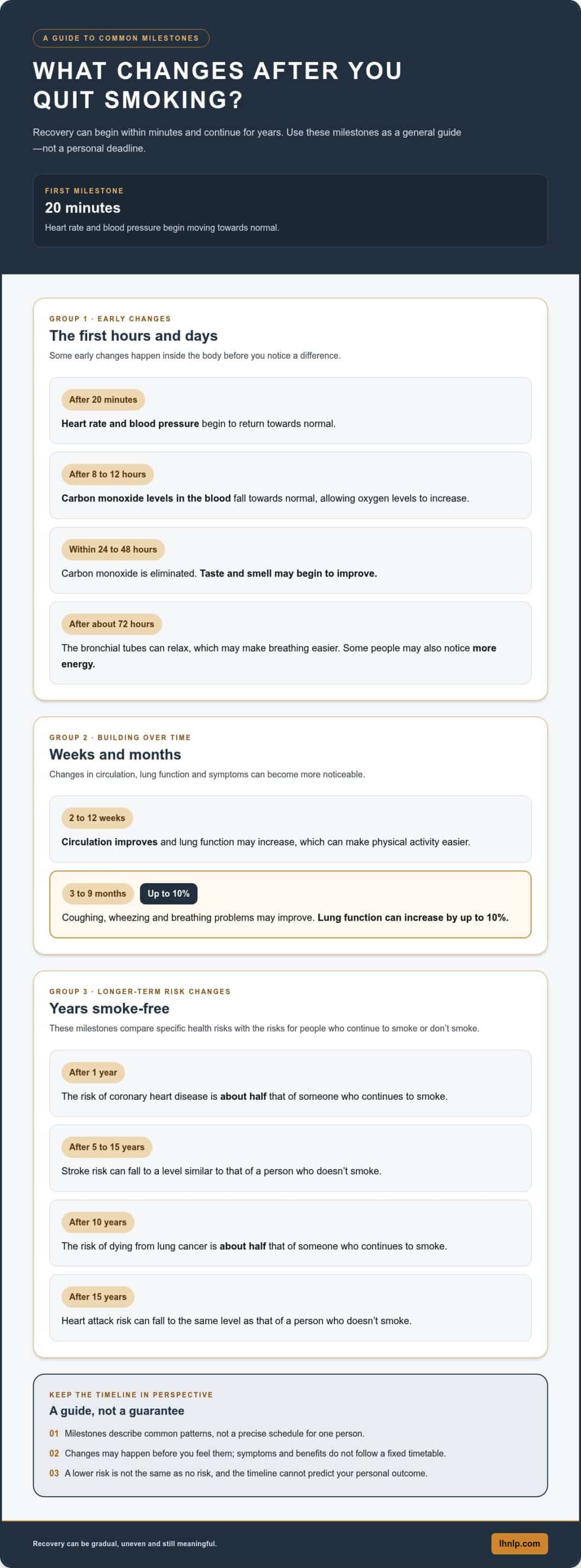
- After 20 minutes: Heart rate and blood pressure begin to return towards normal.
- After 8 to 12 hours: Carbon monoxide levels in the blood fall towards normal, allowing oxygen levels to increase.
- Within 24 to 48 hours: Carbon monoxide is eliminated, and taste and smell may begin to improve.
- After about 72 hours: The bronchial tubes can relax, which may make breathing easier. Some people may also notice more energy.
These changes don’t necessarily arrive as a sudden, obvious turning point. You might not feel different at 20 minutes or notice your senses changing at 48 hours. That doesn’t invalidate the underlying progress, and symptoms don’t follow a fixed timetable.
Changes over weeks, months and years
As smoke-free time builds, changes may become more noticeable in circulation, lung function and longer-term disease risks. The timeframes below are estimates, and the comparisons refer to specific outcomes and groups. A lower risk is not the same as no risk.
- 2 to 12 weeks: Circulation improves, and lung function may increase, which can make physical activity easier.
- 3 to 9 months: Coughing, wheezing and breathing problems may improve. Lung function can increase by up to 10%.
- After 1 year: The risk of coronary heart disease is about half that of someone who continues to smoke.
- After 5 to 15 years: Stroke risk can fall to a level similar to that of a person who doesn’t smoke.
- After 10 years: The risk of dying from lung cancer is about half that of someone who continues to smoke.
- After 15 years: Heart attack risk can fall to the same level as that of a person who doesn’t smoke.
These comparisons describe changes in risk, not a guarantee that past smoking has left no lasting effect. Smoking history and individual health matter, and the timeline can’t predict your personal outcome. If you’re exploring ways to stop smoking, smoking-cessation hypnotherapy is one possible personalised option alongside appropriate medical care.
Why recovery can feel different: cravings, coughs and withdrawal
Quitting can set positive changes in motion while leaving you uncomfortable in the short term. Cravings, irritability or restlessness don’t cancel out the health benefits of stopping smoking. They can reflect nicotine withdrawal as your body adjusts to life without cigarette smoke. That overlap can feel confusing, but discomfort alone doesn’t mean quitting is harming you.
Experiences differ. You might have strong cravings but little change in your breathing, or notice a cough without other withdrawal symptoms. The health improvements after quitting smoking timeline is a broad guide, not a way to interpret every sensation. Pay attention to how symptoms develop, and seek medical advice if something feels severe, gets worse or concerns you.
Are cravings or withdrawal symptoms normal after quitting?
Cravings are a possible part of nicotine withdrawal, alongside feelings such as irritability and restlessness. They can be especially challenging in the early days. NHS guidance describes withdrawal symptoms as often most intense during the first week, with cravings commonly peaking in the first two to three days. For many people, symptoms ease over the following three to four weeks, but there’s no set day when cravings stop for everyone.
A craving can feel urgent without lasting forever. Notice what tends to bring one on, such as a familiar routine or a stressful moment, and decide what could help you get through that particular urge. If withdrawal feels hard to manage, suitable stop-smoking support can help you plan for triggers and explore options. You don’t have to rely on willpower alone.
Can coughing or breathing feel different after quitting?
Respiratory symptoms may change after stopping, but there isn’t one pattern that applies to everyone. Some people experience a temporary cough; others may not. A cough can have different causes, so the symptom alone can’t show that the lungs are clearing or healing. Likewise, a cough or breathlessness shouldn’t automatically be dismissed as a normal part of quitting.
Take persistent, severe or worsening symptoms seriously. Contact your GP or NHS 111 for medical advice if you’re concerned about a cough or a change in breathing. If symptoms feel like an emergency, call 999. A general quitting timeline cannot diagnose what’s happening, and seeking advice is a sensible step, not a sign that your efforts to stop smoking have failed.
Separate two questions: “Could this feeling be related to withdrawal?” and “Does this symptom need medical attention?” Both can matter at once. Cravings may be part of adjustment, while a persistent or worrying physical symptom still deserves assessment. Reaching out for support, whether for withdrawal or a health concern, can help you keep moving towards a smoke-free life with greater confidence.
How to use the quitting timeline to support your progress
A timeline can offer encouragement, but it works best as a set of reference points rather than a pass-or-fail test. Your body’s recovery isn’t a race against a calendar, and you don’t need to feel every change listed in a health guide to know that staying smoke-free matters. Use milestones to notice progress, not to judge yourself.
Set realistic milestones without comparing your recovery
Public-health timelines describe common patterns across groups. They can give context, but they aren’t personal targets or guarantees. Instead of measuring yourself against another person’s symptoms, look for changes that matter in your own day-to-day life, however small they seem.
A simple note on your phone or in a journal can help you spot patterns over time. You might record:
- Smoke-free milestones, such as getting through a day or a familiar social occasion without smoking.
- Situations that bring on cravings, including routines, people or feelings.
- Changes in wellbeing, such as how you feel during a walk or whether taste and smell seem different.
Keep the record neutral. A difficult day doesn’t cancel out a better one, and a symptom isn’t proof that a specific health milestone has or hasn’t happened. The purpose is to build awareness and identify where you may need more support.
Where to find support for cravings and staying smoke-free
If cravings are making it difficult to continue, consider practical stop-smoking support through NHS services, your GP or a pharmacist. They can help you discuss suitable options for your circumstances. Seek medical advice for symptoms that are persistent, severe or worrying, rather than relying on a quitting timeline to explain them.
A lapse is not the same as losing all your progress. It doesn’t make future health benefits impossible or mean you must abandon your quit plan. Pause, consider what led to the cigarette, and choose a next step that helps you return to being smoke-free. If you’re using a support plan, tell the person supporting you what happened so you can adjust it together.
Some people also consider personalised hypnotherapy as one possible form of smoking-cessation support. It isn’t a substitute for medical care, and it won’t be the right approach for everyone. At London Hypnotherapy & NLP, three to six sessions are advisable for smoking cessation, though individual needs differ. Read about the smoking-cessation treatment approach as one option alongside appropriate healthcare and other suitable support.
Measure progress by the choices you make, not by whether your experience matches a published schedule. If personalised support feels useful, explore smoking-cessation support with London Hypnotherapy & NLP.
Personalised support for quitting smoking in London and online
Health information can help you understand what may change after your last cigarette, but staying smoke-free can also involve working through habits, triggers and the role smoking has played in daily life. London Hypnotherapy & NLP offers smoking-cessation hypnotherapy as one possible approach. It isn’t a replacement for conventional medical care, and no single method will suit everyone.
Kamal is a registered Clinical Hypnotherapist with over 25 years of experience. For smoking cessation, three to six sessions are advisable, though the number may differ from person to person. Support is personalised, so sessions can take account of your smoking patterns and what you hope to change, rather than treating the health improvements after quitting smoking timeline as a promise of how quickly you’ll feel different.
What personalised smoking-cessation support may involve
The approach may draw on Clinical Hypnotherapy, NLP, counselling and coaching. These methods can help explore the thoughts, routines and situations connected with smoking, while supporting you to consider new ways of responding. The work is tailored to the individual. It doesn’t assume that everyone smokes for the same reasons or experiences quitting in the same way.
During hypnosis, you remain fully aware and in control throughout. You can hear what is happening and choose how you respond. Hypnotherapy is an optional form of support, not a medical treatment or a substitute for advice from your GP, pharmacist or NHS stop-smoking service. If you’re managing a health condition or have concerns about withdrawal, continue to seek appropriate medical guidance.
This support can be one part of a wider quit plan. You can discuss the situations in which cravings arise and the changes you want to make, while continuing to use suitable medical or NHS support. The aim is to build an approach around your needs, not to promise a particular result or timetable.
In-person and online sessions with London Hypnotherapy & NLP
Sessions are available in person at 96 Harley St, London W1G 7HY, or online via Zoom or Skype. Each session lasts 45 minutes to an hour. Having both in-person and online formats gives you a choice of setting for personalised support.
Read about the smoking-cessation treatment approach and consider how it might fit alongside other appropriate support. The decision is personal, and it’s reasonable to consider how the approach relates to your own goals and circumstances.
If this kind of support feels relevant to your quit plan, explore smoking-cessation support as a possible next step.
Choose a next step that fits your quit journey
The health improvements after quitting smoking timeline can offer perspective, but your next step doesn’t need to wait for a particular milestone. Consider what would make staying smoke-free feel more manageable this week: preparing for a familiar trigger, asking someone you trust for encouragement, or exploring structured support. Small, deliberate choices can help turn your intention into a routine.
Personalised hypnotherapy can sit alongside appropriate medical care and other support. Kamal is a registered Clinical Hypnotherapist with over 25 years of experience. Three to six sessions are advisable for smoking cessation, although individual needs vary, and outcomes aren’t guaranteed.
There’s no single path or perfect pace. Choose support that feels appropriate to you, and keep returning to your smoke-free goal even if progress has difficult moments. Explore personalised smoking-cessation support with London Hypnotherapy & NLP.
Frequently Asked Questions
How soon after quitting smoking do health improvements begin?
Some measurable health changes can begin within 20 minutes of your last cigarette, when heart rate and blood pressure start moving towards normal. The health improvements after quitting smoking timeline also includes changes in blood carbon monoxide within hours. These shifts may not create an immediate sensation, so don’t use how you feel in the moment as the only measure of progress. Benefits continue to build over time.
What happens to your body in the first 24 hours after quitting smoking?
In the first day, heart rate and blood pressure begin to settle, and carbon monoxide in the blood falls. NHS timeline guidance says carbon monoxide levels drop to normal within 8 to 12 hours, allowing oxygen levels to rise. By 24 hours, these internal changes may not feel dramatic. Taste and smell changes are often described over the following 24 to 48 hours, rather than as a guaranteed first-day effect.
How long does it take for breathing to improve after quitting smoking?
There isn’t one exact point when everyone’s breathing improves. Bronchial tubes may relax after about 72 hours, which can make breathing easier, while circulation and lung function can improve over the following weeks. Coughing, wheezing or breathing problems may improve over 3 to 9 months, but timing and noticeable changes differ. If breathlessness persists, worsens or worries you, seek medical advice instead of waiting for a milestone.
Can coughing get worse after you quit smoking?
A cough can change after quitting, and some people notice a temporary increase, but it isn’t possible to tell from the cough alone what’s causing it. Don’t assume that every cough means your lungs are clearing, or dismiss a persistent or worsening cough as part of quitting. Note when it began and whether it’s changing, then contact your GP or NHS 111 if you’re concerned. Seek urgent help for severe symptoms.
Does quitting smoking reduce health risks even after many years?
Yes. Quitting can reduce some smoking-related risks over time, even after many years of smoking. For example, after 10 years, the risk of dying from lung cancer is about half that of someone who continues to smoke; after 15 years, heart attack risk can fall to the level of someone who doesn’t smoke. These are comparisons, not guarantees, and quitting doesn’t erase all past exposure or eliminate risk.
Do health improvements after quitting smoking happen at the same rate for everyone?
No. General timelines describe patterns, not a personal schedule. Your smoking history and individual health can affect how recovery unfolds and which changes you notice first. One person may find physical activity easier before noticing a change in coughing, while another may not feel an obvious difference for some time. Use milestones as context, not a test. Seek medical advice about symptoms rather than using a timeline to interpret them.
Can hypnotherapy help someone quit smoking?
Hypnotherapy may be a helpful option for some people, but it won’t suit or work for everyone, and it isn’t a substitute for conventional medical care. London Hypnotherapy & NLP offers personalised smoking-cessation support that may combine Clinical Hypnotherapy, NLP, counselling and coaching. Three to six sessions are advisable, though individual needs differ. During hypnosis, clients remain fully aware and in control throughout; outcomes aren’t guaranteed.