

NLP techniques for anxiety are best understood as reflective exercises, not as a proven replacement for anxiety care. If you’ve found conflicting claims online, or worry that an exercise might bring up more than you’re ready to face, that uncertainty makes sense. Here, “NLP” means Neuro-Linguistic Programming, not the artificial intelligence field that uses the same abbreviation.
This article explains what Neuro-Linguistic Programming means in this context, what the evidence can and can’t tell us, and how to approach gentle exercises at your own pace. You’ll also learn what one-to-one NLP coaching with London Hypnotherapy & NLP can involve, and when anxiety may call for support from a GP or mental health professional.
We’ll look at commonly associated techniques and give practical steps for trying them thoughtfully. They shouldn’t be treated as a substitute for established care. You’re in charge of how far you go: pause or stop if an exercise feels uncomfortable. Small, considered steps can help you decide what kind of support feels right.
Key Takeaways
- Understand how Neuro-Linguistic Programming approaches language, attention and patterns of response.
- Explore NLP techniques for anxiety as reflective exercises, not established treatments or guaranteed solutions.
- Learn a gentle way to examine a mild concern, consider a balanced perspective and pause if discomfort rises.
- See how one-to-one NLP coaching can offer guided exploration of personal goals and responses.
- Recognise when self-help may not be enough and professional or medical support could be appropriate.
What Are NLP Techniques for Anxiety and Their Goals?
Anxiety can feel automatic: a thought appears, the body reacts, and attention narrows before you’ve had time to choose what to do next. Becoming curious about that sequence can be a useful starting point. It doesn’t mean the anxiety is your fault, or that you can simply think it away. It means noticing your responses with care.
In this context, NLP techniques for anxiety means exercises associated with Neuro-Linguistic Programming that explore how language, attention, mental imagery and learned responses may shape someone’s experience. NLP isn’t a single standardised clinical protocol. Trying an exercise isn’t a diagnosis or a guaranteed treatment.
The following video discusses NLP approaches to anxiety. Treat its suggestions as ideas to consider, rather than clinical guidance or a promise of results.
What does NLP mean in an anxiety context?
“Neuro-Linguistic Programming” is commonly explained through three ideas: “neuro” refers to experience and perception, “linguistic” to language, and “programming” to patterns of response. The name can sound more definitive than the approach is. Practitioners may invite someone to notice the words they use, the images they bring to mind, what they focus on, and how they respond in particular situations. A general overview is available in Neuro-linguistic programming (NLP) on Wikipedia.
These ideas don’t explain every person’s anxiety. Anxiety can relate to circumstances, health, past experiences and many other factors, and can affect people in very different ways. A recurring thought may be one part of someone’s experience, not its sole cause.
What can these techniques reasonably aim to support?
Used reflectively, an exercise might help you describe a reaction, notice what draws your attention, or consider a situation from another perspective. For example, you could identify the words that come to mind before a difficult conversation, then look for a more balanced way to frame what’s ahead. The aim is exploration, not forcing yourself to feel calm.
Someone may find an exercise personally useful, but that experience alone doesn’t establish that NLP treats an anxiety disorder. Keep the distinction clear: a coaching exercise is not a diagnosis, a guaranteed outcome, or a replacement for appropriate medical or mental health care. For a wider view of available approaches, explore these anxiety support options.
In one-to-one NLP coaching, a practitioner can guide you in exploring your goals and responses. You can decide what feels relevant and say when you’d rather pause. The purpose is to consider possible perspectives, not to claim that anxiety has one simple cause or solution.
How Common NLP Techniques for Anxiety Work in Practice
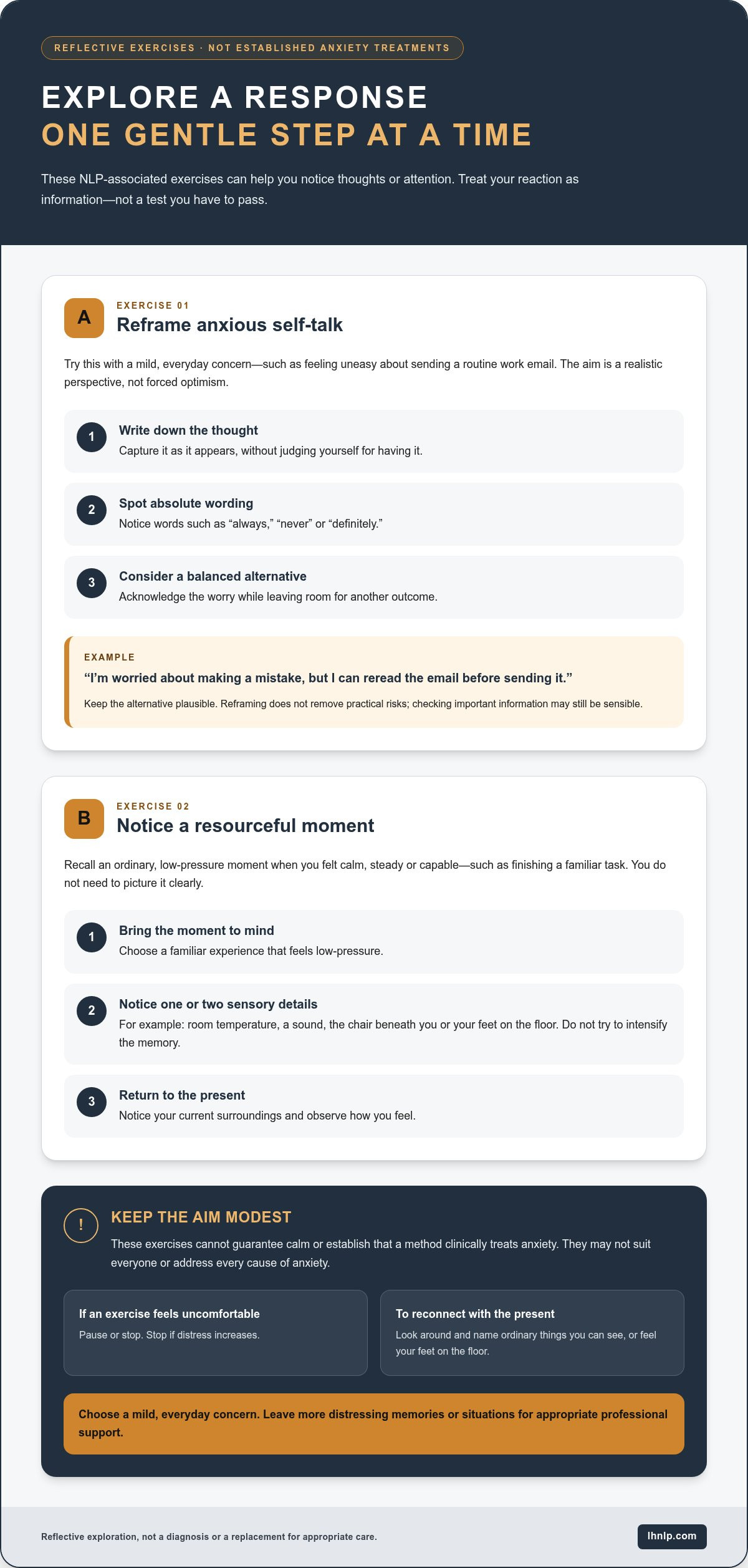
The exercises below are examples associated with NLP, not established anxiety treatments. They offer structured ways to notice thoughts and attention, but they won’t suit everyone or address every cause of anxiety. Choose a mild, everyday concern, such as feeling uneasy about sending a routine work email. Leave more distressing memories or situations for appropriate professional support.
A reflective exercise can help you explore your response, but it isn’t evidence that a method clinically treats anxiety. Try each step gently, and treat your reaction as information, not a test you have to pass.
Reframing anxious self-talk without dismissing the feeling
This exercise focuses on the wording of a thought, not on forcing optimism. Notice an absolute prediction, such as “I’ll definitely get this email wrong.” Ask what a more balanced, compassionate version might sound like. For example: “I’m worried about making a mistake, but I can reread the email before sending it.”
- Write down the thought as it appears, without judging yourself for having it.
- Notice absolute words such as “always”, “never” or “definitely”.
- Consider a realistic alternative that acknowledges the worry and leaves room for another outcome.
The alternative should feel plausible, not artificially positive. Reframing can’t establish whether the concern is realistic or remove practical risks. If the email contains important information, checking it may be sensible. The exercise is about widening your perspective, not dismissing the facts.
Using sensory attention and a resourceful-state exercise
Some NLP-associated exercises invite you to recall a manageable moment when you felt calm, steady or capable. Choose an ordinary memory, such as finishing a familiar task. You don’t need to picture it clearly. Instead, gently notice any details that come to mind: the room’s temperature, a sound, the chair beneath you or the feeling of your feet on the floor.
- Bring to mind a familiar, low-pressure moment of ease or confidence.
- Notice one or two neutral sensory details, without trying to intensify the memory.
- Return attention to your current surroundings and observe how you feel.
This isn’t a way to guarantee calm, and some people may find recalling a memory uncomfortable or unhelpful. Stop if distress increases. Look around and name ordinary things you can see, or feel your feet on the floor, to reconnect with the present.
Keep the aim modest: observe whether a different perspective or point of attention feels useful to you, without treating that response as proof of clinical effectiveness. If you’d prefer guided exploration of your goals and responses, learn about personalised NLP coaching.
Are NLP Techniques for Anxiety Evidence-Based, and How Do They Compare?
It’s reasonable to ask whether a technique that sounds helpful is supported by evidence that it treats anxiety. Personal accounts can describe someone’s experience, but testimonials don’t establish that an approach works reliably for different people, or that it treats an anxiety disorder. The important distinction is between a reflective exercise someone finds useful and evidence of clinical effectiveness.
What can research establish about NLP for anxiety?
Research needs to be judged by what it tested, how it was designed and how certain its findings are. A 2024 systematic review and meta-analysis reported reduced anxiety symptoms in studies of self-administered interventions based on NLP models, but rated the overall certainty of the evidence as very low, citing limitations such as risk of bias and differences between studies. Crucially, “NLP” in digital health research can mean natural language processing, the technology used by computers to work with language. That is not Neuro-Linguistic Programming, so those findings can’t be taken as proof that NLP coaching treats anxiety.
For Neuro-Linguistic Programming specifically, the evidence described here doesn’t justify calling it proven, ineffective, or equivalent to established treatments. NICE guidance for anxiety disorders includes psychological therapies such as CBT and, where appropriate, medication. This helps distinguish an exploratory coaching approach from care recommended in clinical guidance.
How is NLP coaching different from CBT or NHS talking therapies?
NLP coaching may use a personalised conversation to explore a person’s goals, language and responses. CBT is a structured psychological therapy that examines the links between thoughts, feelings and behaviour, and supports people to develop and practise coping strategies. NHS Talking Therapies services in England provide access to evidence-based psychological support, including CBT for anxiety and depression. These approaches differ in purpose and evidence base; this comparison isn’t an individual treatment recommendation.
The table offers a broad orientation, not a ranking. The right kind of support depends on a person’s circumstances and needs.
| Approach | Broad purpose | Evidence status and when guidance may matter |
|---|---|---|
| NLP coaching | Explore goals, language and responses through coaching. | Evidence for treating anxiety disorders is uncertain. Consider clinical guidance if anxiety is persistent or disrupting daily life. |
| Self-guided NLP-associated exercise | Reflect on a thought or try another perspective. | A personal response doesn’t establish treatment effectiveness. Stop if distress increases. |
| CBT or NHS Talking Therapies | Structured psychological support for anxiety and related difficulties. | NICE guidance includes CBT for anxiety disorders. A GP or mental health professional can help discuss suitable care. |
NLP coaching can be considered as a separate form of guided exploration, not as a replacement for a GP, mental health professional or prescribed care. For an overview of the practice’s hypnotherapy and NLP approaches, see the treatments information.
How Can You Try NLP Techniques for Anxiety Thoughtfully and Safely?
A useful self-reflection exercise should leave you free to stop, not obliged to push through. If you choose to try NLP techniques for anxiety, focus on a mild, everyday concern and treat the exercise as a prompt for reflection, not a test or a substitute for care. Skip any step, pause, or stop as soon as discomfort rises.
A brief reflection exercise for an everyday worry
Choose one specific, low-pressure situation, such as an upcoming routine phone call. Don’t trace its entire history or bring up traumatic experiences. Notice the thought and feeling that arise, consider one plausible alternative, then record whether the process felt useful, neutral or uncomfortable. There’s no right result, and you don’t need to change how you feel.
- Name a mild situation you’re comfortable reflecting on, using a short description.
- Notice the thought and feeling that come up. You might write, “I’m worried I’ll stumble over my words.”
- Ask whether another reasonable interpretation is possible, without insisting on a positive one. For example: “I might feel nervous, and I can still make the call.”
- Reflect briefly on how the exercise felt. If unease increases, stop and bring your attention to your present surroundings.
A balanced alternative isn’t a promise that everything will go smoothly. It’s simply another way to hold the thought, while allowing that uncertainty and practical concerns may still be present. Don’t use the exercise to suppress symptoms, force yourself to feel calm, or decide that an underlying concern is unfounded.
When should you pause self-help and seek support?
Pause self-help if an exercise intensifies distress or feels difficult to manage. Consider speaking with a GP or mental health professional if anxiety persists, worsens, or disrupts everyday activities such as work, sleep or relationships. You don’t need to wait until things feel unmanageable. A professional can help you discuss what support may be appropriate.
Keep any prescribed treatment in place unless the clinician responsible for your care advises otherwise. Coaching or a self-guided exercise shouldn’t replace medical advice or established mental health support. If you’re unsure what help you need urgently in England, NHS 111 can guide you to an appropriate next step. For immediate danger or a life-threatening emergency in the UK, call 999.
If you’d like guided exploration of your goals and responses, you can explore one-to-one NLP coaching as a separate form of support, while keeping clinical care needs distinct.
What Can NLP Anxiety Support Look Like with a Practitioner in London or Online?
Self-guided reflection is something you try on your own; one-to-one NLP coaching adds a conversation in which you can describe your goals and responses while a practitioner guides the exploration. It’s a different kind of support from mental health treatment. A session isn’t a psychiatric assessment, and coaching doesn’t provide a psychiatric diagnosis or medical prescriptions. Keeping those roles clear helps you choose the kind of support you’re looking for.
What might a personalised NLP coaching conversation involve?
A conversation may begin with what you’d like to understand or approach differently, then explore a particular situation and how you respond to it. The practitioner can discuss reflective approaches that feel comfortable to you, while you decide what you’re willing to explore. There’s no need to disclose more than you choose.
The process should be collaborative and responsive to your preferences. You can ask questions, decline an exercise, or pause the discussion. NLP techniques for anxiety aren’t a fixed script, and a coaching conversation can’t promise a particular outcome. Its focus is guided exploration of your goals and responses, not diagnosing an anxiety disorder or replacing medical or mental health care.
How can you explore support that fits your circumstances?
Choose the format that suits your circumstances. London Hypnotherapy & NLP offers in-person appointments at locations including Harley Street, Ealing and Tokenhouse Yard. Virtual consultations via Zoom and Skype are another option if you’d prefer to talk remotely.
It may help to distinguish between the support options. Anxiety and NLP treatments gives an overview of the approaches, while online hypnotherapy sessions describe a virtual route for hypnotherapy. NLP coaching and hypnotherapy are distinct approaches, and neither should be presented as a substitute for medical advice or clinical care when that’s what you need.
You don’t have to arrive with a complete plan. It can be enough to identify what you hope to explore and what would help you feel comfortable in a guided conversation. If anxiety is significantly affecting your day-to-day life, consider speaking with a GP or mental health professional about appropriate support as well.
To learn more about the practice and its approach, explore the practice. You can consider whether guided NLP coaching feels like a useful next step, without assuming in advance what the outcome will be.
Choose a Next Step That Feels Right for You
You don’t need to decide everything at once. A useful next step might be to note what you want help with, what feels comfortable to explore, and whether you’d prefer to begin with a conversation or discuss clinical support with a health professional. Let your needs, not pressure to make quick progress, guide that choice.
NLP techniques for anxiety may offer prompts for reflection, but they can’t guarantee change or replace appropriate mental health care. You’re allowed to be curious and cautious at the same time. If anxiety is affecting your wellbeing, seeking support is a considered step, not a failure to manage things alone.
If personalised guidance feels like a helpful place to begin, explore one-to-one NLP coaching with London Hypnotherapy & NLP. Take the time you need to choose an approach that respects your comfort and circumstances.
Frequently Asked Questions
Can NLP help with anxiety?
Some people use NLP-associated exercises to reflect on anxious thoughts or responses, but they shouldn’t be presented as a proven treatment for anxiety. Research claims need careful interpretation: studies may test different techniques, populations or outcomes, and a reported benefit doesn’t guarantee a similar experience for you. If anxiety persists or interferes with daily life, discuss appropriate support with a GP or mental health professional. NLP techniques for anxiety are not a replacement for clinical care.
What is the best NLP technique for anxiety?
There isn’t one NLP technique that’s best for everyone. Some people may prefer reframing a worry in more balanced language; others may find a gentle exercise recalling a manageable moment more comfortable. Your response matters more than following a technique perfectly. Keep any self-reflection low intensity, and stop if distress rises. A technique that feels helpful to one person isn’t necessarily suitable for another, and it shouldn’t replace care you need.
Can I use NLP techniques for anxiety on my own?
You can try gentle reflective exercises independently if you feel comfortable, but taking part is entirely optional. For example, you might note a mild concern about an upcoming appointment and consider one realistic alternative thought. Don’t revisit traumatic experiences alone or push yourself to continue through rising anxiety. Pause if you feel worse. Self-help is different from personalised guidance or clinical treatment, so seek professional support if anxiety is persistent or affecting everyday life.
How is NLP different from CBT for anxiety?
NLP refers to a collection of communication and change techniques, while cognitive behavioural therapy (CBT) is a structured psychological approach with its own established practice framework and a stronger evidence base for anxiety care. Their aims and methods aren’t interchangeable, and this distinction doesn’t mean one option is right for everyone. If symptoms affect work, relationships or daily routines, a qualified health professional can help you discuss appropriate support options.
Is NLP scientifically proven to treat anxiety?
Research on NLP as a broad approach isn’t automatically evidence that it treats anxiety. A 2024 systematic review reported reduced symptoms in studies of self-administered interventions based on NLP models, but judged the overall certainty of evidence very low because of limitations including bias and differences between studies. It’s also important to check what “NLP” means in each study. Testimonials, popularity or search listings alone can’t establish effectiveness.
When should I seek professional help for anxiety?
Seek appropriate support if anxiety persists, worsens or makes daily activities difficult, such as working, sleeping or maintaining relationships. You don’t need to wait until it feels overwhelming. A GP can discuss your concerns and possible next steps. In England, if you urgently need help but aren’t sure where to turn, follow current NHS 111 guidance. If there’s immediate danger or a life-threatening emergency in the UK, call 999.
Can I have NLP anxiety support online in the UK?
Yes. London Hypnotherapy & NLP offers virtual consultations via Zoom and Skype, as well as in-person appointments in London. An online conversation can make access more convenient, but it doesn’t guarantee that coaching will suit your needs or produce a particular outcome. If you choose a virtual session, consider whether you have a private space to talk. For urgent or emergency health concerns, use appropriate NHS services rather than relying on coaching.