

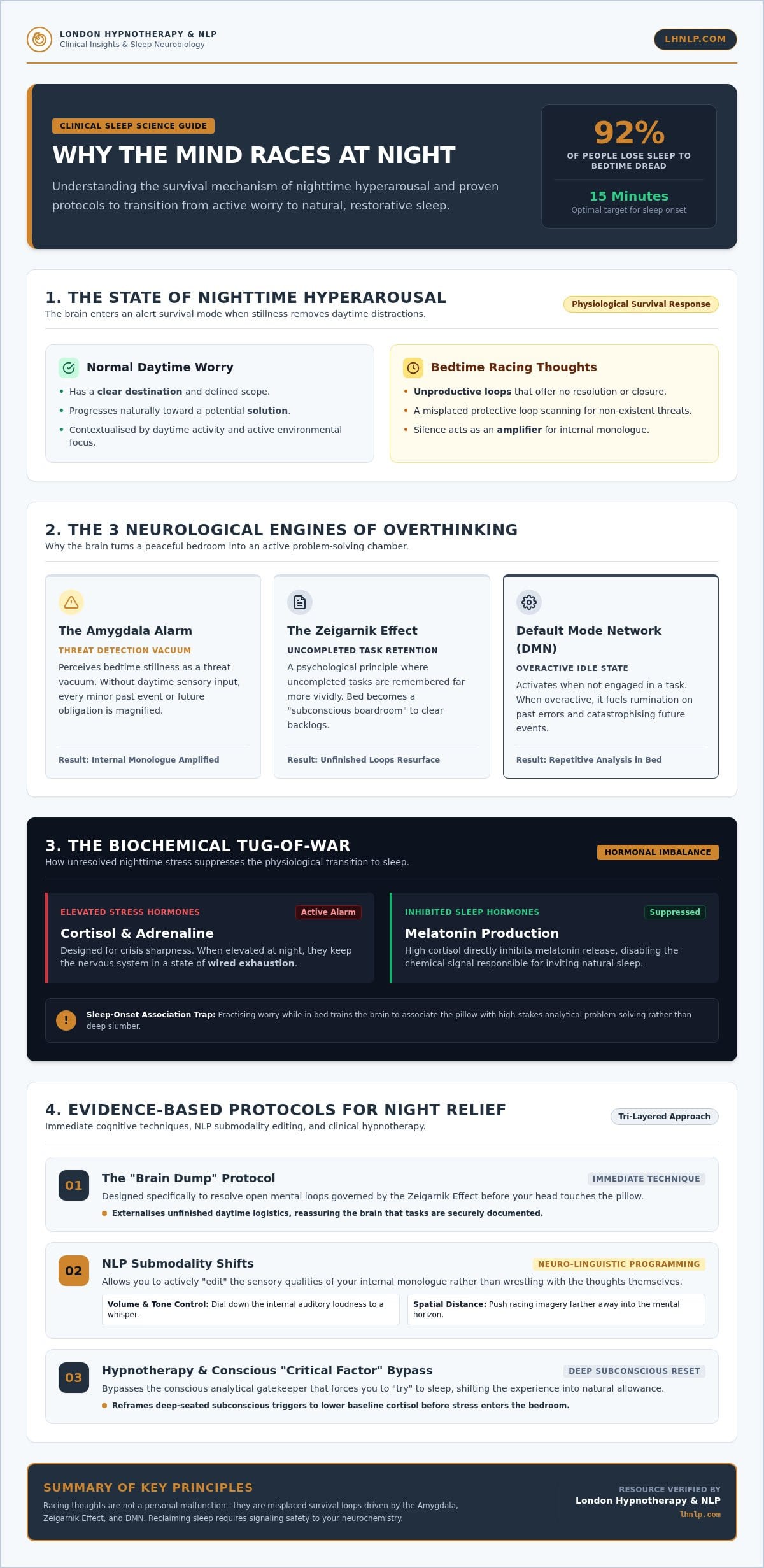
Imagine the house is silent, the lights are out, and you’ve done everything “right,” yet your brain suddenly decides it’s the perfect time to audit every conversation you’ve had this week. If you’re lying awake wondering how to stop my mind racing at night, you aren’t alone; recent data shows that 92% of people lose sleep due to this specific type of bedtime dread. It’s an exhausting cycle that leaves you feeling irritable and out of control before the sun even rises. You’re likely weary of the chronic fatigue that follows a night of mental gymnastics, feeling like a passenger in your own head.
We understand that this isn’t just about being “tired,” it’s about a survival mechanism in your brain that has forgotten how to switch off. This guide explores why your internal monologue becomes a shouting match at 2 AM and introduces professional NLP and hypnotherapy-backed techniques to quiet that noise. By learning to reframe your subconscious responses, you can reclaim the ability to fall asleep within 15 minutes and wake up feeling genuinely refreshed. We’ll move beyond basic sleep hygiene to provide tools that manage stress before it ever hits the bedroom.
Key Takeaways
- Recognise the “hyperarousal” state where your brain remains in an alert survival mode; this creates a physical barrier between exhaustion and restorative rest.
- Master immediate, practical protocols for how to stop my mind racing at night, including the “Brain Dump” technique designed to resolve mental loops.
- Uncover the science of the Default Mode Network (DMN) and how shifting your internal focus can lower the cortisol levels that fuel nighttime anxiety.
- Discover how NLP submodality shifts allow you to “edit” the volume and tone of your internal monologue, making racing thoughts feel distant and manageable.
- Understand the role of professional hypnotherapy in bypassing the conscious “critical factor,” shifting your experience from the struggle of trying to sleep to the natural process of allowing it.
Understanding Why Your Mind Races at Night
The phenomenon of racing thoughts is far more than just a busy mind; it’s a rapid, often uncontrollable succession of ideas that loop back on themselves, creating a mental carousel that refuses to slow down. As you lay down to rest, your body might feel heavy with the day’s fatigue, yet your brain enters a state of hyperarousal. This is a physiological survival response where the nervous system remains on high alert, scanning for potential threats that don’t actually exist in your quiet bedroom. You might find yourself replaying a social interaction from three years ago or catastrophising about a work presentation scheduled for next week. If you’re searching for how to stop my mind racing at night, it’s vital to realise that your brain isn’t malfunctioning. It’s simply stuck in a misplaced protective loop.
To better understand this concept, watch this helpful video:
The Difference Between Normal Worry and Racing Thoughts
Normal worry usually has a clear destination; you identify a problem and eventually move toward a potential solution. Racing thoughts, by contrast, are unproductive loops that offer no resolution. This happens because the amygdala, your brain’s ancient alarm system, perceives the stillness of the night as a vacuum that must be filled with “threat detection.” Without the ambient noise and distractions of daytime London life, every small concern is magnified. The silence doesn’t bring the peace you crave; instead, it acts as an amplifier for your internal monologue, making every thought feel louder and more urgent than it truly is.
The Psychological ‘To-Do List’ Trap
Our minds are subject to the Zeigarnik Effect, a psychological principle suggesting that we remember uncompleted tasks far more vividly than those we’ve finished. For many professionals, the feeling of never being “done” creates a heavy psychological backlog that the mind attempts to clear once the lights go out. Your brain uses the night to process these unresolved daytime emotions and logistics. In a city where the pace of life is relentless, the pressure to stay ahead can turn your bed into a subconscious boardroom. It’s a natural reaction to the modern “always-on” culture, where the boundary between productivity and rest has become dangerously thin. Learning how to stop my mind racing at night requires us to address these unfinished loops with intention.
The Science of Nighttime Anxiety and Rumination
When the sun sets and the city slows down, your internal chemistry should ideally follow suit. However, for many, the transition from high-stakes productivity to restorative rest is blocked by a surge of cortisol and adrenaline. These hormones are designed to keep us sharp during a crisis, yet they often overstay their welcome well into the late hours. If you’re searching for how to stop my mind racing at night, you’re essentially looking for a way to signal to your nervous system that the “threat” of the workday has passed. When cortisol levels remain elevated, they inhibit the production of melatonin, the hormone responsible for inviting sleep, leaving you in a state of wired exhaustion.
This mental speed is further fueled by the Default Mode Network (DMN), a collection of brain regions that becomes active when we aren’t focused on a specific task. While the DMN is vital for creativity and self-reflection, an overactive DMN can lead to repetitive nighttime anxiety and racing thoughts. Instead of resting, the brain begins to ruminate on past events or future worries, mistaking the quiet of the bedroom for an opportunity to solve every unresolved problem in your life. We often accidentally reinforce this by “practising” worry in bed, creating a sleep-onset association where the brain identifies the pillow as a place for analysis rather than slumber.
Cortisol vs. Melatonin: The Internal Tug-of-War
The delicate balance of your circadian rhythm is easily disrupted by modern habits. Checking a late-night work email or scrolling through a bright screen doesn’t just provide information; it triggers a physiological “fight or flight” response. This spike in cortisol mid-evening acts like a mental alarm clock. Trying to force yourself to sleep during this chemical peak only increases your anxiety, as the frustration of being awake creates even more stress. It’s a self-perpetuating loop where the effort to find rest becomes the very thing that keeps it out of reach.
The London Lifestyle: City Stress and the Racing Mind
Living and working in a global hub brings a unique set of pressures that can keep the nervous system in a state of permanent alert. The sensory overload of a London commute, combined with an “always-on” professional culture, means many of us never truly decompress before reaching the front door. This chronic environmental stress shortens the fuse of our mental resilience, making it harder to down-regulate at night. If you feel that the pace of the city has hijacked your ability to rest, exploring specific strategies for stress management in London can provide the necessary bridge between a frantic day and a peaceful night. Reclaiming your evening starts with understanding that your mind is simply trying to keep up with a world that doesn’t want to stop. If you find this balance difficult to strike alone, professional NLP coaching can help you install new mental boundaries that protect your peace.
Immediate Techniques to Quiet a Busy Brain
While understanding the science of hyperarousal is helpful, you need practical strategies to calm racing thoughts when the clock strikes 3 AM. One of the most effective methods is the “Brain Dump” protocol. By physically writing down every task, worry, or “what-if” scenario on a piece of paper before bed, you signal to your brain that the information is safely stored. This resolves the Zeigarnik Effect, which is the mind’s tendency to keep uncompleted tasks in active memory. Once it’s on paper, your subconscious can finally release the need to rehearse it.
If you’re already in bed and searching for how to stop my mind racing at night, try the adapted 5-4-3-2-1 grounding technique. Instead of scanning the room, focus on immediate sensory sensations: identify five things you can feel, such as the weight of the duvet or the pillow against your cheek, and four sounds, like your own breath or the distant hum of the city. This shifts your awareness from abstract future anxieties into the physical present. If logic-based worry persists, use “Cognitive Shuffling.” This involves imagining random, unrelated images, a red apple, a sailing boat, a library book, to disrupt the brain’s attempt to build a coherent, stressful narrative.
It’s also crucial to follow the “12-minute rule.” If you’ve been lying awake for more than twelve minutes feeling frustrated or alert, get out of bed. Go to a different room, keep the lights low, and engage in a mundane task until you feel a genuine wave of sleepiness. This prevents your brain from forming a permanent association between your bed and the feeling of being “stuck” in a racing mind.
Physical Grounding for Mental Stillness
Progressive Muscle Relaxation (PMR) is a powerful tool to signal safety to your nervous system. By systematically tensing and releasing each muscle group from your toes to your jaw, you force the body out of a “fight or flight” state. This physical release directly impacts the Vagus Nerve, which acts as the primary highway for the parasympathetic nervous system. Stimulating the Vagus Nerve serves as a biological kill switch for the racing mind, instantly lowering your heart rate and blood pressure.
The Power of the ‘Mental Filing Cabinet’
Visualization can bridge the gap between daytime stress and nighttime peace. Imagine a sturdy, ornate filing cabinet in your mind; place each intrusive thought into a folder, label it, and lock it away until 9 AM tomorrow. You can reinforce this by setting a dedicated “worry time” during your lunch break, ensuring your brain knows there’s a scheduled slot for problem-solving. At London Hypnotherapy & NLP, we help clients master these subconscious shifts to reclaim their sleep. You can learn more about us and how our practitioners teach these bespoke tools to professionals across the city.
Rewiring Your Nighttime Response with NLP
While grounding techniques address the immediate physical symptoms of hyperarousal, Neuro-Linguistic Programming (NLP) allows you to intervene at the level of the mind’s internal coding. NLP treats your thoughts like a digital film that can be edited, adjusted, and reframed. If you are struggling with how to stop my mind racing at night, it’s often because you are a passive observer of a mental “movie” that feels overwhelming. By learning to manipulate the submodalities of your thoughts, the specific way your brain represents information, you can strip these intrusive ideas of their power before they spiral into a sleepless night.
One primary tool is the Swish Pattern. This involves taking a mental image of your nighttime anxiety and instantly “swishing” it away, replacing it with a vibrant, calm image of yourself at total peace. With repetition, your brain begins to automatically bypass the stressor and move toward the relaxed state. You can also utilise “Anchoring” to create a physical trigger for tranquility. By pressing your thumb and forefinger together while in a state of deep relaxation, you create a neurological link. When you repeat this gesture in bed, your nervous system receives a clear signal to down-regulate, providing a reliable path back to slumber.
Changing the Internal Soundtrack
The voice of your racing thoughts often has specific qualities: it might be fast, high-pitched, or positioned uncomfortably close to your ear. You have the power to change this internal soundtrack. Try mentally turning down the “volume” of your thoughts or changing the tempo until the words become slow and unintelligible. This creates a sense of “Dissociation,” where you become the observer of the thought rather than the victim of it. Shifting your language from “I am worried” to “I am having a thought about being worried” creates a vital psychological distance that prevents the mind from entering a loop.
Reframing the Bedroom as a Sanctuary
Many professionals accidentally turn their bedrooms into a mental boardroom, training the brain to associate the pillow with high-level problem-solving. NLP helps you install a mental “threshold” at your bedroom door, a boundary that daytime concerns are simply not permitted to cross. By consciously reframing the bed as a sanctuary dedicated solely to rest, you break the old neurological pathways of nighttime rumination. For a more comprehensive look at how these techniques integrate with clinical methods, you can explore Hypnotherapy London to see NLP’s role in modern sleep treatment. If you are ready to break these patterns permanently, our NLP coaching sessions provide the practical framework needed to retrain your subconscious mind and reclaim your evenings.
How Professional Hypnotherapy Provides Lasting Relief
While self-applied NLP techniques and grounding exercises offer vital immediate support, professional hypnotherapy addresses the deeper architecture of your sleep patterns. Many people find that despite their best efforts, a part of their mind remains “on guard” throughout the night. In clinical terms, we refer to this as the Critical Factor, the analytical gatekeeper of the conscious mind that often rejects new suggestions of calm. Professional hypnotherapy allows us to gently bypass this barrier, communicating directly with the subconscious to resolve the underlying hyperarousal. If you are searching for how to stop my mind racing at night, the solution often involves shifting from the active struggle of “trying” to sleep to the natural state of “allowing” it to happen.
Sleep is a biological process that cannot be forced by willpower; in fact, the more conscious effort you apply, the more elusive rest becomes. By addressing the root causes of your anxiety rather than just the symptoms, hypnotherapy helps realign your internal clock. We often use a process called “Future Pacing” during our sessions. This involves guided imagery where you mentally rehearse the experience of falling asleep with ease and waking up refreshed. This mental rehearsal creates a new neurological blueprint, making a peaceful night feel like a safe, familiar, and achievable reality for your brain.
What to Expect in an Insomnia Hypnotherapy Session
It’s natural to have questions about entering a hypnotic state, but the process is far removed from stage performances. You remain in complete control and fully aware of your surroundings throughout the session. Kamal uses solution-focused techniques designed to create rapid, meaningful shifts in how your brain processes nighttime stress. Instead of dwelling on the problem, we focus on mobilising your internal resources to build resilience. If you have specific concerns about the experience, you can find detailed answers in our FAQs regarding the hypnotic state and its benefits for sleep.
Virtual vs. In-Person: Finding Your Path to Calm
We recognise that the relentless pace of life in the capital can make scheduling a priority. To accommodate busy London professionals, we offer highly effective Online Hypnotherapy Services that allow you to engage in treatment from the comfort of your own home. For those who prefer a face-to-face connection, in-person consultations are available at our clinical spaces in Harley Street and Ealing. Both paths provide the same specialist support for insomnia treatment and stress management, tailored to your unique psychological landscape. If you’re ready to quiet the internal noise and reclaim your vitality, please Contact London Hypnotherapy & NLP to begin your journey toward a more restful life. Understanding how to stop my mind racing at night is the first step; taking action to retrain your subconscious is the second.
Reclaiming Your Right to Restful Sleep
The transition from the frantic energy of a London day to a peaceful night is not always automatic, but it’s entirely possible. We’ve explored how racing thoughts are simply an overactive survival mechanism, a brain that’s forgotten how to disarm. By implementing grounding protocols and using NLP to edit your internal soundtrack, you can begin to break the cycle of hyperarousal. Learning how to stop my mind racing at night is ultimately about moving from a state of active struggle to one of subconscious allowance. You possess the internal resources to quiet the noise; sometimes, you just need the right guide to help you access them.
Since 2005, London Hypnotherapy & NLP has provided expert clinical support to those feeling out of control of their own thoughts. Whether you prefer a face-to-face session at our Harley Street or Ealing locations or the convenience of a global Zoom consultation, our specialized techniques are designed for rapid, lasting mindset shifts. You don’t have to face chronic fatigue and irritability alone. Book a Consultation with London Hypnotherapy & NLP today to start your journey toward the deep, refreshing sleep you deserve. Rest is waiting for you.
Frequently Asked Questions
How can I stop my mind from racing at night without medication?
You can utilise cognitive reconditioning tools like the “Brain Dump” or somatic grounding exercises. These methods address the psychological root of hyperarousal rather than masking symptoms. Clinical hypnotherapy offers a drug-free pathway by retraining the subconscious to accept relaxation as the default nighttime state. It’s about signalling safety to your nervous system so the brain can naturally down-regulate without pharmaceutical intervention. This solution-focused approach empowers you to reclaim control over your own mental environment.
Why does my anxiety get worse as soon as I lie down to sleep?
Anxiety often intensifies at night because the external distractions of your London day vanish, leaving a sensory vacuum. Without emails or commutes to focus on, your brain’s Default Mode Network becomes overactive, scanning for unresolved threats. This shift into “threat detection” mode makes small worries feel urgent. It’s a misplaced survival response where the mind attempts to solve life’s problems in the quietest hours. Understanding this mechanism is the first step toward calming the internal noise.
Is it possible to ‘cure’ a racing mind in just a few sessions of hypnotherapy?
While we don’t promise a “cure” for medical conditions, many clients experience significant relief within a few sessions. Hypnotherapy is a solution-focused treatment that creates rapid shifts by bypassing the conscious mind’s resistance. Most people notice a measurable change in their ability to settle as they learn to reframe their nighttime response. The goal is to build a sustainable habit of relaxation that lasts long after the sessions at our Harley Street clinic conclude.
What is the 4-7-8 breathing technique and does it really work for sleep?
The 4-7-8 technique involves inhaling for four seconds, holding for seven, and exhaling for eight. This specific rhythm acts as a natural tranquiliser for the nervous system by stimulating the Vagus Nerve. It helps move the body from a state of “fight or flight” into the parasympathetic “rest and digest” mode. While it’s a powerful immediate tool, it works best when combined with deeper cognitive work like NLP to address the root of the arousal.
How do I know if my racing thoughts are a sign of an anxiety disorder?
If your racing thoughts are persistent, cause significant distress, or interfere with your daily London life, they might be linked to a broader anxiety disorder. While hypnotherapy is highly effective for stress management, we don’t provide psychiatric diagnoses. If you feel out of control or experience physical symptoms like panic attacks, it’s wise to consult a GP. Our sessions focus on providing practical, solution-focused tools to manage the cognitive arousal that keeps you awake.
Can NLP techniques be used by beginners to stop nighttime rumination?
Yes, NLP is designed to be practical and accessible for everyone. Beginners can easily learn to “edit” their internal monologue by changing the volume or tone of their thoughts. If you’re wondering how to stop my mind racing at night, these submodality shifts provide immediate, tangible results. With a bit of practice, you can learn to distance yourself from intrusive thoughts, turning a loud, threatening internal voice into a distant, harmless whisper that no longer disturbs you.
How many sessions of hypnotherapy are typically needed for insomnia treatment?
The number of sessions varies depending on the complexity of your stress patterns and how long you’ve struggled with sleep. Typically, clients see meaningful progress within three to six sessions. Each appointment at our London clinics is personalized to your specific needs. We focus on creating rapid, solution-focused shifts, ensuring you walk away with a bespoke toolkit of NLP and hypnotic anchors. This approach helps you maintain your progress independently and reclaim your nighttime peace.
What should I do if I wake up at 3 AM with my mind already racing?
If you’ve been awake for more than twelve minutes, it’s best to leave the bedroom and engage in a quiet, mundane task under low light. This prevents your brain from associating your bed with the frustration of wakefulness. You might also try “Cognitive Shuffling,” which involves imagining random, unrelated images to disrupt the brain’s attempt to build a stressful narrative. This effectively “bores” the mind back into a state of sleepiness, allowing you to return to bed.