

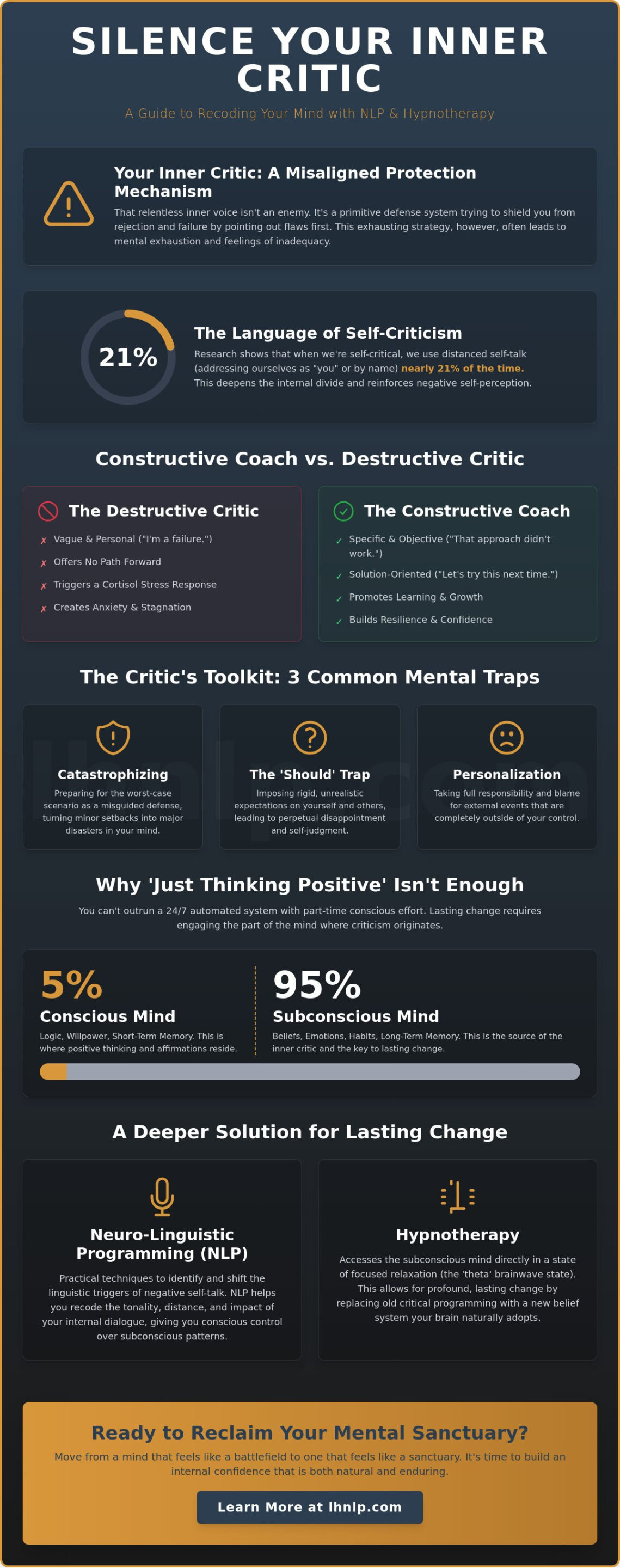
What if that relentless inner voice isn’t actually your enemy, but a misaligned protection mechanism trying to keep you safe in the most exhausting way possible? You’re likely intimately familiar with the mental exhaustion that comes from constant self-policing, or that persistent, quiet ache of feeling like you’re never quite enough regardless of your achievements. Research from 2025 shows that when we are critical, we often use distanced self-talk, addressing ourselves in the second or third person nearly 21% of the time, which only deepens this internal divide. Learning how to stop negative self-talk requires more than just “thinking positive”; it demands a deeper conversation with the parts of your mind that operate below the surface of your daily awareness.
You deserve a mind that feels like a sanctuary rather than a battlefield. This masterclass will show you exactly how to dismantle your inner critic and recode your subconscious mind using the precision of Neuro-Linguistic Programming (NLP) and the transformative power of hypnotherapy. We’ll move through a methodical process of understanding your mind’s protective intent, identifying the linguistic triggers that keep you stuck, and implementing practical tools to finally switch off the critic. It’s time to replace exhaustion with mental quietude and build an internal confidence that feels both natural and enduring. Real change is a methodical process, and it begins with a single shift in perspective.
Key Takeaways
- Understand why your mind uses harsh criticism as a misguided survival strategy; learn to acknowledge its protective intent without letting it dictate your self-worth.
- Discover practical NLP techniques for how to stop negative self-talk by shifting the tonality and perceived distance of your internal dialogue.
- Explore why traditional positive thinking often fails and how accessing the subconscious through hypnotherapy allows for more profound, lasting change.
- Identify the cognitive dissonance that makes standard affirmations feel untrue, and learn to build a belief system that your brain naturally adopts.
- Learn how professional support in high-pressure environments can provide the mental sanctuary needed to reclaim your focus and confidence.
Understanding the Inner Critic: The Anatomy of Negative Self-Talk
Negative self-talk isn’t a random occurrence or a sign of weakness; it’s a repetitive cognitive loop of self-limiting beliefs that often feels like an uninvited guest in your own mind. This internal dialogue, formally known as intrapersonal communication, functions as a constant feedback loop that shapes our self-concept and emotional resilience. When you’re trying to figure out how to stop negative self-talk, it’s essential to recognize that this voice isn’t trying to sabotage you. It’s actually a ‘protective’ paradox. Your brain often uses harsh criticism as a primitive defense mechanism, mistakenly believing that by pointing out your flaws first, it can shield you from the pain of external rejection or failure.
To better understand this concept, watch this helpful video:
This relentless internal scrutiny takes a significant physical toll on your body. Every time you indulge in sharp self-criticism, your brain’s amygdala triggers a stress response, flooding your system with cortisol. It’s a biological high-alert state that was designed for escaping predators, not for managing a Tuesday morning meeting. Distinguishing between constructive feedback and destructive self-talk is the first step toward reclaiming your peace. Constructive feedback is specific, objective, and solution-oriented; destructive talk is vague, personal, and offers no path forward. Understanding this distinction allows you to begin the process of reframing these subconscious patterns.
Common Patterns of a Critical Mind
Most of us fall into predictable mental traps that fuel our exhaustion. Catastrophizing is a common one, where the mind prepares for the worst-case scenario as a misguided defense. Then there’s the ‘Should’ Trap, where rigid expectations create a life of perpetual disappointment. You might also struggle with personalization, where you take full responsibility for external events that are entirely beyond your control. These patterns aren’t just habits. They’re deeply ingrained neural pathways.
The Impact on Mental Health and Performance
Chronic self-criticism is more than an annoyance; it’s a primary driver of social anxiety and professional stagnation. When your internal dialogue is focused on lack, you inadvertently create ‘glass ceilings’ that limit your career growth and relationship depth. You stop taking risks because the voice inside has already decided you’ll fail. The internalized critic is a psychological byproduct of early environmental conditioning, where external voices of authority are eventually adopted as our own internal narrative. Learning how to stop negative self-talk is the key to shattering these invisible barriers and stepping into your true potential.
The Subconscious Root: Why Mindfulness Alone Isn’t Always Enough
While mindfulness is a beautiful tool for observation, many people find that simply ‘noticing’ a thought doesn’t make it disappear. This is because your internal dialogue is largely driven by the subconscious mind, which governs about 95% of your mental activity. If your subconscious has been programmed to prioritize self-criticism as a survival strategy, conscious willpower will eventually fatigue. You can’t outrun a 24/7 automated system with a part-time conscious effort. This is why understanding how to stop negative self-talk requires a deeper dive into the mechanics of the mind rather than just surface-level awareness.
In 2026, the science of neuroplasticity has evolved to show that rewiring these neural pathways is a matter of focused attention rather than sheer force. Hypnotherapy offers a unique advantage here by facilitating the ‘theta’ brainwave state. In this state, you bypass the ‘critical factor’ of the conscious mind, allowing you to suggest new, more supportive patterns directly to the subconscious. It’s like updating the operating system of your brain instead of just trying to close a stubborn pop-up window. When you change the root code, the symptoms of self-sabotage begin to dissolve naturally.
The Role of Clinical Hypnotherapy
Hypnosis acts as a bridge. It connects your conscious desire for peace with your subconscious habits. During a session, we often address the ‘Initial Sensitising Event’ (ISE). This is the specific moment in your past where the inner critic first formed its protective, albeit harsh, narrative. By revisiting these moments in a safe, controlled environment, you can release the emotional charge and install new, empowering responses. It’s a natural state of deep learning that many find surprisingly familiar and deeply restorative.
NLP: The Software Manual for Your Brain
Neuro-Linguistic Programming (NLP) complements this by providing the ‘how-to’ for your mental software. The ‘Neuro’ part refers to your nervous system, while ‘Linguistic’ focuses on how your language shapes your reality. The words you choose aren’t just descriptions of your world; they’re the architects of your physiological state. Through techniques like ‘modeling’, you can learn to adopt the internal dialogue structures used by naturally confident people. If you feel ready to explore these tools more deeply, professional NLP coaching can provide the structured guidance needed to make these changes permanent.
Beyond Positive Thinking: A Solution-Focused Analysis
Many people embark on the journey of self-improvement only to hit a wall of frustration when forced toxic positivity fails to take root. If you’ve ever stood in front of a mirror reciting affirmations that felt like blatant lies, you’ve experienced cognitive dissonance. Your brain is a highly efficient truth detector. When you tell yourself you’re overflowing with confidence while feeling paralyzed by anxiety, your subconscious mind simply rejects the data. This rejection often reinforces the very critic you’re trying to silence. Learning how to stop negative self-talk isn’t about sugar coating a difficult reality; it’s about shifting toward neutral thinking first. Neutrality acts as a bridge, allowing you to move from “I’m a failure” to “I am a person who is currently learning a new skill,” which is a statement the subconscious can actually accept.
While traditional talk therapy often focuses on the history and the “why” of a problem, solution focused NLP and hypnotherapy prioritize the “how” of the change. This distinction is vital for those who feel they’ve analyzed their past for years without seeing a shift in their daily internal weather.
Subconscious Alignment vs. Conscious Effort
Trying harder isn’t always the answer. In fact, the Law of Reversed Effort suggests that the more consciously you struggle against a subconscious habit, the more power that habit gains. It’s like trying to smooth out turbulent water with your hands; the effort only creates more ripples. NLP reframing offers a faster alternative to standard cognitive restructuring for several specific reasons:
- It works with the brain’s natural coding system, focusing on the structure of the thought rather than just the words.
- It addresses the emotional root at a neurological level, which creates an immediate shift in your physiological state.
- It utilizes the subconscious mind’s preference for efficiency, replacing old loops with streamlined, supportive pathways.
This alignment ensures that your conscious goals and subconscious programs are finally moving in the same direction. When the internal friction stops, change becomes an effortless byproduct of a well tuned mind.
The Power of Professional Guidance
Self help books and podcasts provide excellent intellectual frameworks, but they rarely act as the pattern interrupter required for deep seated change. A skilled therapist acts as a mirror, identifying the blind spots and linguistic glitches that you’re too close to see. Kamalyn Kaur specializes in this transition, helping clients move beyond intellectual understanding into a lived, felt experience of peace. When you have a partner to guide you through the nuances of your own mind, the process of discovering how to stop negative self-talk becomes a methodical, supported journey rather than a lonely struggle against yourself.
5 Practical NLP Techniques to Stop Negative Self-Talk
Moving from the theoretical understanding of your mind into the actual architecture of change requires tools that address the structure of your thoughts. Neuro-Linguistic Programming (NLP) provides these tools by treating your internal dialogue as a series of sensory codes that can be edited. When you learn how to stop negative self-talk through these methods, you aren’t just ignoring the critic; you’re fundamentally changing its ability to influence your nervous system. These five steps offer a methodical way to reclaim your mental space and build a more supportive internal environment.
- Step 1: The Voice Shift. This involves changing the auditory sub-modalities of your inner critic. If the voice is loud, booming, or sharp, try making it sound squeaky or whispery.
- Step 2: Perceptual Positioning. View the problem from a distance. Imagine you’re a neutral observer watching yourself from across the room, which naturally reduces the emotional intensity of the self-criticism.
- Step 3: Reframing. Identify the positive intent behind the thought. If your mind says, “You’re going to fail,” the intent might be “I want to protect you from embarrassment.” Acknowledging this intent allows you to negotiate a better way to feel safe.
- Step 4: Anchoring. Link a resourceful state, like calm or confidence, to a physical touch. This creates a manual “switch” you can use to interrupt a negative spiral instantly.
- Step 5: The Swish Pattern. Use visualization to replace an old, self-sabotaging image with a vibrant, compelling image of your desired self.
Changing the Sub-Modalities of Thought
Your brain processes thoughts through specific qualities like brightness, volume, and location. By adjusting these “sub-modalities,” you can strip a negative thought of its power. If a critical image is large and in full colour on your mental screen, try shrinking it down to the size of a postage stamp and making it black and white. The Mickey Mouse technique transforms a sharp, internal reprimand into a high-pitched, squeaky caricature that is impossible to take seriously. These small shifts in the structure of your thinking create immediate relief in your emotional state.
Building New Neural Anchors
Anchoring is a way to “stack” positive emotions so they’re available whenever you need them. By repeatedly bringing up feelings of deep calm or intense confidence and pairing them with a specific physical trigger, like pressing your thumb and forefinger together, you create a new neural pathway. Practice makes permanent; the 21-day integration period for new NLP anchors ensures these responses become an automated part of your subconscious toolkit. Mastering how to stop negative self-talk is a skill that flourishes with professional feedback, so consider booking Confidence Building Sessions to refine your mental architecture and accelerate your progress.
Reclaiming Your Mental Space: Professional Support in London
Living in London often feels like being caught in a high-velocity stream where the pressure to perform is relentless. The city’s corporate competition and the ‘always-on’ culture don’t just affect your schedule; they permeate your internal dialogue. When you’re navigating a packed commute or a high-stakes meeting, the noise of the city can amplify your inner critic. Finding a way for how to stop negative self-talk isn’t just a luxury in this environment; it’s a vital necessity for maintaining your mental health. Seeking professional support in established hubs like Harley Street or Ealing provides more than just a session; it offers a physical and mental sanctuary where you can step out of the chaos and into a space designed for transformation.
In a professional NLP and hypnotherapy session with Kamalyn, the focus shifts from merely discussing problems to actively installing solutions. Unlike traditional models that might require years of analysis, solution-focused therapy is designed for efficiency. You’ll experience a blend of cognitive reframing and subconscious work that addresses the root of your internal chatter. It’s a methodical process where you learn to navigate your own mind with the same precision you use to navigate the city. Most people find that they experience significant shifts in just a few sessions, as we focus on the mechanics of change rather than just the history of the struggle.
Tailored Treatments for London Professionals
Corporate life brings specific challenges that require specialized tools. Many clients come to us struggling with public speaking anxiety or a persistent sense of imposter syndrome that keeps them from reaching their full potential. These aren’t personality traits; they’re linguistic and neurological patterns that can be unlearned. Effective Stress Management in London requires more than just a holiday. It requires the subconscious tools to remain calm and resourceful amidst the pressure. By focusing on your specific professional triggers, we can help you build a resilient internal narrative that supports your ambitions.
Taking the First Step Toward Inner Peace
The journey to a quieter mind begins with a single conversation. We often recommend a brief chemistry call to ensure you feel comfortable and understood before beginning your sessions. While many prefer the sanctuary of our London offices, virtual hypnotherapy sessions via Zoom offer the same level of depth and efficacy for those with demanding global schedules. This flexibility ensures that your path to mental clarity fits seamlessly into your life.
Remember that you’re the architect of your mind, not its prisoner. Learning how to stop negative self-talk is the first step in reclaiming your mental space and designing a life that feels as good on the inside as it looks on the outside. If you’re ready to start this methodical process of change, feel free to reach out to us to discuss your specific needs and begin your journey toward lasting mental quietude.
Architecting Your New Internal Narrative
You’ve explored the mechanics of the mind and discovered that your inner critic is often just a misguided protector. Realizing that mindfulness is the foundation allows you to embrace the deeper work of subconscious recoding. By applying the NLP techniques we’ve discussed, you can move past the limitations of willpower and start to experience true mental quietude. Understanding how to stop negative self-talk isn’t just about silencing a voice; it’s about fundamentally changing your neurological response to life’s challenges.
If you’re ready to move beyond self-help and experience a methodical, professional transformation, we’re here to guide you. With over 20 years of clinical experience and a specialized approach that blends NLP with hypnotherapy, we provide the expert support needed for lasting change. Whether you visit us at our Harley Street location or connect with us virtually, you’ll find a dedicated partner for your growth. Book a consultation with London Hypnotherapy & NLP to silence your inner critic and begin your journey today. You possess the internal resources to rewrite your story. It’s simply a matter of learning how to use them.
Frequently Asked Questions
What is the 3-3-3 rule for negative thoughts?
The 3-3-3 rule is a grounding technique that interrupts a spiraling mind by focusing on your immediate sensory environment. You start by naming three things you see, followed by three sounds you hear, and finally moving three parts of your body, such as your ankles, fingers, or shoulders. This process forces the brain to shift from internal, abstract self-criticism to external, concrete reality, providing a necessary pause in the cycle of mental exhaustion.
Can hypnotherapy really stop me from being self-critical?
Hypnotherapy works by accessing the subconscious mind to update the “software” that generates your internal dialogue. Instead of just trying to suppress the critic, it helps you understand the protective intent behind the voice and negotiate more supportive ways to achieve safety. This approach is highly effective for those wondering how to stop negative self-talk because it addresses the root cause rather than just managing the conscious symptoms.
How long does it take to rewire my brain using NLP?
While many people experience a profound internal shift during their first NLP session, the full integration of new neural pathways typically takes about 21 days of consistent practice. This period allows the brain to move from conscious effort to an automated habit. By using tools like anchoring or the Swish pattern regularly, you ensure that your new, resourceful internal narrative becomes your mind’s default setting rather than a temporary state.
Is negative self-talk a symptom of an anxiety disorder?
Persistent self-criticism is often a core component of the emotional experience of anxiety, acting as a repetitive loop that keeps the nervous system on high alert. While it isn’t always a clinical disorder on its own, it fuels the stress response that makes daily life feel overwhelming. Addressing these thought patterns is a vital step in any comprehensive approach to stress management and emotional well-being.
What is the difference between an inner critic and a conscience?
Your conscience serves as a gentle moral compass that guides you toward your values, whereas the inner critic is a fear-based mechanism that uses shame to prevent perceived failure. While a conscience encourages growth and repair, the inner critic focuses on limitation and self-punishment. Distinguishing between these two voices allows you to honor your integrity without succumbing to the destructive weight of constant, unearned guilt.
How can I stop negative self-talk at work?
To interrupt a critical spiral in a professional setting, you can use subtle pattern interrupters like changing the tonality of the internal voice or using a physical anchor. Shifting your language from “I’m failing” to “I’m currently navigating a complex task” moves your mind into a neutral, solution-oriented state. This practical application of how to stop negative self-talk helps maintain your focus and confidence even during high-pressure corporate situations.
Can meditation make negative self-talk worse?
Meditation can occasionally make self-criticism feel more intense because it brings your full attention to the volume of your internal chatter without necessarily providing the tools to change it. This phenomenon occurs when the mind becomes hyper-aware of its own noise without a method for resolution. In such cases, combining mindfulness with active reframing techniques like NLP can provide the necessary structure to transform the thoughts you are observing.
What should I do if my negative self-talk feels like it’s not my own voice?
Feeling like the critical voice belongs to someone else is a common experience, as the inner critic is often an internalized version of early environmental influences or authority figures. Recognizing that the voice isn’t yours is actually a powerful first step in distancing yourself from its impact. You can use NLP sub-modality shifts to further weaken its influence, eventually replacing that externalized echo with a voice that is authentically your own.