

What if the judgment you fear from others is actually a mirror reflecting a critical inner voice you haven’t yet learned to quiet? You might find yourself constantly scanning rooms for approval or replaying social interactions in your head until you’re left feeling utterly depleted. This chronic need to please isn’t just a personality trait; it’s a survival mechanism that has outlived its usefulness. Understanding how to stop caring what people think starts with the realization that most people are far too focused on their own lives to notice the perceived inadequacies you’re working so hard to hide. With a third of adults reporting high anxiety levels in 2026, it’s clear that social exhaustion is a widespread burden. You deserve a different path.
It’s time to shift from seeking external validation to cultivating internal autonomy. This guide explores the deep psychological roots of indecisiveness and fear of judgment, offering a bridge between where you are and the confidence you crave. You’ll learn how professional NLP and hypnotherapy techniques can help you dismantle these barriers at a subconscious level. We’ll preview a journey toward unshakeable self-belief and the ability to set firm personal boundaries. By the end of this guide, you’ll have the tools to speak up in any group and live a life defined by your own values. Your transformation begins now.
Key Takeaways
- Uncover the “spotlight effect” and learn why your brain overestimates the attention others pay to your actions, freeing you from the weight of perceived judgment.
- Explore the evolutionary and subconscious origins of people-pleasing, transforming outdated survival programs into modern mental autonomy.
- Master practical NLP techniques to reframe your internal critical voice, effectively changing the psychological “manual” for how you process social feedback.
- Discover actionable exercises, such as the “So What?” drill, to learn how to stop caring what people think and reclaim your voice in group settings.
- Identify when to seek professional confidence building sessions to address deep-seated social anxieties through solution-focused therapeutic approaches.
Understanding the “Spotlight Effect” and the Psychology of Judgment
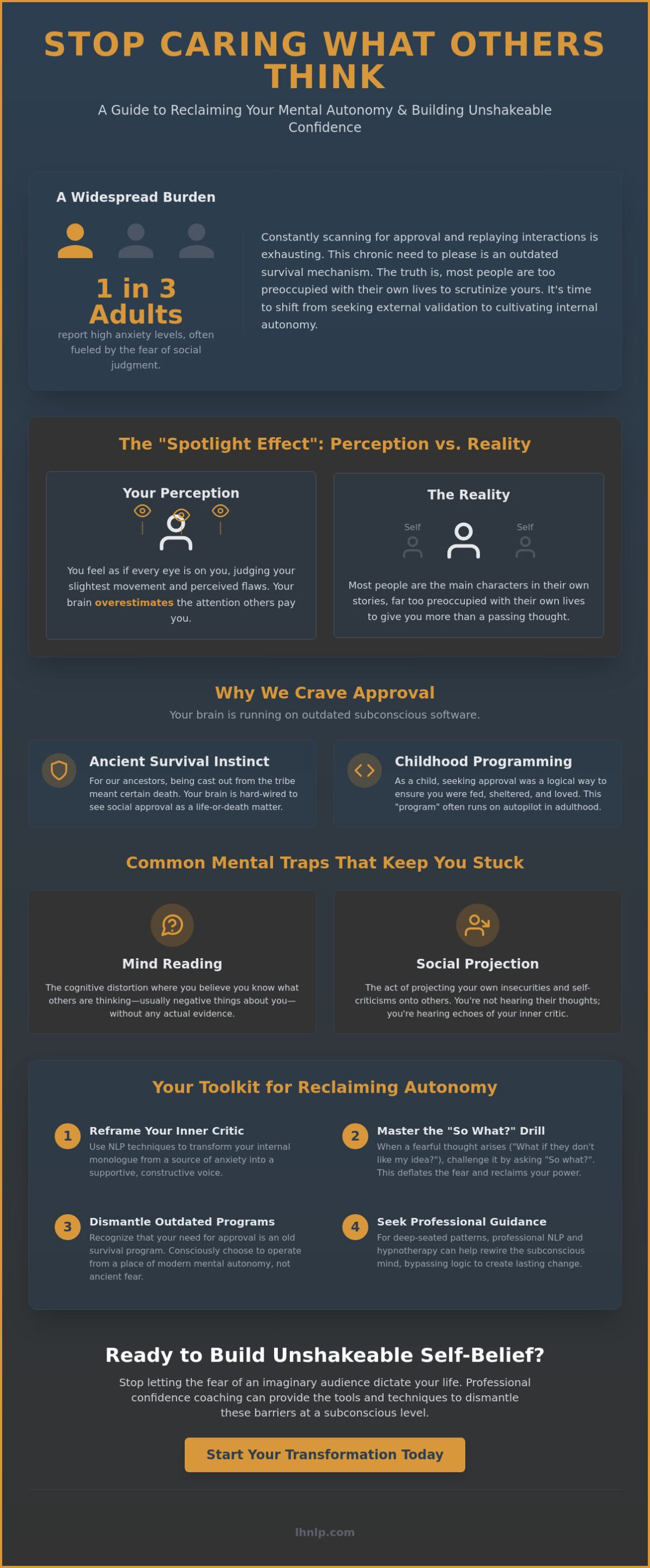
Imagine walking into a room and feeling as though every eye is pinned on your slightest movement. This sensation is a common cognitive bias known as the spotlight effect. Understanding the Spotlight Effect reveals that we tend to overestimate how much others notice our appearance or behavior. In reality, most people are the protagonists of their own internal dramas, far too preoccupied with their own perceived flaws to scrutinize yours. This hyper-vigilance isn’t a personal failing; it’s an ancient survival mechanism. For our ancestors, being cast out of the tribe meant certain death. Therefore, the brain evolved to prioritize social approval as a matter of life and death. While we no longer face predators on the savannah, our nervous systems still react to a critical glance as if it were a physical threat.
There’s a vital distinction between healthy social awareness and debilitating anxiety. Awareness allows you to navigate a meeting with grace or offer empathy to a friend. Anxiety, however, is the alarm that never turns off. It’s the difference between checking the weather and living in a constant fear of a storm. Learning how to stop caring what people think is ultimately about teaching your nervous system that it’s safe to be seen. We often perform for an “Invisible Audience.” This is the psychological habit of projecting our deepest insecurities onto the blank faces of strangers. If you feel inadequate about your career, you might assume every person you meet is judging your professional status.
The Myth of the Mind-Reader
When you wonder how to stop caring what people think, you’re usually trying to stop caring about your own imagination. We fall into the trap of “Mind Reading,” a cognitive distortion where we believe we know exactly what others are thinking without any evidence. Social projection is the act of assuming others share your self-criticisms. You aren’t hearing their thoughts; you’re hearing the echoes of your own inner critic. This realization is the first step toward reclaiming your mental autonomy. By understanding that your social fears are often just your own voice in a different costume, you can begin to dismantle the power they hold over your decisions.
Why Logic Alone Fails to Stop the Worry
You can tell yourself a thousand times that a stranger’s opinion doesn’t matter, yet your heart still races. This happens because the amygdala, the brain’s emotional center, triggers a “fight or flight” response before your logical mind can intervene. The fear is visceral, not intellectual. True freedom requires more than just positive thinking or logic. Because these patterns are hard-wired into the subconscious, real change must happen at that deeper level. This is where professional NLP coaching and hypnotherapy become essential tools. They bypass the noisy surface mind to rewire the underlying programs that keep you stuck in approval-seeking loops. You’re not just learning a new thought; you’re building a new internal foundation.
Why Your Subconscious Mind Prioritises External Validation
While the spotlight effect explains how we perceive the world, we must look deeper into the subconscious mind to understand why we feel so vulnerable to the opinions of others. The subconscious operates on specific prime directives, primarily protection and belonging. For a child, external validation isn’t just a luxury; it’s a necessity for survival. When you were young, seeking approval was a logical way to ensure you were fed, sheltered, and loved. The problem arises when this early childhood “approval seeking” becomes an automated adult program that never received an update. You’re essentially running outdated software on modern hardware. This is why learning how to stop caring what people think requires addressing the root cause rather than just the symptoms.
Worrying about judgment often carries what psychologists call a “secondary gain.” Your mind might believe that by obsessing over what others think, you’re staying safe from the pain of unexpected rejection. It’s a form of hyper-vigilance that masquerades as preparation, but it ultimately keeps you small. When you lack a core self-identity, you become a social chameleon, constantly shifting your personality to match the expectations of the room. This lack of a solid internal anchor makes every external criticism feel like a threat to your very existence. True autonomy begins when you realize that your worth is not a variable determined by the public’s vote.
The Internal Critic vs. The Internal Mentor
Neurobiology identifies a specific “Editor” or “Critic” voice that lives within our internal dialogue. This voice uses the fear of judgment to keep you safely tucked within your comfort zone, effectively preventing the risks associated with growth. Constant social monitoring leads to significant ego-depletion. You spend so much mental energy scanning for threats that you have little left for creativity or genuine connection. By shifting this dialogue toward an internal mentor, you can begin to trust your own judgment over the perceived whispers of the crowd. If you feel ready to explore these internal shifts, Virtual Hypnotherapy Sessions can help you bridge the gap between where you are and the social freedom you deserve.
Hypnotherapy: Re-coding the Social Safety Program
Change doesn’t have to be a battle of wills. Clinical hypnosis allows you to bypass the critical faculty of the mind to update outdated safety programs. It’s a methodical process of desensitising the fear of being truly seen or judged. By accessing the subconscious, we can dismantle the old “belonging at any cost” program and replace it with a robust sense of self-assurance. For those seeking professional support in the UK, hypnotherapy London provides a structured path to re-coding these social safety programs at their source. You aren’t just learning how to stop caring what people think; you’re reclaiming your mental autonomy.
The NLP Approach: Reframing the Inner Critic
If the subconscious mind is the engine of your behavior, Neuro-Linguistic Programming (NLP) serves as the user manual for the brain. It provides a structured methodology for understanding how we code our experiences through language and sensory filters. Many people struggle with how to stop caring what people think because they treat their social fears as solid, unchangeable facts. NLP invites you to see these fears as mere “data” that can be edited. By shifting the way you represent the “critic” in your mind, you can effectively dismantle the power it holds over your emotional state. This isn’t about ignoring your thoughts; it’s about changing the very structure of how you perceive them.
A central concept in NLP is the use of “submodalities,” which are the fine-grained qualities of our internal thoughts. When you imagine someone judging you, that mental image has specific properties: Is it big or small? Is it in color or black and white? Where is the voice coming from? You can experiment with shrinking the “Critic” by mentally turning down its volume or changing its tone to something ridiculous, like a cartoon character. Moving the location of the voice from right next to your ear to a distant point in the room can immediately reduce the anxiety it produces. These small shifts signal to your nervous system that the threat is not as immediate or significant as it first appeared.
Changing the Internal Narrative
Our self-talk is often littered with “Musts” and “Shoulds” that create an invisible cage of expectations. “I must be liked by everyone” or “I should have said that differently” are linguistic traps that keep you tethered to external validation. NLP treats the mind like software that can be patched and updated to better serve your current goals. One powerful tool is the “Swish Pattern,” where you learn to rapidly replace a mental image of social judgment with a vivid, compelling image of your most confident self. This process creates a new neural pathway, training your brain to automatically “swish” toward confidence whenever a social doubt arises.
Building a Stronger Self-Image Layer
To truly master how to stop caring what people think, you must shift from an “External Reference” to an “Internal Reference” point. People with an external reference look to others to decide if they’ve done a good job; those with an internal reference have an inner yardstick for success. You can begin to build a mental “shield” that filters incoming comments. This allows you to distinguish between useful feedback, which helps you grow, and “projection,” where others simply cast their own insecurities onto you. If you’re looking for a structured way to implement these changes, working with an NLP practitioner London can provide the guided reframing sessions necessary to solidify your new internal compass. You’re not just changing a thought; you’re evolving your entire social identity.
Practical Steps to Reclaim Your Autonomy Today
Theory provides the foundation, but true transformation requires deliberate action. To master how to stop caring what people think, you must move from intellectual understanding to experiential proof. Your brain needs evidence that social disapproval is not a life-threatening event. We begin this process by introducing small, manageable stressors that retrain your nervous system to remain calm in the face of perceived judgment. It’s about shifting your focus from the external “noise” to your internal signal.
- Step 1: The “So What?” Drill. When you feel the prickle of anxiety, follow the fear to its logical end. If a colleague thinks your presentation was imperfect, so what? Perhaps they mention it to someone else. So what? You still have your skills, your home, and your life. Usually, the “worst-case scenario” is just a temporary moment of discomfort.
- Step 2: Voluntary Vulnerability. Practice making small, controlled social “mistakes.” Wear a slightly eccentric accessory or ask a “silly” question in a meeting. These experiments prove that the world doesn’t crumble when you aren’t perfect.
- Step 3: Values Alignment. Identify your top three values, such as integrity, curiosity, or kindness. When you act in alignment with these, the opinions of others become secondary. You are answering to your own internal compass rather than a public vote.
- Step 4: The Circle of Excellence. This NLP technique involves imagining a circle on the floor that represents your peak state of confidence. Step into it, breathe deeply, and anchor that feeling. You can mentally “step into” this circle before any challenging social interaction.
- Step 5: Digital Detox. With recent 2026 data showing that 91% of adults feel high or extreme pressure, reducing your exposure to the comparison trap of social media is essential. It lowers the noise of the “invisible audience” that fuels social exhaustion.
The “Opinion Filter” Exercise
Not all feedback is created equal. You can visualize a mental filter that only allows the opinions of people you truly respect to reach your inner self. Use the “Three Gates” of feedback: Is it true? Is it kind? Is it useful? If a comment doesn’t pass at least two of these gates, it’s likely a projection of the other person’s issues. Practising selective caring is more sustainable than trying to not care at all. It allows you to stay open to growth while remaining shielded from toxicity. Who have you given a “front row seat” in your mind who hasn’t earned it?
Small Wins: The Confidence Ladder
Confidence is a muscle that grows through progressive resistance. Start by expressing a small, contrary opinion in a safe environment, like choosing a different restaurant than your friends. As your internal safety grows, you can gradually increase the social stakes. If you find the lower rungs of this ladder too daunting to climb alone, professional confidence building sessions can provide the support and techniques needed to accelerate your progress. You don’t have to navigate this journey in isolation. Each small win is a brick in the fortress of your new mental autonomy.
Beyond Self-Help: Professional Confidence Coaching in London
There comes a point where self-help exercises reach their natural limit. While the techniques discussed earlier provide a solid foundation, the unique, high-pressure professional and social landscape of a city like London can amplify deep-seated social phobias. In an environment where 33% of adults reported high levels of anxiety in early 2026, finding a path toward unshakeable self-assurance often requires a more structured, professional intervention. If you’ve found that your efforts to learn how to stop caring what people think have stalled, it may be because the underlying program is too deeply rooted for willpower alone to shift. This is not a personal failure; it’s simply a sign that your subconscious is protecting you with an intensity that requires expert navigation.
Unlike traditional talk therapy, which often focuses on endless “venting” or analyzing the past, a solution-focused approach prioritizes the future. Kamal at London Hypnotherapy & NLP structures sessions to be both methodical and transformative. We don’t just talk about the fear; we use professional NLP and hypnotherapy to update the mental software driving it. In a professional consultation, you can expect a calm, non-judgmental assessment of your current triggers followed by a clear roadmap for change. We focus on mobilising your inner resources, ensuring that the shift toward confidence feels natural and sustainable rather than forced.
Tailored Support in the Heart of London
For many, the physical environment plays a crucial role in the breakthrough process. We offer in-person sessions in prestigious, neutral spaces such as Harley Street and Ealing, providing a sanctuary where you can explore your social fears away from the noise of daily life. These locations offer a professional anchor for your transformation, allowing you to step out of your usual patterns and into a new way of being. If you find that your social concerns are part of a broader pattern of worry, you may find our guide on therapy anxiety London particularly useful for navigating your path to relief. A neutral, expert perspective is often the catalyst that turns “trying” into “doing.”
Taking the First Step Toward Social Freedom
Reclaiming Your Internal Compass for Social Freedom
If you’re ready to move beyond self-guided steps and experience a profound shift, expert guidance can bridge the gap. Kamal has been providing clinical expertise since 2005 as a specialist in anxiety and confidence. Whether you prefer an in-person breakthrough in Harley Street or the convenience of a session via Zoom, the path to unshakeable self-belief is open to you. Book your confidence-building session with Kamal today and discover the clarity that comes with a quieted mind. Your social freedom isn’t just a distant hope; it’s a methodically achievable reality waiting for you to claim it.
Frequently Asked Questions
Is it actually possible to completely stop caring what people think?
Completely eliminating social awareness isn’t the goal; rather, it’s about shifting from a place of emotional dependency to one of internal autonomy. You wouldn’t want to become entirely indifferent to others, but you can certainly stop being controlled by their perceived judgments. Learning how to stop caring what people think involves building a strong internal reference point so that external opinions are treated as secondary data rather than absolute truths about your worth.
How is social anxiety different from just being shy?
Shyness is generally a personality trait characterized by a preference for quiet or a slower warm-up period in groups. Social anxiety is a more intense, fear-based condition that involves a persistent dread of being scrutinized or humiliated. While a shy person might eventually feel comfortable once they’re familiar with a room, someone with social anxiety often experiences physical symptoms like a racing heart and may avoid opportunities entirely to escape the threat of judgment.
Can hypnotherapy help with public speaking anxiety specifically?
Yes, hypnotherapy is highly effective for public speaking anxiety because it addresses the subconscious “threat” response directly. By accessing the deeper mind, we can desensitize the fear of being the center of attention and replace it with a sense of calm authority. This process updates the internal safety programs that previously associated a podium or a meeting room with danger, allowing you to speak with clarity and presence in any professional setting.
What is the “Inner Critic” and why is it so loud in social situations?
The Inner Critic is an internalized collection of past warnings and societal expectations meant to keep you safe from rejection. In social situations, this voice becomes louder because your subconscious perceives a high risk of tribal exclusion. It uses self-criticism as a preemptive strike, hoping that if you judge yourself first, you’ll be better prepared for the judgment of others. Reframing this voice is a core part of building unshakeable confidence and social freedom.
How many sessions of NLP or hypnotherapy are usually needed for confidence?
While every individual’s journey is unique, most people experience significant shifts within three to six sessions of NLP or hypnotherapy. These modalities are solution-focused, meaning we aim for efficient and lasting change rather than years of open-ended discussion. The goal is to provide you with the internal tools and subconscious updates necessary to navigate social landscapes with ease, allowing you to sustain your progress independently over the long term without constant professional intervention.
What should I do if I feel guilty after saying “no” to someone?
Feeling guilty after setting a boundary is often a sign of old “people-pleasing” conditioning that equates saying “no” with being unkind. To navigate this, remind yourself that a boundary is a way of being honest about your capacity. When you understand how to stop caring what people think in a healthy way, you realize that your primary responsibility is to your own integrity. Guilt is just a habit that fades as you practice values-aligned living.
Does stopping caring about opinions make you less empathetic?
Paradoxically, becoming less dependent on others’ opinions often makes you more genuinely empathetic. When you act out of a need for approval, your kindness is often a form of social currency used to buy safety. By reclaiming your autonomy, you can offer support and compassion from a place of choice rather than obligation. You’re able to listen more deeply because you aren’t constantly scanning for how the conversation affects your own social standing.
Can I do these confidence exercises at home by myself?
You can certainly practice foundational confidence exercises, such as the “So What?” drill or digital detoxing, in your daily life. These at-home practices are excellent for maintaining progress and building awareness. However, for deep-seated social phobias or long-standing patterns of people-pleasing, professional guidance is often necessary to reach the subconscious levels where these programs are stored. A professional ensures that you are applying the techniques safely and effectively for your specific needs.