

What if the silence you maintain during high-stakes meetings isn’t a sign of patience, but a symptom of a subconscious script that’s no longer serving you? It’s a quiet burden to feel invisible while your peers advance, or to feel the slow burn of mental exhaustion because you’ve taken on yet another project you didn’t have the capacity for. You likely believe that being “nice” is the only way to maintain harmony, yet you’re left feeling drained and overlooked. Learning how to be more assertive at work isn’t about becoming aggressive; it’s about reclaiming your voice through a methodical process of inner realignment.
In the following sections, we’ll bridge the gap between where you are and where you deserve to be. We’ll discover how to transform your workplace communication from passive to powerful using proven psychological shifts and NLP techniques that speak directly to the mind’s deeper layers. By the end of this guide, you’ll understand how to set clear boundaries without a shred of guilt and project a level of professional confidence that naturally invites respect. We will walk through the steps of this internal transformation together, turning your career into a space of authentic expression and steady growth.
Key Takeaways
- Redefine assertiveness as a balanced middle path of communication that prioritizes mutual respect over power struggles or passive silence.
- Uncover the psychological roots of people-pleasing and learn how to be more assertive at work by addressing the subconscious “freeze” response.
- Explore how NLP and hypnotherapy bypass the limitations of willpower to create authentic, sustainable shifts in your professional confidence.
- Gain actionable strategies for setting healthy boundaries and expressing your needs clearly using “I” statements and rhythmic communication techniques.
- Understand the value of personalized therapeutic support in transforming suppressed frustration into a powerful tool for career advancement.
Understanding Assertiveness: The Middle Path to Professional Respect
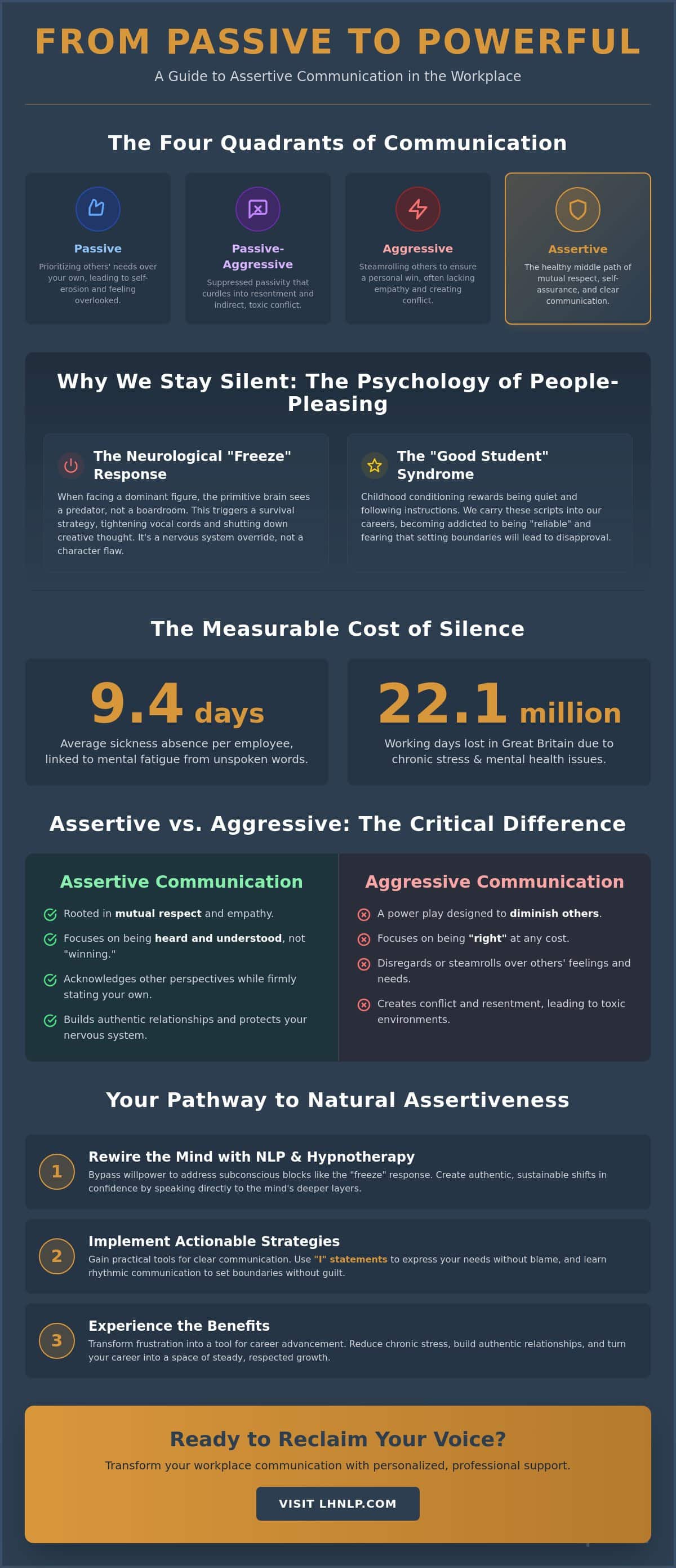
In the relentless pulse of London’s corporate world, where the average sickness absence has climbed to 9.4 days per employee, the weight of unspoken words often translates into physical and mental fatigue. Many professionals mistakenly view assertiveness as a sharp-edged tool for dominance, yet it’s actually a soft, steady path of equilibrium. It’s the art of occupying your rightful space without crowding others out. According to the psychological definition of assertiveness, this state is about being self-assured and confident without being aggressive. It’s a vital distinction for anyone wondering how to be more assertive at work while maintaining their professional integrity.
To find this middle path, we must recognize the four distinct quadrants of communication. Passivity is a slow erosion of the self, where we prioritize others’ comfort over our own fundamental needs. Aggression is the opposite extreme, where we steamroll over colleagues to ensure a personal “win.” Then there’s the toxic fog of passive-aggression, which usually stems from suppressed passivity that eventually curdles into resentment. Assertiveness stands alone as the healthy centre. It’s the shift from wanting to “be right” to ensuring you are “being heard,” a subtle change in intention that fosters genuine collaboration rather than conflict.
Assertive vs. Aggressive: Clearing the Misconception
Most people-pleasers live in constant fear of being perceived as “difficult” or a “jerk,” yet they’re usually miles away from that threshold. Aggression lacks empathy; it’s a power play designed to diminish others. Assertiveness, however, is deeply rooted in mutual respect. You acknowledge the other person’s perspective while firmly stating your own. When you learn how to be more assertive at work, you aren’t abandoning your kindness. You’re simply adding a layer of self-respect that prevents your natural empathy from being exploited by more dominant personalities.
The Emotional Benefits of Standing Your Ground
The Psychology of the People-Pleaser: Why We Stay Silent
Our silence is rarely a lack of words; it’s often a neurological survival strategy. When we face a dominant authority figure or a high-stakes deadline, the primitive part of our brain doesn’t see a boardroom. It sees a predator. This triggers a biological “freeze” response, where our vocal cords literally tighten and our creative thinking shuts down. Understanding this is the first step in learning how to be more assertive at work. You aren’t “weak” or “cowardly.” You’re simply experiencing a nervous system override that prioritizes safety over expression.
This response is frequently reinforced by years of childhood conditioning, often referred to as the “Good Student” syndrome. In our early years, we were rewarded for being quiet, following instructions, and never rocking the boat. We carry these scripts into the London corporate landscape, where the pressure to perform can feel like a constant demand for approval. We become addicted to being “the reliable one” who never says no, fearing that any boundary will lead to social exclusion. In the age of instant communication, a simple email can trigger the same primitive fear of being cast out from the tribe.
Identifying Your Assertiveness Blockers
Recognizing these patterns requires honest self-reflection. Do you find yourself thinking, “I don’t want to be a burden,” or “They probably know better than me”? These internal dialogues are the anchors holding you back. This “Approval Addiction” might feel like safety, but it’s often what stalls your promotion prospects because leaders are expected to have a voice. While seeking practical strategies for assertive communication, you must also pay attention to your body. Do you feel a knot in your stomach or a tightness in your chest before a meeting? These are physical symptoms of suppressed needs that demand your attention.
The Long-term Cost of Silence
The price of being “too nice” is high. Over time, the inability to speak up leads to resentment and “Quiet Quitting,” where you mentally check out because the environment feels unsustainable. This ongoing suppression is a significant contributor to burnout, requiring specialized stress management to resolve the accumulated tension. Interestingly, your colleagues might actually prefer you to be more direct. Clarity is a form of kindness. When you’re honest about your capacity, you become a more predictable and trustworthy partner. If these patterns feel deeply ingrained, our Confidence Building Sessions offer a supportive space to rewrite these internal narratives and find your natural voice again.
Rewiring the Mind: NLP and Hypnotherapy for Natural Assertiveness
Why is it that we can rehearse a difficult conversation for hours, only to find our voices failing the moment we open our mouths? Willpower is a finite resource, and when it’s pitted against a lifetime of subconscious conditioning, the old habits usually win. If you’ve been searching for how to be more assertive at work, you’ve likely realized that simply “trying harder” isn’t the answer. To achieve a lasting shift, we must address the neurological architecture that supports our communication. By using tools like Neuro-Linguistic Programming (NLP) and hypnotherapy, we can update the internal maps that dictate our professional interactions.
While willpower acts as the engine, the subconscious mind is the GPS that determines the direction. If your internal map says that speaking up is dangerous, no amount of effort will make it feel natural. These modalities don’t just teach you what to say; they change how you feel about saying it. This alignment is crucial. When your internal state matches your external words, you project an aura of authentic confidence that colleagues instinctively respect.
NLP Techniques for Instant Confidence
NLP offers practical, rapid interventions to shift your state. One powerful tool is the “Circle of Excellence,” where you mentally step into a space of peak resourcefulness before a big presentation. Another is reframing, which involves changing the meaning of an event. Instead of seeing a boundary as a “confrontation,” you can reframe it as a “necessary clarification” that ensures project success. We also use the Meta Model to challenge limiting beliefs. When you think “I can’t say no,” the Meta Model asks, “What specifically would happen if you did?” This questioning breaks the spell of vague, irrational fears.
Hypnotherapy: Changing the Subconscious Script
Clinical hypnosis allows us to bypass the critical conscious mind, which is often the source of our self-doubt and hesitation. By accessing the subconscious, we can dissolve the “freeze” response and replace it with a calm, steady presence. Research from the University of Texas highlights the connection between assertiveness and stress reduction, proving that when we stop suppressing our needs, our nervous system finally finds rest. Through visualization, we prime the brain for successful assertive outcomes, making the real-world experience feel like a familiar, safe routine. If you’re ready to move beyond surface-level tips, our NLP Coaching and hypnotherapy sessions provide the deep-level reprogramming required for true professional freedom.
Practical Strategies for Assertive Communication at Work
Having understood the subconscious drivers of our behavior, we can now turn our attention to the tangible tools of expression. Learning how to be more assertive at work is often a matter of replacing old, apologetic linguistic patterns with structures that convey clarity and respect. The most foundational of these is the “I” statement. Instead of saying, “You’re giving me too much work,” which triggers immediate defensiveness in the listener, try, “I feel that my current capacity is at its limit, and I’m concerned about maintaining the quality of my output.” This shift moves the conversation from blame to collaborative problem-solving, allowing you to advocate for your needs without burning professional bridges.
When faced with a persistent colleague who refuses to accept a boundary, the “Broken Record” technique becomes your shield. You simply repeat your stance in a calm, neutral tone without adding new justifications. If someone asks for a “quick favor” that you don’t have time for, you might say, “I understand this is important, but I don’t have the capacity to take it on today.” If they push, you repeat the exact same sentence. It removes the need for elaborate excuses and signals that your boundary is not up for negotiation. Your vocal tone should be “down-sloping” at the end of sentences, which suggests authority rather than the “up-talk” that makes statements sound like questions.
The Assertive Communication Toolkit
Your language acts as a signal to others about how you value your own contributions. Small shifts carry immense weight. Replacing “I just think” with “I’m confident that” removes the verbal “shrinkage” that often plagues people-pleasers. In meetings, managing interruptions is essential for professional respect. A simple, “I’d like to finish my point before we move on,” keeps the floor without being aggressive. These techniques are vital for maintaining boundaries around remote work schedules, ensuring that your personal time is respected as much as your professional output.
Navigating Difficult Conversations
Navigating a relationship with an over-demanding manager requires a blend of empathy and firm scripting. When asking for a raise or promotion, focus on the documented value you’ve delivered rather than your personal needs. Prepare a script for high-stress scenarios so that when the moment arrives, your brain has a pre-recorded path to follow. This preparation prevents the “freeze” response we discussed earlier. If you find that these social dynamics still feel overwhelming, our Public Speaking Coaching and confidence sessions can provide the practical practice you need to master these interactions in a safe environment.
Overcoming Workplace Anxiety with Professional Support in London
While understanding the mechanics of communication is a vital first step, there are times when the weight of the past or the sheer intensity of the present makes self-application feel out of reach. In a city where only 10% of employees feel truly engaged and 41% experience high daily stress, the struggle to find your voice isn’t a personal failure; it’s a reflection of the environment’s immense demands. If you’ve tried the linguistic tools and boundary-setting techniques but still find your throat tightening in the boardroom, personalized support can provide the breakthrough that a guide alone cannot. This is where the work of Kamalyn Kaur at London Hypnotherapy & NLP becomes a bridge to your new professional reality.
A structured Confidence Building Sessions programme goes beyond surface-level tips. It dives into the neurological roots of your hesitation, using the rhythmic flow of clinical hypnosis and the strategic precision of NLP to reprogram the internal scripts that keep you small. In the context of 2026, where AI integration and hybrid work are shifting the very nature of professional roles, knowing how to be more assertive at work is no longer just an advantage. It’s an essential skill for career longevity and mental well-being. By addressing the subconscious “freeze” response we explored earlier, we move from theoretical knowledge to embodied change.
Tailored Sessions in the Heart of London
We understand that a London professional’s schedule is often a delicate balancing act. To support this, we offer sessions at prestigious and accessible locations, including Harley Street, Ealing, and Tokenhouse Yard. By integrating Hypnotherapy London services into your routine, you create a dedicated space for inner recalibration amidst the city’s noise. For those whose roles involve frequent travel or remote work, our virtual consultations ensure that your progress remains consistent, regardless of where your career takes you. This flexibility allows you to prioritize your growth without adding to your existing stress.
Your Path to Unshakeable Professional Confidence
Transformation doesn’t have to be a years-long endeavour. Many of our clients experience a significant shift from anxiety to a state of calm authority in as little as 3 to 4 sessions. This isn’t just about your job. It’s about the ripple effect that occurs when you finally value your own needs and time. When you master how to be more assertive at work, you find that your personal relationships also gain a new level of honesty and depth. If you’re ready to stop the cycle of suppressed frustration and start leading with quiet, unshakeable confidence, contact Kamal today to book your initial consultation and begin the journey toward your most authentic professional self.
Reclaiming Your Voice and Your Career
The journey toward professional confidence is not about changing who you are; it’s about removing the subconscious barriers that prevent your true self from being heard. We’ve explored how the biological “freeze” response and childhood conditioning can be updated through the precision of NLP and hypnotherapy. By mastering the “I” statement and the “Broken Record” technique, you now possess the practical toolkit needed to set boundaries with grace. Learning how to be more assertive at work is a methodical process of inner realignment that yields profound external rewards in every area of your life.
If you’re ready to accelerate this transformation with expert guidance, Kamalyn Kaur offers specialized support for professional anxiety. As a dedicated practitioner since 2005, Kamalyn integrates deep psychological insights with practical coaching to help you move from silence to strength. Whether you visit our tranquil spaces in Harley Street or the City of London, you’ll find a partner committed to your professional growth and emotional well-being.
Book a Confidence Building Session in London today to start your transition from invisible to influential. Your voice is your most valuable asset. It’s time to use it with unshakeable confidence.
Frequently Asked Questions
Is assertiveness a skill that can be learned later in life?
Yes, assertiveness is a neurobiological habit that you can reprogram at any stage of your career. Our brains remain plastic throughout our lives, allowing us to replace the primitive “freeze” response with a calm, steady voice. It’s never too late to learn how to be more assertive at work. By updating your internal communication maps, you can transform years of passivity into a new standard of professional respect.
How can I be assertive with a boss who is very intimidating?
When dealing with an intimidating manager, focus your communication on shared professional goals rather than personal conflict. Use “I” statements to explain how their behavior or demands impact your ability to deliver high-quality results. This approach reframes your boundary as a commitment to excellence. It’s about speaking to the role they hold while staying firmly rooted in the value you provide to the organization.
Will being assertive make my colleagues dislike me?
Authenticity and clarity actually strengthen professional relationships rather than damaging them. While some might be surprised by your new boundaries initially, most colleagues will appreciate the predictability that honesty brings. People generally feel safer and more respected when they know exactly where you stand. True respect is built on the foundation of mutual boundaries, not on the unstable ground of constant compliance and suppressed resentment.
What is the fastest way to build confidence for a meeting?
The fastest way to shift your state before a high-pressure meeting is through an NLP anchoring technique. Mentally step into a “Circle of Excellence” where you recall a specific moment of total confidence. Breathe deeply and allow that feeling to flood your nervous system. This brief internal shift primes your brain for authority, ensuring you enter the room from a place of resourcefulness rather than hesitation.
Can hypnotherapy really help with workplace anxiety?
Clinical hypnotherapy is highly effective because it addresses the subconscious roots of workplace anxiety. It allows you to bypass the critical conscious mind that fuels self-doubt and persistent overthinking. By dissolving the “freeze” response at its source, hypnotherapy helps you build a foundation of self-worth that doesn’t rely on external validation. This creates a lasting, natural sense of confidence that remains steady even in high-pressure environments.
How do I stop being a people-pleaser at work?
Breaking the cycle of people-pleasing requires you to address your “Approval Addiction” through small, consistent actions. Start by setting low-stakes boundaries, such as declining a minor request that falls outside your remit. As you see that the world doesn’t end when you say no, your confidence will grow. Learning how to be more assertive at work is a methodical process of proving to your subconscious that your needs are valid.
What is the difference between NLP and standard career coaching?
While standard career coaching often focuses on external goals and strategies, NLP works on the internal architecture of your behavior. It addresses the “how” of your communication by reframing the subconscious narratives that drive your actions. NLP provides specific tools to change your emotional state and linguistic patterns. This makes it a powerful modality for those who know what they should do but feel neurologically stuck in old patterns.
How do I handle a colleague who ignores my boundaries?
If a colleague repeatedly ignores your boundaries, the “Broken Record” technique is your most effective response. State your boundary clearly and calmly, and then repeat it without adding new justifications or excuses. New explanations only give the other person more room to negotiate or find loopholes. By maintaining a steady, rhythmic repetition of your stance, you signal that your boundary is firm and is not open for debate.