
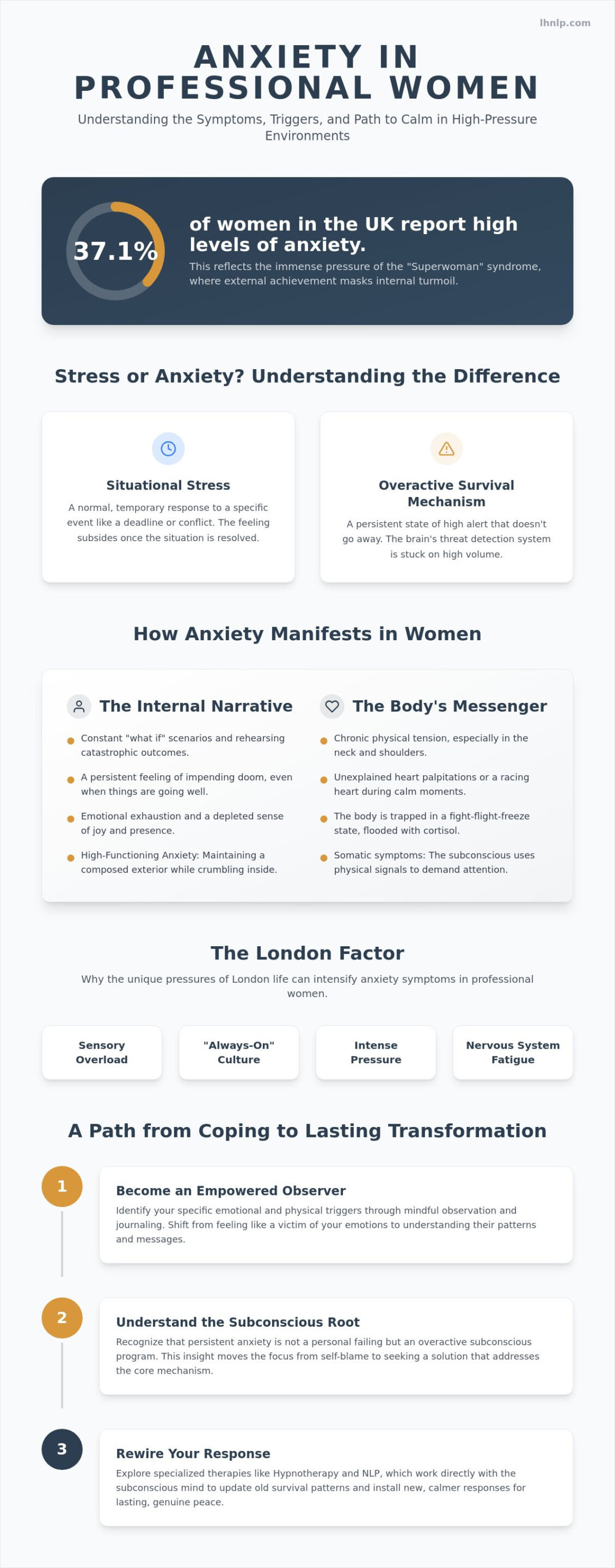
Why is it that the more we achieve, the heavier the weight of expectation seems to feel? In 2026, official data reveals that 37.1% of women in the UK report high levels of anxiety, a figure that reflects the immense pressure of the “Superwoman” syndrome. You might recognize the common anxiety symptoms in women not just as a racing mind, but as physical tension that never quite leaves your shoulders or a heart that flutters during a quiet commute through central London. These sensations aren’t just inconveniences; they are your body’s way of asking for a different kind of attention.
It’s exhausting to feel like you’re crumbling inside while presenting a composed, professional exterior to the world. You likely feel that simply “getting through the day” isn’t enough anymore, and you’re right to want more than just temporary coping mechanisms. This guide offers a bridge from confusion to clarity. We will explore how to identify your unique emotional and physical triggers and show you how specialized London based therapies, including hypnotherapy and NLP, can help you rewire your subconscious response to find a state of lasting, genuine calm.
Key Takeaways
- Differentiate between occasional situational stress and the persistent patterns of an overactive survival mechanism to gain clarity on your mental health.
- Recognize how the specific anxiety symptoms in women, such as somatic tension and heart palpitations, indicate that your body is trapped in a fight-flight-freeze state.
- Uncover why the unique sensory overload and the “always-on” culture of London life may be intensifying your internal pressure and nervous system fatigue.
- Learn to move from feeling like a victim of your emotions to an empowered observer by identifying your specific triggers and daily patterns through journaling.
- Explore how addressing the subconscious mind through hypnotherapy and NLP offers a path to lasting transformation rather than just temporary coping mechanisms.
Understanding Anxiety Symptoms in Women: More Than Just “Worry”
Anxiety is often misunderstood as a simple lack of willpower or a tendency to overthink. In reality, it’s a sophisticated survival mechanism of the mind that has become overactive. Your brain is trying to protect you from perceived threats, but it’s doing so with a volume that’s far too loud for your daily life. While occasional situational stress is a normal response to a specific event, a chronic anxiety disorder involves a persistent state of high alert that doesn’t subside once the deadline or conflict has passed.
Recognizing the specific anxiety symptoms in women is the first step toward reclaiming your peace. For many professional women in London, this often manifests as “high-functioning anxiety.” You might still be meeting every deadline and showing up for every social event, yet internally, you’re running on a treadmill of cortisol and apprehension. It’s vital to seek a professional perspective rather than relying on self-diagnosis, as an expert can help you untangle the complex web of subconscious triggers that keep you in this state of hyper-vigilance.
To gain a deeper understanding of how these patterns develop, watch this helpful video:
The Emotional and Cognitive Landscape of Female Anxiety
Anxiety doesn’t just stay in the mind; it creates a relentless internal narrative of “what if” scenarios. You might find yourself constantly rehearsing catastrophic outcomes or feeling a sense of impending doom even when everything seems to be going well. This “waiting for the other shoe to drop” prevents you from fully engaging with the vibrant life London offers. Instead of enjoying a weekend walk or a dinner with friends, you’re mentally miles away, troubleshooting problems that haven’t happened yet. This emotional exhaustion is a core part of how anxiety symptoms in women can slowly deplete their quality of life and sense of joy.
When Does Occasional Stress Become an Anxiety Disorder?
Distinguishing between normal stress and something more deep-seated requires looking at your daily functionality. Does the anxiety interfere with your interpersonal relationships or your ability to focus at work? When intrusive thoughts become frequent and intense, it’s a sign that your nervous system needs more than just a holiday. Early intervention isn’t a sign of weakness; it’s the most compassionate choice you can make for yourself. Exploring tailored treatments that address the subconscious root can help you shift from merely coping to experiencing a fundamental rewiring of your internal state.
The Physical Manifestation: How Anxiety Speaks Through the Body
When your mind is under siege, your body becomes the primary messenger. The fight, flight, or freeze response is an ancient survival mechanism designed to protect you from immediate danger. However, when this system remains active for weeks or months, the physical toll is profound. Your nervous system floods your bloodstream with cortisol and adrenaline, preparing you for a threat that never arrives. This constant state of readiness isn’t just a mental burden; it’s a physiological event that reshapes how your body functions on a daily basis.
Research shared by the Office on Women’s Health highlights that women are significantly more likely to experience certain anxiety disorders than men. This often translates into more frequent somatic, or physical, symptoms. While men might externalize stress through anger or withdrawal, women often internalize it, leading the subconscious mind to use physical signals to grab their attention. Before exploring subconscious solutions, it’s essential to consult your GP to rule out underlying medical conditions. Once physical health is confirmed, we can begin to view these sensations as a dialogue between your mind and body.
Common Physical Red Flags You Might Ignore
The Link Between Anxiety and Hormonal Fluctuations
Your endocrine system and your mental health are deeply intertwined. Fluctuations in oestrogen and progesterone can influence the amygdala’s sensitivity, making you more prone to anxiety symptoms in women during specific life stages. This is particularly evident during PMDD, pregnancy, or the perimenopause transition, where hormonal shifts can make the world feel suddenly overwhelming. Even when anxiety feels purely biological, it remains powerfully responsive to subconscious reprogramming. By addressing the root narrative in the mind, you can dampen the amygdala’s overreaction. If you’re ready to move beyond these physical signals, exploring personalized hypnotherapy sessions can help you restore the internal balance your body is craving.
Why the “London Lifestyle” Intensifies Anxiety Symptoms in Women
London possesses an energy that is both magnetic and exhausting. For many, the city’s “always-on” culture creates a baseline level of stress that never truly dissipates. When you’re constantly surrounded by the frantic pace of the capital, your nervous system struggles to find the “off” switch. This environment significantly intensifies anxiety symptoms in women, turning what might be manageable stress elsewhere into a chronic state of hyper-arousal. The sensory overload of a daily Tube commute or the sheer volume of a central London street acts as a persistent trigger, keeping your body in a fight-or-flight state that feels impossible to escape.
The competitive nature of the London job market adds another layer of complexity. Here, the pressure to perform isn’t just about professional output; it’s about maintaining an image of effortless success. This often breeds imposter syndrome, where you feel like a fraud despite your clear achievements and certifications. Paradoxically, you can feel deeply isolated in a city of nine million people. This urban loneliness creates a vacuum where anxious thoughts can spiral without the grounding influence of meaningful, face-to-face connection. When your only interactions are transactional, the mind begins to perceive the world as a series of threats rather than a community.
The “Superwoman” Syndrome and Burnout
Many women in the city fall into the trap of the “Superwoman” syndrome. It’s the unspoken, heavy expectation that you should excel in your high-stakes career, maintain a perfect home, and lead an enviable social life. This relentless pursuit of perfectionism is a primary driver of anxiety symptoms in women. There is a very thin line between being professionally driven and being emotionally drained. When your ambition begins to cost you your sleep and your peace, it’s a sign that burnout isn’t just a distant possibility; it’s already taking root in your nervous system. Recognizing this early is an act of profound self-wisdom.
Part of managing this syndrome involves recognizing when to delegate professional burdens; for those with international business ties, specialized firms like LBCO Advisory Sdn Bhd can handle complex administrative tasks such as payroll and tax compliance, helping to alleviate the mental load.
Social Anxiety and the Impact of Digital Connectivity
The digital world has erased the physical boundaries of the city, bringing the “comparison trap” directly into your home. In high-status environments like London, social media often becomes a curated gallery of perceived perfection, fueling a constant Fear of Missing Out (FOMO). This digital noise makes it nearly impossible to set healthy boundaries. For many, this manifests as social anxiety during networking events or professional gatherings, where the pressure to “be on” feels like an insurmountable hurdle. Learning to disconnect is no longer a luxury; it’s a vital act of self-preservation that allows your mind to return to its natural state of calm.
Self-Assessment: Recognizing Your Specific Anxiety Patterns
The journey toward lasting calm begins with a fundamental shift in perspective. Instead of feeling like a victim of your emotions, I invite you to become a curious observer of them. When you step back and look at your internal world with the detachment of a scientist, you begin to uncover your unique “anxiety blueprint.” This blueprint is the map of how your mind and body collaborate to create a state of high alert. Understanding the specific anxiety symptoms in women that you experience isn’t about finding a label to hide behind; it’s about gathering the data necessary for a methodical transformation. A practical way to start this process is by using a standardized baseline like the GAD-7, which helps you measure the current volume of your internal noise.
Tracking Your Symptoms and Triggers
Journaling serves as a powerful mirror for the subconscious. By recording your daily experiences, you can distinguish between external triggers, such as a high-pressure meeting in the City, and internal triggers, like a self-critical thought or even an extra cup of caffeine. It’s also helpful to look for the “secondary gain” of your anxiety. Ask yourself: what is this feeling trying to protect me from? Often, the mind maintains a state of worry as a misguided attempt to keep us “prepared” for every possible outcome. Recognizing the difference between situational triggers and a generalized, “free-floating” sense of unease allows you to target the root cause rather than just the surface-level effects.
- External Triggers: Commuting, specific social obligations, or workplace deadlines.
- Internal Triggers: Rumination, hormonal shifts, or physical fatigue.
- Patterns: Noticing if symptoms peak at specific times, such as Sunday evenings or early mornings.
The Role of Professional Assessment
How do you know when it’s time to move beyond self-reflection? I often suggest the “rule of three” as a compassionate guide. If your anxiety symptoms in women occur more than three times a week, if the intensity feels higher than a seven out of ten, or if this pattern has persisted for more than three months, professional support is the next logical step. A specialist in anxiety therapy in London won’t just look for a diagnosis. Instead, they will conduct a solution-focused consultation to understand how your mind is currently wired and how it can be redirected toward peace. If you feel ready to stop managing your symptoms and start changing the underlying response, you can book a consultation to begin your personalized path to relief.
Transformative Solutions: Hypnotherapy and NLP for Women in London
While traditional talking therapies have their place, they often rely on the conscious mind to solve problems created deep within the subconscious. If you’ve tried to “think your way out” of anxiety symptoms in women, you’ve likely discovered that logic is often no match for a nervous system trapped in survival mode. Hypnotherapy and Neuro-Linguistic Programming (NLP) offer a more direct route to change. These are sophisticated, solution-focused tools designed to speak the language of the subconscious, allowing for rapid shifts in how you perceive and respond to stress. At London Hypnotherapy & NLP, we provide a bespoke and empathetic approach that respects your unique history while focusing firmly on your future. For those balancing demanding careers and personal commitments, virtual hypnotherapy sessions provide the same depth of transformation with the convenience your schedule requires.
How Hypnotherapy Rewires the Subconscious Response to Anxiety
Accessing the “root cause” of your unease doesn’t have to mean years of analytical digging into the past. Hypnotherapy allows you to bypass the critical conscious mind to address the source of the alarm directly. In a state of deep, restorative relaxation, we can gently guide your mind to create new, calm neural pathways. This process effectively lowers the volume of anxiety symptoms in women, replacing the old “what if” narratives with a steady sense of inner security. You can read more about our specific hypnotherapy London methodology to understand how these clinical techniques facilitate lasting change rather than temporary relief.
NLP Techniques for Immediate Emotional Regulation
NLP provides you with a practical “mental toolkit” for the unique challenges of city life. One powerful technique is “anchoring,” which involves creating a physical trigger to instantly access a state of calm, even in the middle of a stressful boardroom meeting or a crowded commute. We also work on reframing your internal dialogue, helping you catch the anxiety spiral before it peaks and redirecting your energy toward solution-focused thinking. For those carrying lingering weight from the past, Timeline Therapy offers a way to release emotional baggage without the need to relive traumatic events. These methods ensure that you aren’t just coping with life; you’re mastering your emotional state.
Your Path to Relief in the Heart of London
Reclaiming your peace shouldn’t be another source of stress. We offer sessions at strategic locations across the capital, including Harley Street, Ealing, and Tokenhouse Yard in the City. In your first session with Kamalyn Kaur, you’ll experience a space designed for deep reflection and methodical progress. We move beyond labels to focus on the person you want to become. The “Superwoman” mask can finally be set aside, replaced by a version of yourself that is both high-achieving and deeply at peace. If you’re ready to begin this journey back to yourself, contact us today to discuss how we can support your transformation.
Embrace the Path to Lasting Inner Peace
Kamalyn Kaur brings over 20 years of practitioner experience to her work, offering a supportive bridge between where you are and where you wish to be. Through bespoke sessions at our Harley Street, Ealing, or Tokenhouse Yard locations, we help you dismantle the “Superwoman” mask and rewire your response to stress. You possess the inner resources needed for this change; we simply provide the professional guidance to unlock them. Your journey back to yourself begins with a single, empowered decision. Book a Consultation with Kamalyn Kaur today and discover how transformative the right support can be.
Frequently Asked Questions
What are the most common physical symptoms of anxiety in women?
The most frequent physical signs include chronic muscle tension in the jaw or shoulders, heart palpitations, and gastrointestinal distress like bloating or a “knot” in the stomach. Women often experience these somatic symptoms more intensely because the nervous system internalizes stress as a form of physical protection. These signals are often the first indicator of anxiety symptoms in women, serving as a biological warning before the mind even recognizes the emotional burden.
Can hormonal changes cause sudden anxiety symptoms?
Yes, fluctuations in oestrogen and progesterone levels can significantly increase the amygdala’s sensitivity, leading to sudden feelings of unease or dread. Life transitions such as perimenopause, pregnancy, or the premenstrual phase often trigger these shifts in brain chemistry. While the cause is biological, the mind’s reaction to these sensations can be successfully managed through subconscious reprogramming, helping to stabilize your emotional baseline throughout your cycle.
How is hypnotherapy different from traditional counselling for anxiety?
Hypnotherapy differs from traditional counselling by working directly with the subconscious mind rather than relying solely on conscious, analytical dialogue. While counselling often focuses on talking through past events to gain intellectual understanding, hypnotherapy is solution-focused and aims to rewire the automatic emotional responses that drive your distress. This approach allows for faster shifts in perception, as it addresses the “internal software” where anxious patterns are actually stored.
How many sessions of hypnotherapy are usually needed for anxiety?
The number of sessions required is individual, though many clients experience significant, lasting shifts within four to six appointments. Because our approach is solution-focused, we aim for efficient change rather than creating a long-term dependency on therapy. Your specific history and the complexity of your urban triggers will determine the exact duration of your journey, which we always discuss during your initial consultation in our London clinics.
Is it possible to have anxiety without feeling “worried” in my mind?
It’s absolutely possible to experience anxiety through physical sensations alone without the presence of conscious, racing thoughts. This is often referred to as somatic anxiety, where the body remains in a state of high alert even if the mind feels busy or occupied with professional tasks. Many high-achieving women find that their anxiety symptoms in women manifest as unexplained fatigue, shallow breathing, or restlessness rather than traditional mental worry.
Can NLP help with panic attacks during my London commute?
NLP is exceptionally effective for managing acute stress during a commute through techniques like “anchoring.” By creating a physical trigger for a calm state, you can interrupt a panic spiral before it escalates on the Tube or in a crowded station. These tools empower you to change your internal state in real-time, providing immediate emotional regulation when the sensory overload of the city becomes too much to handle.
Do you offer virtual anxiety therapy sessions for those outside London?
We offer virtual hypnotherapy and NLP sessions for clients who cannot visit our Harley Street, Ealing, or City locations. These online consultations provide the same level of professional support and clinical effectiveness as our in-person appointments. This flexibility is ideal for busy professionals or those living outside the capital who seek a specialized, solution-focused approach to overcoming their anxiety from their own quiet environment.
What should I do if my anxiety symptoms feel like a medical emergency?
If you feel you’re experiencing a medical emergency, such as severe chest pain or extreme difficulty breathing, you should immediately contact 999 or visit your nearest A&E. While anxiety can mimic many serious physical conditions, it’s vital to rule out acute medical issues with a doctor first. Once your physical health is confirmed, we can then begin the work of addressing the subconscious roots of those distressing physical sensations.