

What if your inability to quit smoking isn’t a lack of strength, but a sign that your mind is actually trying to protect you? You’ve likely stood over a bin, crushing a half-full pack with a mix of resolve and desperation, only to find yourself back at the shop just a few hours later. It’s an exhausting cycle that leaves you feeling like a personal failure, especially when you realize you’re among the 70% of smokers who genuinely want to quit. You keep asking yourself, “why have I failed to quit smoking before?” while the heavy weight of health anxiety lingers in your thoughts.
We often blame a lack of discipline, yet research from 2025 shows that stress and anxiety are the primary triggers for relapse in over 60% of cases. You’ll soon discover that willpower is a fragile, finite resource that simply cannot compete with the deep-seated patterns of your subconscious mind. This article explains the hidden architecture of your habits and provides a new perspective on why your past attempts stalled. By addressing the internal barriers rather than just the physical symptoms, you can finally find the confidence to try a different, non-medical path toward lasting freedom.
Key Takeaways
- Recognize that willpower is a finite cognitive resource, and learn why relying solely on conscious effort creates the internal friction that often leads to relapse.
- Uncover the hidden “Secondary Gains” of your habit, identifying the ways your subconscious uses smoking to manage stress or provide a sense of emotional comfort.
- Discover how shifting your internal identity can finally answer the frustrating question, “why have I failed to quit smoking before?” and help you move beyond the feeling of deprivation.
- Explore how methods like hypnotherapy and NLP address the psychological rituals of smoking, filling the mental void that chemical substitutes like patches often leave behind.
The Willpower Gap: Why Conscious Effort Often Falls Short
You decide to quit. Your logic is sound. Your heart is ready. Yet, the moment a deadline looms or a personal conflict arises, that resolve seems to evaporate, leaving you searching for a lighter. If you have spent years asking yourself, “why have I failed to quit smoking before”, the answer lies in the friction between your logic and your instincts. This tension is known as the Willpower Gap. It’s the space where your conscious desire to be healthy meets the deep, habitual impulse to reach for a cigarette. Most people view this gap as a personal flaw, but it’s actually a predictable psychological response.
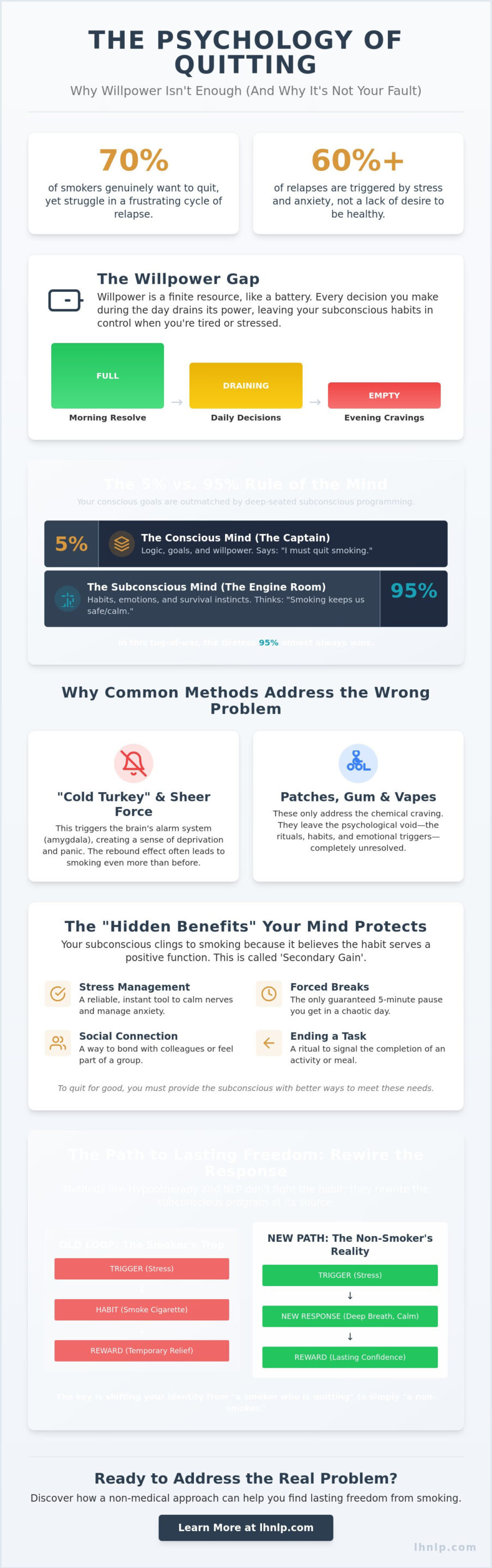
Willpower isn’t a fixed personality trait; it’s a finite cognitive resource that behaves much like a battery. Throughout a typical day, every decision you make, from what to wear to how to handle a difficult email, drains a bit of that energy. By the time evening arrives, your “willpower battery” is often running on empty. When your conscious guard is down, your brain defaults to its most practiced survival strategies. For many, the process of smoking cessation feels impossible because they are trying to fight a 24/7 habit with a battery that only lasts eight hours. You aren’t weak; you are simply outmatched by a system designed to keep you doing what it thinks you need to survive.
To better understand why this cycle repeats, watch this helpful video:
The 5% vs. 95% Rule of the Mind
Think of your mind as a massive ship. Your conscious mind is the captain, standing on the bridge making logical decisions about the destination. This represents only about 5% of your mental processing. The other 95% is the engine room, your subconscious, which manages every automated system, from your heartbeat to your deepest habits. When the captain shouts “turn left” but the engine room is locked into “go straight,” the ship isn’t going to turn. This creates cognitive dissonance, which is the agonizing mental tension you feel when you hold the belief that smoking is killing you while simultaneously performing the action of lighting up. In this tug-of-war, the engine room almost always wins because it never gets tired.
Why ‘Cold Turkey’ Triggers the Brain’s Alarm System
When you attempt to quit “cold turkey” without preparing your inner mind, you often accidentally trigger the amygdala, the brain’s ancient alarm system. Your subconscious has learned to associate smoking with safety, stress relief, or a moment of peace. When you suddenly remove that “tool,” the amygdala perceives it as a threat to your emotional stability. This triggers a deprivation mindset, where every minute without a cigarette feels like a sacrifice. Eventually, the psychological pressure builds until the “rebound effect” kicks in. This is why many people who try to quit through sheer force of will find themselves smoking even more than before once their resolve finally snaps. Real change doesn’t come from fighting the alarm; it comes from teaching the brain that it’s already safe.
Understanding ‘Secondary Gains’: The Hidden Benefits of Your Habit
To truly understand your relationship with cigarettes, you must look past the smoke and the chemical labels. We often view a habit as a purely destructive force, yet the subconscious mind rarely maintains a pattern unless it perceives a specific, functional benefit. In the world of psychology, this is known as “Secondary Gain.” It is the hidden reason your mind clings to the very thing your logic wants to discard. If you have spent late nights wondering, “why have I failed to quit smoking before”, the answer often lies in these invisible rewards that your subconscious is unwilling to surrender.
Your subconscious mind functions like a devoted, albeit misguided, protector. It doesn’t see the long term health risks in the same way your conscious mind does. Instead, it sees a tool that provides immediate stress relief, a sense of social belonging, or perhaps the only five minutes of peace you get during a chaotic workday. The cigarette becomes a “forced break” or a “social lubricant.” In its own way, your mind is trying to help you navigate life’s pressures, but it’s currently using a harmful instrument to achieve those positive intentions. Recognizing these gains is the first step toward finding healthier ways to meet those same needs through specialized professional support.
Smoking as an Emotional Anchor
Over time, the act of smoking becomes an emotional anchor, tethered to specific states of mind. When you feel overwhelmed, your brain triggers the urge to smoke because it has linked that action to a feeling of “calm” or “focus.” Interestingly, the relaxation people report often comes from the physical act of the “deep breath” taken during inhalation, which mimics natural relaxation techniques. Your mind has simply misattributed that physiological relief to the nicotine. Identifying these emotional triggers allows you to see the habit for what it is: a learned response to internal discomfort rather than a permanent part of your personality.
The Conflict of Interests Within
Have you ever felt like there are two different people living inside your head when a craving hits? One part of you is the rational adult who values health and longevity, while the other is like a demanding child who only wants comfort right now. This internal “split” is why willpower feels so exhausting. You aren’t fighting a lack of character; you are caught in a conflict of interests between your conscious goals and your subconscious safety mechanisms. When you stop fighting yourself and start understanding the need behind the habit, the urge begins to lose its power. You can then begin to negotiate with the subconscious, showing it that it can protect you without the need for a cigarette.
The Identity Trap: Are You a Smoker Who Doesn’t Smoke?
Many individuals who struggle with cessation find themselves caught in a subtle but powerful psychological snare. They aren’t just fighting a chemical; they’re fighting a self-image. If you still view yourself as a “smoker who is trying to stop,” you’re essentially telling your brain that you’re in a state of permanent deprivation. You’re a smoker who is being denied their “prize.” This mental framing is a primary reason why you might ask, “why have I failed to quit smoking before.” True freedom doesn’t come from resisting a cigarette; it comes from the quiet realization that you are simply no longer the person who needs one.
Your self-image is reinforced by the social circles you inhabit and the labels you accept. If your identity is tied to being the “social smoker” at the pub or the person who takes the “stress breaks” with colleagues, quitting feels like a form of social exile. Your subconscious views the habit as a bridge to connection. When you try to quit without shifting this internal narrative, the mind perceives a loss of belonging. You aren’t just giving up tobacco; you feel like you’re giving up a part of your personality. To succeed, you must move beyond the “smoker” label entirely and embrace the identity of a non-smoker who is indifferent to the habit.
Breaking the Environmental Habit-Loop
Habits are often tied to specific “spatial anchors” that trigger the urge before you’ve even had a conscious thought. In London life, these might be the specific corner of the train station where you wait, the walk to the office, or the designated break area. Your brain has mapped these environments as “smoking zones.” To disrupt this automaticity, you must consciously change your physical routine. Take a different route to the station or choose a new spot for your morning coffee. However, changing the scenery is only a temporary fix if the internal map remains the same. You must learn to inhabit these spaces without the mental ghost of the habit following you.
Shifting Your Internal Narrative
The language you use during this transition is incredibly influential. There is a profound psychological difference between saying “I can’t have a cigarette” and “I don’t want a cigarette.” The former implies a struggle against an external rule, while the latter reflects an internal choice and a new identity. Visualizing yourself as a non-smoker in high-stress situations helps to pre-program your response, making the transition feel natural rather than forced. Identity-based change represents the most sustainable form of cessation because it removes the internal conflict between who you are and what you do.
Why Patches and Gum Only Solve Half the Problem
Many people approach smoking cessation as a purely chemical challenge. They believe that if they can just manage the nicotine withdrawal, the habit will simply disappear. While research shows that those using Nicotine Replacement Therapy (NRT) are 55% more likely to sustain cessation for six months compared to those using nothing, these tools often leave the deeper psychological ritual untouched. If you’ve spent money on patches only to find yourself lighting up while wearing one, you’ve likely asked, “why have I failed to quit smoking before?” The answer is that the chemical addiction is only a small fraction of the problem. The rest is a complex web of mental associations and physical rituals.
This gap creates what we call the “Psychological Void.” It’s that gnawing sense of emptiness that persists even when your blood nicotine levels are perfectly stable. NRT doesn’t provide the “reward” of the hand-to-mouth action or the mental “reset” that a cigarette break offers. The mechanical habit is often far stronger than the chemical urge itself. This is also why “cutting down” rarely works; it simply makes each remaining cigarette feel more precious, reinforcing the brain’s belief that the habit is a valuable prize rather than a burden. To find lasting freedom, you need to look beyond the chemistry and address the underlying mental patterns through comprehensive hypnotherapy sessions.
The Myth of the ‘Magic Pill’
External solutions like gum or medication are often treated as magic pills, but they fail to address the internal cause of the habit. Relying on a crutch without changing the underlying thought pattern is like painting over rust; the problem remains just beneath the surface. Kamalyn Kaur’s approach focuses on the “software” of the mind, helping you rewrite the scripts that trigger the urge in the first place. When you update the internal programming, the need for external substitutes naturally falls away because the mental requirement for the habit no longer exists.
Willpower vs. Imagination
There is a psychological principle known as the law of reverse effect. It states that when willpower and imagination are in conflict, imagination always wins. If you use your willpower to try and stop smoking while your imagination is vividly picturing the relief of a cigarette, the mental image will eventually overpower your resolve. You can’t “will” yourself out of a habit that your imagination still finds attractive. Success comes from aligning your imagination with your health goals, allowing you to see yourself as someone who is genuinely indifferent to smoking. When your inner vision matches your outward goals, the struggle ends.
Rewiring the Response: How Hypnotherapy & NLP Create Lasting Change
The question of why have I failed to quit smoking before finds its definitive answer here: you were trying to solve a subconscious problem with a conscious tool. While willpower attempts to suppress the urge, stop smoking hypnotherapy works by bypassing the critical conscious mind entirely. This allows us to communicate directly with the “engine room” of your brain, where the habit is stored. By entering a state of focused receptivity, we can update the internal scripts that once told you smoking was necessary for your survival or emotional stability. It’s a process of neurological editing that makes the transition feel natural rather than like a constant battle against yourself.
Neuro-Linguistic Programming (NLP) complements this by targeting the specific habit-loops and mental associations that trigger the urge. If your brain has spent decades linking a cup of coffee with a cigarette, NLP provides the techniques to “unplug” that connection instantly. Instead of just hoping the craving won’t come, we install new, healthy responses to those old triggers. This solution-focused approach replaces the “Psychological Void” we discussed earlier with a sense of calm and empowerment. Understanding why have I failed to quit smoking before is the first step, but rewiring that response is the path to true, lasting freedom.
Generic “quit kits,” apps, or nicotine patches fail because they are designed for everyone and no one at the same time. They cannot address your unique “Secondary Gains” or the specific emotional anchors you’ve built over a lifetime. A personalized session allows for a deep dive into your personal history with the habit, ensuring that the new mental patterns we install are perfectly aligned with your values and lifestyle. It isn’t about being told to stop; it’s about your mind deciding that it no longer wants to continue.
What Happens in a Smoking Cessation Session?
Clinical hypnosis is often misunderstood. It is not a loss of control or a “sleep” state, but rather a period of deep, focused relaxation where your mind becomes exceptionally open to positive change. During a session, we work together to identify and remove the hidden benefits your subconscious has been protecting. Once those secondary gains are addressed, we install new anchors for stress and relaxation. You’ll leave the session not feeling “deprived,” but feeling as though a heavy weight has finally been lifted from your shoulders.
Why Londoners Choose Hypnotherapy for Smoking
For busy professionals, efficiency is a primary concern. Hypnotherapy is often preferred because it can achieve in just a few sessions what traditional talk therapy might take months to address. Many clients also find the convenience of online hypnotherapy services invaluable, allowing them to undergo this transformation from the comfort and privacy of their own home. You don’t have to be a victim of your past failures any longer. Book your consultation with Kamalyn today to finally close the willpower gap and step into your life as a non-smoker.
Stepping Into Your Smoke-Free Identity
Your journey toward freedom begins with the realization that you aren’t fighting a lack of character, but a deeply ingrained subconscious pattern. If you’ve spent years asking why have I failed to quit smoking before, you now understand that your mind was simply trying to protect you using the only tools it knew. By closing the willpower gap and addressing the hidden secondary gains of your habit, you can finally move beyond the identity of a smoker and embrace the quiet confidence of a non-smoker. You don’t have to carry the weight of past attempts anymore; they were simply lessons in how the mind operates.
With over 20 years of practitioner experience in clinical hypnotherapy and specialized solution-focused NLP techniques, I am here to help you navigate this internal shift. Whether you visit our convenient London locations in Harley Street and Ealing or prefer a virtual session, the path to change is ready for you. It’s time to stop fighting yourself and start living with clarity and health. Your new life as a non-smoker is not a distant dream, but a methodical process of inner alignment.
Ready to quit for good? Book your London smoking cessation session here.
Frequently Asked Questions
Is it normal to fail several times before successfully quitting smoking?
Yes, it’s perfectly normal to experience several setbacks before achieving lasting success. Most people find that their previous attempts failed because they only addressed the chemical aspect of the habit while ignoring the subconscious drivers. When you ask yourself, “why have I failed to quit smoking before,” remember that you weren’t lacking discipline. You were simply fighting an internal battle without the right tools to reach the subconscious level where habits truly live.
Can hypnotherapy work even if I have a very ‘strong’ or ‘analytical’ mind?
Absolutely. A strong, analytical mind is actually an asset during a session because you already possess the ability to focus deeply. Hypnosis isn’t about losing control or being “weak-willed.” It’s a state of heightened awareness where your analytical mind steps aside for a moment to allow your subconscious to accept new, healthier programming. This focused state is exactly where the most profound and lasting changes happen.
How many sessions of hypnotherapy are usually needed to stop smoking for good?
Many clients achieve their goal in just one or two intensive sessions. Unlike traditional talk therapy that can span months, smoking cessation through hypnotherapy is designed to be highly efficient and results-oriented. We focus on the immediate rewiring of your habit-loops, ensuring you leave the session with a fresh perspective and the mental tools required to maintain your freedom as a non-smoker.
Will I experience weight gain if I use hypnosis to quit smoking?
Is nicotine addiction the main reason why I keep relapsing?
Nicotine plays a role, but psychological factors are the most common reasons people relapse. A 2025 study found that stress, anxiety, and grief were triggers for 61% of individuals who returned to smoking. This explains why have I failed to quit smoking before even after the physical nicotine has completely left your system. Addressing these emotional triggers is the fundamental key to preventing future relapses and ensuring long-term success.
How is hypnotherapy different from just using an app or listening to a recording?
Live sessions provide a level of personalization that a generic app or recording simply cannot match. Every smoker has a unique set of “secondary gains,” such as using the habit for a specific work break or social connection. A practitioner can identify these specific anchors in real-time and tailor the session to your personal history. This ensures that the root cause of your specific habit is fully resolved.
Can NLP help with the social anxiety of being a non-smoker?
Yes, NLP coaching is highly effective for building social confidence and changing your internal narrative. We use specific techniques to help you uncouple the feeling of “belonging” or “confidence” from the act of smoking. This allows you to stand in a social gathering feeling completely at ease without a cigarette in your hand. You’ll discover that your social identity is based on who you are, not what you do.
What happens if I have a ‘slip-up’ after my hypnotherapy session?
If a slip-up occurs, it’s treated as a valuable piece of feedback rather than a sign of failure. It usually indicates a specific situation or emotion that your subconscious hasn’t yet learned to handle without the old habit. We use that moment to refine your mental strategy and strengthen your new response. This compassionate approach removes the guilt and focuses entirely on your continued growth and final success.