

What if the secret to a cool, composed face isn’t found in a colder room, but in the way you perceive the gaze of others? For many, the sudden surge of heat during a meeting or social gathering feels like an unwanted spotlight that refuses to dim. Research indicates that roughly 50% of those experiencing social anxiety struggle with this intense physical response, yet the more you focus on the heat, the more persistent it becomes. This guide explores how to stop blushing when nervous by shifting your internal dialogue and cooling the emotional fire that fuels the flush.
You’ve likely felt that familiar dread before a presentation, wondering if your skin will betray your inner tension to every person in the room. It’s a heavy burden to carry, often leading you to avoid the very social connections you crave. We’re going to dive into the psychological mechanics of blushing and introduce you to the transformative power of NLP and hypnotherapy. By retraining your subconscious mind to remain steady, you’ll learn how to regain control of your presence and step into any room with a sense of quiet, unshakable confidence.
Key Takeaways
- Understand how the “fight or flight” mechanism creates a cycle of hyper-vigilance, where the fear of blushing becomes the very trigger that fuels the physical response.
- Master a five-step “Emergency Cooling” protocol and externalisation techniques to regain your physical composure the moment you feel a flush beginning.
- Discover how to stop blushing when nervous by using NLP and hypnotherapy to reset the subconscious alarm system that willpower alone cannot reach.
- Develop a long-term strategy for social confidence that replaces the urge to avoid meetings with a steady, calm presence during high-pressure interactions.
The Science of Blushing: Why Your Body Turns Red Under Pressure
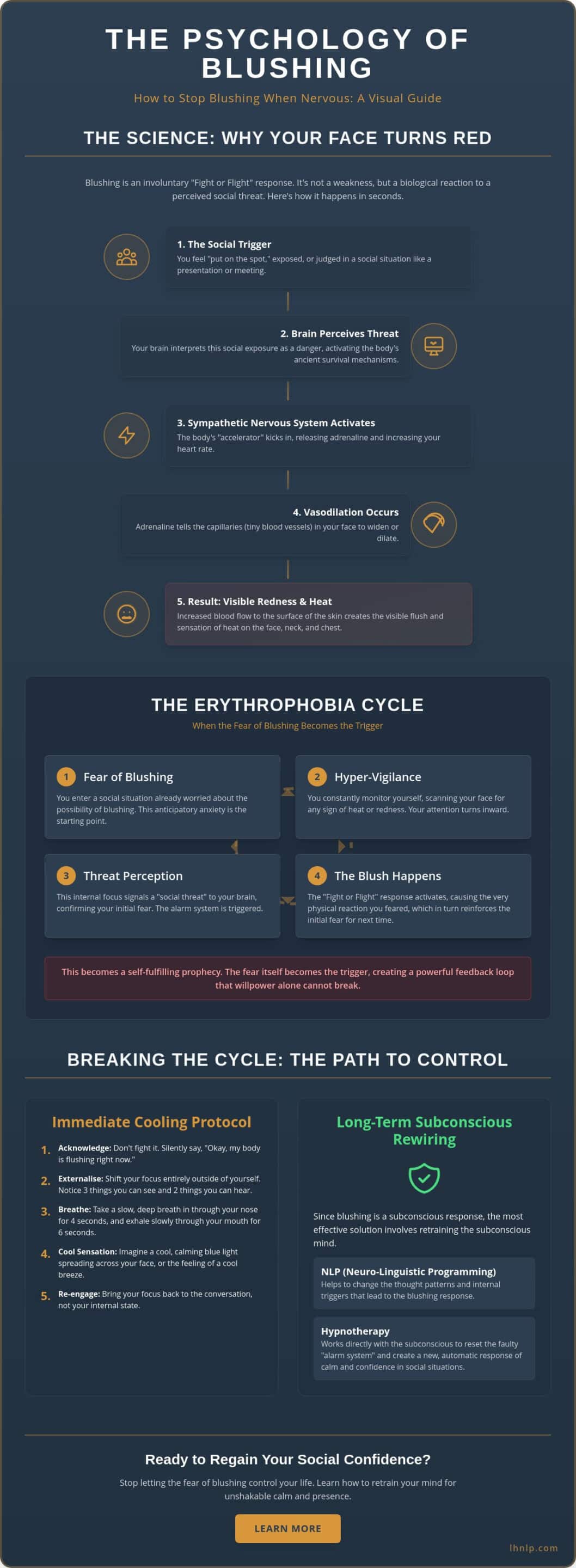
Blushing is far more than a simple change in skin tone; it’s a complex, involuntary physiological response rooted in our very survival. At its core, the flush you experience is a vasodilation response triggered by your sympathetic nervous system. When you feel “put on the spot” or socially exposed, your brain perceives this as a threat, much like it would a physical predator. This triggers the famous “Fight or Flight” mechanism, causing your body to release adrenaline. This hormone acts as a chemical messenger, telling the small blood vessels in your face, known as capillaries, to widen. As these vessels expand, more blood flows to the surface, creating the heat and redness we recognize as a blush. Understanding The Science of Blushing helps us realize that this isn’t a sign of personal weakness, but a highly active nervous system attempting to protect you.
While the sensation can feel overwhelming, it’s helpful to remember that blushing is a uniquely human experience. It often serves as a silent, honest signal of social intelligence and empathy. By showing a blush, you’re subconsciously communicating that you care about social norms and the opinions of others. This transparency can actually foster trust in professional settings, even if it feels like your face is betraying your inner calm. To better understand this biological process and how it manifests, watch this helpful video:
The Role of the Sympathetic Nervous System
Your sympathetic nervous system acts as the body’s accelerator. When you are looking for how to stop blushing when nervous, you’re essentially looking for ways to regulate this internal speed. In a social “threat” scenario, your heart rate increases and your breathing shallows. Because the facial skin has a higher density of capillary loops and is closer to the surface than on other parts of the body, the rush of adrenaline shows up most prominently on the face, neck, and chest. It’s a lightning-fast reaction that happens before your conscious mind can even process the situation. This is why willpower alone often fails to stop the redness once it has begun.
Blushing vs. Flushing: Knowing the Difference
It’s important to distinguish between emotional blushing and medical flushing. True blushing is almost always linked to a specific social or emotional trigger, appearing and disappearing relatively quickly. In contrast, medical flushing can be more prolonged and may be caused by factors such as:
- Rosacea or other inflammatory skin conditions.
- Hormonal changes, such as those experienced during menopause.
- External triggers like spicy foods, alcohol, or sudden changes in room temperature.
The Erythrophobia Cycle: When the Fear of Blushing Becomes the Trigger
Blushing is rarely just a physical event; for many, it becomes a psychological trap where the symptom and the fear of the symptom feed into one another. The primary obstacle you face is not the redness itself, but the dread of it appearing. This specific fear, known as erythrophobia, creates an internal environment of high alert. When you enter a social situation worrying about your skin tone, your brain perceives a potential for “social defeat.” This signals the sympathetic nervous system to prepare for a threat, which, as we explored in the previous section, triggers the very vasodilation you’re trying to avoid. It’s a cruel paradox that turns a natural response into a source of deep distress.
You might find yourself constantly scanning your face for the slightest hint of warmth or prickling. This state of hyper-vigilance keeps your attention locked inward, away from the conversation or the presentation at hand. Instead of engaging with the person in front of you, you’re monitoring your internal “temperature.” The moment you feel that tiny spark of heat, your brain sounds the alarm. The adrenaline surge follows, and the full flush arrives. While these psychological shifts are vital, it’s also helpful to ground your understanding with professional medical advice on blushing to ensure you’re addressing both the mind and body.
Breaking the Self-Conscious Loop
To master how to stop blushing when nervous, you must first change how you label the sensation. When you tell yourself “I am blushing,” it carries a heavy weight of shame and judgment. If you can consciously reframe the experience as “I am noticing a physical sensation of warmth,” you begin to strip away its emotional power. Erythrophobia acts as a self-fulfilling prophecy where the anticipation of the symptom creates the symptom itself. If this cycle begins to feel unmanageable and starts to shrink your world, seeking social anxiety support can help you deconstruct these deep-seated patterns.
The Spotlight Effect in Professional Settings
We often suffer from the “Spotlight Effect,” a cognitive bias where we overestimate how much others notice our appearance or mistakes. You might feel like your face is a bright neon sign, but observers often don’t notice the blush or they interpret it quite differently than you do. Research suggests that people who blush are frequently perceived as more authentic, trustworthy, and empathetic. While you may feel incompetent in the moment, your colleagues likely see a person who is deeply engaged and sincere. Reframing the blush as a sign of your own integrity can be the first step toward regaining your social presence. If you find that this cycle is limiting your career growth, exploring our confidence building sessions can provide the tools needed to break the loop for good.
Immediate Techniques to Cool Down and Regain Composure
When the heat begins to rise, your first instinct might be to hide or look away. However, the most effective way to manage the flush is to engage with it through a structured response. By shifting your focus from the internal sensation of heat to the external environment, you effectively interrupt the feedback loop between your mind and your skin. This process, known as externalisation, forces your brain to process sensory data from the room rather than ruminating on your own physical state. Healthline offers a detailed guide with 10 specific techniques to stop blushing, which can serve as a valuable toolkit for these high-pressure moments.
If you feel a flush starting, follow this 5-step Emergency Cooling protocol to steady your system. First, lengthen your exhale to be twice as long as your inhale; this signals the vagus nerve to slow your heart rate. Second, if possible, sip some cold water to lower your core temperature. Third, pick an object in the room and notice three specific details about its texture or color. Fourth, fire a pre-prepared NLP anchor by pressing your thumb and forefinger together to recall a state of calm. Finally, use a simple verbal acknowledgment to diffuse the tension. These steps provide a bridge from panic back to presence.
Physical Cooling Strategies
The “cold wrist” trick is a powerful form of physical first aid. By running cold water over your wrists or holding a cold drink against your pulse points, you rapidly cool the blood circulating through your body. This can dampen the intensity of the vasodilation response. Deep, rhythmic breathing is equally essential. When you focus on expanding your diaphragm, you move out of the “chest breathing” associated with panic. A well-hydrated body is also more resilient to sudden temperature spikes. Keeping a glass of ice water nearby during meetings isn’t just a comfort; it’s a tool for physiological regulation.
Cognitive Reframing in the Moment
Learning how to stop blushing when nervous often requires a shift in your internal narrative. The “So What?” technique is remarkably effective for lowering the emotional stakes. If you notice yourself turning red, ask yourself, “So what if I am?” This simple question can strip the power from the fear of judgment. In our online hypnotherapy services, we often teach the NLP “Swish” pattern. This involves mentally replacing the image of your red, embarrassed face with a vibrant, clear image of yourself looking cool and composed. You can also take the wind out of the blush’s sails by simply saying, “It’s just a bit warm in here.” By acknowledging the heat without the shame, you stop the secondary surge of adrenaline that keeps the blush alive.
Rewiring the Subconscious: How Hypnotherapy and NLP Stop Blushing
Trying to stop a blush with willpower is like trying to stop a wave with your hands. Because blushing is an autonomic response, it bypasses your conscious mind entirely. This is the primary reason why even the most logical person struggles with how to stop blushing when nervous; you’re fighting a biological reflex with a thought. To create a lasting change, we must speak the language of the subconscious mind. This is where hypnotherapy London becomes a vital tool. By accessing the deeper layers of the psyche, we can reset the internal “alarm system” that mistakenly identifies social interactions as physical threats. Hypnotherapy for blushing has been used by professionals for decades to manage public speaking fears.
Neuro-Linguistic Programming (NLP) complements this by addressing the “mental software” that triggers the flush. Think of your mind as having a set of pre-programmed responses to certain social cues. If your current software is set to “alert” whenever you’re the center of attention, the body will follow suit. NLP allows us to rewrite these scripts, replacing the old, unhelpful triggers with new associations of calm and control. When you change the internal representation of the event, the physical response naturally follows. It’s a methodical process of updating your psychological blueprints to better serve your current goals.
Hypnosis for Emotional Regulation
During a session, we use guided visualisation to help you associate social presence with a “cool blue” sensation that spreads through the body. We also use desensitisation, which is the practice of mentally rehearsing challenging social situations while in a deep state of trance. This builds a psychological immunity to previous triggers. By establishing post-hypnotic suggestions, we ensure that a sense of automatic calm becomes your default state during therapy anxiety London sessions and in your daily life. You aren’t just learning to cope; you’re training your nervous system to remain steady.
NLP Techniques for Social Confidence
One of the most effective NLP tools is dissociation. This involves viewing a stressful situation from a third-person perspective, which immediately reduces the emotional intensity of the experience. We also work on reframing the “heat” you feel. Instead of labeling it as embarrassment, we can train the mind to perceive it as a surge of excitement or creative passion. For those navigating high-stakes London boardrooms, building a “Circle of Excellence” provides a mental anchor that you can step into whenever you need to feel unshakeably composed. If you’re ready to move beyond temporary fixes and master your internal state, you can explore our full range of treatments to begin your personal transformation.
Taking Control: Your Path to Lasting Social Confidence
The journey toward social freedom isn’t an overnight event, but a series of intentional, compassionate shifts in how you relate to your body. Once you understand the mechanics of the flush and the power of subconscious rewiring, the focus moves toward sustainable integration. You’ve already learned the immediate tools and the psychological frameworks; now, we look at how to cement these changes into your daily life. The busy professional environment of London demands a high level of presence, and mastering how to stop blushing when nervous is ultimately about reclaiming that presence. As you work on your inner confidence, you might also find that sharpening your professional communication skills helps you feel more at ease; you can discover College of Media and Publishing to explore online courses that support your career development. Remember, blushing is a habit of the mind that can be unlearned with the right guidance and persistence.
One of the most effective long-term strategies involves a controlled, supportive form of “Exposure Therapy.” This isn’t about throwing yourself into the deep end of a high-stakes presentation immediately. Instead, it’s about gradually testing your new NLP anchors and breathing techniques in low-pressure environments. You might start by intentionally speaking up in a small team meeting or engaging in a brief conversation with a stranger. Each successful interaction acts as a building block, proving to your nervous system that you’re safe and in control. Over time, these small wins accumulate, effectively desensitising the triggers that once caused a full-blown flush.
Creating Your Personalised Strategy
A holistic approach often yields the best results. This means combining your psychological tools with foundational lifestyle choices, such as ensuring adequate sleep and managing your caffeine intake, which can otherwise keep your nervous system on a “hair-trigger.” We also recommend keeping a “Confidence Journal.” Rather than recording every time you felt a flush, use this space to track your successes. Note the moments you stayed calm, the times you used your NLP anchors effectively, and the instances where you felt truly heard. Finding a skilled London NLP practitioner can provide the external perspective needed to refine this strategy and keep you moving forward.
What to Expect in a Professional Session
If you’re ready to dive deeper, a professional session offers a structured environment for transformation. We begin with an initial consultation to identify your specific blushing “drivers”—the unique thoughts or situations that spark your reaction. From there, a typical session moves from deep relaxation into active mental reprogramming. We use the techniques discussed earlier to update your subconscious blueprints, ensuring that calm becomes your new default setting. If you’re tired of the cycle and ready to step into your full social potential, you can book a consultation with Kamalyn Kaur to begin your journey toward lasting composure.
Step Into Your New Social Presence
We’ve journeyed through the complex interplay between the mind and the skin, revealing how the physiological flush is often sustained by the very fear of its arrival. By shifting your focus from internal heat to the external world and updating your subconscious blueprints through NLP and hypnotherapy, you can finally break the erythrophobia cycle. Learning how to stop blushing when nervous isn’t about suppressing your natural responses; it’s about training your nervous system to feel safe and steady even when all eyes are on you.
True transformation happens when we address the root causes rather than just the symptoms. If you’re ready for rapid change, you can Book Your Confidence Building Session in London with Kamalyn Kaur. As an expert NLP and Hypnotherapy practitioner with convenient locations in Harley Street and Ealing, Kamalyn offers a personalised, solution-focused approach tailored to your unique needs. You don’t have to navigate this path alone. With the right tools and a bit of courage, you can reclaim your social freedom and step into any room with quiet, unshakable confidence. Your composed future is waiting for you.
Frequently Asked Questions
Is blushing a sign of social anxiety disorder?
Blushing is one of the most common physical symptoms of social anxiety; research suggests that approximately 50% of individuals diagnosed with the disorder experience excessive flushing. While many people blush occasionally, it becomes a clinical concern when the fear of turning red leads to avoiding meetings or social events. It’s the emotional distress and life interference, rather than the redness itself, that defines the condition.
Can hypnotherapy really stop an involuntary physical reaction like blushing?
Yes, hypnotherapy is uniquely suited to managing autonomic responses because it works directly with the subconscious mind where these reflexes originate. By retraining your brain’s “alarm system,” we can dial down the fight or flight response that causes vasodilation. This is a primary method for those learning how to stop blushing when nervous, as it addresses the neurological root rather than just the surface symptom.
How many sessions does it typically take to see results for blushing?
Most individuals begin to notice a significant shift in their physical composure within three to six sessions. The exact duration depends on how long the pattern has been established and the intensity of the underlying triggers. Because our approach is solution-focused, we aim for rapid change that allows you to feel in control of your social presence as quickly as possible.
Will people notice if I am using NLP techniques in a meeting?
No, the beauty of NLP is that the techniques are entirely internal and invisible to those around you. Whether you’re firing a calm anchor by touching your fingers together or using a mental dissociation technique, you appear completely engaged in the conversation. You can regain your composure in real time without anyone in the boardroom knowing you’re performing a psychological exercise.
Are there any medications that stop blushing, and do I need them?
There aren’t any FDA-approved medications specifically created to treat blushing, although some doctors may prescribe beta-blockers to manage the physical symptoms of anxiety. Whether medication is appropriate is a decision for your GP. Many people prefer psychological interventions like hypnotherapy because they offer a long-term, sustainable solution that doesn’t rely on external substances or carry potential side effects.
Can I do hypnotherapy for blushing online via Zoom?
Yes, virtual sessions are just as effective as sitting in a London clinic. As long as you have a quiet, comfortable space where you won’t be interrupted, the process of guided relaxation and mental reprogramming works perfectly over video. This flexibility makes it easier to integrate your sessions into a busy schedule while still receiving expert, personalised support.
What is the “Swish Pattern” in NLP and how does it help with blushing?
The Swish Pattern is a rapid mental technique that replaces a trigger image, like the feeling of heat, with a desired state of calm. When you feel a flush starting, you mentally “swish” the image of a red face away and replace it with a clear, vibrant image of yourself looking composed. This breaks the neurological circuit that typically leads to a full-blown blush.
Why does my blushing get worse when I try to stop it?
Blushing intensifies when you try to stop it because your focused effort creates “meta-anxiety,” or anxiety about the anxiety itself. By monitoring your face for heat, you signal to your brain that you’re in a high-threat situation. This triggers a secondary surge of adrenaline, which keeps the blood vessels dilated and makes the redness more persistent and intense.