

Imagine sitting in a crowded café in Notting Hill, surrounded by the hum of voices, yet feeling an invisible glass wall between you and the person sitting across from you. You crave the warmth of a true connection, yet every time a relationship begins to deepen, an internal alarm sounds, urging you to retreat. This protective mechanism is a common response to hidden wounds, but it often leaves you feeling profoundly alone in a city of millions. If you find yourself repeatedly pushing away the very closeness you desire, seeking fear of intimacy hypnosis London can be the first step toward understanding the silent scripts running in your subconscious mind.
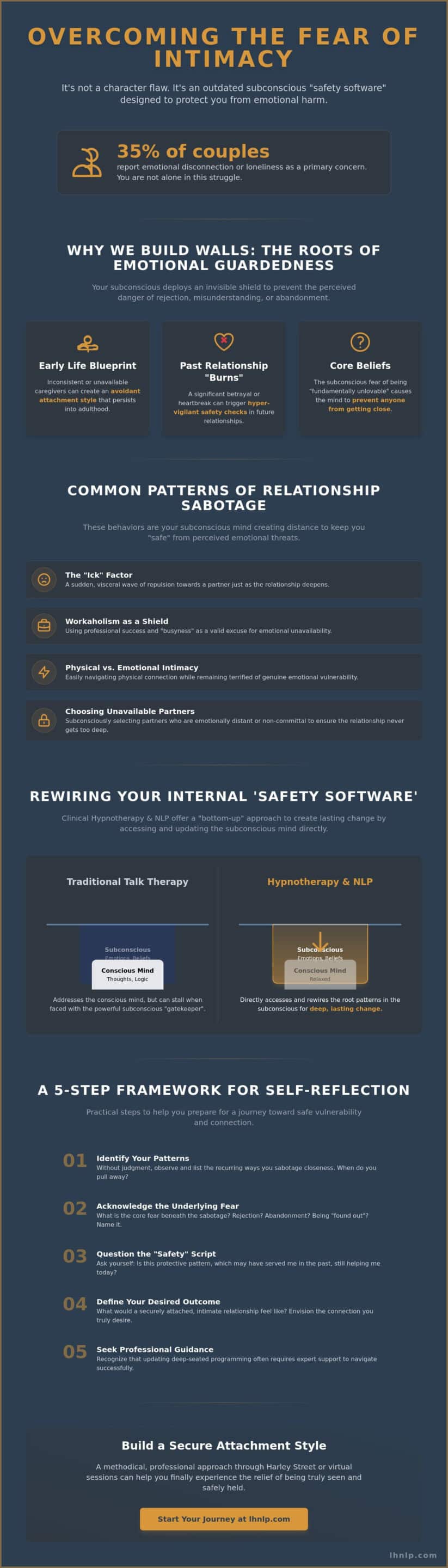
It’s exhausting to live with the constant fear that being “found out” will lead to inevitable rejection. With 35% of couples reporting emotional disconnection or loneliness as a primary concern, you’re certainly not alone in this struggle. You likely recognize the cycle of choosing unavailable partners or sabotaging connections just as they start to feel real. Why does the heart retreat when the soul longs to stay? This guide explores how clinical hypnotherapy and NLP can help you dissolve these subconscious barriers to vulnerability. We’ll examine how to update your internal “safety software” to develop a secure attachment style, allowing you to finally experience the profound relief of being truly seen and safely held.
Key Takeaways
- Understand why fear of intimacy is often an outdated subconscious “safety software” designed to protect you from emotional harm.
- Learn how clinical hypnotherapy and NLP provide a receptive environment to rewire deep-seated patterns of relationship sabotage.
- Discover the benefits of fear of intimacy hypnosis London as a “bottom-up” approach that creates lasting change where traditional talk therapy might stall.
- Gain a practical five-step framework for self-reflection to help you prepare for a journey toward safe vulnerability.
- Explore how a methodical, professional approach in Harley Street or virtual sessions can help you build a secure attachment style.
Understanding the Fear of Intimacy: Why We Build Walls
The human heart possesses an innate desire for deep connection, yet for many, this longing is met with a silent, internal resistance that feels impossible to override. Fear of intimacy isn’t a character flaw or a lack of desire for love. Instead, it’s a subconscious protective mechanism that interprets emotional closeness as a direct threat to your psychological safety. It functions like an invisible shield, deployed by the mind to prevent the perceived danger of being rejected, misunderstood, or engulfed by another’s needs. For those living in a high-stakes environment, exploring fear of intimacy hypnosis London offers a pathway to dismantle these walls through professional, methodical support.
Living in a global city like London often provides a convenient veil for these internal barriers. The transience of the population and the relentless focus on career progression allow many to mask their emotional guardedness as mere “busyness.” We might hide behind a packed social calendar or the demands of a corporate role to avoid the quiet, unfiltered vulnerability that a lasting relationship requires. When we stay perpetually on the move, we don’t have to face the stillness where our fears reside. Ultimately, intimacy fear is a survival strategy that has outlived its usefulness.
To better understand how the subconscious mind manages these protective barriers, watch this helpful video:
The Roots of Emotional Guardedness
Our blueprint for connection is usually drafted in the early chapters of our lives. If your caregivers were emotionally unavailable or inconsistent, you might have developed an avoidant attachment style as a necessary coping mechanism. These early scripts act as a foundational filter for every adult interaction. Beyond childhood, a significant “burn” from a past relationship can trigger hyper-vigilant subconscious safety checks. This often stems from a deep-seated belief that being truly known leads to being abandoned. If you feel that you’re fundamentally unlovable, your mind will work tirelessly to prevent anyone from getting close enough to confirm that fear.
Signs You Are Sabotaging Your Connections
Sabotage often appears in visceral, almost physical ways. You might experience the “ick” factor, where a sudden wave of disgust toward a partner arises just as the relationship deepens. This isn’t a reflection of their character, but rather your subconscious creating distance to keep you “safe.” In the London corporate world, workaholism frequently serves as an intimacy shield, where professional success is used to justify emotional absence. Some people also find they can easily navigate physical intimacy while remaining terrified of the emotional kind. Sharing a life is far more daunting than sharing a space. Identifying these patterns through fear of intimacy hypnosis London allows you to move from reactive sabotage to conscious connection.
How Hypnosis and NLP Rewire the Subconscious for Connection
The subconscious mind acts as the ultimate gatekeeper of our emotional safety. While your conscious mind might logically understand the causes and symptoms of fear of intimacy, the deeper layers of your psyche are often running on outdated survival scripts. These scripts were written during moments of vulnerability that led to pain. Now, they function as a relentless security system. If you’ve ever felt an invisible wall go up just as someone got close, you’ve experienced this gatekeeper in action. It doesn’t care about your happiness. It only cares about your survival.
Hypnosis provides a unique, relaxed environment where this gatekeeper can finally stand down. Contrary to popular myths, you remain in complete control throughout a session. It’s not about mind control; it’s about mind empowerment. Think of it as a state of focused attention that allows for a new kind of learning. By gently quieting the critical conscious mind, hypnosis allows us to communicate directly with the subconscious layers where these protective walls were first built. This is why fear of intimacy hypnosis London is so effective; it addresses the root cause rather than just managing the surface symptoms.
The Power of Subconscious Reframing
Transformation often begins by identifying the Initial Sensitising Event (ISE). This is the moment, often in childhood or a formative early relationship, where the subconscious first decided that intimacy was dangerous. Through ‘Inner Child’ work within the hypnotic state, we can revisit these moments with a new perspective. We don’t change the past, but we change the emotional charge it carries. We provide that younger version of yourself with the safety and reassurance they missed. This process allows your subconscious to understand that the original danger is over, making it safe to lower the drawbridge in the present day.
NLP Techniques for Relationship Confidence
If hypnosis is the environment for change, Neuro-Linguistic Programming (NLP) is the language we use to update your mental software. One powerful tool is ‘Anchoring.’ We can help you create a physical or mental trigger that instantly floods your system with feelings of calm and groundedness during vulnerable moments. Another effective method is the ‘Swish’ pattern. This technique trains your brain to automatically replace a fearful response with a feeling of curiosity or confidence. You can learn more about our NLP treatments to see how these methods apply to various emotional challenges.
These tools are not just theories. They are practical, methodical steps that help you move from a state of hyper-vigilance to one of secure connection. If you feel ready to explore how these sessions can support your personal journey, you might find it helpful to discuss your specific situation with a professional who understands these complexities.
Hypnotherapy vs. Traditional Counselling for Relationship Issues
Traditional talk therapy often relies on a top-down approach. You spend your sessions consciously discussing your history, identifying negative patterns, and exploring the reasons why you feel guarded. While this insight is undeniably valuable, many individuals find that knowing why they push people away doesn’t actually stop the visceral reaction when someone gets close. You might intellectually understand your fear, yet still feel your chest tighten or your mind go blank during a moment of connection. Hypnotherapy, by contrast, is a bottom-up modality. It works directly with the subconscious and the nervous system to resolve the emotional charge before it ever reaches your conscious thought. For those seeking fear of intimacy hypnosis London, this distinction is vital. It’s the difference between intellectually understanding your barriers and actually dissolving them.
Why Logic Isn’t Enough to Cure Fear
Logic rarely wins a battle against a survival instinct. When you experience what’s known as an Amygdala Hijack, your brain’s limbic system perceives emotional vulnerability as a threat to your safety. In these moments, your logical mind effectively goes offline. You might know your partner is kind and trustworthy, yet your body reacts as if you’re under attack. Hypnosis addresses this somatic response by retraining the subconscious to maintain a sense of internal safety. By understanding How Hypnotherapy Works, we can see how it bypasses the critical faculty to create a calmer, more receptive baseline. If these feelings of panic or avoidance are a recurring theme in your life, you might also find clarity in reading See our guide to therapy for anxiety in London.
A Tactical Approach to Emotional Freedom
At London Hypnotherapy & NLP, Kamalyn Kaur’s approach is fundamentally solution-focused and methodical. We move quickly from the question of “Why am I like this?” to the more empowering question of “How do I change this?” This tactical shift is especially beneficial for busy London professionals who require a time-efficient path to growth. By combining the deep subconscious work of hypnosis with the practical, linguistic tools of NLP, we provide a robust toolkit for genuine change. You won’t just talk about your fear; you’ll learn to actively rewire your response to it. This process often includes specific mental exercises to apply between sessions, ensuring that the shifts you experience in the chair translate into real-world confidence and lasting emotional freedom.
Breaking the Cycle: Practical Steps to Prepare for Intimacy Therapy
A structured approach can make the process feel less overwhelming. Consider this five-step framework for initial readiness:
- Observe the pattern: Look back at your last three significant connections. Is there a common point where you began to withdraw or create conflict?
- Acknowledge the emotional tax: What is this fear costing you in terms of joy, companionship, and long-term personal growth?
- Identify the ‘Point of Retreat’: Pinpoint the specific moment or action that usually triggers your desire to end a relationship or go cold.
- Define ‘Safe Closeness’: What would it look like to be vulnerable while still feeling in control of your personal boundaries?
- Commit to the process: Understand that change is a methodical journey, not a singular event. Real growth requires a willingness to be uncomfortable.
Choosing the right environment for this work is equally important. Whether you prefer the focused, clinical prestige of a clinic in Harley Street or the comfort and privacy of virtual hypnotherapy sessions, the most critical factor is rapport. You must feel a sense of professional safety and intellectual alignment with your therapist. Without this foundation of trust, your subconscious will naturally remain on the defensive. Listen to your intuition during the initial contact; it’s the best guide for finding the right partner for your transformation.
Identifying Your Sabotage Patterns
Begin by keeping a ‘Relationship Trigger Journal’ for one week. Note down any moments where you felt the urge to push someone away or create distance through sarcasm, silence, or sudden “busyness.” Pay close attention to your body. Do you feel a tightness in your chest, or do you find yourself looking away when a conversation gets personal? Recognizing these physical cues helps you distinguish between healthy boundaries, which protect your energy, and fear-based walls, which isolate your heart. Once you see the wall, you can begin to dismantle it.
What to Expect in Your First Session
Your journey usually begins with a thorough consultation where we identify your specific goals and clear up any misconceptions about the process. The transition into a light trance state is a natural, gentle experience. It often feels like being deeply absorbed in a vivid daydream or the moments just before you fall asleep. You remain fully aware and in control, while your mind becomes more receptive to positive, lasting change. To learn more about the practicalities of our work, you can read our FAQs on what to expect. If you feel ready to take this step, you can book your initial consultation today.
Expert Hypnotherapy for Intimacy in London: Your Path to Vulnerability
The journey toward emotional openness doesn’t have to be a journey into the unknown. At London Hypnotherapy & NLP, Kamalyn Kaur’s philosophy is rooted in the conviction that internal change is a guided, methodical process, not a stroke of luck or a mysterious occurrence. We recognize that the walls you’ve built were once vital. They were your mind’s way of ensuring you survived difficult emotional terrain during your formative years. However, just as software requires an update to function in a modern environment, your internal safety protocols may need a system update to allow for the connection you now crave. You aren’t broken; your protection is simply running on an outdated version of reality.
Choosing fear of intimacy hypnosis London is an investment in your future self and the quality of every relationship you will ever have. Whether you visit our discreet and professional practices in Harley Street or Ealing, or prefer the convenience of virtual hypnotherapy sessions, the focus remains entirely on your unique internal landscape. We provide a sanctuary where vulnerability is not viewed as a weakness, but as the very birthplace of joy, creativity, and authentic living. It’s a space where you can finally put down the heavy armor you’ve been carrying for years.
Personalised Treatment Plans at London Hypnotherapy & NLP
Taking the Next Step Toward Connection
The benefits of healing your relationship with intimacy rarely stop at your romantic life. This work creates a significant ripple effect that touches every corner of your existence. As you become more comfortable with vulnerability, you’ll likely notice an increase in your career confidence and the genuine depth of your friendships. When you no longer fear being “found out” or rejected, you’re free to show up fully in every room you enter. The first step is often the hardest, yet it’s the one that leads to the most rewarding transformation. We invite you to contact Kamalyn today to start your journey toward a more connected and fulfilling life. You deserve to experience the relief of a heart that is both safe and open.
Embracing a Future of Secure Connection
The walls you’ve built to protect yourself don’t have to be permanent fixtures of your life. By understanding that your fear is merely an outdated survival strategy, you open the door to a new way of relating to others. We’ve explored how subconscious reframing and NLP techniques can dismantle these barriers, allowing you to move from a state of hyper-vigilance to one of secure, authentic connection. Seeking fear of intimacy hypnosis London provides the methodical support needed to ensure this change isn’t just temporary, but a fundamental shift in your internal landscape.
With over 20 years of experience in clinical hypnotherapy and NLP, Kamalyn Kaur specializes in helping individuals navigate the complexities of anxiety and relationship-focused behavioral change. Whether you choose to meet at our prestigious London locations, including Harley Street, or through virtual sessions, you’ll receive expert guidance tailored to your specific journey. It’s time to trade the exhaustion of self-sabotage for the profound joy of being truly seen. You are ready to build the meaningful relationships you deserve. Book a consultation with Kamalyn Kaur to overcome your fear of intimacy and begin your path toward lasting emotional freedom.
Frequently Asked Questions
Is fear of intimacy the same as being “commitment-phobic”?
No, these concepts are distinct, though they often overlap in their outward appearance. Commitment phobia usually refers to a resistance to the formal structures of a relationship, such as marriage or shared living. Fear of intimacy, however, is a deeper struggle with emotional vulnerability itself. You might be in a long-term marriage yet still maintain invisible walls that prevent your partner from truly knowing your inner world. One is about the contract; the other is about the connection.
How many sessions of hypnotherapy are usually needed for intimacy issues?
The number of sessions depends on the complexity of your past experiences, but most clients see significant shifts within four to eight sessions. The initial meetings focus on identifying the subconscious scripts that trigger your “flight” response. Subsequent sessions use hypnosis and NLP to solidify new, secure patterns of behavior. This methodical approach ensures that the changes are integrated into your daily life rather than being fleeting insights.
Will I have to talk about my childhood in every session?
No, our focus is primarily on your present reactions and your future goals. While we may revisit specific early memories to identify the root of a protective mechanism, we don’t dwell on the past for the sake of it. We look at childhood only long enough to understand the “Initial Sensitising Event.” Once the emotional charge is resolved, we move forward to help you build the relationship confidence you desire today.
Can I do hypnotherapy for intimacy issues online via Zoom?
Yes, virtual sessions are a highly effective way to experience fear of intimacy hypnosis London from the comfort of your own home. Many clients find that being in a familiar, private environment allows them to enter a deeper state of relaxation more quickly. As long as you have a stable internet connection and a quiet space where you won’t be interrupted, the results are identical to in-person sessions.
What if I am naturally an introvert? Is that a fear of intimacy?
Introversion is a personality trait, not a psychological barrier. Introverts often crave and excel at deep, one-on-one connections; they simply need time alone to recharge their energy. Fear of intimacy is different because it involves an active, subconscious push-back against closeness. If you find yourself sabotaging a relationship just as it becomes meaningful, you’re likely dealing with a protective wall rather than a simple preference for quiet time.
Is hypnotherapy safe for people who have experienced past relationship trauma?
Yes, hypnotherapy is a gentle and safe modality for processing past “burns” without the risk of re-traumatisation. Because the process occurs in a state of deep physical and mental relaxation, your nervous system remains calm while we reframe the painful memories. This allows you to detach the old pain from your current reality. It’s a way of teaching your subconscious that the past is over and you are safe now.
How do I know if my partner has a fear of intimacy or if they just aren’t interested?
The key indicator is often the timing of their withdrawal. A lack of interest usually manifests as consistent indifference or a failure to make an effort from the start. Fear of intimacy, however, often shows up as a “push-pull” dynamic. They might be incredibly attentive and present one day, only to become cold or pick a fight the moment a deeper level of commitment or vulnerability is reached.
Will hypnotherapy change my personality or just my reactions?
Hypnotherapy doesn’t change who you are; it removes the obstacles that prevent you from being your authentic self. The goal of fear of intimacy hypnosis London is to update your subconscious reactions so you no longer feel the need to hide or retreat. You’ll still be the same person, but you’ll have the freedom to choose closeness instead of being forced into isolation by an outdated survival instinct.