

What if the confidence you admire in others isn’t a fixed personality trait, but a specific neurological state that you can consciously anchor and refine? We often treat self-belief as something we either possess or lack, yet this perspective ignores the fact that our minds operate on repeatable patterns. You’ve likely experienced that paralyzing moment in a professional setting where impostor syndrome takes hold, your heart begins to race, and your inner critic becomes the loudest voice in the room. It’s exhausting to maintain a facade of composure when your internal world feels like it’s trembling.
I understand how deeply these moments can impact your career and relationships, but there’s a path toward lasting change. By applying clinical NLP techniques for confidence, you can transform these reactive patterns into a foundation of unshakeable self-belief. This guide will show you how to manage physical nerves through proven neurological shifts and move toward a permanent transformation in your self-perception. We’ll explore the methodology behind state management and how to choose practitioners who meet the high standards of professional bodies like the ANLP or ABNLP in this unregulated field.
Key Takeaways
- Understand why standard positive thinking falls short and how to strategically reprogram the mental maps that dictate your professional presence.
- Learn how to use NLP techniques for confidence like anchoring to create an immediate shift into a resourceful state during high-stakes situations.
- Discover the method of adjusting submodalities to change the coding of your thoughts; this effectively drains the emotional intensity from past anxieties.
- Explore the science of modeling excellence to map the specific physiology and language patterns of the individuals you admire most.
- Recognize the value of combining professional coaching with hypnotherapy to turn intellectual understanding into a deep, neurological transformation.
Beyond “Fake It Till You Make It”: How NLP Redefines Confidence
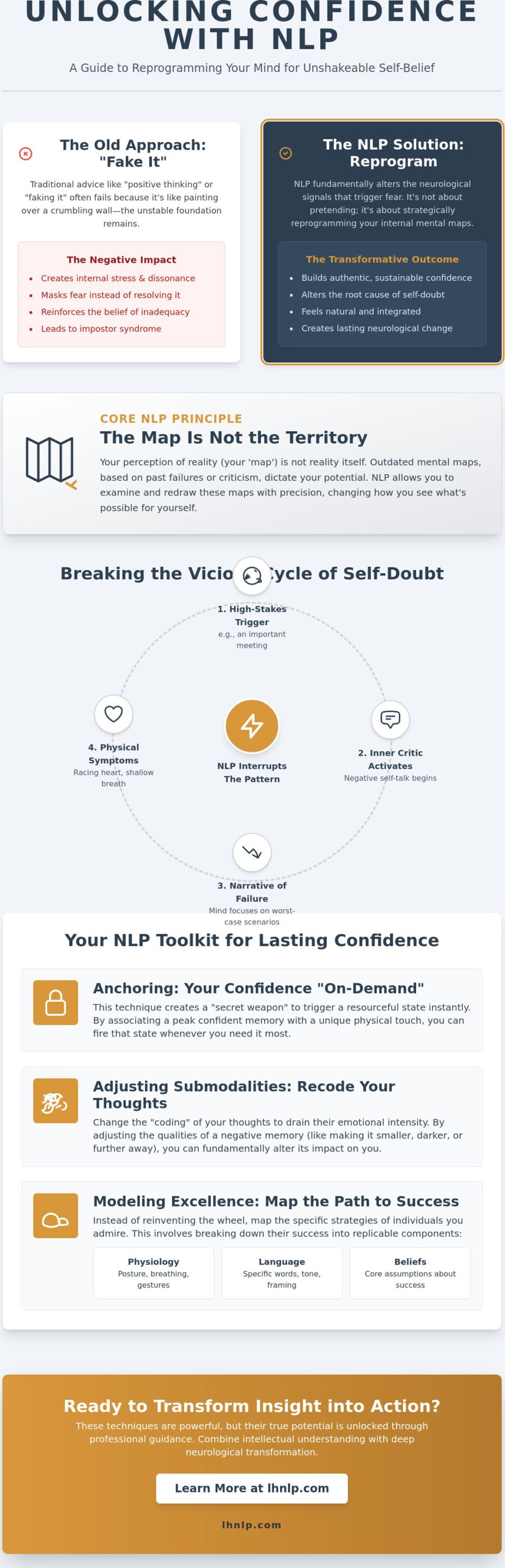
Many professionals are told to “fake it till they make it.” While well intentioned, this advice often creates a painful cognitive dissonance that actually increases internal stress. It suggests that your true self is inadequate and must be hidden behind a mask. Neuro-Linguistic Programming (NLP) offers a more profound alternative. It isn’t about pretending to be someone you aren’t. Instead, it’s the strategic reprogramming of your internal mental maps. When you use specific NLP techniques for confidence, you aren’t just masking your fear; you’re fundamentally altering the neurological signals that trigger it.
We often view confidence as a fixed personality trait, something you’re born with or you’re not. This is a limiting belief that keeps many people stuck. In reality, confidence is a “state” of mind and body that can be entered at will. In high-pressure environments like the City of London, where competition is fierce and expectations are relentless, traditional positive thinking often fails. It’s like putting a fresh coat of paint on a crumbling wall. The foundation remains unstable. NLP addresses the deep connection between your thoughts, your language, and your physical responses to create a shift that feels natural and sustainable.
To better understand how these internal shifts work, watch this helpful video:
The Anatomy of Self-Doubt in High-Pressure Environments
In professional settings, self-doubt isn’t just a feeling; it’s a neurological loop. Your internal critic observes a high-stakes meeting and immediately begins a narrative of failure. This triggers physical symptoms like shallow breathing or a racing heart. For professionals in London, these pressures are amplified by the sheer pace of industry. There’s a distinct difference between situational nerves, which are a natural response to growth, and chronic self-criticism that paralyzes your ability to lead. NLP helps break this loop by identifying the exact moment the critic speaks and interrupting the pattern. It’s about regaining control of the internal dialogue.
The NLP Philosophy: The Map Is Not the Territory
A central tenet of this methodology is that “the map is not the territory.” This means our perception of reality is not reality itself. We all carry a mental map of our skills, our worth, and our potential. Often, these maps are outdated, based on a single past failure or a critical comment from years ago. If your map says “I am not a leader,” you’ll navigate your career to avoid responsibility. NLP techniques for confidence allow you to examine these distorted maps and redraw them with precision. By updating your internal representation of yourself, you change how you move through the world. You aren’t changing who you are; you’re changing how you see what’s possible.
The Anchor and the Frame: Two Essential NLP Techniques for Confidence
Mastering the theory of mental maps is a vital first step, yet true transformation requires tools that function in the heat of the moment. This is where practical NLP techniques for confidence move from intellectual concepts to lived experiences. Within professional NLP coaching, these methods serve as the foundation for bypassing the conscious mind’s habitual resistance. By learning to anchor and reframe, you’re essentially installing a new operating system for your emotional responses. It isn’t about ignoring reality; it’s about choosing which part of reality to focus on.
Anchoring is often described as a “secret weapon” because it utilizes the brain’s natural capacity for association. Much like a specific melody can instantly evoke a forgotten memory, a deliberate anchor allows you to trigger a state of certainty on demand. Research into NLP for self-esteem shows that these neurological shortcuts are essential for managing performance anxiety. This technique bridges the gap between how you feel now and how you want to feel during a high-stakes interaction.
Anchoring: Creating an Instant Trigger for Certainty
To build a reliable anchor, follow this methodical four-step process:
- Step 1: Recall a specific time when you felt peak confidence. See what you saw, hear what you heard, and feel the sensations in your body with vivid detail.
- Step 2: Amplify that feeling. Make the mental image brighter and the internal sounds clearer until the emotion reaches a crescendo.
- Step 3: At the peak of the feeling, apply a unique physical trigger, such as pressing your thumb and forefinger together firmly for several seconds.
- Step 4: Release the pressure, think of something neutral to “break the state,” and then test the trigger to see if the confident feeling returns naturally.
Cognitive Reframing: Turning Self-Criticism into Strategic Insight
Reframing is the art of changing the meaning we attribute to an event. Content reframing asks you to see the situation itself differently, while context reframing explores how a perceived “weakness” could be a strength in another setting. For instance, you might reframe the phrase “I am nervous about this presentation” to “My body is energized for this performance.” This shift doesn’t deny the physical sensation. It simply changes the narrative from one of fear to one of preparation and readiness.
You can practice this in real-time with a simple three-step exercise. First, identify the limiting belief as it arises. Second, ask yourself: “What else could this mean?” or “In what context would this be useful?” Third, consciously choose the most empowering interpretation. While these tools are powerful, they require consistent repetition to become automatic habits. If you’re ready to deepen this practice, consider how Confidence Building Sessions can accelerate your progress through expert guidance.
Shifting Your Internal Cinema: Submodalities and Mental Imagery
Imagine your mind as a private cinema where you’re both the director and the sole audience member. Most of us are unaware that we don’t just “think” of a failure; we replay it in high definition, with surround-sound criticism and a heavy emotional weight. In the framework of neuro-linguistic programming, these fine details—the brightness, size, distance, and clarity of an image—are known as submodalities. They’re the coding of our internal experience. By learning to manipulate these settings, you can use NLP techniques for confidence to strip an intimidating memory of its emotional charge. It’s not about deleting the past; it’s about changing how that past “feels” in your nervous system today.
When you change the structure of a thought, you change the response it triggers. This shift happens because the brain doesn’t just respond to the content of a memory, but to how that memory is represented. If a mental image of a difficult meeting is large, bright, and close to your face, your body reacts as if the threat is immediate. By consciously editing these submodalities, you’re essentially telling your brain that the “event” is no longer a priority. This process allows you to maintain a sense of calm and perspective, even when reflecting on previous challenges that once felt overwhelming.
Adjusting the “Settings” of Your Mind
You can experiment with this right now through a simple mental exercise. Close your eyes and recall a memory that usually triggers a flicker of self-doubt. Notice the image: is it in color? Is it moving? Now, try an experiment. Drain the color from the image until it’s a grainy, black-and-white photograph. Shrink it down until it’s the size of a postage stamp, and then push that tiny image far into the distance until it’s just a speck on the horizon. These structural mental edits bypass the analytical, logical mind to communicate directly with the limbic system, allowing you to change your feelings without needing to argue with your thoughts. You’ll likely find that the emotional “sting” of the memory has vanished.
The Swish Pattern: Replacing Doubt with Your Desired Self
The Swish Pattern is a more dynamic tool designed to replace a recurring doubt with a powerful vision of your desired self. First, identify your “cue image”—the split second you begin to feel self-doubt, such as the sight of a boardroom door. Next, create a vivid “outcome image” representing the confident, capable version of you. The “swish” occurs when you take that small, dark outcome image and suddenly expand it to cover the cue image, making it bright, vibrant, and overwhelming. This neurological swap is a cornerstone of professional coaching and is frequently used in phobia treatment to break deep-seated patterns of fear. By repeating this swish rapidly, you train your brain to automatically move toward confidence whenever the old trigger appears. Using these NLP techniques for confidence ensures that your internal cinema always plays the version of the story that empowers you.
Modeling Excellence: The NLP Strategy for Social and Professional Confidence
Excellence leaves clues. If you observe a leader who navigates high-stakes negotiations with grace, you’re witnessing more than just “natural talent.” You’re seeing a specific, repeatable strategy involving physiology, internal dialogue, and belief systems. In neuro-linguistic programming, we call this Modeling. It’s the study of the structure of excellence, allowing you to map the internal processes of those you admire and install those same patterns in your own life. When we apply NLP techniques for confidence through modeling, we move beyond mere imitation. We’re essentially decoding the “software” of success to understand how it functions under pressure.
One powerful application of this strategy is the “Circle of Excellence.” This technique involves imagining a circle on the floor in front of you and “filling” it with the qualities of your most confident self or a mentor you admire. By stepping into this circle, you physically and mentally engage with a peak state. This is particularly effective for those seeking public speaking coaching, as it provides a portable, invisible sanctuary of certainty that you can access before walking onto a stage or into a boardroom.
Learning from the Unstoppable: The Art of Modeling
The art of modeling begins with keen observation. Instead of just listening to what a confident leader says, notice their micro-behaviors. How do they breathe? What’s the specific tilt of their head when they’re challenged? How do they use silence to command a room? By “trying on” the physiology of a confident person, you send a direct signal to your nervous system that you’re safe and capable. It’s important to remember that modeling isn’t about copying someone else’s personality. It’s about identifying the structural elements of their confidence and integrating them into your unique style. This is one of the most practical NLP techniques for confidence because it provides a clear, objective blueprint for change.
Precision Language: How Your Vocabulary Dictates Your Self-Belief
Your internal and external vocabulary acts as the architect of your reality. NLP places a heavy emphasis on “modal operators,” which are words that reflect our relationship with rules and possibilities. Words like “must” and “should” often create a sense of heavy obligation and underlying anxiety. Conversely, words like “can,” “will,” and “choose to” open up a sense of agency and power. To project authority, you must also eliminate “softeners” from your speech—those subtle phrases like “I just think” or “I might be wrong but” that undermine your message before you’ve even delivered it.
Consider removing these “Confidence Killers” from your internal dialogue and professional speech:
- “I’ll try”: This phrase presupposes failure. Use “I will” or “I am.”
- “I’m just”: This minimizes your role and expertise.
- “Maybe we could”: This dilutes a strategic recommendation into a timid suggestion.
- “I should have”: This anchors you in past regret rather than future possibility.
If you’re ready to move from understanding these strategies to embodying them in your career, our Public Speaking Coaching can help you refine your presence and language for maximum impact.
Professional NLP Coaching in London: Transforming Insight into Action
While the techniques discussed, from anchoring to the swish pattern, are powerful tools for self-regulation, there’s a limit to what one can achieve through solo practice. It’s often difficult to see the edges of our own mental maps or identify the subtle linguistic patterns that keep self-doubt in place. Professional guidance provides the objective mirror necessary to navigate your internal world with precision. In a clinical setting, we don’t just talk about change; we facilitate a methodical restructuring of your neurological responses. This is why many high-achievers in the City seek out specialized support to refine their NLP techniques for confidence. Working with a practitioner allows you to address the root of the “internal critic” rather than just managing the symptoms it produces.
A common question many clients ask is whether these shifts are permanent. The answer lies in a process called neurological consolidation. By repeatedly accessing resourceful states and interrupting old patterns, you’re essentially myelinating new neural circuits. These new pathways become faster and more resilient than the old habits of doubt. Over time, the confident response becomes your default setting. It isn’t a temporary “high” or a fleeting moment of motivation, but a fundamental change in how your brain processes information and social cues.
The Synergy of Hypnotherapy and NLP
The “Kamal Method” represents a unique synergy between clinical hypnosis and neuro-linguistic programming. While NLP provides the precise structural tools to rewire your thoughts, hypnotherapy allows these changes to bypass the critical conscious mind and reach the subconscious faster. Think of NLP as the architect’s blueprint and hypnotherapy as the deep foundation that ensures the structure stands firm. During a professional session, you’ll experience a state that’s profoundly safe, calm, and transformative. This dual approach ensures that the “new you” isn’t just a conscious effort but a natural, automatic response. For those interested in the deeper mechanics of this process, our Hypnotherapy London pillar offers a comprehensive exploration of clinical hypnosis.
Taking the First Step Toward Unshakeable Confidence
Realizing that your brain is plastic is the first step toward genuine freedom. Change isn’t a matter of luck; it’s a choice and a method. Whether you visit our clinics in Harley Street or Ealing, the approach is always tailored to your specific London lifestyle and the unique pressures you face in your career or relationships. We don’t believe in one-size-fits-all solutions. Instead, we map your specific triggers and goals to create a personalized roadmap for your development. If you’re ready to move beyond self-criticism and step into a version of yourself that feels truly authentic and capable, you can book a consultation for confidence building sessions. Your mind has the capacity for incredible transformation. It’s simply a matter of providing it with the right instructions and the right environment to grow.
Stepping Into Your Most Resourceful Self
The journey from self-doubt to unshakeable self-belief isn’t about hope; it’s about the methodical application of neurological principles. You’ve seen how confidence is a state you can consciously enter through anchoring and how the swish pattern can replace old anxieties with vibrant new possibilities. By refining these NLP techniques for confidence, you’re not just managing nerves; you’re redrawing the very map of what you believe is possible in your career and your relationships. These tools offer a bridge between the person you are today and the leader you’re capable of becoming.
While self-practice is a vital beginning, the most profound shifts often happen when an experienced guide helps you navigate the deeper layers of your subconscious. Kamal Kaur brings over 20 years of clinical experience to every session, offering a personalised, solution-focused approach that bridges the gap between intellectual insight and permanent action. Whether you visit our clinics in Harley Street or Ealing, you’ll find a supportive environment dedicated to your evolution. It’s time to silence the inner critic and lead with certainty. Book your professional NLP confidence session in London today and begin the process of truly rewiring your mind. The power to change has always been within you; now you have the tools to unlock it.
Frequently Asked Questions
What exactly are NLP techniques for confidence?
These techniques are psychological tools designed to reprogram the internal “maps” or patterns of thought that govern your emotional states. By consciously changing the language you use and the structure of your mental imagery, you can shift from a state of doubt into a state of certainty. This methodology focuses on how the brain processes information, allowing you to choose more empowering responses to professional and social challenges.
How long does it take for NLP to build lasting confidence?
While many individuals experience a noticeable shift in perspective during their first session, building unshakeable, lasting confidence typically requires a few weeks of consistent practice. This period allows for neurological consolidation, where new, resourceful pathways in the brain become stronger than old habits of self-criticism. A personalized approach ensures these shifts are integrated into your daily routine for permanent results.
Can I use NLP techniques for confidence on my own?
Yes, many NLP techniques for confidence, such as anchoring and reframing, are specifically designed for self-application in real-time situations. However, working with a professional coach is often beneficial for identifying subconscious blind spots that you might miss alone. A practitioner provides the clinical precision needed to ensure these tools are applied effectively for deep, transformative change.
Is NLP the same as CBT for building self-esteem?
No, although both approaches aim to improve mental well-being, they operate differently. Cognitive Behavioural Therapy (CBT) focuses on the logical analysis of thoughts and finding evidence to disprove negative beliefs. In contrast, NLP works directly with the “coding” and structure of the subconscious mind. It often produces faster results by bypassing the analytical mind to change how a memory or thought feels immediately.
How does NLP help with public speaking anxiety specifically?
NLP addresses public speaking anxiety by interrupting the neurological loop of fear that often precedes a presentation. Through techniques like the “Circle of Excellence,” you can install a physical trigger that brings you back to a state of calm and authority. It also helps you shift your “internal cinema,” making the audience seem less intimidating and your own presence more commanding and grounded.
Will NLP work if I am a naturally shy person?
Absolutely, because NLP doesn’t view shyness as a permanent personality trait, but rather as a specific set of internal representations and behaviors. By using NLP techniques for confidence, a shy person can model the physiology and language patterns of more assertive individuals. This allows you to expand your comfort zone and access internal resources that may have previously felt out of reach.
Are there any side effects to using NLP techniques?
There are no medical or harmful side effects to using these methods. It is a non-invasive, gentle process that relies on your own internal resources. You might experience a temporary sense of emotional fatigue as you break old patterns, but this is simply a sign of the brain reorganizing itself. Most people report feeling a sense of relief and increased clarity after a session.
What is the “Anchoring” technique in NLP?
Anchoring is the process of creating a deliberate association between a physical trigger and a specific emotional state. By repeatedly linking a touch, such as pressing your thumb and finger together, to a memory of peak confidence, you create a neurological shortcut. This allows you to retrieve that feeling of certainty instantly during high-pressure moments, ensuring you stay composed and focused when it matters most.