

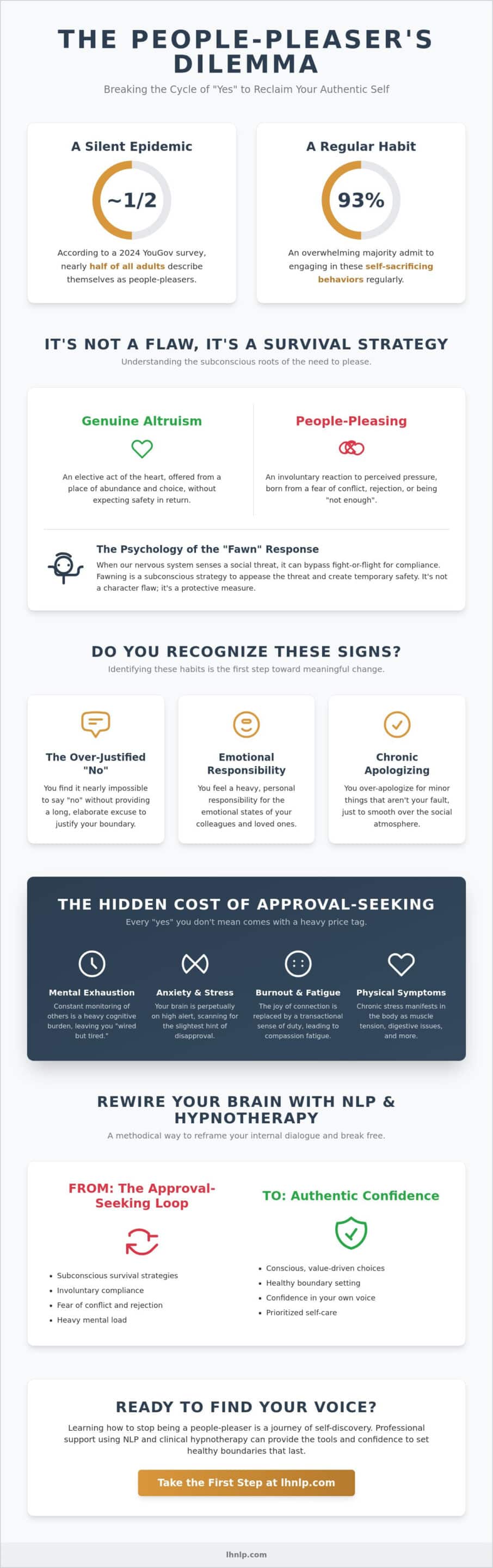
Did you know that according to a 2024 YouGov survey, nearly half of all adults describe themselves as people-pleasers? It’s a staggering figure that highlights a silent epidemic of emotional exhaustion, where 93 percent of people admit to engaging in these self-sacrificing behaviors regularly. You likely know the heavy toll of saying “yes” when your inner voice is screaming “no,” only to be left with a hollow sense of resentment and a fading sense of self. Learning how to stop being a people pleaser isn’t about becoming cold or indifferent; it’s about reclaiming the identity you’ve slowly traded away for the comfort of others.
It’s exhausting to carry the weight of everyone else’s expectations while your own needs sit gathering dust on a shelf. We understand that this pattern isn’t just a personality trait, but a deeply rooted subconscious survival strategy designed to keep you safe. This guide will show you how to dismantle those old blueprints using professional NLP and hypnotherapy techniques. We’ll explore the hidden roots of your compliance and provide a clear path to setting boundaries that feel like a relief rather than a source of guilt.
Key Takeaways
- Understand that people-pleasing is often a subconscious survival strategy rooted in early experiences rather than a fixed personality trait.
- Explore how NLP and clinical hypnotherapy provide a methodical way to reframe your internal dialogue and break free from the mental load of approval-seeking.
- Master practical techniques, such as the “power of the pause,” to discover how to stop being a people pleaser while maintaining your authentic connections.
- Recognize the hidden relationship between chronic people-pleasing and emotional exhaustion, allowing you to prioritize self-care as a necessary foundation for health.
- Learn how professional support, including virtual hypnotherapy sessions, can guide you through the process of setting healthy boundaries with confidence.
What is People Pleasing? Understanding the Subconscious Need to Please
People-pleasing often feels like a virtuous trait, a badge of kindness we wear to prove our value to the world. However, beneath the surface of every “yes” lies a complex architecture of survival. It’s a chronic urge to prioritize the needs of others as a way to avoid the sharp edges of conflict or rejection. When you begin exploring how to stop being a people pleaser, you first have to recognize that this behavior is a maladaptive coping mechanism. It usually takes root in early life, when we learn that our safety or belonging depends on how well we can mirror the expectations of those around us. This clinical state, often referred to as Understanding Sociotropy (People Pleasing), shows how an individual’s self-esteem can become overly dependent on social harmony and external validation.
To gain a deeper perspective on how these patterns manifest and how you can begin to shift them, watch this insightful video:
There’s a profound difference between genuine altruism and the fawning response. Kindness is an elective act of the heart, offered without the expectation of safety in return. In contrast, being a “pushover” is an involuntary reaction to perceived pressure. You aren’t choosing to be helpful; you’re trying to manage the internal discomfort of a potential fallout. One comes from a place of abundance, while the other is born from a fear of being “too much” or “not enough.”
The Psychology of the “Fawn” Response
Our nervous systems are finely tuned to social cues. When we feel a threat to our connection with others, the brain may bypass the typical fight or flight options in favor of compliance. This creates a temporary sense of security by diffusing tension before it can escalate. Fawning is a subconscious strategy to appease a perceived threat. By understanding this biological root, you can start to see your patterns with compassion rather than judgment. It’s not a flaw in your character; it’s a protective measure your brain once needed.
Signs You Might Be a People Pleaser
Identifying these habits is the first step toward change. You might recognize yourself in these common experiences:
- You find it nearly impossible to say “no” without providing a long, elaborate excuse to justify your boundary.
- You feel a heavy, personal responsibility for the emotional states of your colleagues or loved ones.
- You catch yourself over-apologizing for minor inconveniences or things that aren’t your fault, simply to smooth over the social atmosphere.
Learning how to stop being a people pleaser requires noticing these moments of automatic compliance as they happen. It’s about pausing long enough to ask if you’re acting out of love or acting out of a need to be safe.
The Hidden Cost: How Approval-Seeking Fuels Anxiety and Stress
Every time you offer a “yes” that your soul hasn’t authorized, you pay a tax in mental energy. This constant monitoring of others’ micro-expressions is a heavy cognitive burden. It leads to a state where your brain is perpetually on high alert, scanning for the slightest hint of disapproval. This isn’t just a habit; it’s an exhaustive lifestyle that frequently masks deep-seated social anxiety. When you focus on how to stop being a people pleaser, you begin to realize that your body has been keeping score. Chronic stress doesn’t stay in the mind. It manifests as physical tension, digestive issues, or a constant sense of being “wired but tired.” Understanding how to stop being a people pleaser is the first step in breaking this cycle of exhaustion.
This persistent state of self-neglect eventually leads to burnout and compassion fatigue. You find yourself unable to care for the very people you’ve been trying to please. It’s a hollow feeling, where the joy of connection is replaced by a transactional sense of duty. Seeking Practical Steps to Stop People-Pleasing can help you identify these patterns before they lead to total emotional collapse.
The Resentment Loop
Resentment is the shadow side of the “yes” you didn’t mean. When you over-extend yourself without reciprocity, a silent tally begins to form in your mind. This resentment doesn’t just hurt you; it poisons the authenticity of your relationships. True intimacy requires the courage to disagree. Without the possibility of a “no,” your “yes” loses its value. You aren’t being kind; you’re being compliant, and that compliance creates a barrier between you and the people you love.
Impact on Mental Well-being
Living without boundaries is like living in a house without walls. Your self-esteem becomes a variable of other people’s opinions, fluctuating with every perceived slight or praise. This instability is a primary driver for those seeking therapy for anxiety in London. Your self-worth should not be a variable of others’ opinions. Rebuilding that inner foundation is a methodical process of reclaiming your voice. If you feel overwhelmed by this weight, professional stress management can provide the tools to steady your nervous system while you learn to stand your ground.
Rewiring the Brain: Using NLP and Hypnotherapy to Stop Pleasing
Changing a lifelong habit often feels like trying to steer a heavy ship with a broken rudder. Willpower is a finite resource, yet the subconscious mind remains a vast reservoir of automated responses that usually override our best intentions. This is why Neuro-Linguistic Programming (NLP) is so effective; it provides a practical map for your internal dialogue. Through the lens of neuroplasticity, we know the brain is capable of forging new social responses at any age. Discovering how to stop being a people pleaser becomes a process of structural change rather than just a mental struggle. It’s about teaching your nervous system that you can be both kind and firm without losing your connection to others.
NLP Techniques for Boundary Setting
One of the most transformative tools in NLP is “Reframing.” This involves shifting your perspective so that a “no” to an external request is seen as a profound “yes” to your own mental health and energy. Instead of viewing a boundary as a wall, you view it as a gateway to your own well-being. Another powerful method is “Anchoring,” where we create a physical or mental trigger for confidence. By touching a specific finger or taking a particular breath, you can summon a state of inner calm during difficult conversations. This practice helps quiet the internal critic that often demands compliance as a price for belonging. It’s a way of reclaiming the narrative of your own life, one thought at a time.
How Hypnosis Breaks the Approval Cycle
While NLP addresses the conscious structures of thought, hypnotherapy London sessions allow us to speak directly to the subconscious. This is where the “need to please” is stored as a survival program, often inherited from childhood experiences where compliance felt like safety. Hypnosis helps the mind realize that those old protective measures are no longer necessary for your adult life. By accessing this deeper level, you can dismantle the fear of rejection at its source. Many clients describe a sense of radiant empowerment after a session focused on self-worth. It’s as if a heavy, invisible weight has finally been lifted, leaving space for your authentic voice to emerge. Learning how to stop being a people pleaser is significantly accelerated when you have professional confidence building sessions to support your journey. You don’t have to navigate this transition alone; having a guide helps you move through the discomfort of change with grace and clarity.
5 Practical Steps to Stop People Pleasing Today
The “Buying Time” Script
The most powerful tool in your arsenal is the pause. Most people-pleasers agree to things before they’ve even finished hearing the request. To break this reflex, you need a script. Use phrases like, “Let me check my diary and get back to you,” or “I need to think about that, I’ll let you know by tomorrow.” This simple act of buying time allows your nervous system to settle. It breaks the “yes” habit and gives you the space to decide if you actually want to commit. Adopting a 24-hour rule for any significant request ensures that your decision comes from a place of clarity rather than a desire to appease.
Once you’ve mastered the pause, you can move on to other essential practices:
- Start Small: Practice setting boundaries in low-stakes environments, such as declining a bag at the shop or choosing the restaurant for a casual lunch.
- Eliminate the “I’m Sorry” Reflex: Notice how often you apologize for having an opinion. Try declining a request with a simple, “I can’t do that this time,” without the accompanying apology.
- Embrace the Discomfort: Understand that guilt is often just a temporary side effect of growth. It’s the sound of an old, maladaptive pattern being dismantled.
Defining Your Non-Negotiables
Knowing how to stop being a people pleaser is impossible if you don’t know what you’re protecting. Identifying your core values allows you to see what you are actually saying “yes” to when you say “no” to someone else. If you value family time, then weekends become a non-negotiable zone. This clarity is a vital component of effective stress management, as it prevents the slow leak of energy that comes from over-commitment. A boundary is a limit you set for yourself, not a command for others. It defines where you end and the rest of the world begins.
If you find that these steps feel daunting to navigate alone, professional guidance can help you anchor these new behaviors. You can begin your transformation today by booking one of our virtual hypnotherapy sessions to reinforce your inner strength from the comfort of your own home.
Professional Support in London: Finding Your Voice with Kamalyn Kaur
Reclaiming your life is a journey that doesn’t have to be walked in isolation. While the practical steps we’ve explored provide a vital foundation, the gravitational pull of lifelong habits can sometimes feel overwhelming. This is where the guidance of a professional like Kamalyn Kaur becomes invaluable. Her approach isn’t about endless talk therapy; it’s a solution-focused integration of NLP and hypnotherapy designed to produce tangible change in just a few sessions. Learning how to stop being a people pleaser is often about more than willpower. It’s about having a partner who understands the intricate clockwork of the human mind and can help you reset the gears of your subconscious responses.
Seeking support is a profound act of self-respect. It marks the moment you decide that your peace of mind is worth the investment. Kamalyn Kaur offers a unique sanctuary for this transformation, with sessions available at her practices in Harley Street and Ealing. For those who prefer the sanctuary of their own home, her virtual hypnotherapy services provide the same level of deep, subconscious work without the need for travel. This flexibility ensures that the process of change fits seamlessly into your life, rather than becoming another source of stress. It’s a methodical process that respects your pace while keeping the focus firmly on your desired outcomes.
What to Expect in a Confidence-Building Session
Inside the safe, non-judgmental environment of the clinic, you’ll explore the specific triggers that cause you to default to compliance. Whether your struggle manifests in the boardroom, within complex family dynamics, or with a romantic partner, each session is meticulously tailored to your unique landscape. You won’t just leave with insights; you’ll leave with practical, “take-home” tools you can use immediately in real-world situations. These confidence building sessions are designed to help you find your voice and use it with clarity and compassion, ensuring that your new boundaries feel natural rather than forced.
Taking the First Step Toward Autonomy
The path to autonomy begins with a single decision to prioritize your own well-being. If you’re curious about how the process works or have questions about the methodology, our FAQs offer a wealth of information to put your mind at ease. Remember, understanding how to stop being a people pleaser is a skill that can be mastered with the right professional guidance. When you’re ready to transition from automatic compliance to authentic connection, the next step is waiting for you. Contact London Hypnotherapy & NLP to begin your transformation and finally reclaim the life you were meant to live.
Embrace Your Voice and Reclaim Your Freedom
Reclaiming your life from the cycle of approval-seeking is a profound act of courage that begins with a single, conscious choice. We’ve explored how these behaviors are often rooted in subconscious survival strategies and how the mental load of monitoring others leads to chronic exhaustion. By understanding how to stop being a people pleaser through the integration of NLP and hypnotherapy, you can transform your internal dialogue and establish boundaries that feel like a sanctuary rather than a burden. This change is not just possible; it’s a methodical process that honors your authentic self and restores your energy.
Kamalyn Kaur brings over 20 years of experience in clinical hypnotherapy to her specialist practice, offering solution-focused therapy at prestigious London locations like Harley Street. You don’t have to carry the weight of everyone else’s expectations anymore. Whether you seek to reduce social anxiety or build lasting confidence, expert guidance can accelerate your progress and provide the tools for long-term autonomy. Reclaim your boundaries and book a session with Kamalyn Kaur today to start building the life you deserve. Your voice is a gift, and it’s time you allowed it to be heard with clarity and strength.
Frequently Asked Questions
Is people-pleasing a mental health disorder?
How is people-pleasing different from being a nice person?
The primary difference lies in the element of choice and the presence of healthy boundaries. A nice person acts out of genuine kindness and feels comfortable saying no when a request exceeds their capacity. In contrast, a people-pleaser acts out of a perceived necessity to avoid conflict or rejection. Kindness is a reflection of your personal values; people-pleasing is a reflection of your subconscious fears.
Can hypnotherapy really help me say no more easily?
Hypnotherapy is exceptionally effective at helping you set boundaries because it speaks directly to the subconscious mind. By addressing the deep-seated fears of abandonment or criticism that drive your compliance, hypnosis allows you to feel safe in your own authority. You’ll find that saying “no” becomes a neutral act of self-preservation rather than a source of intense internal panic or overwhelming guilt.
Will people think I am selfish if I stop people-pleasing?
Some individuals who have benefited from your lack of boundaries may initially perceive your change as selfish. However, authentic relationships are built on mutual respect rather than one-sided sacrifice. As you learn how to stop being a people pleaser, you’ll find that healthy, supportive people will actually respect you more for having clear limits. Self-care is a prerequisite for being able to care for others sustainably.
How long does it take to break the habit of people-pleasing?
The timeline for change varies between individuals, but solution-focused approaches like NLP and hypnotherapy can often produce significant shifts in just a few sessions. While breaking a lifelong habit is a process, the brain’s neuroplasticity allows for rapid rewiring when you target the subconscious roots. Consistent practice of small boundaries will reinforce these new neural pathways and make them your default response over time.
Can NLP help with social anxiety related to people-pleasing?
NLP is a powerful tool for managing the social anxiety that often triggers the urge to please. By using techniques like reframing and anchoring, you can change the internal “critic” voice that fuels your apprehension. This allows you to enter social situations with a sense of grounded confidence, making it much easier to stay true to your own needs without the interference of anxious thoughts.
What is the “fawn” response in relation to people-pleasing?
The “fawn” response is the fourth trauma response, alongside fight, flight, and freeze. It involves a subconscious strategy of appeasing or “fawning” over a perceived threat to create a sense of safety. In the context of people-pleasing, this response manifests as an automatic drive to mirror others’ expectations to avoid the danger of conflict or emotional abandonment. It’s a survival mechanism that can be professionally unlearned.
How do I set boundaries with a difficult family member?
Setting boundaries with difficult family members requires consistency and the use of clear, neutral language. Start by identifying your non-negotiables and communicate them using “I” statements, such as “I can’t take calls after 8 PM as I’m resting.” Don’t feel the need to over-explain or justify your limits with long excuses. Remember that their reaction is a reflection of their own patterns, not a failure of your boundary.