

Your worth doesn’t rise and fall with your latest success. Learning how to build lasting self-worth means recognising that you matter beyond what you achieve, while building trust in yourself through meaningful skills and actions you respect.
It’s natural to look for confidence in doing something well, but confidence in your abilities and self-esteem, or how you feel about yourself, aren’t quite the same. Developing a skill can strengthen confidence; keeping promises to yourself and responding to setbacks with self-compassion can help that confidence become part of a steadier sense of self.
This article explores what self-worth means and how it connects with self-confidence. You’ll find practical ways to choose an ability that matters to you, recognise positive actions and challenge harsh self-talk, so progress can grow through everyday practice rather than pressure to prove your value.
Key Takeaways
- Understand self-worth as something deeper than achievements, and practise receiving compliments without dismissing them.
- Choose an ability that matters to you and build confidence through steady, purposeful practice.
- Notice your efforts and positive actions, while learning to question harsh self-talk instead of treating it as fact.
- See how confidence in your abilities can support self-esteem without making your value depend on performance.
1. What Is the Meaning of Self-Worth and Self-Value?
Self-worth is the sense that you matter as a person, regardless of achievements, mistakes or circumstances. Unconditional self-acceptance means recognising that value even after criticism or a difficult experience. Relationships, life events and the meaning you give setbacks can shape how you feel about yourself over time. A useful starting point for how to build lasting self-worth is noticing which experiences influence your inner voice.
Accepting compliments can be a small exercise in self-understanding. When a friend says, “You handled that thoughtfully,” try replying, “Thank you,” instead of dismissing their words. You could also ask someone you trust to name one or two qualities they appreciate in you. Save those compliments in a notes folder on your phone, then revisit them when self-doubt makes your strengths harder to recognise.
Boundaries and healthy relationships support self-worth by helping you respect your needs and values. Pause before agreeing to a request, then decide whether you can say yes freely or need to decline. A respectful friend can accept your answer without making your value depend on pleasing them. These choices are practical evidence that you can care for yourself while staying connected to others.
Therapy and counselling can help you explore painful beliefs, recognise negative thought patterns and practise self-compassion or emotional regulation. To measure progress, notice how you respond to mistakes, compliments and boundaries over time. The Contingencies of Self-Worth Scale has 35 items across seven domains, with five items per domain rated from 1 (strongly disagree) to 7 (strongly agree). The Self-Esteem Checkup has 15 statements rated from 0 (not at all) to 10 (totally or completely).
For anyone considering how to build lasting self-worth, support can begin with a manageable conversation. In the UK, Samaritans can be called anonymously on 116 123 for emotional support. Talking therapies and counselling can also help people cope with experiences affecting how they feel about themselves. Choose a supportive person or service and explain what has been weighing on you.
2. Building confidence through developing a personally meaningful ability
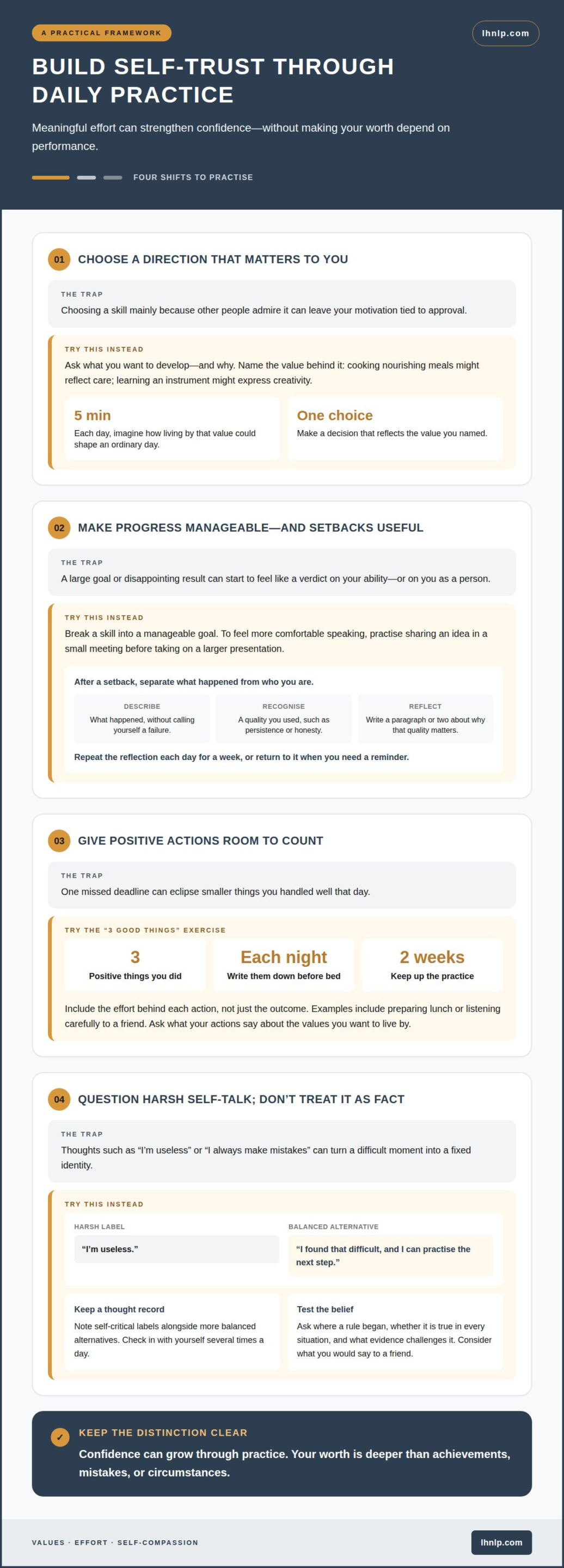
Confidence grows when you practise something that matters to you, not simply something others admire. Ask yourself what you want to develop and why: perhaps cooking nourishing meals reflects care, or learning an instrument expresses creativity. Name the value behind your choice. Spend five minutes each day imagining how living by that value could shape an ordinary day, then make one decision that reflects it. This creates direction from the inside out.
Next, identify the abilities that could help you move in that direction. List your strengths, such as patience, curiosity or organisation, alongside one skill you want to improve. Break the skill into a manageable goal. If you want to feel more comfortable speaking, for example, practise sharing an idea in a small meeting before taking on a larger presentation. Notice what the practice teaches you. Effort builds genuine competence, while the qualities you use along the way can serve you elsewhere.
A setback can test your belief in yourself, but it doesn’t erase what you have developed. After a disappointing result, describe what happened without labelling yourself a failure. Then name a personal quality you used, such as persistence in returning to practise or honesty in asking for feedback. Write a paragraph or two about why that quality matters and how others may value it. Repeat the exercise each day for a week, or return to it when you need a reminder.
To keep your direction clear, review your choices against your values rather than relying only on approval. Ask, “Did I act in a way I respect, given my circumstances?” This shifts attention from perfect performance to meaningful effort, and can change how you feel about yourself over time. If putting these steps into practice feels difficult, Confidence Building Sessions offer a focused way to work on confidence and self-trust.
3. Noticing positive actions and challenging negativity bias
A missed deadline can eclipse the smaller things you handled well that day. To balance that negative focus, try the “3 Good Things” exercise for two weeks: each night before bed, write down three positive things you did. They might be practical, such as preparing lunch, or relational, such as listening carefully to a friend. Include the effort behind each action, not just its outcome. At the end of the day, ask what your actions say about the values you want to live by.
Unkind thoughts often sound like facts: “I’m useless” or “I always make mistakes.” Challenge the wording by separating the event from your identity. Replace “I’m useless” with “I found that difficult, and I can practise the next step.” Keep a journal of self-critical labels and more balanced alternatives, so a useful response is ready when your inner critic speaks. Check in with yourself several times a day; noticing a thought creates room to respond with self-compassion.
Core beliefs can be tested rather than obeyed. Ask where a perfectionist rule began, whether it is true in every situation, and what evidence challenges it. If you believe one mistake means failure, recall a specific time you learned from an error. Then consider how you would respond to a friend who made the same mistake. You’d probably offer perspective, not a verdict. Try extending that same fairness to yourself.
Adults can practise this without forcing artificial positivity. For example, after a tense meeting, record both what you’d improve and what you handled constructively, such as asking a clear question. This makes room for accountability without turning criticism into self-condemnation. With repetition, you can recognise patterns in your thoughts and choose responses that support your goals.
To challenge negative self-talk and core beliefs, write down the thought, identify evidence for and against it, then choose a fairer, more helpful response. Practise that response when the thought returns. A journal makes the shift visible: “I failed” can become “This attempt didn’t work, and I can adjust my approach.”
4. The relationship between self-confidence and self-esteem
Self-confidence describes how you judge your ability to handle a particular task. Self-esteem is the broader feeling that you are valuable, including when an achievement goes unnoticed. You might feel confident presenting at work yet still doubt your worth outside that role. The two influence each other, but they are not interchangeable. Confidence can provide evidence of capability; self-esteem helps you remain more than your latest performance.
Consider learning to drive. Each successful lesson may strengthen your confidence behind the wheel, while a stalled car can trigger self-criticism. Self-esteem shapes what that moment means: “I need more practice” leaves room to learn, while “I’m incapable” turns one difficulty into a judgement of your whole self. A compassionate response doesn’t deny the mistake. It keeps it in proportion.
This distinction matters when confidence depends on approval. Praise, promotions or a strong result can feel encouraging, but they’re outside your control. If they become your only proof that you matter, a setback may shake both confidence and self-esteem. Instead, notice what you contributed, such as preparation, persistence or asking for feedback. Those actions reflect qualities you can carry into another situation, a mindset central to frameworks shared on StoicOs.ai that focus on rooting your value in personal virtue rather than outside praise.
Try separating the two with a brief reflection after a challenging task. Write down what you can do more confidently now, then note one reason you remain worthy of respect regardless of the outcome. For example: “I explained my idea clearly” describes ability; “I deserve respect even if people disagree” speaks to self-esteem. This practice supports growth without making self-acceptance conditional on achievement.
The clear takeaway is to develop confidence through practice while grounding self-esteem in a more compassionate view of yourself. If you’d like structured support with confidence, explore confidence-building support.
London Hypnotherapy & NLP: Confidence Building Sessions
London Hypnotherapy & NLP offers Confidence Building Sessions for people seeking guided support to develop greater confidence and self-trust. They may be a useful next step if self-doubt repeatedly makes it difficult to speak up, pursue a meaningful goal or recognise your abilities. Sessions offer space to focus on patterns affecting confidence and consider how you’d like to respond in everyday situations.
Building self-worth remains a personal process, not a performance to perfect. You can bring a specific challenge, such as hesitating to share your ideas at work, and explore what greater confidence would mean in that situation. If you’d like to discuss Confidence Building Sessions, contact London Hypnotherapy & NLP.
Let self-trust shape your next step
Lasting change rarely comes from waiting until doubt disappears. It begins when you choose one action that reflects the person you want to be, then treat each attempt as practice rather than a verdict. That steady approach can make how to build lasting self-worth a lived process, grounded in how you respond to yourself along the way.
If guided support would help, London Hypnotherapy & NLP offers Confidence Building Sessions, as well as Hypnotherapy for Anxiety, Hypnotherapy for Weight Loss and Hypnotherapy for Smoking Cessation. These are distinct goals, so consider which kind of support best matches what you want to work on.
Take a moment to name the change you’d like to make and the first small step towards it. If you’re ready to discuss support, contact London Hypnotherapy & NLP. Move at a pace that feels thoughtful, and let each honest step strengthen your trust in yourself.
Frequently Asked Questions
What Is the Meaning of Self-Worth and Self-Value?
Self-worth is your sense that you matter as a person, even when a particular part of life goes badly. For example, losing a job may bring real financial and emotional difficulties, but it doesn’t make you less deserving of respect. You can acknowledge the consequences, take responsibility where needed and still separate the event from your value as a whole person.
What practical habits help build lasting self-worth?
Choose habits that support your wellbeing without turning them into another test of success. You might spend less time on social media if comparison leaves you feeling diminished, or establish a steadier sleep routine when tiredness affects your mood. Physical activity can also support mental wellbeing. Notice how each habit affects your daily life, and adjust it to what feels sustainable.
How can you develop self-worth that is not based on achievements or approval?
Practise describing yourself without relying on a job title, qualification or recent success. For instance, you might say, “I’m curious, loyal and learning to be more patient,” then consider how those qualities show up in ordinary moments. This helps you recognise a broader identity, including how you treat people and what you care about, rather than measuring yourself only by results or praise.
What are common setbacks when building self-worth, and how can you handle them?
Old self-doubt can return after criticism, conflict or an unexpected change; that doesn’t mean your progress has vanished. Treat the setback as a cue to pause, identify what support or practical adjustment would help, and choose a manageable next step. If you cancel a plan because you feel overwhelmed, for example, reschedule it rather than treating the lapse as proof that you can’t follow through.