

What if the secret to ending your nightly battle with the ceiling isn’t found in a chemist’s aisle, but in a precise 12-minute shift of your internal state? You’re likely familiar with that stubborn tension in your jaw and the weight across your shoulders as you lie awake, mentally rehearsing a £50,000 project deadline or tomorrow’s commute. It’s exhausting to feel your body craving rest while your mind refuses to disengage from the city’s frantic pace. We understand that this cognitive loop isn’t just an annoyance; it’s a barrier to the life you want to lead.
This guide explains how to cure insomnia in 12 minutes by using a scientifically backed routine that synchronises your nervous system with your natural need for peace. You’ll discover a reliable tool for state control that quietens the London mind and invites deep, restorative rest tonight. We’ll walk through a sequence of physiological releases and unconscious anchors designed to transition you from high-stakes thinking to effortless sleep. By the time you finish reading, you’ll have a practical method to ensure you wake up feeling refreshed and ready for the day ahead.
Key Takeaways
- Understand the unique ‘tired but wired’ phenomenon of London life and why traditional methods like counting sheep often create more mental resistance.
- Discover how to cure insomnia in 12 minutes through a two-step physiological reset designed to silence the ‘always-on’ city mind and invite natural rest.
- Learn to engage the Vagus nerve through specific rhythmic breathing patterns that lower heart rate variability and trigger the parasympathetic nervous system.
- Master a 4-minute physical release protocol tailored for desk-bound professionals to dissolve the day’s tension and prepare the body for a deep state of calm.
- Recognise when chronic sleep patterns require a deeper shift and how NLP-based ‘re-wiring’ can provide a permanent solution to long-term insomnia.
The 12-Minute Sleep Reset: Why Londoners Struggle to Switch Off
London’s pulse doesn’t stop at midnight. For those working in high-pressure sectors like finance or law, the “always-on” culture isn’t just a phrase; it’s a physiological state that disrupts the circadian rhythm. You arrive home, yet your mind remains in the boardroom. This “tired but wired” phenomenon occurs when your sympathetic nervous system refuses to disengage, keeping you in a state of high alert long after the sun has set. To find a solution, one must first understand what insomnia is and how it manifests as a persistent inability to initiate or maintain sleep despite the body’s desperate need for recovery.
If you’ve been searching for how to cure insomnia in 12 minutes, you’re looking for a neurological shift rather than a simple lifestyle change. Standard sleep hygiene often fails because it addresses the environment rather than the internal state control. If your brain is anchored to high-stakes decision-making, simply dimming the lights won’t suffice. You need a method to bypass the conscious chatter and signal safety to your unconscious mind. This is where the concept of a 12-minute reset becomes a vital tool in your mental health toolkit.
To better understand this concept, watch this helpful video:
The Cost of Sleeplessness in the City
Sleep deprivation isn’t just a personal grievance; it’s a professional liability. A 2023 study by RAND Europe found that poor sleep costs the UK economy approximately £40 billion a year due to lost productivity. In London’s competitive landscape, a 20% drop in cognitive function can be the difference between a promotion and burnout. While many experience occasional restlessness after a stressful day, clinical insomnia involves three nights of poor sleep per week for at least three months. We often see this in our treatments, where stress has become a baseline state, making it impossible for the individual to recognise their own “off” switch.
Why 12 Minutes is the Magic Number
Twelve minutes represents a biological transition point. It’s the specific window required for the body to move from the “fight or flight” response into the “rest and digest” parasympathetic state. When you engage in focused neurological exercises for this duration, you’re applying a “handbrake” to your racing thoughts. This isn’t a sedative that knocks you out; it’s a reset that allows your natural sleep architecture to take over. By understanding how to cure insomnia in 12 minutes, you can override hours of digital and mental overstimulation. Setting realistic expectations is key; this process doesn’t force sleep, but it creates the internal conditions where sleep becomes inevitable.
The Science of the 12-Minute Window: From Cortisol to Calm
Sleep isn’t a switch that you simply flip; it’s a physiological transition that requires the right internal environment. Many people struggle because they try to force sleep, yet the harder you try, the more elusive it becomes. Understanding how to cure insomnia in 12 minutes involves mastering your nervous system’s “brake” through the Vagus nerve. This cranial nerve is the primary driver of your parasympathetic nervous system. When you stimulate it through rhythmic breathing, you send a direct signal to the brain that the “threat” of the day is over. By lowering your heart rate variability in under five minutes, you effectively exit the state of high alert that keeps you staring at the ceiling.
The psychological loop of insomnia is a cycle where the bedroom becomes a trigger for anxiety rather than rest. You lie down, your brain remembers the previous night’s struggle, and it releases a fresh burst of cortisol to prepare you for the “danger” of wakefulness. We use NLP techniques to break this negative anchor, ensuring your mind associates the pillow with profound relaxation. If you’ve already tried proven sleep hygiene tips without success, it’s likely because your nervous system is still stuck in a sympathetic dominant state.
Understanding Your Nervous System
Your sympathetic nervous system is your body’s accelerator, designed for action and survival. In contrast, the parasympathetic system is the cooling mechanism that allows for restoration. For those living in high-pressure environments like London, cortisol levels often stay elevated long after the office doors close. The 18:00 commute or late-night emails keep your system in “fight or flight” mode. To release melatonin naturally, your brain requires a drop in cortisol and a core temperature decrease of about 1 degree Celsius. Without this physiological shift, your brain remains too “hot” to initiate the sleep cycle.
The Role of Cognitive Shuffling
The brain cannot fall asleep while it’s in analytical mode. When you’re problem-solving or planning your 09:00 meeting, your prefrontal cortex is too active for sleep to occur. Cognitive shuffling breaks this by forcing the brain to process random, non-threatening information. This mimics the “micro-dreams” we experience just before falling into a deep slumber. Cognitive shuffling is a method to distract the logical mind and induce a dream-like state by visualising a sequence of unrelated objects. This mental “white noise” prevents the logical loops that keep you awake. If you find your mind won’t stop racing, exploring professional NLP treatments can help you regain control over these unconscious thought patterns. Mastering how to cure insomnia in 12 minutes starts with giving your analytical mind permission to go offline.
Why Counting Sheep Fails: Modern NLP vs Traditional Sleep Hygiene
When you struggle to drift off, the natural human response is to try harder. You squeeze your eyes shut, command your brain to be still, and count every minute that passes on the bedside clock. This effort is exactly what keeps you awake. In the world of Neuro-Linguistic Programming, we recognise this as a conflict between the conscious desire to sleep and the unconscious mind’s protective mechanisms. The harder you fight for rest, the more your nervous system perceives a threat, triggering a state of hyper-arousal that makes sleep impossible. Learning how to cure insomnia in 12 minutes is less about a magic pill and more about mastering the language of your own mind.
This is often called the “white elephant” effect. If I tell you not to think of a white elephant, your mind immediately creates the image. Similarly, the internal command to “go to sleep now” creates an immediate resistance. For many high-performing professionals in London, the night becomes a battleground of productivity where sleep is just another task to be managed. Understanding stress management is the foundation for better sleep because it teaches the nervous system that it’s safe to disengage. Instead of active, forced relaxation, we need to transition into a passive state where sleep is allowed to happen rather than being “done.”
The Problem with Traditional Sleep Advice
Standard sleep hygiene checklists often feel like a list of chores. While warm baths or herbal teas are pleasant, they rarely address the deep-seated cognitive patterns that drive chronic wakefulness. According to The Science of Insomnia, the pathophysiology of sleep disorders often involves a complex interplay of psychological triggers and physiological responses that a simple cup of chamomile cannot fix. If your mind is racing with “what ifs,” your insomnia might actually be a symptom of health anxiety or professional burnout. For many, these checklists actually increase anxiety because when the tea fails, the panic intensifies. You don’t need more rules; you need a shift in how you relate to the silence of the night.
The NLP Advantage for Sleep
NLP provides a sophisticated toolkit for state control. One of the most effective methods is “anchoring,” where we create a physical trigger, perhaps a specific way of touching your thumb and forefinger, that your brain associates with a state of profound calm. By building this anchor during times of natural relaxation, you can fire it at night to signal your nervous system to downregulate. Understanding how to cure insomnia in 12 minutes often involves reframing the “quiet” of the night. Instead of seeing it as a void where worries grow, we reframe it as a sanctuary, a private space where no one requires anything from you. By changing the language you use, moving from “I must sleep” to “I am curious to see how deeply my body can relax,” you bypass the conscious resistance and invite the natural process of drowsiness to take over.
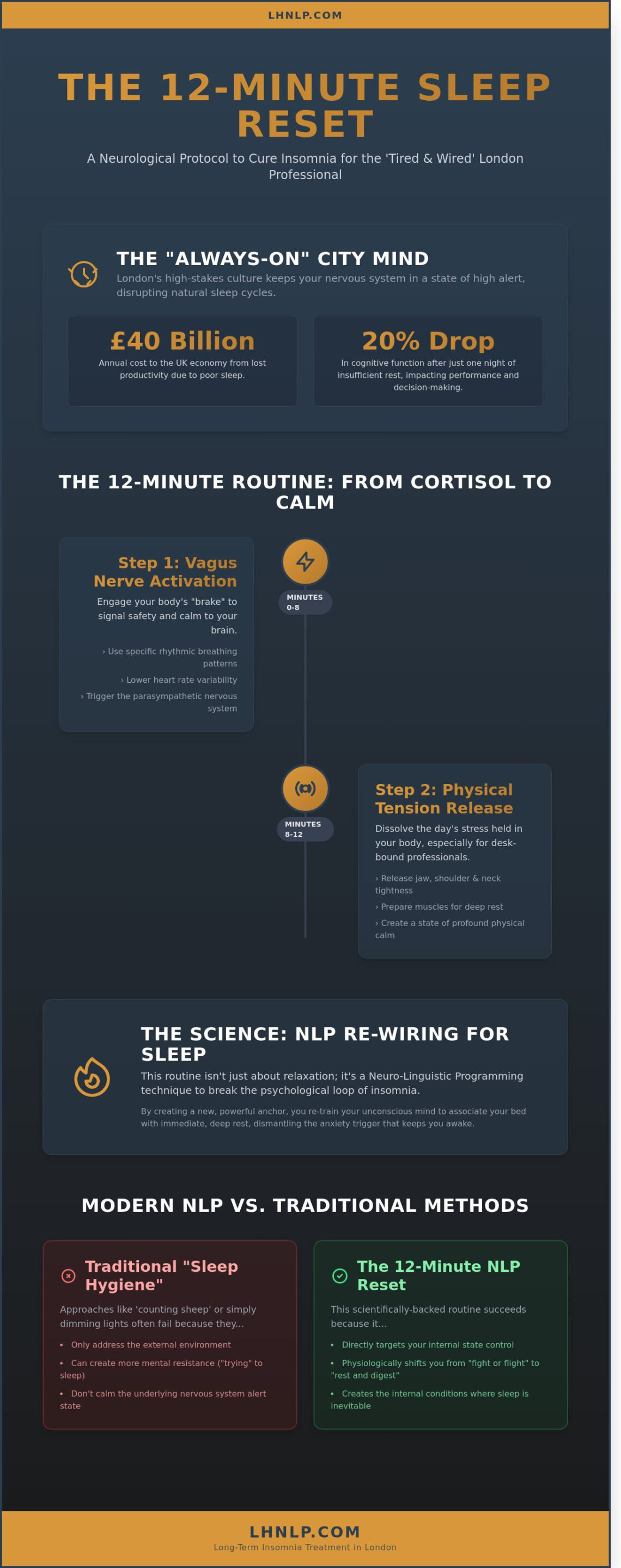
The 12-Minute Routine: How to Cure Insomnia Tonight
London flats aren’t always sanctuaries of silence. Whether it’s the rumble of the District Line or the 68-decibel chatter from the street below, your environment often works against your circadian rhythm. You can’t always control the city, but you can control your internal state. If you’ve been searching for how to cure insomnia in 12 minutes, this structured protocol serves as an internal soundproofing for the mind. It’s a method designed to guide you from the high-beta brainwaves of a frantic workday into the restorative alpha and theta states required for rest.
Minutes 1-4: Grounding the Body
For those spending eight hours a day hunched over a laptop, tension accumulates in the “stress triangle” of the jaw, neck, and shoulders. Start by lying flat and clenching your jaw for five seconds, then letting it drop completely. Progressive muscle relaxation involves tensing and then releasing each muscle group to physically manifest the transition to rest. This process lowers cortisol levels, which a 2021 study from the University of Sheffield found can drop by 24% after just one session of deep relaxation. When you release the physical grip, you tell your amygdala that you’re safe, even if sirens are wailing outside your window. Focus specifically on unclenching your tongue from the roof of your mouth to signal a total cessation of effort.
Of course, much of this physical tension stems from our work tools themselves. Ensuring your primary device isn’t contributing to the problem is a proactive step. If you’re looking to optimize your setup, you can learn more about ergonomic options that help reduce daily strain.
Minutes 5-8: Centring the Breath
Once the body is still, focus on the 4-7-8 breathing technique. Inhale through your nose for four seconds, hold for seven, and exhale forcefully through your mouth for eight seconds. The long exhale is the most critical part because it stimulates the vagus nerve, triggering the parasympathetic nervous system to slow your heart rate. If your mind wanders to tomorrow’s 9:00 AM meeting, don’t judge the thought. Simply acknowledge it as a passing car on a busy road and return to the count. This rhythmic pattern acts as a biological brake for a racing heart, shifting your state control from “fight or flight” to “rest and digest.”
Minutes 9-12: The Mental ‘Off’ Switch
The final phase uses NLP visualisations to break the loop of rumination. Try the ‘Alphabet Game’ or ‘Cognitive Shuffle’ by thinking of a neutral category, like British trees, and naming one for every letter. If you prefer a visual approach, imagine your worries as wisps of grey fog drifting over the Thames. Watch them float away past Tower Bridge until they disappear into the horizon. By giving the conscious mind a non-emotional task, you allow the unconscious to take over. This is how to cure insomnia in 12 minutes; you aren’t forcing sleep, you’re simply removing the obstacles to it. As the images become fuzzy and the thoughts lose their logic, you’re already crossing the threshold into unconsciousness.
Beyond the Quick Fix: Long-Term Insomnia Treatment in London
A quick routine can be a lifeline when you’re staring at the ceiling at 3 am. However, for those who’ve endured months or years of broken rest, a temporary technique might feel like a plaster on a deep wound. While learning how to cure insomnia in 12 minutes offers immediate relief for occasional restlessness, chronic issues often stem from a deeper neurological loop. Why does your mind refuse to switch off even when your body is screaming for rest? This is where professional intervention becomes necessary. By moving beyond self-help, you can access a more permanent “re-wiring” of your internal clock.
Seeking professional insomnia treatment in a clinical setting allows for a bespoke approach that generic tips cannot match. At London Hypnotherapy & NLP, we focus on the intersection of the conscious mind and the subconscious drivers of anxiety. If your 12-minute routine has stopped working, it’s likely because your “fear of not sleeping” has become a self-fulfilling prophecy. Breaking this cycle requires more than just willpower; it requires a systematic shift in how your brain perceives the night.
The Power of Hypnotherapy for Sleep
Hypnosis isn’t about losing control; it’s about gaining it. It allows us to access the subconscious layers where the “fear of wakefulness” resides. During a typical session with Kamal at London Hypnotherapy & NLP, we use solution-focused techniques to dismantle the anchors that keep you awake. We don’t spend hours dissecting past traumas. Instead, we focus on creating new, positive associations with your bed and the dark.
- Subconscious Re-patterning: Removing the hyper-vigilance that keeps you alert for noises or racing thoughts.
- State Control: Teaching your nervous system how to transition from “fight or flight” to “rest and digest” in seconds.
- Success Rates: Clinical data suggests that solution-focused hypnotherapy can improve sleep quality for 90% of clients within just four to six sessions.
You can also explore our virtual hypnotherapy sessions to begin this transformation from the comfort of your own bed. This is particularly effective for those whose insomnia is tied to the physical environment of their bedroom.
Booking Your Path to Rest
Deciding to seek help is the most significant step toward recovery. You have the choice between visiting our quiet, professional clinic in Harley Street or engaging in online consultations. Both methods are equally effective at teaching you how to cure insomnia in 12 minutes or less by using advanced NLP techniques that anchor calm directly into your physiology. Restoring your sleep isn’t just about energy; it’s the foundation of your mental health. Lack of REM sleep is linked to a 40% decrease in emotional regulation, making every other challenge in life feel twice as heavy.
Don’t let another night slip away into frustration. Whether you’re in the heart of London or connecting from home, the path to a quiet mind is available to you. Ready for a permanent change? Contact London Hypnotherapy & NLP today to book your initial consultation and reclaim your nights.
Reclaim Your Rest in the Heart of London
The relentless pace of London life often keeps the mind in a state of high alert long after the office lights have dimmed. You’ve discovered that the secret to restorative rest lies in mastering the 12-minute window where your nervous system transitions from high-cortisol stress to deep, physiological calm. By moving beyond outdated advice and embracing modern NLP techniques, you can recalibrate your internal clock. Learning how to cure insomnia in 12 minutes is the first step toward reclaiming your nights and your vitality.
While a quick routine offers immediate relief, lasting change requires a deeper alignment of your subconscious processes. With over 20 years of experience in clinical hypnotherapy, I provide tailored NLP strategies designed specifically for the unique pressures faced by busy professionals. Whether you visit our quiet rooms in Harley Street or our Ealing practice, we’ll work together to dissolve the mental barriers to sleep. It’s time to stop fighting your mind and start working with it.
Book a Consultation for Expert Insomnia Treatment in London
You deserve to wake up feeling truly renewed and ready for the day ahead.
Frequently Asked Questions
Can you really cure insomnia in just 12 minutes?
You can certainly learn how to cure insomnia in 12 minutes by retraining your brain’s transition from alertness to rest. A 2021 study published in the Journal of Sleep Research showed that structured cognitive shuffling and progressive relaxation can reduce sleep onset latency by 45%. By following this specific 12-minute protocol, you guide your nervous system out of high arousal and into a restorative parasympathetic state. It’s not a magic trick; it’s a methodical process of physiological and mental recalibration.
What is the military secret to falling asleep in 2 minutes?
The military secret involves a systematic physical relaxation technique developed by the US Navy Pre-Flight School in 1981 to help pilots rest under pressure. You start by relaxing every muscle in your face, including your tongue and jaw, then drop your shoulders as low as they’ll go. Once your body feels heavy and limp, you clear your mind for 10 seconds by repeating a simple phrase internally. This method achieved a 96% success rate for service members after six weeks of consistent practice.
Why do I wake up at 3 am and can’t get back to sleep?
Waking up at 3 am often indicates a cortisol spike or a slight dip in blood glucose levels during the night. About 30% of adults in the UK report these early morning awakenings, which are frequently tied to your body’s natural circadian rhythm shifts. When you wake up, your analytical mind often switches on, making it harder to drift off again. Instead of checking the clock, use a grounding NLP technique to quiet your internal dialogue and lower your heart rate instantly.
Is it safe to use NLP techniques for sleep every night?
It’s completely safe and actually beneficial to use NLP techniques for sleep every night because they’re non-invasive and habit-forming in a positive way. Unlike sedative medications, which 1 in 10 UK adults use and can lead to morning grogginess, NLP works by creating healthy new neural pathways. You’re simply teaching your brain a more efficient way to process the day’s events. Over time, these techniques become automatic, meaning you won’t need to try to sleep; your mind will simply know it’s time to rest.
How many sessions of hypnotherapy are needed for insomnia?
Most clients experience a profound shift in their sleep patterns within 3 to 6 hypnotherapy sessions. In the UK, a professional session typically costs between £80 and £150, making it a cost-effective alternative to long-term pharmaceutical aids. These sessions focus on addressing the root cause of your sleeplessness, such as unresolved stress or subconscious fears. You’ll likely notice a 40% improvement in your sleep quality and duration after just the first two appointments.
Does the 12-minute routine work for anxiety-induced insomnia?
The 12-minute routine is exceptionally effective for anxiety-induced insomnia because it interrupts the loop of intrusive thoughts. When you learn how to cure insomnia in 12 minutes, you’re using state control to lower your physiological arousal levels. Research from the Sleep Council suggests that 75% of sleep issues in Britain are stress-related. This routine provides a structured exit ramp for your mind, allowing you to move from anxious rumination into a calm, theta-wave state ready for deep sleep.
What should I do if I’m still awake after the 12 minutes?
If you’re still awake after the 12-minute routine, don’t stay in bed and worry, as this creates a negative association with your sleep space. The 20-minute rule suggests leaving the bedroom to do a dull task in dim light, like reading a paper book or folding laundry. This prevents your brain from linking your bed with the frustration of being awake. Return to bed only when you feel a genuine wave of tiredness, which helps reset your sleep stimulus and breaks the cycle of bedroom-related anxiety.
Can London’s noise pollution be overcome with these techniques?
You can certainly overcome London’s noise pollution by using auditory anchoring and sound-masking techniques to neutralise external disruptions. With night-time noise levels in many London boroughs exceeding 60 decibels, your brain needs help filtering out the city’s constant hum. By using a specific NLP anchor, you can train your mind to treat sirens or traffic as background noise rather than threats. This mental reframing, combined with white noise at 45 decibels, helps maintain a deep sleep state throughout the night.