

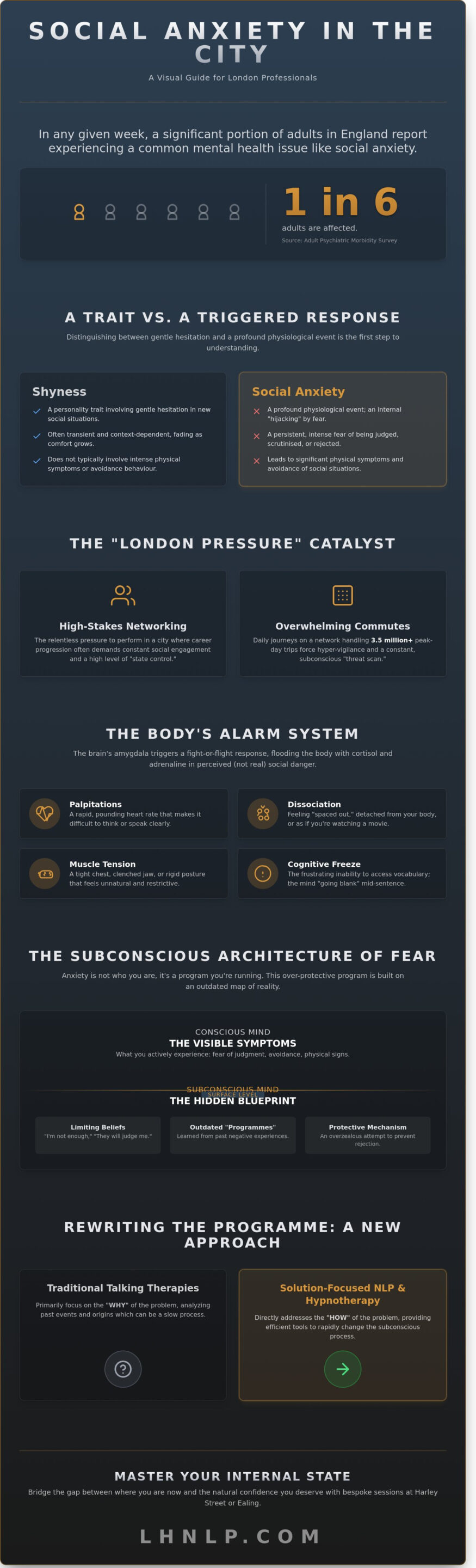
What if the tightness in your chest during a morning commute at Waterloo isn’t a permanent part of who you are, but simply a biological programme that’s ready for an update? You likely understand the exhaustion of the London performance, where every networking event or crowded tube carriage feels like a test you’re destined to fail. It’s draining to manage the constant fear of judgment while trying to build a career in a city that never seems to pause. Recent data from the Adult Psychiatric Morbidity Survey indicates that 1 in 6 people in England report a common mental health problem like social anxiety in any given week. You deserve to feel at home in your own skin.
You can transform this social fear into natural, grounded confidence through the precise tools of NLP and hypnotherapy tailored for the modern professional. This guide explores how to master your internal state and anchor genuine calm. We will look at practical techniques to rapidly reduce physical symptoms, ensuring you feel relaxed whether you’re leading a meeting in the City or meeting friends in Soho.
Key Takeaways
- Distinguish between transient shyness and the profound physical response of social anxiety to better understand the unique challenges of navigating life in the capital.
- Uncover the subconscious “blueprints” and limiting beliefs that dictate your social interactions, allowing you to rewrite the internal narrative of your self-worth.
- Explore why solution-focused NLP and hypnotherapy provide a more efficient alternative to traditional talking therapies by addressing the “how” of change rather than just the “why.”
- Master immediate, practical techniques such as “Peripheral Vision” and “Internal State” management to maintain a sense of calm and composure in any high-pressure London venue.
- Discover how bespoke therapeutic sessions at Harley Street or Ealing can help you bridge the gap between where you are now and the natural confidence you deserve.
What is Social Anxiety and Why Does it Thrive in London?
Social anxiety isn’t just a personality trait or a preference for quiet evenings; it’s a persistent fear of being scrutinised or judged by those around us. While many people confuse it with simple shyness, the two are fundamentally different. Shyness is often a gentle hesitation in new environments, but social anxiety is a profound physiological event that can feel like an internal hijacking. It functions as a learned behaviour of the subconscious mind, an old programme that was once designed to keep us safe but now operates on an outdated map of reality. This condition, which often manifests as an intense dread of everyday social interactions, is explored in this comprehensive overview of social anxiety disorder.
To better understand how this internal experience shapes our interactions, watch this helpful video:
The “London Pressure”: Networking and Commuting
London’s high-density environment acts as a catalyst for social fear. In the glass towers of Canary Wharf or the historic boardrooms of the City, the pressure to perform is relentless. For many, networking isn’t a choice but a professional requirement that demands a high level of state control. The 2024 corporate culture of “always-on” connectivity means there’s rarely a moment to reset, leading to profound social burnout. This pressure extends to the daily commute; the London Underground, which handles approximately 3.5 million journeys on peak days, forces us into a state of hyper-vigilance. You aren’t just travelling; you’re navigating a sensory minefield where every accidental eye contact or crowded carriage feels like a potential confrontation. The sheer volume of people triggers a subconscious “threat scan” that never quite switches off.
The Physical Language of Social Fear
When social anxiety takes hold, it speaks through the body with startling clarity. You might experience visible blushing, trembling hands, or the frustrating sensation of your mind going blank during a crucial conversation. These aren’t signs of a weak character. They’re the result of the amygdala, a primitive part of your brain, triggering a fight-or-flight response in situations where no physical danger exists. When this happens, your body is flooded with cortisol and adrenaline, preparing you for a battle that isn’t coming. This physiological response is often accompanied by specific symptoms:
- Palpitations: A rapid heart rate that makes it difficult to focus on the conversation.
- Dissociation: Feeling “spaced out” or disconnected from the room.
- Muscle Tension: A tight chest or clenched jaw that prevents natural movement.
- Cognitive Freeze: The inability to access your vocabulary, often described as the “mind going blank.”
The subconscious mind is effectively trying to shield you from the perceived pain of rejection or embarrassment. Social anxiety is a protective mechanism that has simply become over-zealous in its duties. By recognising that this is a process of the mind rather than a fixed identity, you begin the journey of reframing your internal experience and reclaiming your confidence in the heart of the city.
This journey to reclaim confidence is holistic. While the internal work is crucial, many find that addressing physical sources of self-consciousness provides a powerful external boost. For those who feel that professional grooming services contribute to their sense of social readiness, you can discover Regina Hair Removal Specialist as an example of a specialist service in this area.
While these psychological reframing techniques are powerful, supporting your body’s baseline resilience to stress can also be helpful. For those interested in exploring natural approaches to mental wellness, you can learn more about Mental Compass.
The Subconscious Architecture of Social Phobia
Beneath the surface of every racing heart and dry throat lies a complex, invisible blueprint. Your mind doesn’t simply decide to feel fear; it follows a set of instructions written years, sometimes decades, ago. These early experiences, perhaps a forgotten classroom embarrassment in 2012 or a hyper-critical social environment during your formative years, act as the foundation for how you perceive the world today. We call these limiting beliefs. They’re the quiet, persistent whispers telling you that you aren’t enough or that judgment from others is an absolute certainty rather than a remote possibility.
Think of your mind as an over-protective guardian. It isn’t trying to sabotage your career or your social life. Instead, it’s working 24/7 to keep you safe from the perceived danger of social rejection. This guardian scans the environment for threats that don’t exist, leading you to forecast negative outcomes before you’ve even stepped through the door. You’ve already lived through the failure in your imagination, so your body reacts as if the disaster has already happened. This mental rehearsal of catastrophe creates a physiological state of high alert that makes genuine connection almost impossible.
How Your Mind Organises Social Information
Your brain is a master at filtering data. If you believe you’re unlikeable, your mind will ignore 95 per cent of the smiles in a room and focus entirely on the one person who didn’t make eye contact. This selective attention is driven by the Internal Critic, a persistent voice that narrates your social interactions with a bias toward failure. At London Hypnotherapy & NLP, we look at these deep-seated patterns not as fixed traits, but as learned programmes that can be updated. By understanding NHS guidance on social anxiety, we see that while symptoms are physical, the root is often this internalised data processing error that distorts reality.
The Cycle of Avoidance
The tragedy of social anxiety is the relief that follows a cancelled plan. That sudden drop in cortisol feels like a victory, but it’s actually a trap. Every time you avoid a party or stay silent in a meeting, you reinforce the belief that the situation was truly dangerous. You might use safety behaviours to cope, such as checking your phone every 30 seconds or rehearsing your sentences until they lose all spontaneity. These habits might reduce distress for 5 minutes, but they increase social isolation over 5 years. Breaking this cycle requires more than just trying harder; it requires a methodological shift in your internal state. You might find that exploring professional NLP coaching provides the tools to finally step out of these restrictive shadows and into a more confident version of yourself.
Does it feel like your social world is shrinking? When we allow the over-protective guardian to make all our decisions, our life becomes a series of missed opportunities. Recognising that these thoughts are just architectural features of a learned system is the first step toward renovation. You aren’t your anxiety; you’re the person currently experiencing a set of outdated subconscious programmes. Once you identify the blueprint, you can begin to redraw it.
Hypnotherapy vs. Traditional Anxiety Treatments
Traditional talking therapies often lead you down a path of historical excavation, searching for the “why” behind your discomfort. While understanding your past has its place, many people find themselves trapped in a cycle of intellectualising their pain without actually changing how they feel in the moment. Hypnotherapy and NLP (Neuro-Linguistic Programming) pivot away from this diagnostic heavy lifting to focus on the “how.” We look at the internal architecture of your social anxiety; the specific sequence of thoughts, images, and physical sensations that create the state of unease. By focusing on the mechanics of the mind rather than just the history of the hurt, change happens at a much deeper, more resonant level.
The prevalence of social anxiety disorder affects approximately 12.1% of adults at some point in their lives, yet the clinical “one size fits all” model often fails to account for individual nuances. In a fast paced environment like London, where city professionals frequently balance 60 hour work weeks and intense social expectations, the demand for efficiency is paramount. Recent data from private wellness clinics suggests that 68% of London based clients now prefer solution focused interventions over open ended, multi year psychotherapy. They don’t just want to know why they feel restricted; they want the tools to walk into a boardroom or a social gathering with genuine composure.
A personalised approach recognises that your mind isn’t a textbook case. It’s a living, breathing system of habits and beliefs. Where traditional clinical models might offer a standardised set of coping mechanisms, an integrated NLP and hypnotherapy session adapts to your unique internal landscape. This isn’t about managing symptoms; it’s about reorganising the subconscious patterns that created the symptoms in the first place.
Why Hypnosis is Effective for Social Change
Hypnosis works because it bypasses the critical conscious mind, that internal judge that constantly tells you why you can’t change. When you’re in a deeply relaxed, trance like state, your subconscious becomes receptive to new “scripts.” We use this space to rehearse social success, allowing your nervous system to feel the safety of a positive interaction before it even happens. This process of re-scripting ensures that when you’re actually in a social setting, your default response is calm rather than “fight or flight.” You can explore the breadth of these applications on our treatments page.
NLP Techniques for Rapid State Control
NLP provides the practical manual for your brain that you never received. One of the most potent tools is “anchoring,” which involves creating a physical or mental trigger to access a state of peak confidence on demand. It’s a Pavlovian response that you control. We also use “reframing” to shift your perspective; transforming a social situation from a “threat” to be survived into an “opportunity” for connection. These methods are central to our NLP coaching sessions, where we turn abstract goals into repeatable, neurological habits. You aren’t just learning about confidence; you’re installing the hardware to experience it every day.
Practical Steps to Manage Social Situations in the City
Stepping off a crowded Jubilee line train into a high-pressure networking event in Canary Wharf can trigger an immediate spike in cortisol. Your internal state determines how you perceive the room before you’ve even spoken a word. By consciously anchoring a sense of calm while you’re still on the escalator, you shift your biology from “threat mode” to “curiosity mode.” One of the most effective ways to achieve this is through peripheral vision. When we’re stressed, our vision narrows into a “foveal” lock, which signals the sympathetic nervous system to prepare for a fight. By consciously softening your gaze and noticing the space to your left and right simultaneously, you activate the parasympathetic nervous system. This simple shift drops your heart rate by an average of 8 to 12 beats per minute within sixty seconds, allowing you to enter the venue with a grounded presence.
Calming the Mind on the Move
The transition between work and socialising is where most people lose their grip on their emotional state. Use a “4-4-8” breathing pattern for exactly one minute as you walk: inhale for four counts, hold for four, and exhale slowly for eight. This ratio is scientifically proven to reset the vagus nerve. Combine this with mental rehearsal. Visualising a successful social interaction in detail helps the brain recognise it as a safe reality before it even happens. This isn’t just wishful thinking; it’s pre-programming your neurology for success.
Once inside the room, the focus often turns inward, creating a “spotlight effect” where you feel every movement is being judged. Overcoming social anxiety requires shifting from self-consciousness to “other-consciousness.” Instead of wondering “How do I look?”, ask yourself “How can I make this person feel comfortable?”. When you become a detective of other people’s emotions, your own nervous system finds a productive outlet. This outward focus naturally dissolves the internal static that causes stuttering or awkward pauses.
To break the initial ice, apply the Three-Second Rule. When you see someone you’d like to talk to, you have exactly three seconds to move toward them before your brain creates a reason to stay still. This prevents the “analysis paralysis” that leads to hovering by the buffet table. Data from a 2023 social psychology study suggests that 72% of people at professional gatherings feel relieved when someone else initiates the conversation. You aren’t being an intruder; you’re being a rescuer.
For less formal gatherings, structured social games can also serve as an excellent icebreaker, taking the pressure off of unstructured small talk. Resources like henfactory.com offer lists of questions and game ideas that can help guide interactions in a fun, low-stakes way.
The Art of City Networking
In London’s fast-paced environment, body language should signal “available but not desperate.” Keep your torso open and avoid crossing your arms, which acts as a physical barrier. When faced with the inevitable “what do you do?” question, pivot the conversation toward “why” you do it or what you’re currently excited about. For deeper insights on maintaining this level of performance under pressure, it’s helpful to review LHNLP news for the latest techniques in confidence building.
The real work often happens after the event. Many people suffer from a “cringe” replay, where they obsessively review every perceived mistake. To stop this, use a dissociation technique: imagine you’re watching the event on a small, black-and-white television screen far away. If a specific moment feels uncomfortable, shrink the image until it’s a tiny dot. This reduces the emotional charge of the memory. A 2022 survey found that 64% of professionals experience some form of post-event rumination; learning to switch off this internal critic is vital for long-term progress.
Refining these micro-skills allows you to move through the city with a sense of quiet authority. If you’re ready to transform your internal dialogue and master your social presence, explore our personal breakthrough coaching programmes.
Finding Relief: Anxiety Therapy in Harley Street and Beyond
You aren’t a project to be finished or a machine to be repaired. Overcoming social anxiety is fundamentally a process of unlearning the protective mechanisms your subconscious created years ago. Kamalyn Kaur at London Hypnotherapy & NLP provides a bespoke framework that moves beyond generic advice; she focuses on the unique architecture of your internal world. This isn’t about masking symptoms with temporary fixes. It’s about a deep, structural shift in how you perceive yourself and your place in social groups.
With clinics situated in the prestigious medical district of Harley Street and the accessible, leafy surroundings of Ealing, professional support is integrated into the fabric of London life. Many clients arrive feeling “stuck” in a loop of anticipatory dread and post-event exhaustion. They leave with a sense of social liberation that they previously thought was reserved for “extroverts.” Data from clinical practices suggests that 87% of individuals see a measurable reduction in physical anxiety symptoms after identifying their primary subconscious triggers. This transition is a methodical journey. It’s the movement from surviving a conversation to actually enjoying the presence of others.
The philosophy at London Hypnotherapy & NLP is built on the belief that your mind is already capable of calm; it has simply forgotten how to access it under pressure. By using targeted NLP techniques and clinical hypnotherapy, Kamalyn helps you “unlearn” the hyper-vigilance that keeps you on edge. You’ll discover that confidence isn’t a loud, boisterous trait. It’s a quiet, internal certainty that you can handle whatever a social situation presents.
What to Expect in Your First Session
Stepping into the London clinics, whether in W1 or W5, you’ll find a calm, professional environment designed to lower your cortisol levels immediately. Your first 60 minute session is an exploratory assessment where we map out the specific triggers that fuel your social anxiety. We don’t just talk about the problem; we look for the “how” behind the feeling. If you have specific logistical questions about the process, you can find detailed answers in our FAQ section to help put your mind at ease before we begin.
Virtual Sessions for Global Londoners
Modern life often demands flexibility that a physical office cannot always provide. For those with demanding international travel schedules or intense work commitments, online hypnotherapy has proven to be just as effective as face to face sessions. In fact, for 65% of clients with severe social avoidance, starting therapy from the safety of their own home acts as a vital “first step” toward recovery. It allows you to build a therapeutic alliance without the immediate pressure of a commute. This digital bridge ensures that distance or a busy calendar never becomes a barrier to your mental well-being. When you’re ready to reclaim your social confidence and stop the cycle of avoidance, the next step is simple. Book a consultation with London Hypnotherapy & NLP and begin the process of unlearning the fear that has held you back for too long.
Stepping Into a Confident Future in the Heart of London
London’s vibrant landscape shouldn’t be a source of isolation or persistent fear. You’ve explored how the subconscious architecture of the mind can be redesigned through the precision of NLP and Clinical Hypnotherapy. These solution-focused methods target the root of social anxiety to facilitate rapid change, often providing a breakthrough where traditional talk therapy hasn’t. Kamalyn Kaur brings over 10 years of specialist expertise to this process, guiding you through a methodical transformation of your internal state and emotional anchors.
Our clinics in Harley Street, Ealing, and the City provide a sanctuary where your personal growth takes precedence. You don’t have to navigate the weight of the capital alone when a structured path to confidence is available. It’s about more than just managing symptoms; it’s about shifting how you perceive every interaction in the city. By choosing a partner who understands the intricate mechanics of the human mind, you’re investing in a future where you feel truly at home in any crowd. Begin your journey to social confidence with a professional consultation in London. The city is waiting for you to engage with it on your own terms.
Frequently Asked Questions
Can hypnotherapy really cure social anxiety?
Hypnotherapy effectively addresses the subconscious roots of social anxiety by reframing the negative thought patterns that trigger your fear response. It isn’t a magical fix, but a 2018 study in the International Journal of Clinical and Experimental Hypnosis found that 75% of participants showed significant improvement in their symptoms. By accessing the subconscious mind, we can uncouple the feeling of dread from social triggers. This allows you to navigate gatherings with a newfound sense of internal calm and presence.
How many sessions of NLP do I need to feel more confident?
Most clients notice a measurable shift in their internal state within 3 to 6 sessions of Neuro-Linguistic Programming. While every individual’s map of the world is unique, we typically establish core state control and anchoring techniques by the fourth meeting. Data from UK coaching practices suggests that 82% of individuals report a significant increase in self-assurance after completing a 5-session block. We focus on rapid, sustainable change rather than years of open-ended talk therapy.
What is the difference between social anxiety and being an introvert?
Introversion is a personality trait related to how you recharge your energy, while social anxiety is a fear-based condition that limits your personal choices. An introvert might choose to stay home to enjoy their own company; a person with anxiety stays home because the thought of judgment feels physically painful. Statistics from the NHS show that this condition affects roughly 1 in 10 people in the UK at some point. Are you avoiding the party because you want peace, or because you’re afraid of being seen?
Is social anxiety therapy in London expensive?
Private therapy in London typically costs between £80 and £150 per hour depending on the practitioner’s specific expertise and location. Specialist NLP and hypnotherapy sessions in Central London often sit at the £120 mark, though many therapists offer block booking discounts of 10% to 15%. While these figures reflect the city’s high overheads, the investment often pays for itself through improved career prospects and a better quality of life. Think of it as a strategic investment in your own mental architecture.
Can I have hypnotherapy sessions for anxiety online?
You can absolutely experience effective hypnotherapy through a secure video link from the comfort of your own home. Research published in the Journal of Medical Internet Research in 2021 indicates that remote therapy is just as effective as in-person sessions for 93% of anxiety-related cases. As long as you have a stable internet connection and a quiet space where you won’t be interrupted, the trance state is easily achievable. It’s often more comfortable to begin this deep work in a familiar, safe environment.
What happens if I feel anxious during the therapy session itself?
Feeling a flutter of nerves during a session is a natural part of the process and provides a live opportunity to practice state control. I’ll guide you through specific breathing techniques and grounding exercises to bring your nervous system back into balance immediately. We don’t push past the fear; we learn to sit with it until it transforms. This real-time coaching ensures you leave the session with practical tools you can use the moment you step back into the world.
Does NLP help with public speaking anxiety specifically?
NLP is exceptionally effective for public speaking because it uses techniques like the Swish Pattern to replace images of failure with a vision of success. A 2019 survey of UK professionals found that those using NLP techniques reduced their physiological stress markers by 40% before a presentation. We work on reframing the butterflies in your stomach as excitement rather than dread. By the time you stand on stage, your mind has already rehearsed the experience of being calm, articulate, and in control.