

What if staying effective under pressure isn’t about pushing harder, but pausing long enough to choose your next move? When deadlines collide and expectations rise, it’s easy to lose focus, feel tension building or react before you’ve had time to think. Learning how to manage a high-pressure environment starts with recognising that pressure can sharpen attention for a while, but too much can cloud judgement.
You may know the feeling: everything seems urgent, your thoughts race and deciding what to do first becomes its own task. That doesn’t mean you’re incapable. It’s a signal to respond deliberately, rather than letting pressure set the pace.
This article will help you spot early signs that stress is affecting your focus, assess competing demands and choose a next step. You’ll also find ways to prepare for predictable pressure points, make space to recover and recognise when persistent pressure may be difficult to manage alone. The aim isn’t to eliminate every demanding moment, but to meet it with greater clarity, one considered choice at a time.
Key Takeaways
- Separate the demands you’re facing from your response to them, and notice when pressure starts to affect your focus or judgement.
- Learn how to manage a high-pressure environment with a simple sequence: pause, notice what’s happening, steady your attention, identify the next decision, and act.
- When demands compete, weigh urgency, consequences, ownership and realistic time required to decide what to act on, schedule, delegate or renegotiate.
- Prepare for predictable pressure points and make space to recover, while recognising that personal habits can’t remove every external demand.
- If pressure persists and affects daily functioning, consider whether appropriate support could help you find a steadier way forward.
How to Manage a High-Pressure Environment by Recognising What Pressure Is Doing
You’re preparing an important presentation, a deadline has moved forward, and messages keep arriving about other work that also needs attention. You may notice your shoulders tightening or find yourself rereading the same line without taking it in. Feeling strained in that moment isn’t a personal failure. It’s a cue to notice how the demands are affecting your attention before deciding how to respond.
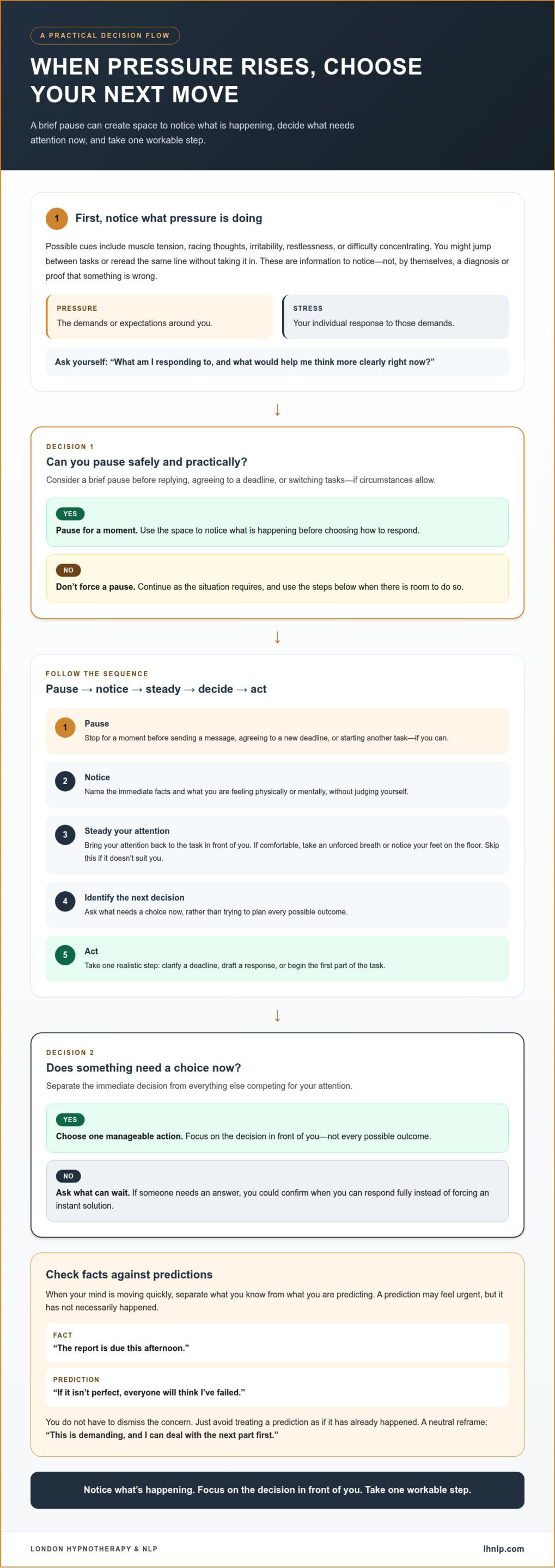
Pressure comes from the demands or expectations around you; stress is your individual response to those demands. The distinction matters because the external situation and your internal experience are connected, but they aren’t identical. Pressure is what’s being asked of you; stress is how your mind and body respond to that demand. Recognising the difference can help you identify what might be changeable in the situation and what you’re experiencing internally.
To explore this idea further, watch this video on handling high-pressure situations:
In a busy London workplace, you might be balancing competing deadlines, preparing for a presentation and managing responsibilities outside work. These circumstances can contribute to occupational stress, but people’s reactions vary. Start by noticing your own signals without treating them as a diagnosis or a complete checklist.
What does a high-pressure environment feel like?
Possible cues include muscle tension, racing thoughts, irritability or difficulty concentrating. You might jump between tasks, struggle to decide what deserves attention first, or feel unusually restless before an important conversation. None of these experiences alone proves that something is wrong. They’re information. Pause and ask, “What am I responding to, and what would help me think more clearly right now?”
When can pressure help, and when can it hinder?
Manageable urgency can sometimes focus your attention on a clear task, such as rehearsing key points before a presentation. But when demands accumulate or continue without enough room to recover, focus may become harder to sustain and decisions may feel less straightforward. Pressure isn’t always helpful or harmful, and your response isn’t simply a matter of willpower.
Try a brief personal check: Can you identify the next useful action, or does everything feel equally urgent? Are you thinking clearly enough to decide, or are tension and racing thoughts taking over? Similar expectations can affect people differently, and your response may change from one day to another. Learning how to manage a high-pressure environment begins with noticing that shift. Recognition creates space to respond more deliberately.
How to Manage a High-Pressure Environment in the Moment
A sudden request, a difficult conversation or a decision with real consequences can make you feel you need to respond instantly. If it’s safe and practical, take a brief pause before replying or switching tasks. A pause won’t remove the demand, but it can create room between what happens and what you choose to do next.
Use this sequence: pause, notice, steady your attention, identify the next decision, and act. It’s a way to orient yourself, not a promise that pressure will disappear. The Association for Project Management shares further perspectives on thriving in high-pressure environments, including the value of attending to mental wellbeing.
What can you do in the first few minutes?
Start by noticing what’s happening without criticising yourself. Is your jaw clenched? Are your thoughts racing ahead to what might go wrong? You don’t need to force these sensations away. If you can, pause somewhere safe, bring your attention to the task in front of you and choose one manageable action rather than trying to resolve every demand at once.
- Pause: Stop for a moment before sending the message, agreeing to a new deadline or beginning another task, if circumstances allow.
- Notice: Name the immediate facts, including what you’re feeling physically or mentally, without judging yourself.
- Steady your attention: Bring it back to the present task. If it feels comfortable, take an unforced breath or notice your feet resting on the floor. Skip this if it doesn’t suit you.
- Identify the next decision: Ask what needs a choice now, rather than trying to plan every possible outcome.
- Act: Take one realistic step, such as clarifying a deadline, drafting a response or beginning the first part of the task.
In plain terms: pause to notice what’s happening, focus on the decision in front of you, then take one workable step.
How can you regain perspective before responding?
When your mind is moving quickly, separate what you know from what you’re predicting. For example, “The report is due this afternoon” may be a fact; “If it isn’t perfect, everyone will think I’ve failed” is an assumption about other people’s reactions. You don’t have to dismiss the concern. Just avoid treating a prediction as if it has already happened.
Then ask: “What does this situation require from me now, and what can wait?” If a colleague needs an answer, the immediate action might be to confirm when you can respond fully, rather than produce an instant solution. A neutral reframe could be: “This is demanding, and I can deal with the next part first.” It recognises the difficulty without turning it into catastrophe.
These steps are one practical way to practise how to manage a high-pressure environment without expecting yourself to feel perfectly calm. If pressure at work is becoming hard to manage, explore support for stress and work-related issues as one possible next step.
How to Prioritise and Communicate When Demands Compete
When several tasks seem urgent, the challenge isn’t simply working faster. It’s making the trade-offs visible: what needs attention first, what can wait and what may need to change. A useful priority is the next action with the clearest consequence if it’s delayed, not necessarily the task making the most noise.
How do you decide what needs attention first?
Check which deadlines are fixed and which only feel immediate because expectations are unclear. Consider what depends on each task, the consequences of delay, who owns the decision and how long the work realistically requires. If a large task feels difficult to start, break it into a smaller step. Choose one action to begin, then record the remaining tasks so they don’t keep competing for space in your mind.
Use this quick comparison to choose a response:
Act now: The deadline is close, the consequences of delay matter and you’re responsible. Identify the next concrete step.
Schedule: The work matters, but it doesn’t need action this moment. Put a realistic time in your plan.
Delegate: Someone else can appropriately take ownership, with enough context and time to do the task.
Renegotiate: The timing, scope or available support doesn’t match the work required. Make that gap clear and discuss options.
This isn’t a formula that makes every demand fit. It’s a way to see your choices more clearly. For example, if a report and meeting preparation both appear due today, check which has the more serious consequence if delayed, whether either depends on someone else’s input and how much focused time each needs. Then make a considered choice rather than splitting your attention between both without progress.
How can you communicate when a demand is unrealistic?
Describe your current commitments and ask which should take priority. A specific question gives the other person something practical to respond to. Where possible, offer options: a later delivery, a narrower scope or additional support. Boundary-setting doesn’t need to be confrontational, and it won’t feel equally safe or possible in every role. Adapt your wording to your workplace and the power you hold.
You might say, “I’m working on the client update and the figures for tomorrow. I can complete one first; which is the priority?” Or: “I can deliver the main findings by Friday, or the full report next week. Which would be more useful?” These phrases state the constraint and invite a decision without implying you can do everything at once.
How to Build Steadier Capacity for a High-Pressure Environment
Preparation can make a demanding moment feel more familiar, while recovery gives you room to return to everyday needs and activities. Neither can remove every external demand. Workloads, deadlines and other people’s expectations may still change, so the aim isn’t to make yourself endlessly resilient. It’s to build a more considered way of meeting predictable challenges, learning from them and adjusting where you can.
How can you prepare for predictable pressure?
For a presentation, exam or difficult conversation, divide preparation into three parts: what you can do beforehand, the first action you’ll take when the moment arrives, and a fallback if plans change. Practise relevant skills in manageable steps rather than waiting until you feel perfectly ready. Beforehand, clarify essential information, responsibilities and realistic limits. A small plan gives you a starting point without pretending you can control every outcome.
- Prepare: Identify what you need to know, what you’re responsible for and what can realistically be completed.
- Choose a first action: Decide how you’ll begin, such as opening with your key point or asking the first question.
- Make a fallback plan: Consider what you’ll do if information is missing, time is short or the conversation takes an unexpected turn.
Practising in steps can help you notice which part feels most demanding. If giving a presentation is difficult, you might first rehearse the opening, then practise the full talk. This isn’t about removing all discomfort; it’s about making the task less unfamiliar and giving yourself a clear route in.
Why do recovery and reflection matter?
After a demanding event, make some space to shift your attention back to ordinary activities, whether that means eating, taking a walk or spending time away from work. Recovery isn’t a reward you must earn by performing perfectly. It’s part of making room for life beyond the pressure point.
Once you’ve had a little distance, review the experience without turning it into a verdict on yourself. Ask:
- What helped me respond or prepare?
- What was difficult, and what was within my influence?
- What specific adjustment might I try next time?
Keep the adjustment practical. You might allow more time to prepare, clarify who is responsible for a decision or plan a short pause afterwards. Broader stress management approaches in London can also help you consider how preparation, coping and recovery fit together.
These habits can support steadier performance, but persistent pressure that affects everyday life may call for more support. If you’d like to discuss stress or work-related concerns, explore individual support for stress.
When to Seek Support for a High-Pressure Environment
Self-management strategies can be useful, but you don’t have to rely on them indefinitely. If pressure persists, affects your everyday functioning or leaves little room to recover between demanding periods, it may be worth considering appropriate support. This isn’t a diagnosis, and it doesn’t mean you’ve failed to cope. It’s a way to take your experience seriously and explore what might help.
How can you tell when self-management may not be enough?
Look at the pattern over time rather than judging yourself by one difficult day. Are work or other responsibilities regularly affecting sleep, relationships or your ability to concentrate? Do you find it hard to return to your usual routines after a demanding period, or do the approaches that once helped no longer feel sufficient? These questions can help you decide whether you’d like more support, without needing to label what you’re experiencing.
Support can take different forms, and professional therapy isn’t necessary for everyone. You might begin by speaking with someone you trust, discussing workload or expectations where that feels possible, or seeking help from a suitably qualified professional. If you have health concerns, speak with an appropriate healthcare professional. Hypnotherapy can be a complementary or alternative approach, but it is not a substitute for standard medical treatment.
What support can London Hypnotherapy & NLP offer?
London Hypnotherapy & NLP provides individual support for stress and work-related issues through an integrated approach involving Clinical Hypnotherapy, NLP, counselling, coaching and psychology. The approach is personalised and solution-focused, with the work shaped around the individual rather than assuming that one method will suit everyone. Outcomes can vary, and no particular result is guaranteed.
Sessions are with a registered Clinical Hypnotherapist with over 25 years of experience and a senior business psychologist. They take place in person at 96 Harley St, London W1G 7HY, or online via Zoom or Skype. During hypnosis, you remain fully in control and aware throughout, with no loss of awareness.
If you’re considering how to manage a high-pressure environment and the strain is continuing beyond individual challenging moments, a different perspective may help. Explore the available therapy and coaching treatments to learn about support for stress and work-related concerns. Seeking support doesn’t mean giving up on your own coping strategies. It can help you understand them more clearly and consider additional options.
Make Your Next Step a Steadier One
Learning how to manage a high-pressure environment isn’t about being calm at all times or carrying every demand alone. It’s about noticing when your usual ways of coping aren’t enough, then choosing a next step that fits the situation. That might mean making one expectation clearer, allowing yourself time to recover or talking through what’s been difficult with someone who can offer a considered perspective.
You don’t have to wait until everything feels unmanageable before exploring support. If pressure has been persistent, or you’d like help finding a more workable way to approach stress and work-related challenges, consider what kind of support feels right for you.
Explore supportive options for managing stress and work-related challenges.
Change can begin with one thoughtful conversation or one small adjustment. Give yourself permission to take that step at your own pace.
Frequently Asked Questions
Can pressure ever improve performance?
Yes, a manageable level of pressure can sometimes help you focus on a clear goal, particularly when you have the skills and time to meet it. For example, a presentation deadline might prompt you to organise your key points. But pressure doesn’t improve performance for everyone or in every situation. If you’re rushing, overlooking details or struggling to think, treat that as a cue to reassess the demands rather than simply push harder.
How can I manage pressure when several deadlines collide?
Start by putting each deadline and its essential requirements somewhere you can see them, rather than relying on memory. Check whether any task depends on another person’s input, and identify the smallest useful step for each. Then set aside focused time for the task with the most immediate consequence. If the available time still doesn’t add up, raise the conflict early. This practical approach can help you manage pressure without trying to do everything at once.
What should I say when a deadline feels unrealistic?
Be clear about the work involved and offer a choice where possible. For example: “I can complete the analysis by Thursday, or prepare the full report by Monday. Which timing best meets the need?” If you’re unsure what can be reduced, ask whether the scope or deadline is more flexible. A calm, specific conversation may help clarify expectations, though your role and workplace circumstances can affect how comfortable it feels to raise the issue.
How can I stop replaying a high-pressure event afterwards?
You may not be able to switch off the replay instantly, but you can give it a boundary. Write down one thing that went as intended, one lesson you want to retain and any action that genuinely needs follow-up. If there’s no further action, remind yourself that reviewing the moment again won’t change it. Then deliberately move to an activity that engages you, such as preparing a meal or taking a walk.
Is it normal to feel nervous before a high-stakes event?
Yes, feeling nervous before an important event can be a normal response to caring about what happens. It doesn’t automatically mean you’re unprepared or unable to cope. Try directing that energy towards a practical check: confirm what you need, rehearse your opening line or decide how you’ll begin. If the nerves repeatedly interfere with everyday activities or feel hard to manage, consider talking with someone you trust or seeking appropriate support.
Can I manage pressure without changing jobs?
Possibly. A job change isn’t the only route to exploring what could make work more manageable. Depending on your circumstances, you might seek clearer priorities, discuss deadlines, adjust how tasks are organised or build support around particular pressure points. Some sources of pressure may be outside your control, so change isn’t always straightforward. If you’re in London and ongoing work pressure is affecting daily life, consider what support or workplace conversation feels realistic for you.