

What if feeling more in control during a presentation takes more than practising your slides? If you’re searching for presentation anxiety coaching London, start by identifying what is getting in the way: presentation technique, anxiety, or the way they interact. Nerves can disrupt focus, confidence and delivery, even when you know your subject well.
It’s reasonable to wonder whether you need practical speaking skills, support with anxiety, or both. The right focus depends on your experience and the presentation you’re preparing for. This guide explains how these forms of support differ, what coaching may involve, and how to choose an approach that fits your goals and circumstances.
At London Hypnotherapy & NLP, public speaking coaching and anxiety support are tailored to the individual and can draw on coaching, NLP, counselling and Clinical Hypnotherapy. Kamal is a registered Clinical Hypnotherapist with over 25 years of experience and a senior business psychologist. Sessions are available in person at 96 Harley St, London W1G 7HY, or online via Zoom or Skype.
Key Takeaways
- Presentation anxiety can affect capable, knowledgeable speakers. Notice how it shows up for you before deciding what kind of support may help.
- Presentation anxiety coaching London can focus on speaking skills, anxiety, or both, depending on the barrier you want to address.
- Use a simple framework to describe the speaking situation, identify what feels difficult, set a practical goal, and choose a session format.
- LHNLP provides public speaking coaching and anxiety support tailored to your situation, drawing on Clinical Hypnotherapy, NLP, counselling and coaching.
- Sessions with Kamal are available in person at Harley Street or online via Zoom or Skype. He is a registered Clinical Hypnotherapist with over 25 years of experience and a senior business psychologist.
Presentation Anxiety Coaching London: Manage Your Nerves
Presentation anxiety is distress or apprehension connected with speaking in front of other people. It might arise before a client pitch, a team update, an interview or a presentation that matters to your work. You can know your subject thoroughly and still find your attention pulled towards what could go wrong. Presentation anxiety isn’t proof that you lack subject knowledge; it describes the distress you experience when sharing that knowledge in front of others.
Some nerves are occasional and ease once you begin. More persistent distress can affect how you prepare, how clearly you communicate, or which opportunities you accept. The term Glossophobia, or the fear of public speaking, is often used for a pronounced fear of speaking before an audience. Feeling anxious about a presentation alone, however, doesn’t establish a diagnosis.
For a practical perspective on public-speaking nerves, watch this video from Alexander Lyon, Communication Coach:
How presentation anxiety can affect a workday
The impact may begin well before you enter the room. You might dread an upcoming team update, struggle to concentrate while preparing slides, or repeatedly rehearse a client pitch because you’re worried you’ll lose your place. During an interview or important presentation, attention can shift away from your message and towards self-monitoring: “Am I speaking clearly? What if I freeze?” Afterwards, you may replay the moment instead of moving on.
Sometimes the effect is less visible. You might volunteer less often, avoid asking questions in meetings, or turn down work that involves presenting. These reactions are worth noticing, but they don’t by themselves mean you have an anxiety disorder. Consider how often the distress occurs and whether it is narrowing your choices or disrupting preparation and delivery.
When presentation anxiety coaching may be worth considering
Individual support may be useful if presentation-related distress keeps returning or avoidance is influencing your work decisions. Start by naming one specific situation you’d like to approach differently: giving a concise update to colleagues, presenting a proposal to a client, or speaking during an interview. A concrete situation gives you a clearer starting point than the broad goal of “being confident.”
Next, consider what you want to change in that moment. Is the main difficulty organising your message, staying focused while speaking, or managing apprehension beforehand? Your answer can help clarify whether your priority is presentation skills, anxiety-focused support, or a combination. If your concerns reach beyond speaking situations, LHNLP also provides anxiety support. Presentation anxiety coaching London can be shaped around the particular situation and support you’re seeking.
What Presentation Anxiety Coaching Can Involve: Skills, Confidence, and Emotional Support
Support can begin by clarifying what you want to be different in a particular speaking situation. Perhaps you’d like to organise your thoughts more clearly, feel more confident addressing colleagues, or respond to the pressure of presenting without being pulled off course by worry. These are personal goals, not a promise of a particular result. Naming them helps keep the work relevant to your experience instead of treating every speaker’s concerns as the same.
Presentation support can address both the speaking situation and your response to it. A useful plan may consider what you want to communicate, what happens emotionally when attention turns to you, and how those factors interact. At LHNLP, the approach may draw on Clinical Hypnotherapy, NLP, counselling and coaching, tailored to the individual. Not every client uses every method; the focus is on your needs and aims.
This integrated perspective can be valuable when the challenge isn’t neatly divided into “skills” or “nerves”. You may understand your material but find apprehension gets in the way of sharing it. Or you may want to strengthen your delivery while exploring why certain speaking situations feel difficult. LHNLP’s public speaking and anxiety support is centred on the individual rather than a one-size-fits-all formula.
Presentation skills goals and anxiety-focused goals
Skills-related goals might include communicating a point more clearly or preparing for a presentation more effectively. Anxiety-focused goals may centre on reducing distress or avoidance around a specific speaking situation. These priorities can overlap: you might want to express your ideas clearly and feel less held back by apprehension. Start by identifying which difficulty matters most, then shape the support around it.
Coaching doesn’t assume that every concern calls for the same exercise or technique. Presentations differ in audience, purpose and pressure. Discussing the situation and the outcome you’re hoping to work towards can keep the focus on what would make a meaningful difference to you.
What hypnosis does and does not mean
Clinical Hypnotherapy may form part of an individual approach, but hypnosis doesn’t mean falling asleep, becoming unconscious or losing control. During a session, you remain fully aware and in control. There is no loss of awareness as part of the process.
Hypnotherapy isn’t a guaranteed solution, and it won’t work for everyone. People respond differently, so keep expectations realistic and consider the approach in light of your needs. In an integrated setting, hypnosis is one possible element alongside NLP, counselling and coaching, not a method that has to define the whole process.
Presentation Anxiety Support Compared: Which Approach Fits Your Main Need?
Choosing support becomes easier when you separate two questions: “What do I want to communicate?” and “What happens for me when I have to communicate it?” If your main difficulty is shaping a message or speaking clearly, skills-focused coaching may be a natural starting point. If apprehension or avoidance is central, anxiety-focused support may feel more relevant. Sometimes the two are closely connected.
| Approach | Primary goal | Difficulty addressed | Could both concerns be relevant? |
|---|---|---|---|
| Presentation-skills coaching | Build confidence and communication skills for presenting | Uncertainty about how to structure or deliver a presentation | Yes. Anxiety may also affect delivery or confidence. |
| Anxiety-focused support | Explore distress and responses connected with presenting | Fear, apprehension or avoidance around speaking situations | Yes. Skills goals may sit alongside emotional concerns. |
| Integrated approach | Consider personal goals and emotional barriers together | A combination of presentation concerns and anxiety | Yes. The focus is tailored to the individual. |
This is a guide to the focus of each approach, not a ranking. Presentation anxiety coaching London can consider skills, anxiety, or how they interact, rather than assuming one explanation fits everyone.
When the main need is presentation technique
You may feel relatively comfortable speaking but want to communicate with more clarity or confidence. Perhaps your ideas are hard to organise, or you’re unsure how to adapt your message to a particular audience. A useful coaching goal could be to express your key points more clearly in the situation that matters to you. Make it practical, such as explaining a proposal in a way that feels coherent and authentic.
That goal differs from trying to eliminate every trace of nervousness. You can feel some nerves and still want to improve how you communicate. Identifying the gap between your current experience and what you’d like to do helps clarify whether the priority is presentation technique, confidence, or something else.
When anxiety feels central, or both needs overlap
Ask yourself what seems to come first. If you understand your content but feel strong apprehension about being watched or judged, the emotional response may deserve attention. If you feel calmer when speaking but worry about what to say or how to organise it, the content or communication goal may be more prominent. These aren’t strict categories; the two can reinforce each other.
LHNLP’s integrated approach may draw on Clinical Hypnotherapy, NLP, counselling and coaching, tailored to the individual rather than requiring every method for every person. It can provide space to explore personal goals alongside emotional barriers. Hypnotherapy is complementary or alternative support, not a substitute for conventional medical treatment, and it won’t be suitable or effective for everyone. The treatment areas and approaches provide further context about the support available.
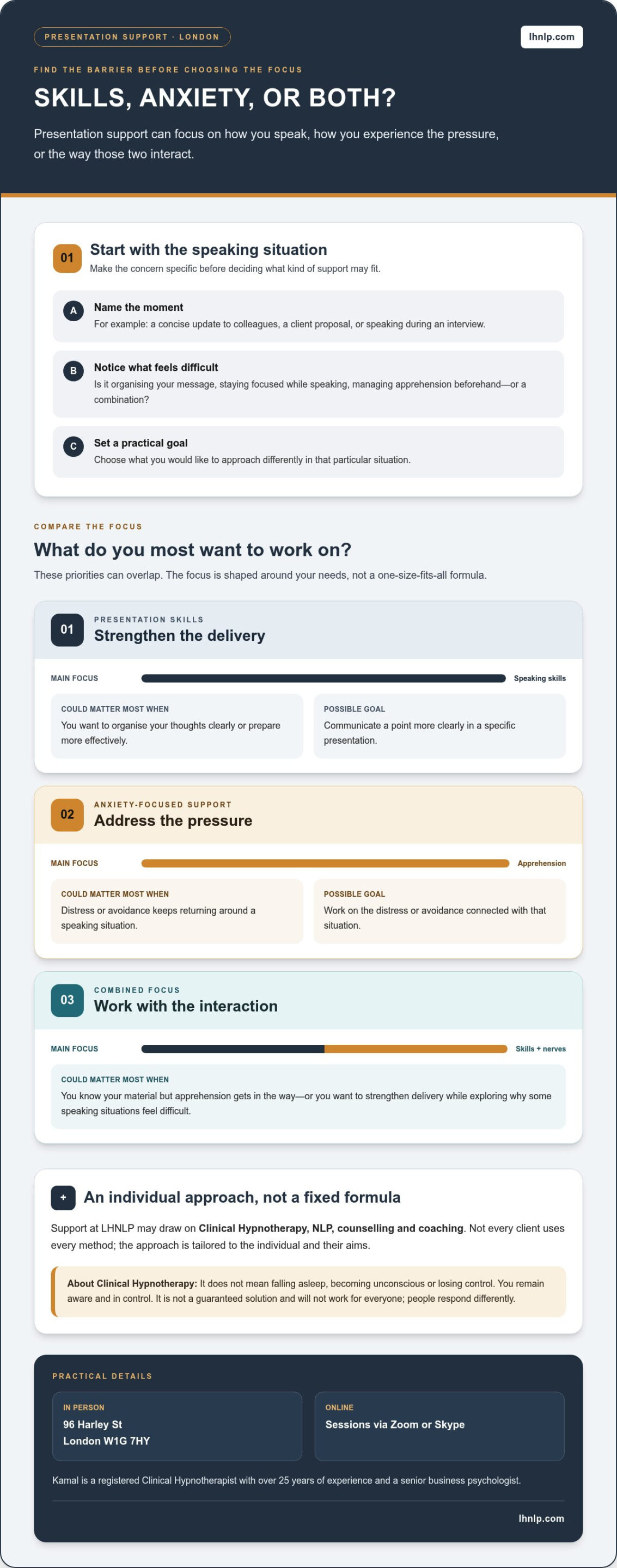
How to Decide on Presentation Anxiety Coaching in London
A clear starting point can make the choice feel less daunting. Instead of asking whether you “should” feel confident, look at the specific moment you want to approach differently and what would make support useful. This four-step framework can help you describe your needs and consider a suitable format for presentation anxiety coaching London.
- Name the situation. Identify the presentation or speaking moment you want to work on, such as contributing to a meeting, presenting a proposal, or speaking to a larger audience. A specific situation gives you something concrete to explore.
- Identify the main barrier. Consider what feels hardest. Is it deciding what to say, communicating your point clearly, feeling apprehensive beforehand, or worrying that anxiety will disrupt your delivery? Practical and emotional concerns can both matter.
- Define a useful outcome. Choose a realistic, personally meaningful goal. You might want to prepare with greater focus, communicate your ideas more clearly, or approach the situation with greater confidence. Treat this as a direction for the work, not a guaranteed performance result.
- Consider the format. Think about whether you’d prefer an in-person appointment in London or an online session, and which option fits your circumstances.
Name the situation and the change you want
It can help to complete this sentence: “I want support with ___ because I’d like to ___.” For example: “I want support with presenting a project update because I’d like to share my key points without becoming distracted by worry.” The first part describes the situation; the second states a useful outcome. Your goal might focus on communication, confidence, emotional distress, or a combination. There’s no single correct priority.
Keep the goal within your influence. You can work towards feeling more prepared or being more willing to take part; you can’t guarantee how an audience will respond or promise to feel no nerves at all. A helpful goal leaves room for progress without demanding perfection.
Choose a format that fits your circumstances
Sessions are available in person at 96 Harley St, London W1G 7HY, or online via Zoom or Skype. If remote support better suits your routine, explore the online hypnotherapy session option. The setting is a practical consideration, not a measure of how seriously you’re taking your goal.
Session planning is individual. There isn’t a fixed number of sessions for presentation anxiety; the number can vary according to the person, their situation and their response to the process. A considered plan can develop around the concern you bring and the aims that feel meaningful to you.
If you’d like to understand the experience and background behind LHNLP’s approach, learn about the practitioner and approach before taking your next step.
Starting Presentation Anxiety Support with LHNLP in London
Presentation anxiety support at LHNLP begins with your circumstances: the speaking situation you’re facing, what feels difficult, and what you’d like to work towards. Public speaking coaching and anxiety support are individual services, shaped around your needs rather than a fixed plan. You don’t need to arrive with a perfect explanation. Start with what you notice and what you hope could feel different.
Your sessions are with Kamal, a registered Clinical Hypnotherapist with over 25 years of experience and a senior business psychologist. Sessions typically last 45 minutes to an hour. The fee is £190 for a one-hour session.
What to expect from LHNLP’s individual approach
Depending on your situation, the approach may draw on Clinical Hypnotherapy, NLP, counselling and coaching. These methods aren’t all used with every client. The focus is on which elements are relevant to your concerns and personal goals. Solution-focused methods may include guided visualisation or progressive muscle relaxation, where appropriate, as part of exploring how you respond to a presentation situation.
If hypnosis is part of your sessions, you remain fully aware and in control throughout. You don’t become unconscious or lose awareness. Hypnotherapy is not a guaranteed solution and won’t work for everyone; your response is individual. It’s one possible part of tailored support, not a promise of a particular outcome.
Take the next step in London or online
You can attend in person at 96 Harley St, London W1G 7HY, or choose an online session via Zoom or Skype. The right format is the one that fits your circumstances and makes it easier to focus on the work. If you’re considering remote support, you can also explore the online hypnotherapy sessions.
Before starting, it may help to note the presentation situation you want to address and what you’d like to work towards. Session planning, including the number of sessions, varies according to the person and their response, so there’s no fixed course to assume. A conversation about your goals can help establish a considered starting point. You can learn more about LHNLP’s practitioner and approach as you decide what feels right.
If you’re ready to explore support for your presentation goals, get in touch with LHNLP to take the next step. You can begin with the situation you’re facing and the change you’d like to work towards.
Take a Considered Step Towards Your Next Presentation
You don’t need to wait until presenting feels easy before seeking support. A useful first step is deciding what you want to approach differently, then choosing help that respects both your practical goals and your experience of anxiety. That intention can give the process direction without demanding perfection or promising a particular outcome.
If you’re considering presentation anxiety coaching London, let your next step be guided by what matters to you: sharing your ideas more freely, feeling more prepared, or making room to take opportunities you’ve been avoiding. Progress is personal, and it can begin with a thoughtful conversation about the situation in front of you.
Explore LHNLP’s individual support for presentation anxiety and consider what you’d like to work towards. You can take this at your own pace, with a clearer sense of the change you hope to make.
Frequently Asked Questions
Is presentation anxiety the same as an anxiety disorder?
Not necessarily. Feeling nervous before a speech doesn’t, by itself, mean you have an anxiety disorder. Presentation anxiety can describe distress tied to a particular speaking situation, while assessing an anxiety disorder requires a qualified health professional. If anxiety is affecting areas beyond presentations or feels hard to manage, consider seeking appropriate professional support. An article can offer general guidance, but it can’t assess your individual circumstances or provide a diagnosis.
Can presentation anxiety affect people who know their subject well?
Yes. Knowing a subject and feeling at ease while presenting it are separate experiences. A knowledgeable person may still feel unsettled by an audience’s attention, the possibility of being judged, or the need to answer questions spontaneously. Notice which part feels most difficult: explaining familiar material, being observed, or responding in the moment. That distinction can guide a more useful conversation about support.
What can I do if my mind goes blank during a presentation?
Pause briefly, take a comfortable breath, and return to a simple signpost, such as your main point or the next heading. For example, you could glance at a note that says “recommendation” and use it to find your place. A pause may feel longer to you than it appears to listeners. If this happens repeatedly, note the situations where it occurs and consider what might help you approach them differently.
Will I lose control or awareness during hypnotherapy for presentation anxiety?
No. During hypnotherapy with LHNLP, you remain fully aware and in control throughout. Hypnosis doesn’t mean becoming unconscious or losing awareness. The process is collaborative, not something that happens to you without your involvement. If you’re unsure what a session may feel like, bring your questions into the conversation before starting. Understanding the approach can help you decide whether it feels comfortable and appropriate for you.
Is hypnotherapy for presentation anxiety available on the NHS?
Hypnotherapy isn’t universally available through the NHS, and this doesn’t mean it is available on the NHS for presentation anxiety specifically. It is recognised for certain conditions, including pain, irritable bowel syndrome (IBS) and some mental-health issues, but access depends on the circumstances and service. Hypnotherapy should be considered complementary or alternative support, not a replacement for conventional medical care or other standard treatment.
Can presentation anxiety support be delivered online?
Yes. LHNLP offers online sessions via Zoom or Skype, as well as in-person appointments at 96 Harley St, London W1G 7HY. Online support may suit you if travelling is difficult or you’d rather speak from a familiar setting. Before a remote appointment, choose a quiet place where you can focus. Presentation anxiety coaching London can be discussed in relation to your goals and the format that suits your circumstances.
Does hypnotherapy work for everyone with presentation anxiety?
No. Hypnotherapy won’t work for everyone, and no specific outcome can be guaranteed. People respond differently depending on their circumstances, the difficulty they’re addressing, their mindset and their openness to the process. The number of sessions can also vary from person to person. Rather than assuming a set course or result, use an individual discussion to consider your aims and whether this approach feels suitable for you.