

What if a video call could still feel like a thoughtful, personal space for change? It’s understandable to wonder whether Skype hypnotherapy sessions can offer the same sense of trust as meeting face to face, and to have practical questions about privacy, technology and what happens once the session begins.
At London Hypnotherapy & NLP, one-to-one sessions are available through Skype or Zoom, with an individualised approach that combines Clinical Hypnotherapy, NLP, counselling and psychology. Kamal is a registered Clinical Hypnotherapist and senior business psychologist with over 25 years of experience. During hypnosis, you remain fully aware and in control throughout.
This guide explains how an online session is structured, how to prepare a quiet and private space, and what to consider when deciding whether this format feels right for you. You’ll also learn how rapport can be built remotely and why progress varies from person to person, without any promise of a particular result. The aim is to help you make an informed, comfortable next step.
Key Takeaways
- Use the comparison of online and Harley Street appointments to decide which setting best suits your privacy, travel needs and personal preference.
- Prepare for Skype hypnotherapy sessions by choosing a quiet, comfortable, private space where you can focus without interruption.
- Sessions last 45 minutes to an hour, and the stated fee applies to a one-hour session.
- For smoking cessation or mild anxiety, 3 to 6 sessions are advisable; the right approach and progress can vary from person to person.
- Hypnosis is not a loss of awareness or control, and it should be considered complementary or alternative to conventional medical treatment, not a replacement for it.
What are Skype hypnotherapy sessions, and who might they suit?
Skype hypnotherapy sessions are one-to-one appointments where a practitioner and client meet by video call for a conversation and guided therapeutic work tailored to the client’s concerns. Unlike a self-guided recording, the session involves direct interaction: the practitioner can respond to what you share and adapt the work to your individual focus. London Hypnotherapy & NLP offers online appointments through Skype and Zoom to clients worldwide.
Hypnosis isn’t sleep, unconsciousness or handing control to someone else. You remain aware and fully in control throughout, with no loss of awareness. It’s a collaborative process, not something done to you. For a broader overview of the subject, see What is Hypnotherapy?
For a practical perspective on making an online therapy appointment work for you, watch:
What happens in a remote hypnotherapy appointment?
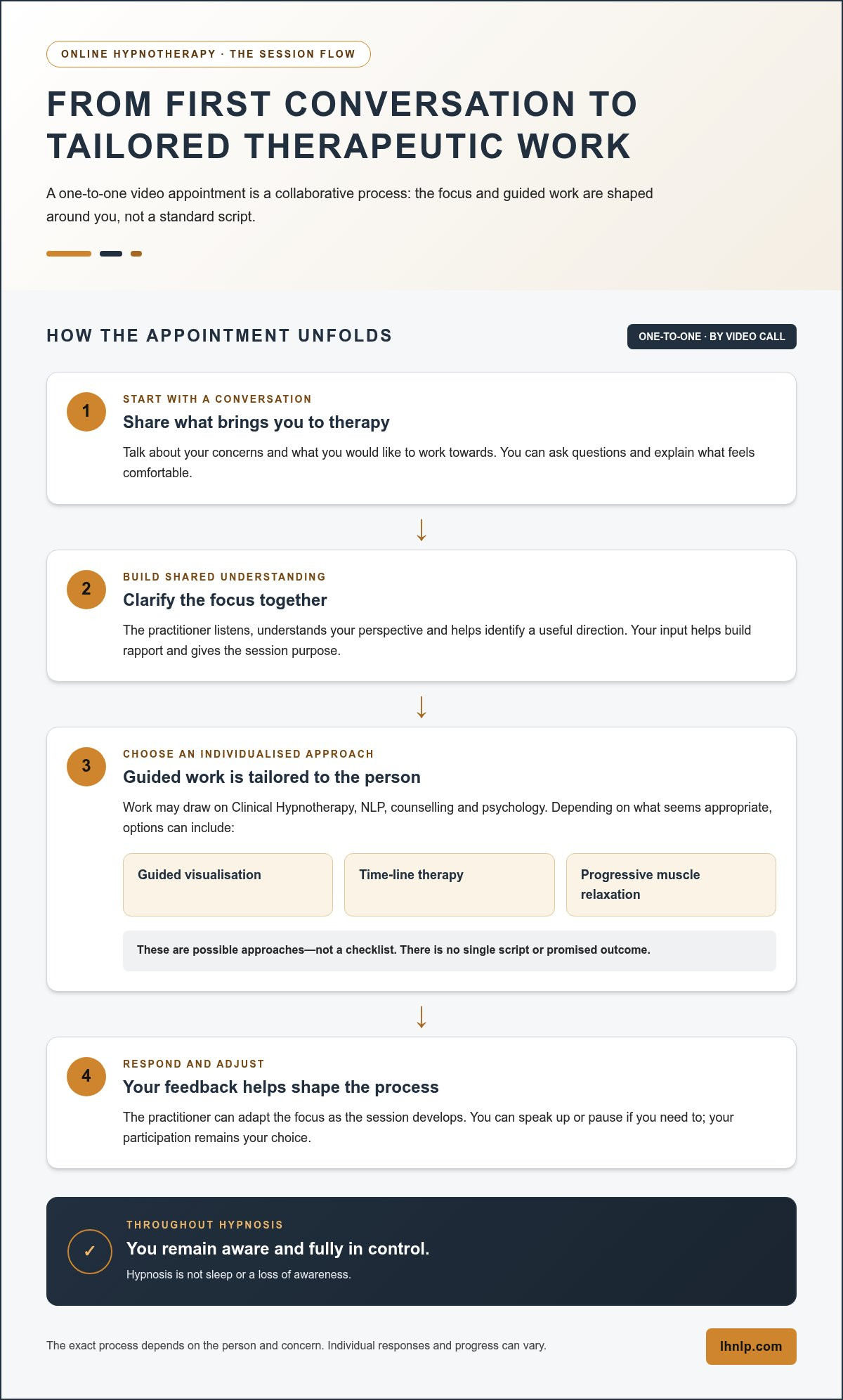
The appointment begins with a conversation about what has brought you to therapy and what you’d like to work towards. This gives the practitioner a chance to understand your perspective, clarify the focus and build rapport. You can ask questions and explain what feels comfortable; you’re an active participant throughout.
The guided therapeutic work is shaped around you. The practitioner may invite you to focus your attention and engage with the session, while drawing on an integrated approach involving Clinical Hypnotherapy, NLP, counselling and psychology. The exact process depends on the person and concern, so there’s no single script or promised outcome. You can speak up or pause if you need to.
Who may prefer a Skype appointment?
An online session may suit someone who values convenience, lives far from London, or feels more at ease speaking from a familiar, private setting. Being at home can make it easier to fit an appointment around daily life, while avoiding the journey to a clinic. LHNLP’s online appointments are available to clients worldwide, so location needn’t prevent a conversation with the practitioner.
Personal preference matters. Some people find a video call comfortable and focused; others may feel more connected in a consulting room. Consider whether you can have a private space and whether speaking through a screen feels manageable for you. The format is one part of the decision, alongside your needs and the rapport you build with the practitioner. Explore LHNLP’s online hypnotherapy services to understand this appointment option. Hypnotherapy is complementary or alternative, not a replacement for conventional medical treatment, and it won’t work for everyone.
How LHNLP approaches Skype hypnotherapy and builds rapport
Online work is still personal work. At LHNLP, sessions bring together Clinical Hypnotherapy, NLP, counselling and psychology, with the focus shaped around the person rather than a standard script. The practitioner and client work together to identify what the client wants to address and what a useful direction might look like. That shared focus helps give the conversation purpose, whether the appointment takes place by video call or in person.
Rapport grows through attentive listening, clear communication and the client’s ability to share what feels relevant. A screen changes the setting, but it doesn’t remove the human exchange: you can explain your concerns, ask questions and say if something doesn’t feel right. In Skype hypnotherapy sessions, that feedback helps the practitioner keep the work responsive instead of assuming one approach will suit everyone.
During hypnosis, you remain aware and fully in control throughout. It isn’t sleep or a loss of awareness, and participation remains your choice.
How the practitioner adapts the work to the person
The session focus reflects your needs and how you respond. For example, if you’re exploring a concern that feels connected to past experiences, the practitioner may consider a different route than if your priority is relaxation or changing a current pattern. The work can draw on guided visualisation, time-line therapy or progressive muscle relaxation, depending on what seems appropriate for you.
These are options, not a checklist or a promise of a particular result. One person may find visualisation a natural way to engage; another may prefer a different form of guided work. Your response and feedback help shape the process, and the practitioner can adjust the focus as the session develops. The aim is individualised, solution-focused support, not a technique applied identically to every client.
What practitioner experience means for an online client
Kamal is a registered Clinical Hypnotherapist and senior business psychologist, with over 25 years of experience across mental-health therapy and related work. That background informs an approach combining structured therapeutic methods with careful attention to the person’s circumstances. Online, as in a consulting room, experience can support a thoughtful conversation and a considered choice of focus; it doesn’t mean every client will have the same needs or progress.
For a closer look at Kamal’s experience, explore how his background informs the practice. If this collaborative, tailored approach feels suited to what you’re looking for, you can learn more about LHNLP’s hypnotherapy support as a next step.
Skype or in-person hypnotherapy: which format fits your circumstances?
Choosing between a video call and a consulting room is a question of fit, not a test of commitment. LHNLP offers one-to-one online appointments and in-person sessions at its Harley Street clinic. Neither format is inherently more effective for everyone; comfort, practical circumstances and how you prefer to talk about personal concerns can all shape your choice.
Consider how each setting would feel on an ordinary day. Would being at home help you settle, or would a dedicated clinic environment make it easier to focus? A professional one-to-one relationship can be built online as well as face to face, though the experience of speaking through a screen may not suit every person.
| Consideration | Online appointment | In-person appointment |
|---|---|---|
| Setting | Meet by video from a place you choose. | Meet at the Harley Street clinic. |
| Travel | No journey to the clinic is needed. | Plan travel to central London. |
| Privacy | Choose a private place where you can speak comfortably. | Have the appointment away from home. |
| Personal preference | May suit you if video conversations feel natural. | May suit you if you prefer being in the same room. |
When a remote session may feel like the better fit
A remote appointment may be convenient if you prefer to speak from a familiar setting or want to avoid travelling to the clinic. Skype hypnotherapy sessions also allow LHNLP to work with clients worldwide. Think about whether you can find a private place to talk and whether a video conversation feels comfortable enough for focused one-to-one work. Your own circumstances matter more than choosing the format that seems most conventional.
When meeting in person may suit your preference
If you value being in a dedicated consulting environment, LHNLP’s in-person option is at 96 Harley St, London W1G 7HY. The clinic is easily accessible by public transport and a short walk from the train station. Choosing face-to-face appointments is a personal preference, not a requirement for progress; online and in-person sessions are different settings for individualised work.
To make your decision, weigh up the practical details alongside how you feel about each setting. If avoiding a journey would ease the day, online may be appealing. If being in the same room feels more reassuring, the Harley Street appointment may fit better. Either way, the aim is to create the conditions for an attentive conversation, not to promise a particular outcome. You can explore LHNLP’s hypnotherapy options as you consider which format feels right for you.
How to prepare for a Skype hypnotherapy session
A little preparation can help you arrive feeling settled and ready to focus. You don’t need special equipment or a complicated routine. For Skype hypnotherapy sessions, the essentials are a private place, a working connection, and a willingness to talk honestly about what you hope to address. Your preparation is there to support the conversation, not to make you perform or get everything exactly right.
- Choose a quiet, private room. Pick a place where you can speak comfortably without expecting to be interrupted. Let anyone you live with know you need some uninterrupted time.
- Make yourself comfortable. Sit in a position you can maintain during the appointment, with your device set up so you can take part without holding it throughout.
- Check Skype and your audio. Before the appointment, make sure you can access Skype and that you can hear and be heard. This simple check can reduce avoidable distractions once the session begins.
- Allow a moment to settle. Give yourself time to move away from other tasks, get comfortable and gather your thoughts before the call.
- Think about what you want to discuss. You might note the concern you’d like to focus on, what you hope could change, and any questions or hesitations you have about hypnosis.
Set up a calm and private space
A quiet room and comfortable position can make it easier to give the conversation your attention. Choose a space where you can talk freely, and reduce likely interruptions by putting aside unrelated tasks and letting others know you’re in an appointment. You don’t need to create a perfect setting. A few minutes to settle in can be enough to help you shift from the pace of the day into a more focused conversation.
Prepare your questions and expectations
You don’t need to arrive with a polished explanation. Sharing what concerns you, what you’d like to be different, and any uncertainty about hypnosis gives the practitioner useful context. If you’re not sure where to begin, say so; the conversation can help clarify the focus. The session plan and number of appointments are individualised, rather than fixed in advance for everyone. Common questions are also covered in the hypnotherapy FAQs.
Preparation can help you feel more at ease, but it can’t guarantee a particular outcome. Hypnotherapy is complementary or alternative, not a replacement for conventional medical treatment, and it won’t work for everyone. You remain fully aware and in control throughout the session. If you’re ready to discuss an online appointment, get in touch with LHNLP about booking.
Book Skype hypnotherapy with LHNLP: realistic expectations and next steps
Considering an appointment is a chance to explore whether this kind of support fits your needs, not a commitment to a particular result or number of sessions. LHNLP’s online appointments take place through Skype or Zoom and are tailored to the individual. The first step is simply to be clear about what you’d like help with and open to discussing what a suitable plan might involve.
Sessions last 45 minutes to an hour. The stated fee applies to a one-hour session. This gives you a clear sense of the appointment’s length, while the work itself remains responsive to your concern and how you engage with it.
What to expect about session numbers and outcomes
There isn’t one session plan that fits everyone. For smoking cessation or mild anxiety, 3 to 6 sessions are advisable. For other concerns, the number of appointments can vary according to the issue, its intensity and your response as the work progresses. Some people may notice a change after one session, while others may need several; neither experience can be promised or assumed in advance.
Hypnotherapy won’t work for everyone, and outcomes aren’t guaranteed. It should be considered complementary or alternative, not a substitute for conventional medical treatment. If you’re receiving medical care, hypnotherapy doesn’t replace that care. Keep expectations grounded: progress is individual, and the decision to continue can be informed by your experience of the sessions.
Take the next step with an online appointment
Before booking, it may help to reflect on what you want to address, what you hope might change and any questions you have about the process. You don’t need a perfectly formed goal. A straightforward description of what’s troubling you, or what you’re unsure about, gives the practitioner a starting point for a considered conversation.
Think about the practical fit, too. LHNLP’s one-to-one online appointments are available through Skype and Zoom, so you can choose a format that works for your circumstances. You can discuss your aims and ask practical questions as you consider whether an online appointment feels right. The aim is to make an informed choice, without pressure to predict exactly how quickly things will change.
If you’re ready to explore the next step, contact LHNLP about an online session. Share what you’d like support with and ask what you need to feel comfortable beginning. Take it one conversation at a time.
Take a thoughtful first step towards change
You don’t need to have every answer before exploring support. A useful starting point may be naming one thing you’d like to feel, understand or approach differently. From there, you can talk through what matters to you and decide whether Skype hypnotherapy sessions feel like a constructive next step. Give yourself room to ask questions and consider your options at your own pace.
The decision is yours. A first conversation can help turn a broad hope into a clearer direction, without requiring you to predict exactly how the process will unfold. If you’re ready to explore whether an online appointment fits your needs, discuss a Skype hypnotherapy session with LHNLP.
Small, considered steps can make change feel more approachable. Start with the question that matters most to you.
Frequently Asked Questions
Can Skype hypnotherapy help with anxiety?
Skype hypnotherapy may be an option to explore for anxiety, though no approach suits everyone. LHNLP offers hypnotherapy for anxiety, and 3 to 6 sessions are advisable for mild anxiety. You might begin by describing a particular situation that feels difficult, such as speaking up at work, so the conversation has a clear starting point. Hypnotherapy is complementary or alternative support, not a replacement for conventional medical care.
How many Skype hypnotherapy sessions might I need to stop smoking?
For smoking cessation, 3 to 6 sessions are advisable, but this is guidance rather than a fixed prescription or guarantee. The number that feels appropriate can depend on your circumstances and response to the work. It may help to consider when you tend to smoke and what you’d like to change, then discuss those patterns with the practitioner. Your plan can be individualised rather than assuming every person follows the same timetable.
How long does a Skype hypnotherapy session last?
A session lasts between 45 minutes and an hour. The time allows for a one-to-one appointment, with the precise focus shaped around your needs rather than a standard script. It can be useful to keep the period after your appointment relatively clear, so you’re not rushing straight into another demand. If you’re planning your day around a session, allow for the full hour.
Do I need to live in London to have Skype hypnotherapy with LHNLP?
No. LHNLP provides online appointments to clients worldwide, so you don’t need to live in London or travel to the Harley Street clinic to meet remotely. This may be useful if you live elsewhere in the UK or abroad and want to speak with the London-based practice from your own location. The appointment is one-to-one; choose a private place where you can take part comfortably.
Will I lose awareness or control during Skype hypnosis?
No. You remain fully aware and in control throughout hypnosis, with no loss of awareness. You can listen, respond and let the practitioner know if you have a question or want to pause. Hypnosis isn’t sleep or a state where another person takes control. If this has been a concern, raise it at the start of the appointment so you can discuss what to expect before the guided work begins.
Does hypnotherapy guarantee that my issue will be resolved?
No, hypnotherapy can’t guarantee that an issue will be resolved, and it won’t work for everyone. People respond differently, so it’s best to approach sessions with an open mind while keeping expectations realistic. Hypnotherapy is a complementary or alternative approach, not a substitute for conventional medical treatment. If you’re receiving care, continue to use that support and consider how hypnotherapy might fit alongside it, rather than replacing it.