

What if resilience isn’t about staying calm and positive, but finding your footing after life knocks you off balance? If pressure, change or a setback has left you doubting your ability to cope, that reaction doesn’t mean you’ve failed. Learning how to build mental resilience starts with a more realistic understanding: difficult feelings can be part of adapting, not evidence that you’re doing it wrong.
You don’t need to feel strong all the time. Generic advice can also be hard to sustain when life is already demanding. Resilience is something you can practise through small, repeatable ways of responding to stress, caring for your wellbeing and reaching for support when you need it.
In this guide, you’ll explore practical coping habits, ways to work with unhelpful thinking, and the role of connection, rest and meaningful activity. You’ll also learn how to recognise when self-guided strategies may not be enough, so you can consider additional support without treating it as a personal failing.
Key Takeaways
- Resilience means adapting to difficulty and finding your footing again, not avoiding distress or staying positive all the time.
- Learn how to build mental resilience by noticing your reactions and choosing a practical next step, rather than judging yourself for feeling unsettled.
- Match a coping practice to the moment: try grounding when overwhelmed, reflective writing to organise thoughts, or reach out when you need connection.
- Use a flexible weekly plan to notice triggers, identify what you need, choose one helpful action and reflect on what worked.
- If distress persists, worsens or disrupts everyday life, seeking professional support can be a constructive next step.
What Does Mental Resilience Mean in Everyday Life?
Pressure, change and setbacks can unsettle anyone. A demanding period at work, a relationship difficulty or an unexpected change of plans may leave you tired, worried or unsure what to do next. Those feelings don’t mean you lack resilience. They’re human responses to difficulty, and you can acknowledge them without letting them define what you’re capable of.
Mental resilience is the ability to adapt to difficulty, respond to what’s happening and gradually regain your footing. It isn’t about avoiding distress or bouncing back immediately. If you’re exploring how to build mental resilience, think of it as a flexible process shaped by the situation and the resources available to you. The broader concept of psychological resilience includes different ways of understanding how people respond and adapt to adversity.
For a practical introduction to resilience, watch this video:
In everyday life, resilience may look quieter than “bouncing back” suggests. It can mean resting before making a decision, setting a boundary when demands exceed your capacity, being honest about how you feel, or asking someone you trust for help. Sometimes the most constructive next step is not to push harder, but to recognise what you need.
Is mental resilience the same as staying positive?
No. Realistic hope leaves room for uncertainty and painful feelings. Forced optimism can pressure you to act as though everything is fine. Naming an emotion, such as frustration or fear, may help you understand what needs attention and choose a more deliberate response. Feeling distressed isn’t weakness, and it isn’t proof that your resilience has failed.
For example, if a setback makes you anxious, acknowledge the reaction and identify one manageable action. You might clarify a practical problem, pause before replying or speak with someone supportive. You don’t have to turn a difficult experience into a positive one before you can respond to it.
Can you build resilience, or are you born with it?
Resilience isn’t simply a fixed quality that some people have and others lack. It can be influenced by personal skills, supportive relationships and the circumstances a person is facing. The same person may cope differently at different times. A useful approach to how to build mental resilience is to practise gradually, without expecting one technique to work for every challenge.
Progress may be uneven. A strategy that helps during a manageable period might feel harder to use when pressure is intense. Needing more support doesn’t erase what you’ve learned. Think of resilience less as armour and more as a set of resources you can draw on, strengthen and adapt over time.
How Resilience Develops: The Skills Behind Recovery
Recovery often begins with a small pause: noticing what’s happening inside you before reacting on autopilot. You might recognise tension, racing thoughts or the urge to withdraw. That awareness won’t make a difficult situation disappear, but it can give you room to ask, “What would help me take the next manageable step?”
Resilience draws on flexible thinking, emotional awareness, practical problem-solving and supportive relationships, alongside the resources available in a person’s circumstances. The American Psychological Association’s description of resilience as adapting well in the face of adversity supports this broader view: coping isn’t one isolated trait or technique.
How do thoughts and emotions affect resilience?
What happens matters, but so can the meaning we assign to it. After receiving difficult feedback at work, you might think, “I’m not good at this,” feel ashamed and avoid asking questions. That interpretation may be understandable, but it isn’t the only possible one.
Cognitive reframing means considering another plausible perspective, not pretending everything is fine. Ask whether the feedback concerns a specific skill, what details could clarify it and what you could try next. The emotion still deserves attention. A more balanced interpretation can simply make room for a considered response. This is one part of how to build mental resilience, not a demand to think positively at all times.
Why do relationships and routines matter?
A trusted person may offer a listening ear, another perspective or practical help. Support doesn’t need to provide perfect advice. Explaining what’s weighing on you can sometimes help you see the situation more clearly. If it feels difficult to ask, try a specific request, such as, “Could you listen while I work out what to do?”
Sleep, movement and regular routines can also support you during stressful periods. A simple pattern, such as keeping a regular wind-down time or taking a short walk, may make daily life feel more manageable. These habits aren’t cures and can’t remove every challenge. Adapt them to your health, circumstances and energy.
The Mayo Clinic’s guidance on building skills to endure hardship also highlights connection, meaningful activity and learning from past experiences as areas to consider. You don’t have to master them all at once. Choose what fits the challenge in front of you.
Recovery rarely follows a neat timetable. You may feel steadier in one area while still finding another difficult, and a new setback can call for different support. If stress or confidence concerns keep getting in the way, you can explore personalised support alongside practical steps of your own.
Which Resilience-Building Practices Fit Your Situation?
The most useful practice depends on what you’re facing. A brief grounding exercise may help you pause during a tense moment, while writing or talking may be more useful when a concern keeps circling in your mind. Treat these approaches as options to test, not universal solutions. The Mayo Clinic’s guidance on building skills to endure hardship also highlights connection, self-care and meaningful activity as possible supports.
| Practice | A situation it may suit | A realistic first step |
|---|---|---|
| Grounding | You feel caught up in an immediate wave of stress. | Pause and name a few things you can see or hear around you. |
| Reflective writing | Your thoughts feel tangled or keep returning to the same concern. | Write down what happened, how you feel and what you need next. |
| Problem-solving | There’s a specific issue you can influence. | Choose one small action, such as drafting a question or checking a deadline. |
| Reaching out | You feel alone with a challenge or need another perspective. | Ask someone you trust to listen or help with one practical task. |
What can you try when stress feels immediate?
Try a simple pause: notice your surroundings, let your breathing settle without forcing it, then identify the next manageable action. Grounding is an optional way to direct attention to the present, not a treatment or a guaranteed way to feel calm. If focusing on your surroundings or breath feels uncomfortable, stop and choose another approach, such as moving to a quieter place or contacting someone supportive.
What helps when a challenge cannot be solved quickly?
Separate what you can influence from what you can’t control. You may not be able to determine how another person responds, for example, but you could prepare a clear question or decide when to follow up. Break the larger concern into one specific step, then consider who could offer perspective or practical help. You don’t have to carry every part of it alone.
If stress is a recurring concern, our guide to Stress Management in London: A Comprehensive Guide to Reclaiming Calm offers further ideas to explore. Finding the right approach to how to build mental resilience may involve trying a practice, noticing how it affects you and adapting it to your circumstances.
How to Build Mental Resilience With a Realistic Weekly Plan
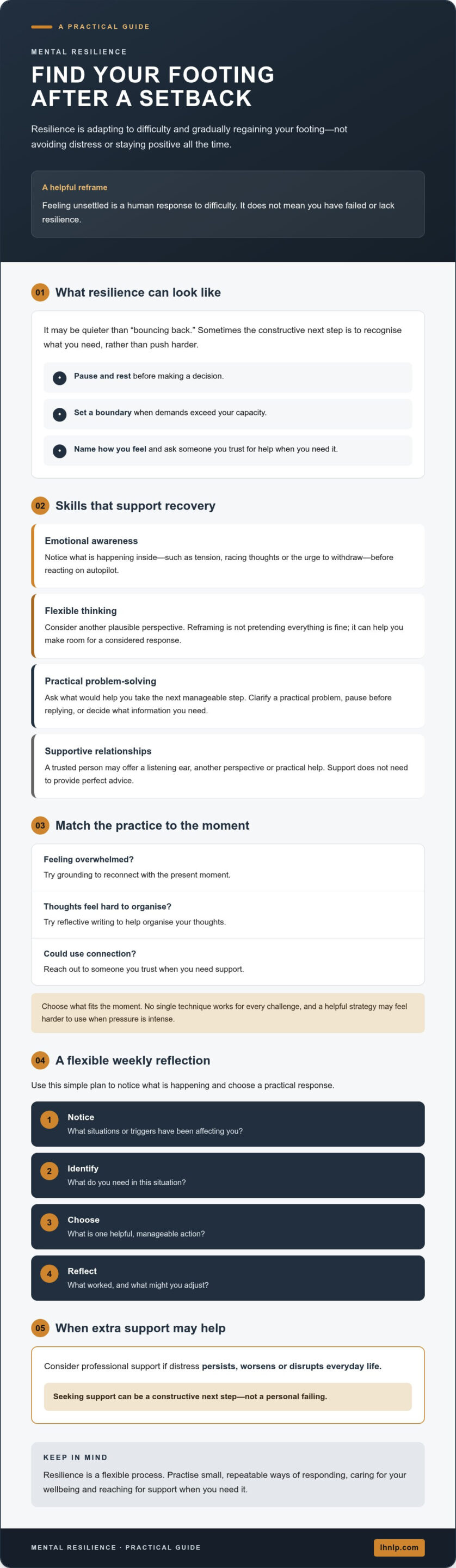
A resilience plan should make daily life more manageable, not become another standard you have to meet. Instead of adding a demanding checklist, choose one small practice to try during the week and review how it fits your circumstances. A brief check-in during a quieter moment may be more sustainable than expecting yourself to practise at the same time every day.
Start by noticing what unsettles you, name what you need, choose one manageable response and review what helped. This gives you a simple structure without assuming every challenge has the same solution.
- 1. Notice a trigger. At some point during the week, identify a moment when pressure rose. What was happening, and what did you notice in your thoughts, feelings or body?
- 2. Name a need. Ask yourself, “What am I feeling, what do I need, and what is one next step?” You might need a pause, clearer information, practical help or a chance to talk.
- 3. Choose one action. Pick a response that’s realistic for your energy and circumstances. You could write down a concern, take a short break or ask someone you trust to listen.
- 4. Review what helped. At the end of the week, reflect on what you tried and what effect it had. Keep, change or set aside the practice based on your experience.
How can you practise resilience in a few minutes a day?
A check-in can be as simple as pausing to ask, “What am I feeling? What do I need? What’s one next step?” If writing suits you, note one challenge and one response you’d like to try. You don’t need a long journal entry or a perfect daily streak. Consistency means returning to a useful practice when you can, not completing it flawlessly.
What should you do after a setback or a difficult week?
Return to basics rather than treating a missed check-in or an unhelpful response as proof you’ve failed. Review the situation with curiosity: what was within your control, what wasn’t, and what might you adjust next time? This is reflection, not a search for someone to blame, especially yourself.
If the plan itself adds pressure, make it smaller or choose a different practice. Learning how to build mental resilience can include recognising when a strategy doesn’t fit. For personalised support with concerns such as anxiety, stress management or confidence, explore hypnotherapy and coaching options and consider whether they suit your needs.
When to Seek Support for Building Mental Resilience
Asking for help can be a practical act of resilience. You don’t have to wait until you’re at breaking point or prove that you’ve tried every self-help strategy first. Consider speaking with a professional if distress persists, gets worse or begins to disrupt everyday functioning, such as work, relationships, sleep or looking after yourself.
Different kinds of support have different purposes. Therapy, hypnotherapy or coaching may offer space to explore concerns, patterns and coping options, but they aren’t a substitute for medical assessment when that’s what you need. If you’re worried about your health, speak with a GP or another appropriate healthcare professional. If you or someone else is in immediate danger, contact emergency services or go to A&E.
Could therapy or coaching help with resilience?
One-to-one support can provide a structured, collaborative setting to talk through what feels difficult, clarify goals and consider possible next steps. Depending on your needs, options may include anxiety hypnotherapy, NLP coaching or stress management. No approach is right for everyone, and outcomes can’t be guaranteed. If anxiety is a central concern, you may also find our article Anxiety Therapy London: A Modern Approach to Lasting Calm in 2026 relevant.
Explore one-to-one therapy and support as possible resources if self-guided strategies aren’t feeling sufficient.
How can you choose a next step that feels manageable?
You don’t need to have everything worked out before reaching out. It may help to write down the main concern and what you hope support might help you explore. For example, you could note that stress is making it difficult to switch off after work and that you’d like to consider different ways to respond.
London Hypnotherapy & NLP offers in-person appointments at locations including Harley Street, Ealing and Tokenhouse Yard, as well as virtual consultations via Zoom and Skype. Ask what the sessions involve and whether the approach seems appropriate for your needs. You can contact the practice to ask about suitability, without needing to commit to a particular approach in advance.
Take One Steady Step Towards Greater Resilience
Resilience isn’t a test of how long you can keep going without feeling unsettled. It’s the practice of noticing what’s happening, choosing a response that fits and adjusting when circumstances change. A small, repeatable habit can be more useful than an ambitious plan you can’t sustain.
If you’re wondering how to build mental resilience, begin with one question: what would help me meet this challenge today? You might pause to identify what you need, take one practical step or speak with someone you trust. If difficulties persist or start affecting everyday life, seeking support is a thoughtful way to care for yourself, not a failure.
London Hypnotherapy & NLP offers personalised one-to-one sessions, with in-person appointments in London and virtual consultations. Support includes anxiety and stress management, though the right approach depends on your individual needs and outcomes can’t be promised. To consider whether this support might suit you, explore one-to-one support options.
You don’t have to feel strong every moment to move forward. Start where you are, and take the next manageable step.
Frequently Asked Questions
Can you build mental resilience at any age?
Yes, resilience-related skills can be practised at different stages of life. You might learn to recognise stress signals, consider different responses to a setback or ask for support more readily. Your circumstances, health and relationships all shape what feels possible, so progress won’t look the same for everyone. Start with one small change that suits your current situation, and adapt it over time.
How do you build mental resilience when life feels overwhelming?
When life feels overwhelming, focus on the next manageable step rather than solving everything at once. Pause to identify what you’re feeling and what you need, then choose one action, such as asking someone you trust to listen or writing down a practical concern. This can be a useful starting point for how to build mental resilience. If distress persists or everyday life becomes difficult to manage, consider seeking professional advice.
Is mental resilience the same as being mentally strong?
No. Mental resilience doesn’t mean hiding emotion, coping alone or remaining calm through every challenge. It involves responding and adapting, which may include acknowledging that you’re struggling, resting, setting a boundary or seeking help. “Mental strength” is sometimes used to suggest pushing through, but doing so isn’t always the most helpful choice. Resilience can include recognising your limits and responding to them with care.
What daily habits can help build resilience?
Choose small habits that support your wellbeing and fit your routine. You could check in with yourself by asking what you’re feeling and what might help, keep a regular wind-down routine, take a walk if that’s suitable for you or make time to connect with someone you trust. These practices can support coping, but they aren’t guaranteed solutions. Pick one to try, then notice whether it feels useful.
What happens if self-help strategies do not improve how I feel?
If your distress persists, worsens or disrupts work, relationships, sleep or daily responsibilities, consider speaking with a GP or another appropriate health professional. Self-help isn’t the only route to support, and finding that a strategy hasn’t helped isn’t a personal failure. A professional can help you consider what kind of support may be appropriate. If you’re concerned about your immediate safety, seek urgent help through local emergency services.
Can therapy help you develop mental resilience?
Professional support may help you explore patterns, clarify goals and consider coping approaches, though there’s no single method that suits everyone or guarantees a particular result. London Hypnotherapy & NLP offers personalised one-to-one hypnotherapy, NLP coaching and stress management, including support related to anxiety. In-person appointments in London and virtual consultations via Zoom and Skype are available. Discuss whether an approach fits your needs before deciding.