

What if feeling more secure in yourself isn’t about forcing positive thoughts, but understanding the patterns behind your self-criticism? If you often feel you’re not good enough, it’s understandable to wonder whether hypnosis for self-love London could help, and to have questions about what happens in a session. Therapeutic hypnosis shouldn’t mean losing control or being judged. You remain part of the process and can raise concerns.
Self-love work is not an instant affirmation or a guaranteed cure. It may offer space to explore how you relate to yourself and what you’d like to change, with confidence-building work or NLP shaped around your circumstances. A suitable approach should feel clear, respectful and collaborative.
This article explains what hypnosis and NLP may involve, what to expect from one-to-one sessions in London, and what to ask when assessing a practitioner’s approach. It also offers practical ways to consider whether this is a useful next step, without expecting a single session to transform how you feel.
Key Takeaways
- Self-love work can focus on self-respect, self-compassion and easing a harsh inner dialogue, rather than repeating positive affirmations.
- In hypnosis for self-love London sessions, discuss your goals and ask how you’ll help choose an approach.
- Hypnosis and NLP are not the only options. Consider what kind of support best matches your preferences, needs and circumstances.
- Before choosing a practitioner, ask about consent, confidentiality, what happens if you feel uncomfortable and how you can give feedback.
- London Hypnotherapy & NLP offers one-to-one confidence-building support and NLP sessions. Ask whether self-worth is a suitable focus for your circumstances.
What does hypnosis for self-love in London mean?
Hypnosis may support reflection on self-worth as part of a personalised therapeutic process. Self-love doesn’t mean thinking you’re perfect or feeling confident every moment. It can mean treating yourself with respect, responding to mistakes with more compassion and questioning an inner dialogue that feels relentlessly harsh.
With hypnosis for self-love London, the focus should be shaped around what you want to explore, not a promise of instant change. Therapeutic hypnosis isn’t stage hypnosis: you’re not asleep or under someone else’s control. It generally involves focused attention and guided exercises, while you remain able to think, respond and raise concerns. People experience hypnosis differently, and outcomes aren’t guaranteed.
If you’d like a gentle introduction to affirmations, this video offers one example of that approach:
What might someone mean by wanting more self-love?
It might mean noticing persistent self-criticism, finding it hard to recognise your strengths, or struggling to set boundaries without guilt. These experiences don’t automatically indicate a mental health condition. They are personal concerns that can affect how you relate to yourself and others. Before seeking support, try naming one specific change you’d like to explore, such as speaking to yourself more fairly after a setback.
How is hypnosis different from repeating positive affirmations?
Affirmations can be helpful for some people, particularly when the words feel believable and relevant. For others, repeating a positive statement can feel disconnected from what they’re experiencing. A hypnosis session may combine conversation, focused attention and personalised therapeutic exercises, giving you space to consider what a more supportive response might look like. A practitioner may discuss an approach such as the Hypnotic Ego-Strengthening Procedure, described as a technique intended to support confidence and inner resources.
Supportive reflection can create room to explore new perspectives, but it can’t guarantee psychological change. The aim isn’t to force a particular feeling or erase difficult experiences. It’s to consider what might help you relate to yourself with greater care. If an exercise feels uncomfortable, you should be able to say so and discuss another approach.
How can hypnosis and NLP explore self-worth?
A session focused on self-worth should begin with a conversation, not a script. You and the practitioner can clarify what you hope to explore, what feels comfortable, and whether hypnosis, NLP or a combination seems appropriate. At London Hypnotherapy & NLP, one-to-one sessions typically last approximately 50 to 60 minutes. Discuss the focus of your session rather than assuming a particular programme or method.
Hypnosis commonly involves focused attention and guided exercises. You remain aware and able to respond. It isn’t a process of surrendering control, and it shouldn’t be presented as changing memories or removing difficult experiences. NLP coaching is another approach the practice offers. Its techniques may be used to explore language, perspectives or responses, with the choice of method depending on your goals and preferences.
Self-compassion can offer a useful frame for this work. The Science of Self-Compassion discusses ideas including self-kindness, common humanity and mindfulness. These may help you describe what a kinder relationship with yourself could mean in everyday situations.
What might happen during a self-worth-focused session?
An initial conversation may cover your goals, concerns and questions about the process. If guided exercises are used, you can discuss what feels suitable and share how you’re responding as the session unfolds. You can ask for an explanation, pause or raise discomfort. A collaborative pace matters: you shouldn’t feel pressured to continue with an exercise that doesn’t feel right.
For example, you might want to explore how you respond internally after making a mistake. The practitioner could discuss an exercise intended to help you notice that response and consider alternatives, adapting the approach to your feedback. This offers an opportunity to reflect, not a promise that a particular belief or feeling will change.
Can hypnosis help change a critical inner voice?
It may be a goal to explore, but hypnosis can’t guarantee that self-talk will become kinder or that self-worth will improve. You might practise noticing a thought such as “I always get things wrong”, then consider a more balanced response: “I made a mistake, and I can decide what to learn from it.” The aim is to examine the pattern, not replace it with forced positivity.
Experiences differ, and no outcome should be guaranteed. If distress is persistent, intense or affecting your day-to-day life, consider discussing it with an appropriately qualified health professional. If you’re weighing up whether the practice’s one-to-one hypnotherapy or NLP coaching suits your goals, you can read about London Hypnotherapy & NLP and ask whether self-worth is an appropriate focus.
Hypnosis for Self-Love: Is It the Right Fit for You?
Choosing support is a personal decision, not a test of whether you’re “doing enough” for yourself. Hypnosis or NLP may appeal if you want structured, one-to-one sessions to explore confidence or self-worth. Self-guided reflection, journalling or talking with a suitably qualified professional may feel more useful to others. These options needn’t be viewed as rivals, and there’s no single approach that suits everyone.
Consider what would help you feel at ease: a guided exercise, space to talk things through or time to reflect privately. Practicalities matter too, including whether in-person or online support is accessible and what kind of professional input your circumstances call for. If you’re considering hypnosis for self-love London, ask about consent and boundaries before a session. Find out how exercises are chosen, whether you can decline or pause, and how to raise concerns. Clear answers can help you decide whether the approach feels collaborative.
Who might want to explore this kind of support?
An adult who wants a planned, one-to-one setting to work towards a confidence or self-worth goal might choose to explore this option. You don’t need a diagnosis to want support with self-criticism or feeling unsure of your strengths. Equally, hypnosis isn’t automatically suitable for every concern. If you’re unsure what kind of help fits, discuss your situation with an appropriately qualified healthcare professional.
When might you consider a different kind of support?
If distress feels severe, continues over time or is affecting sleep, relationships, work or day-to-day functioning, consider seeking an assessment from a suitably qualified health professional. They can help you understand your options and whether another form of support may be more appropriate. Hypnosis is not a substitute for medical care or emergency help.
If you’re comparing the services offered by London Hypnotherapy & NLP, its treatment options provide an overview of the approaches available. Self-love isn’t a confirmed named programme, so discuss whether your particular goal is a suitable focus before deciding. Start with what you need, what feels comfortable and the guidance relevant to your circumstances.
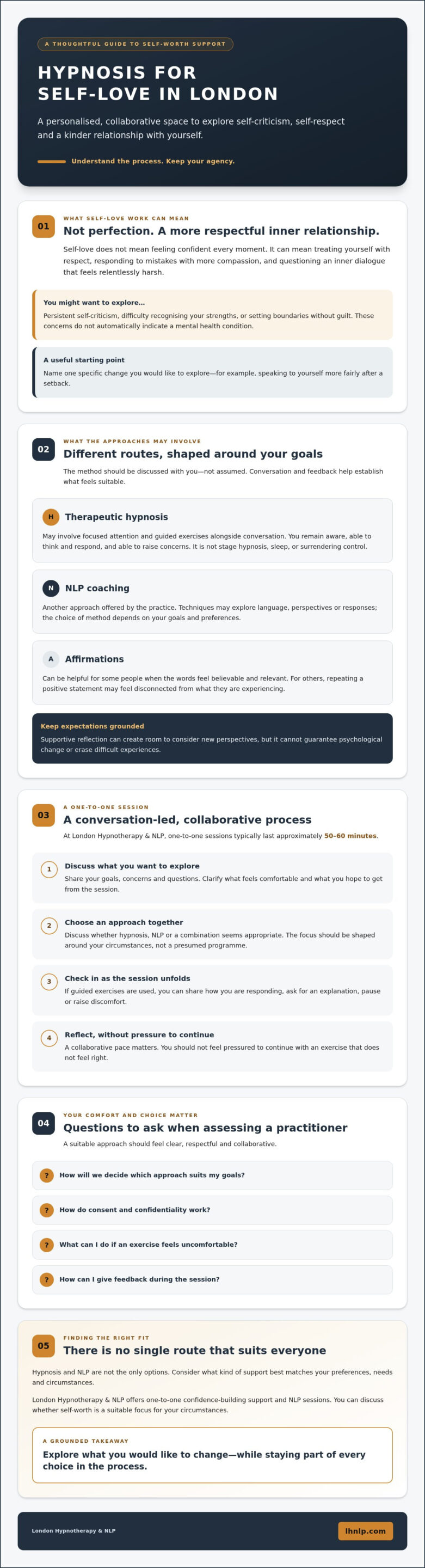
How to choose a London hypnotherapist for self-love support
Start with a clear, manageable goal. Rather than expecting to “love yourself” straight away, you might want to explore responding to mistakes with less self-criticism or feeling more confident setting boundaries. Then ask how a practitioner would work towards that goal, check the practical arrangements and decide whether their answers and approach feel right for you.
In the UK, hypnotherapy isn’t a statutorily regulated profession. Ask directly about relevant training and any professional affiliations, then check membership details with the organisation named by the practitioner. You can also ask what they do if your needs fall outside their scope. Look for clear, realistic explanations rather than promises of a particular result.
Questions to ask before booking
Use an initial conversation to understand what working together might involve. For example, ask:
- How would you approach a self-worth or confidence goal, and how would we agree on a suitable focus?
- What happens at the first appointment, and how do we review whether the approach feels useful?
- How do you handle consent, confidentiality, discomfort and feedback during a session?
- What would you recommend if my needs require support beyond your professional scope?
Notice whether the answers are easy to understand and leave room for your preferences. You should be able to ask questions, discuss boundaries and make an informed decision without pressure.
In-person sessions in London or online appointments?
Think about what would help you feel comfortable and able to focus. An in-person appointment may suit you if you prefer meeting face to face, while an online session may reduce travel or fit more easily around your circumstances. Consider whether you’ll have privacy at home, a reliable internet connection and a comfortable space for a video call. Neither format is automatically better.
London Hypnotherapy & NLP lists in-person appointments across London, including Harley Street, Ealing and Tokenhouse Yard, as well as virtual consultations via Zoom and Skype. Locations and online arrangements can change, so check current availability before making plans. For background on the practitioner and practice, see the practitioner and practice information.
If you’re considering hypnosis for self-love London, self-worth isn’t a separately confirmed named programme, so ask whether it’s an appropriate focus for your circumstances. To discuss your goals and practical options, contact London Hypnotherapy & NLP.
Explore personalised self-worth support with London Hypnotherapy & NLP
London Hypnotherapy & NLP offers one-to-one hypnotherapy, NLP sessions and confidence-building support. If you’re considering hypnosis for self-love London, self-worth may be a goal to discuss within this personalised work, but self-love isn’t a separately confirmed named programme. An initial conversation can help establish whether your aims are a suitable focus and which approach, if any, feels right for you.
It may help to describe your goal in everyday terms. For instance, you could explain that you’d like to feel more confident expressing an opinion or want to respond to setbacks with less self-criticism. The practitioner can discuss your circumstances and how confidence-building, hypnotherapy or NLP might relate to what you hope to explore. You don’t need a perfect explanation, and making an enquiry doesn’t commit you to sessions.
What to expect when you enquire
Ask whether your goal fits the practitioner’s scope, what an initial appointment involves, and how you can raise questions or concerns. Individual sessions typically last approximately 50 to 60 minutes, but confirm the current format and details directly. You can also ask about practical arrangements, including whether an in-person or virtual appointment may be suitable for you.
For practical information before getting in touch, browse the practice’s frequently asked questions. The practice lists in-person appointments in London, including Harley Street, Ealing and Tokenhouse Yard, and virtual consultations via Zoom and Skype. These are format options, not a guarantee of availability, so check which locations and online arrangements are currently offered.
Choose a next step that feels comfortable
Before contacting a practitioner, you might note what you want help with, what would make a session feel safe and any questions about consent, confidentiality or their approach. Take time to consider the answers. A good fit should allow you to make an informed choice, including deciding that a different kind of support is more appropriate.
There’s no need to expect instant transformation or decide on a course of sessions before discussing your needs. If you’d like to explore whether the practice’s one-to-one confidence-building, hypnotherapy or NLP sessions could suit your goals, discuss your goals with the practice.
Take a thoughtful next step towards feeling more secure
Self-love work is less about forcing a positive mindset and more about exploring self-worth, self-compassion and the way you speak to yourself. Hypnosis or NLP may offer a structured way to reflect on these goals, but experiences differ and no particular outcome is guaranteed. Suitable support should respect your preferences and feel collaborative.
If you’re considering hypnosis for self-love London, London Hypnotherapy & NLP offers one-to-one hypnotherapy, NLP and confidence-building sessions. Self-love isn’t a confirmed named programme, so ask whether your goal is a suitable focus. Sessions typically last approximately 50 to 60 minutes; confirm the current details. In-person London and virtual consultation options are listed, but check availability and arrangements before planning.
You don’t have to decide everything at once. A conversation can help you ask questions, discuss suitability and consider a comfortable next step. Discuss your goals with London Hypnotherapy & NLP when you feel ready. A kinder relationship with yourself can begin with one considered choice.
Frequently Asked Questions
Is hypnosis for self-love effective?
Hypnosis can’t guarantee a particular result, and people’s experiences differ. In a personalised session, a practitioner may explore your goals, self-talk and confidence, then agree an approach with you. Ask how you’ll review whether the sessions feel useful and what options are available if your needs call for different support. Hypnosis should not be presented as a proven cure or as a promise that your self-worth will change.
Can hypnosis help with low self-esteem?
Confidence-building and self-worth goals can be discussed in one-to-one sessions, but hypnosis can’t promise to resolve low self-esteem. A practitioner should first understand your circumstances and what you hope to work on, then explain whether their approach seems suitable. If distress is persistent, severe or affecting everyday life, consider speaking with an appropriately qualified healthcare professional about the support that may meet your needs.
What happens during a self-love hypnosis session?
A session may begin with a conversation about your goals, concerns and comfort with the process. If you and the practitioner agree to continue, it may include guided exercises tailored to your preferences and responses. One-to-one appointments with London Hypnotherapy & NLP typically last approximately 50 to 60 minutes, but confirm current details and the practitioner’s process beforehand. You can ask questions and discuss boundaries during the session.
Can I be controlled during hypnosis?
Therapeutic hypnosis isn’t stage hypnosis and should be approached collaboratively, with the process explained and your agreement sought. The practitioner should make room for questions and take your comfort and boundaries seriously. People can experience hypnosis differently, so if you’re concerned about control or consent, raise this before starting. Ask what you can do if you want to pause or stop an exercise.
How many hypnosis sessions do I need to build self-love?
There’s no fixed number of sessions that can be promised for everyone. The right plan depends on your goals, preferences and circumstances, and self-love isn’t a guaranteed or instant outcome. Ask the practitioner how you’ll review your progress and whether the approach remains suitable as your goals develop. London Hypnotherapy & NLP’s one-to-one sessions typically last approximately 50 to 60 minutes; confirm current arrangements directly.
Can I have hypnosis for self-love online in London?
London Hypnotherapy & NLP lists virtual consultations via Zoom and Skype, but check current availability and whether an online format suits your needs. Consider whether you’ll have privacy, a comfortable place to focus and reliable internet access. Weigh these practical details against the travel and setting involved in an in-person appointment, then ask the practitioner about any concerns before arranging a session.
How do I choose a hypnotherapist for self-worth support in London?
Ask about relevant training and experience, how the practitioner might approach your self-worth goal, and how consent, confidentiality and progress are handled. Check professional information and affiliations directly, and choose someone whose explanations help you feel comfortable rather than pressured. London Hypnotherapy & NLP lists in-person appointments in London and virtual consultations, but confirm current locations and availability. Be cautious of guarantees or claims of certain results.