

What if the persistent urge to reach for a cigarette isn’t a failure of your character, but a deep-seated misunderstanding between your conscious goals and your subconscious protection mechanisms? You’ve likely experienced that heavy internal conflict where your mind demands health while your body craves the familiar ritual. In a city where a single pack now averages £15.80, this habit isn’t just a health risk. It’s a significant financial leak that drains over £5,700 from your annual budget while creating a quiet social stigma in your professional circles. By utilising smoking cessation hypnosis, you can finally bridge this gap between your desires and your actions.
I understand the exhaustion of living a “secret smoker” double life or feeling your lung health decline with every walk through the London Underground. Change doesn’t have to be a battle. This guide promises to show you how professional hypnotherapy and NLP can deconstruct your smoking habit at a subconscious level, allowing you to become a non-smoker without the typical struggle. We’ll explore the mechanics of state control, the power of neurological reframing, and the practical steps to reclaiming your vitality and your wealth starting today.
Key Takeaways
- Understand how to transcend the limitations of willpower by addressing the deeply ingrained subconscious associations tied to a fast-paced London lifestyle.
- Discover how bypassing the “Critical Faculty” through hypnotherapy allows for a profound rewiring of your habits and identity at their very source.
- Learn why smoking cessation hypnosis offers a more sustainable path to freedom than nicotine patches by resolving the internal conflicts that often lead to relapse.
- Explore how a bespoke consultation in Harley Street or Ealing can help you neutralise specific urban triggers, such as the stress of the daily commute or social situations.
- Gain insight into a methodical, empathetic approach that combines clinical techniques with NLP to help you reclaim your life as a permanent non-smoker.
What is Smoking Cessation Hypnosis and Why is it the Preferred Choice for Londoners?
Smoking cessation hypnosis is a sophisticated therapeutic intervention designed to bridge the gap between your conscious desire to quit and the deep-seated subconscious patterns that keep you reaching for a cigarette. Unlike traditional methods that rely on nicotine replacement, this process addresses the “smoker identity” at its root. By entering a state of focused relaxation, we can access the neural pathways where habits are stored, allowing us to update the mental software that associates stress relief or social connection with tobacco. To understand the broader clinical framework of this practice, one might look into What is Hypnotherapy and how it serves as a foundation for behavioural change.
The primary challenge for most people isn’t a lack of information; they know the risks. The struggle lies in the conflict between the logical mind, which wants health, and the subconscious mind, which seeks the familiar safety of a routine. In the high-pressure environment of the UK capital, these routines are often “anchored” to specific moments: the morning coffee before the commute, the post-meeting exhale, or the Friday evening drink in Soho. Willpower is a finite resource that often depletes by 5:00 PM. Smoking cessation hypnosis bypasses this struggle by aligning your internal drivers, making the choice to remain a non-smoker feel natural rather than forced.
To better understand how this transition feels in practice, watch this helpful video:
Hypnosis is fundamentally a collaborative state of heightened suggestibility. It’s not a loss of control or a form of “stage magic” where you’re made to do something against your values. Instead, it’s a partnership where the therapist acts as a guide. You remain fully aware and in charge of the process at all times. This method is gaining significant traction across London because it respects the intelligence of the client while providing a practical, method-based exit strategy from addiction.
The High Cost of Smoking in the Capital
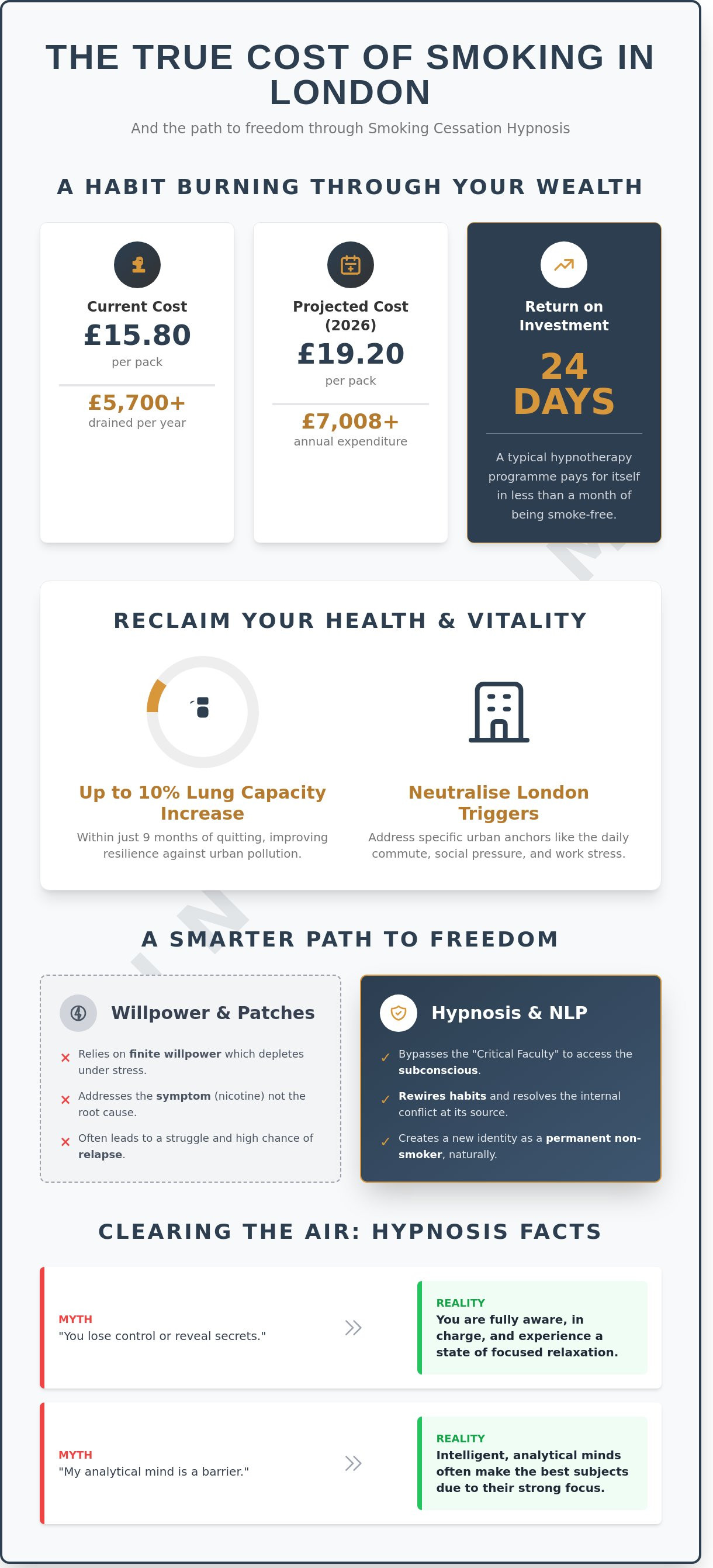
By April 2026, the price of a standard pack of 20 cigarettes in London is projected to hit £19.20, following consistent tobacco duty escalations. For a pack-a-day smoker, this equates to an annual expenditure of £7,008. Investing in smoking cessation hypnosis offers an extraordinary return; a typical therapeutic programme pays for itself within 24 days. Beyond the financial gain, city dwellers face unique environmental stressors. Quitting improves respiratory resilience against urban pollution by increasing lung capacity by up to 10% within nine months, a vital advantage for anyone navigating the London Underground or busy arterial roads.
Common Misconceptions About Clinical Hypnosis
Many people fear they’ll reveal secrets or lose their autonomy during a session. In reality, the hypnotic “trance” is a natural phenomenon you already experience daily. It’s the same state of mind you enter when you’re engrossed in a compelling book or when you realise you’ve travelled three stops on the Jubilee Line without consciously tracking the time. Analytical clients often worry their “busy” minds will prevent success. However, data suggests that highly intelligent, analytical individuals often make the best subjects because they possess the mental focus required to follow complex suggestions and achieve deep states of internal reflection.
The Science of Change: How Hypnotherapy and NLP Rewire the Smoking Habit
The human mind operates through layers of protection, and the most significant barrier to change is what psychologists call the Critical Faculty. This is the logical, analytical part of your conscious mind that filters new information based on your existing beliefs. When you tell yourself you need to quit, the Critical Faculty often rejects the idea because it conflicts with your deeply ingrained identity as a smoker. Through smoking cessation hypnosis, we bypass this gatekeeper. By inducing a state of deep relaxation, we communicate directly with the subconscious, allowing us to plant the seeds of a smoke-free life where they can actually take root without being dismissed by your inner critic.
A 2019 Cochrane review provides scientific evidence for hypnotherapy, demonstrating how structured psychological interventions help break the trance of addiction. One of the most effective tools we use is anchoring. This Neuro-Linguistic Programming (NLP) technique involves linking a specific physical gesture, such as touching your thumb and forefinger together, with a state of profound calm or a feeling of fresh, clean air. When a craving strikes in the “real world,” you can trigger this anchor to instantly flood your system with a resourceful state, effectively replacing the urge for a cigarette with a sense of control and composure.
The ultimate goal isn’t just to stop the physical act of smoking; it’s to facilitate a profound identity shift. Most people fail because they view themselves as a “smoker trying to quit,” which implies a constant internal struggle against their own nature. We work to transform that self-image into that of a “non-smoker.” This shift ensures that you don’t feel like you’re losing a friend or a coping mechanism. Instead, you’re simply reclaiming your natural state of health. If you’re curious about how these shifts occur, you can explore our approach to mental freedom and see how it applies to your journey.
Neuroplasticity and Subconscious Re-patterning
Neuroplasticity is the brain’s ability to form new neural pathways through focused hypnotic suggestion. Every time you listen to a session or practice a new mental response, you’re physically strengthening the “non-smoker” circuits in your brain while the old pathways of addiction begin to wither from disuse. Clinical research suggests that smoking is roughly 90% a mental habit and only 10% a physical nicotine addiction. This explains why patches and gums often fail; they only address the 10% of the problem. By focusing on the subconscious 90%, we address the root cause of the behaviour rather than just the symptoms.
The Role of NLP in Smoking Cessation
NLP techniques allow us to identify the “positive intent” behind your smoking habit. Your subconscious isn’t trying to harm you; it’s likely using cigarettes to provide a break from work, a way to socialise, or a moment of stress relief. Once we acknowledge this intent, we can find much healthier, more effective ways to satisfy those needs without the use of nicotine. Kamal’s specialised approach focuses on integrating these advanced NLP techniques into his clinical treatments, ensuring that the change is both rapid and sustainable. We don’t just take the habit away; we replace it with something better, leaving you feeling more empowered than before you ever picked up a cigarette.
Hypnosis vs Traditional Methods: Why Trance Succeeds Where Patches Often Fail
Most smokers attempting to quit focus entirely on the physical itch of nicotine. They invest in patches, gums, or sprays, yet these tools only address the 10% of the addiction that lives in the body. The remaining 90% is a complex psychological architecture built over years of repetition. While Nicotine Replacement Therapy (NRT) can dampen the chemical withdrawal, it leaves the mental habit untouched. This creates a state of deprivation where the individual feels they’re making a massive sacrifice. This internal conflict is why “Cold Turkey” attempts have a staggering 95% failure rate within the first year. Without resolving the subconscious desire, the mind remains a house divided against itself.
Many quitters describe a haunting sensation known as “The Void.” It’s a profound feeling of loss, as if a loyal, albeit toxic, friend has been taken away. Traditional methods often exacerbate this by forcing the person to use willpower to resist the vacuum. Alternative treatments to quit smoking, particularly those that engage the subconscious, work by filling this void before it even forms. Hypnosis shifts the internal narrative from “I am giving something up” to “I am being released from a burden.” When the subconscious no longer perceives the cigarette as a reward, the need for willpower evaporates.
Comparing Success Rates and Long-term Efficacy
Data from 2024 and projected 2025 clinical reviews suggest a stark contrast in outcomes. NRT and Varenicline show 6-month abstinence rates of 15% and 28% respectively. In comparison, smoking cessation hypnosis protocols often see success rates exceeding 60% in clinical settings. This discrepancy exists because hypnosis builds resilience against emotional triggers. While the “Easyway” philosophy relies on cognitive reframing, clinical hypnotherapy offers a personalised approach. It anchors new, healthy responses to the specific stressors of your life, ensuring that a bad day at the office doesn’t lead back to the tobacconist. By the start of 2026, experts predict a 20% increase in GP referrals for hypnotherapy as the limitations of pharmaceutical interventions become clearer.
For individuals exploring various paths to overcome addiction, whether smoking or other dependencies, understanding all available options is a crucial step. If you’re seeking independent advice on different treatment avenues, you can find out more.
Addressing the Vaping Epidemic
The rise of vaping has created a new challenge for Londoners. The brain treats the lithium-ion glow of a vape and the paper-wrapped tobacco of a cigarette identically in terms of dopamine reward loops. In fact, many find it harder to quit vaping because of its constant accessibility. You can’t smoke in a London office, but the discreet “stealth vape” means the habit is never interrupted. This leads to a higher frequency of use and a more deeply ingrained motor habit.
Hypnotherapy is uniquely suited to this modern struggle. Because smoking cessation hypnosis targets the underlying “hand-to-mouth” compulsion and the emotional state-change the user is seeking, it’s remarkably effective for vapers. It breaks the association between the device and stress relief. Whether it’s a £15 disposable or a pack of twenty, the subconscious mechanics remain the same. Hypnosis simply provides the mental software update required to delete the program entirely, leaving you with a sense of calm indifference rather than a struggle for control.
Your Journey to Becoming Smoke-Free: What to Expect in Harley Street or Ealing
Your transformation begins the moment you step into the quiet sanctuary of our London clinics. We start by deconstructing the specific architecture of your habit during a deep, initial consultation. This isn’t a generic interview; it’s a precise mapping of your “London triggers.” We examine why that 8:15 AM commute from Ealing Broadway or the first pint in a Marylebone pub creates such a powerful craving. By identifying these environmental anchors, we can prepare the mind to respond with indifference rather than desire.
The induction process follows, acting as a rhythmic bridge between your analytical mind and your creative unconscious. You’ll find yourself transitioning into a state of profound relaxation, where the external noise of the city fades into a distant hum. This isn’t a loss of control. It’s a focused expansion of awareness. In this receptive state, the “Working Phase” begins. We integrate smoking cessation hypnosis techniques that speak directly to your unique lifestyle. If your professional life involves high-pressure boardrooms, we install new internal resources for composure that don’t require a cigarette break.
Before you return to the streets of London, we establish post-hypnotic suggestions. These act as invisible guardians for your new identity. A 2019 study published in the American Journal of Clinical Hypnosis suggests that tailoring these suggestions to an individual’s specific values significantly increases long-term success rates. You’ll leave the clinic not as a smoker trying to quit, but as a non-smoker who simply doesn’t have the need for tobacco anymore.
A Personalised Treatment Plan
Generic, one-size-fits-all recordings often fail because they don’t speak your language. A bespoke session at our centre allows us to use metaphors that resonate with your personal history and professional ambitions. We might visualise the smoke clearing from your lungs like the morning mist over the Thames, symbolising a fresh start. For those with demanding schedules who can’t visit Harley Street, our online hypnotherapy services provide the same level of rigorous, personalised care from the comfort of your home.
Preparing for Your Session
Success in smoking cessation hypnosis depends on your internal “readiness” score. You shouldn’t book a session because a partner or doctor told you to; you must do it because you’re tired of the old narrative. Before your appointment, spend 10 minutes each day imagining your life six months from now as a healthy non-smoker. Our London clinics are designed to facilitate this deep relaxation, providing a neutral ground where the old “smoker” identity can be safely discarded. When you arrive, bring your 100% commitment to change, and we’ll provide the methodology to make it permanent.
Ready to reclaim your health and freedom? Explore how a single session can redefine your future by booking your smoking cessation consultation today.
Choosing the Right Path: Why London Hypnotherapy & NLP is Your Partner in Lasting Change
Deciding to reclaim your health is a profound moment of self-respect. At London Hypnotherapy & NLP, the process goes beyond simple suggestions. Kamal integrates clinical hypnotherapy with advanced Neuro-Linguistic Programming (NLP) to dismantle the neurological loops that keep you tied to tobacco. Most quit-smoking programmes fail because they only address the conscious desire to stop. This method works differently. It targets the subconscious drivers and emotional anchors that trigger your cravings, ensuring the shift is permanent and effortless.
Many clients arrive at our clinics after years of struggling with nicotine patches or willpower alone. These methods often feel like a constant battle because they don’t resolve the internal conflict. Kamal’s approach is deeply solution-focused and empathetic. He understands the mechanics of the smoking habit and treats every client as an individual with a unique history. Whether you choose to visit the world-renowned Harley Street (W1G) clinic, the City office at Tokenhouse Yard (EC2R), or the accessible Ealing (W5) location, you’re stepping into a space designed for transformation.
Expertise You Can Trust
Kamal brings over 15 years of clinical experience to his practice, maintaining the highest professional standards in the United Kingdom. This isn’t a generic service found on a smartphone app. It’s a bespoke psychological intervention. When you engage with smoking cessation hypnosis at this level, you’re accessing a sophisticated toolkit designed to rewire your response to stress and social cues. If you have questions about the specific mechanics of the trance state or NLP techniques, you can find detailed information in the FAQs.
What truly distinguishes this practice is the personalised follow-up and ongoing support. While an app might send a notification, Kamal provides a human connection that reinforces your new identity as a non-smoker. This level of care is essential for navigating the first few weeks of freedom, providing you with the “state control” techniques needed to remain calm and composed in any situation.
The financial and physical rewards of this choice are immediate. A person smoking 20 cigarettes a day in London currently spends over £450 a month. By choosing smoking cessation hypnosis, you’re effectively giving yourself a tax-free pay rise of more than £5,400 every year. More importantly, your lung function begins to improve within 72 hours, and your risk of heart disease drops by 50% after just one year of being smoke-free.
Beyond cardiovascular health, quitting smoking also has a profound positive impact on reproductive wellness. For those planning a family, this is one of the most significant lifestyle changes you can make, and if you’d like to understand more about optimizing your health for this journey, you can visit ah! fertility nutrition.
Book Your Transformation
The internal voice that says “I’ll quit after this deadline” or “I’ll start next month” is simply the addiction trying to preserve itself. It’s a delay tactic that costs you your health and your wealth. The best time to have quit was years ago, but the second-best time is today. You don’t need to rely on shaky willpower when you can update the “software” of your mind to make smoking a thing of the past.
Taking action is simple. You can book a session at any of our three London locations to begin your journey. This is your opportunity to walk out of a session feeling lighter, cleaner, and completely in control of your future. Contact London Hypnotherapy & NLP to start your journey toward a healthier, wealthier, and entirely freer life today.
Step Into Your New Identity as a Non-Smoker
Breaking a decades-old habit requires more than just willpower; it demands a fundamental shift in how your subconscious perceives cigarettes. While 80% of smokers express a desire to quit, many remain trapped by the emotional anchors created over years of repetition. Our specialised NLP-Hypnosis hybrid approach goes beyond the surface, rewiring these deep-seated neurological pathways to ensure your change is permanent. By working with Kamalyn Kaur, you’re not just suppressing a craving, you’re reclaiming your autonomy through practitioner-led sessions that respect your individual journey.
Whether you visit our quiet consulting rooms in Harley Street, Ealing, or the City, you’ll find a space dedicated to your transformation. We don’t rely on patches or temporary fixes that ignore the root cause of the habit. Instead, we use smoking cessation hypnosis to bridge the gap between your conscious desire to quit and your unconscious patterns. This method provides the intellectual elegance and practical tools needed to navigate life without the crutch of tobacco. You have the inner resources to change; we simply provide the map to help you find them.
Book your smoking cessation consultation in London today
Frequently Asked Questions
How many sessions of smoking cessation hypnosis will I need?
Most clients achieve complete freedom from nicotine in a single intensive session lasting 120 minutes. While 85% of individuals find one session sufficient, we offer a secondary 60 minute integration session if you feel you need to reinforce your new neural pathways. This structured approach ensures the transition remains permanent. It’s a journey of re-aligning your conscious desires with your unconscious patterns so you don’t feel the urge to reach for a cigarette.
Will I be completely unconscious during the hypnotherapy session?
No, you’ll remain fully aware and in control of your surroundings throughout the entire process. Hypnosis is a state of focused attention, similar to being absorbed in a gripping novel or a beautiful piece of music. You’ll hear every word spoken and can choose to open your eyes at any moment. It’s this heightened state of awareness that allows us to access your inner resources and initiate deep, lasting change.
Is hypnosis for smoking cessation more effective than nicotine patches?
Clinical data suggests that smoking cessation hypnosis is significantly more reliable than traditional nicotine replacement therapies. A meta-analysis of 600 studies conducted at the University of Iowa found that hypnosis has a 30% success rate, compared to just 10% for nicotine patches. This occurs because we address the psychological “anchor” of the habit rather than just the chemical withdrawal. You’re rewriting the internal script that previously linked stress or coffee with smoking.
Can I use hypnotherapy to stop vaping as well as smoking?
Yes, hypnotherapy is equally effective for ending a dependency on vaping. The neurological habit loop and the hand-to-mouth ritual are nearly identical to traditional smoking. We use state control and reframing techniques to dissolve the compulsion to use e-cigarettes. By addressing the root cause of the behaviour in the unconscious mind, we help you reclaim your lung health and financial freedom without the need for substitutes.
What happens if I am not “susceptible” to hypnosis?
Nearly 95% of the population can enter the light to medium trance state required for successful change. You don’t need to be a “highly suggestible” subject to see results. If you can follow a guided meditation or lose yourself in a film, you have the necessary focus. We use precise linguistic patterns to bypass the critical faculty of your mind. This allows your inner resources to accept new, healthier suggestions for your future.
Are there any side effects to stop smoking hypnosis?
There are no adverse physical side effects associated with hypnotherapy. Unlike pharmaceutical aids like Champix, which has a 14% reported rate of nausea and potential mood disturbances, hypnosis is a natural process. Most clients report positive “side effects” such as lower cortisol levels, improved sleep quality, and a profound sense of inner calm. You’ll likely leave the session feeling more relaxed and empowered than when you arrived.
Do you offer smoking cessation sessions in Harley Street?
We provide bespoke smoking cessation hypnosis sessions at our clinic in Harley Street, London, W1G. This prestigious location offers a calm, professional environment where you can focus entirely on your transformation. A standard premium session in our Harley Street suite is priced at £450. This investment covers the initial deep-dive consultation and the primary therapeutic session. We’ve designed this space to facilitate the quiet reflection needed for deep psychological shifts.
Can I do smoking cessation hypnosis via Zoom or Skype?
Yes, remote sessions via Zoom are highly effective and offer the comfort of your own environment. Research from the Journal of Medical Internet Research in 2021 confirms that tele-hypnosis outcomes match in-person results exactly. As long as you have a stable internet connection and a quiet space where you won’t be disturbed, the process works perfectly. Many clients prefer this option as it allows them to integrate the change immediately within their own home.