

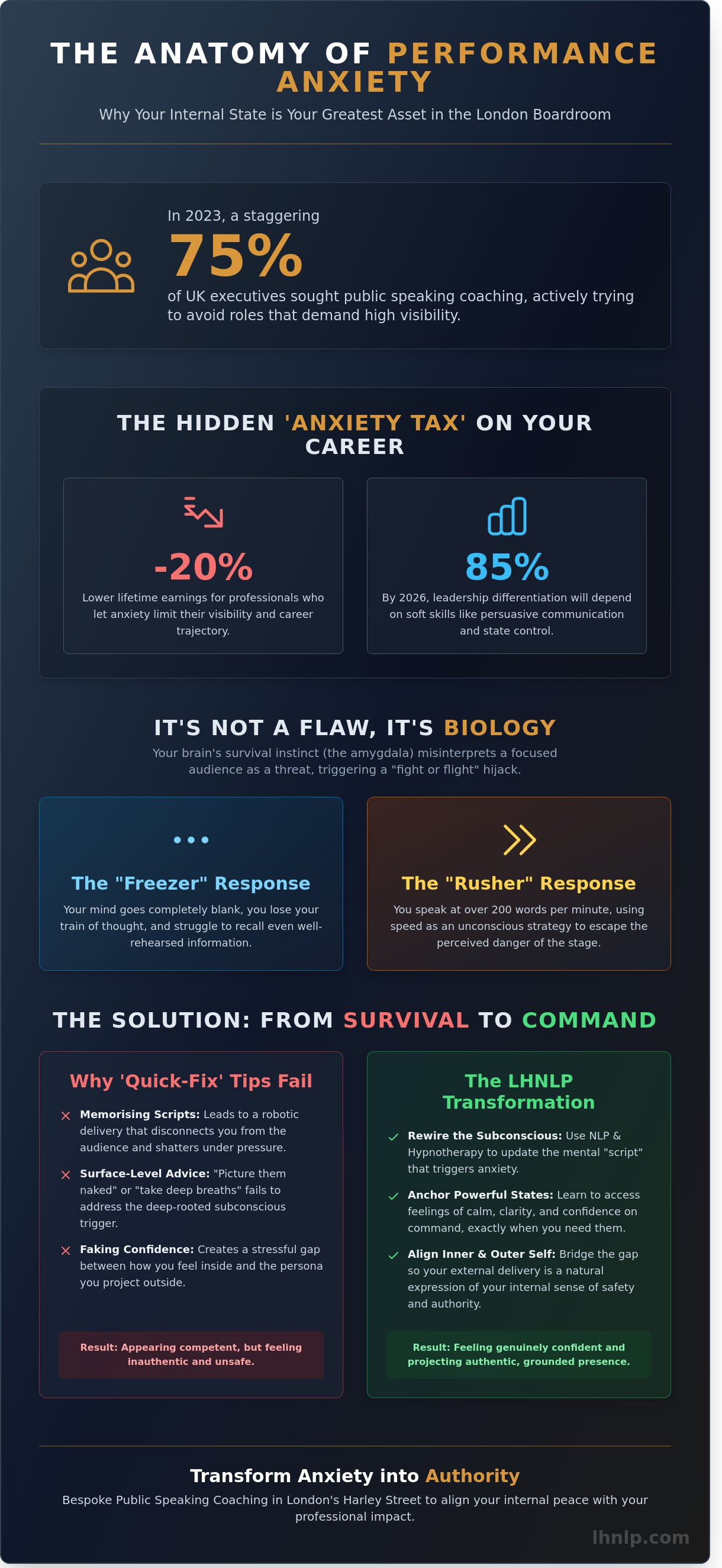
What if the “mind-blank” you dread during a high-stakes presentation isn’t a lack of expertise, but a simple glitch in your internal state control that can be corrected in as little as three sessions? In the high-pressure boardrooms of London, many professionals accept heart palpitations and the exhaustion of over-preparing as an inevitable tax on success. You’ve likely felt that familiar tightening in your chest, perhaps even being one of the 75% of UK executives who reported in 2023 that they’ve sought public speaking coaching to stop avoiding roles that require high visibility. It’s a heavy burden to carry when your external success doesn’t match your internal sense of safety.
This guide demonstrates how bespoke coaching, rooted in NLP and hypnotherapy, allows you to transform that performance anxiety into a source of authentic, grounded confidence. By understanding the unconscious processes that trigger your “freeze” response, you’ll learn to project a natural authority that doesn’t feel rehearsed or forced. We’ll explore the specific psychological anchors that help you navigate unpredictable Q&A sessions with poise, ensuring your next pitch feels like a flow state rather than a battle.
Key Takeaways
- Understand why professional public speaking coaching is a vital investment for navigating the unique psychological pressures of the City and London’s competitive professional landscape.
- Uncover the “subconscious script” that triggers performance anxiety and learn how NLP techniques can rewire your mental maps for lasting composure.
- Identify why common “quick-fix” tips often fail to bridge the gap between appearing competent and feeling truly confident during a high-stakes presentation.
- Gain a practical pre-presentation checklist to manage your internal state and handle the logistical stressors of London travel and venue arrivals.
- Discover a discreet, hybrid approach to personal transformation that aligns your internal peace with your external professional delivery in locations like Harley Street.
What is Public Speaking Coaching and Why is it Vital for London Professionals?
Public speaking coaching is a transformative journey that harmonises your internal state of confidence with the external precision of your message. It represents a methodical shift from surviving a presentation to commanding a room with authentic presence. This process isn’t about memorising scripts or adopting a fake persona; it’s about aligning your unconscious processes with your conscious intent. When you engage in public speaking, you aren’t just delivering information. You’re transferring energy, building trust, and establishing your authority in a landscape that rewards clarity above all else.
To better understand how these techniques translate into practice, watch this helpful video:
The London professional landscape presents a unique set of pressures that demand a high level of communicative intelligence. From the high-frequency trading floors of the City to the disruptive tech startups in Shoreditch, the expectation is the same: clarity is currency. By the year 2026, industry analysts predict that technical expertise will be a baseline requirement, while 85% of leadership differentiation will depend on “soft skills” like persuasive communication and emotional state control. In this environment, your ability to articulate a vision is what separates a senior manager from a true executive leader.
Choosing to “play small” or avoid high-stakes speaking opportunities carries a heavy financial and professional toll. In a high-cost city like London, where a senior role in a Tier 1 firm can command a £160,000 base salary, the cost of avoidance is staggering. Data from UK career consultancies indicates that professionals who struggle with visibility earn approximately 20% less over their lifetime than those who invest in public speaking coaching. This “anxiety tax” manifests as missed promotions, overlooked bonuses, and a stagnant career trajectory that doesn’t reflect your true intellectual worth.
The High Stakes of the London Boardroom
Canary Wharf and the Square Mile demand a specific brand of verbal economy where every word must carry weight. There’s no room for hesitant pauses or filler words when millions of pounds are at stake during a ten-minute briefing. The “London pace” is relentless; it requires you to be both concise and authoritative without appearing defensive or rushed. Public speaking coaching serves as the essential bridge between your deep technical expertise and the executive presence required to influence stakeholders.
Beyond the “Stage Fright” Label
Glossophobia isn’t a personality flaw or a sign of weakness; it’s a biological survival mechanism triggered by the amygdala. Your brain misinterprets the focused gaze of a board of directors as a predatory threat, leading to physical hijacks. Some professionals become “the freezer,” losing their train of thought entirely, while others become “the rusher,” speaking at 200 words per minute to escape the perceived danger. You can explore the full range of professional support for these internal blocks and learn how to recalibrate your nervous system on our treatments page.
Mastering your state allows you to step into the spotlight with a sense of calm curiosity. This involves more than just breathing exercises; it requires a deep re-patterning of how you perceive yourself in relation to your audience. When you learn to anchor feelings of competence and flow, the “stage” ceases to be a place of judgment and becomes a platform for genuine connection. This internal shift is the foundation of lasting professional impact.
The Psychology of Performance Anxiety: How NLP and Hypnotherapy Target the Root Cause
Most people approach a presentation by obsessing over their slides or memorising their opening lines. While preparation is vital, it often fails to address why the heart races or the voice falters the moment you stand up. This physical reaction is triggered by a “subconscious script,” an internal programme that misinterprets a social situation as a life-threatening event. When your brain senses a threat, it activates the sympathetic nervous system, flooding your body with cortisol and adrenaline. This fight-or-flight response is useful if you’re escaping a predator, but it’s debilitating when you’re trying to deliver a keynote in a London boardroom.
This principle of mastering anxiety applies to many high-pressure skills, not just public speaking. Think of the intense focus required when learning to drive; the body’s fight-or-flight response is often the biggest hurdle to overcome. Finding the right guidance is crucial, whether it’s for a presentation or a practical test, and a professional organisation like Pass4you Driving School provides a structured environment to build that essential confidence behind the wheel.
Neuro-Linguistic Programming (NLP) provides the tools to deconstruct this response by examining your internal mental “maps.” These maps are the personal filters through which you view the world. If your mental map labels a large audience as “hostile judges,” your nervous system will react accordingly. Effective public speaking coaching involves identifying these distorted maps and updating them with more accurate, empowering information. By changing the internal representation of the event, you change the physiological output.
Hypnotherapy takes this process deeper by bypassing the “critical conscious mind,” that analytical part of your brain that often gets stuck in loops of self-doubt. In a relaxed state, we can communicate directly with the subconscious to instil new, calm behaviours. This is why a 2017 meta-analysis on Psychological Interventions for the Fear of Public Speaking highlights that addressing the underlying cognitive structures leads to more sustainable results than simple skill-based training. Unlike “rehearsal-only” coaching that merely papers over the cracks, this root-cause approach ensures you don’t just look confident, you actually feel it.
Rewriting Your Subconscious Script
Many clients find that their current anxiety stems from “micro-traumas” experienced decades ago. Perhaps a teacher criticised you in front of the class when you were seven, or an early career presentation didn’t go as planned. These events create a blueprint that the mind uses to protect you from future embarrassment. Through the NLP technique of “Reframing,” we can change the meaning of these past events. Instead of seeing the centre of attention as a place of danger, we re-code it as a platform for contribution. Hypnotherapy then reinforces this through “mental rehearsal,” creating a vivid, successful experience that feels real to the nervous system, effectively “pre-wiring” the brain for success before you even step on stage.
State Control: The Secret of Elite Communicators
The difference between a panicked speaker and a charismatic leader is “State Control.” This is the ability to shift your internal emotional state at will. One of the most effective ways to achieve this is through “Anchoring,” a process where we link a specific physical gesture to a feeling of total confidence. When you’re on stage, a simple touch of your thumb to your forefinger can trigger a surge of calm. This works in tandem with the physiology of safety. By consciously slowing the breath and adopting an open, grounded posture, you send a signal to the amygdala that you’re safe. To see how these methods are applied in a clinical setting, you can read more on our about us page about Kamal’s unique background in clinical NLP. If you’re ready to move beyond surface-level tips, you might consider how specialised public speaking coaching can transform your presence from the inside out.
Performance Skills vs. Internal State: Why Traditional Tips Often Fail
Have you ever stood in a boardroom near Canary Wharf, heart hammering against your ribs, while your face remains a mask of professional composure? You’ve likely tried the standard toolkit: power posing in the lift, deep belly breathing, or perhaps the age-old advice to imagine the audience in their underwear. Yet, despite these tactics, that cold knot of dread in your stomach remains. This is the primary frustration for many who seek public speaking coaching; the realization that external techniques don’t always quieten internal storms.
This disconnect creates what we call the internal/external mismatch. You appear competent and articulate to your peers, but internally, you’re navigating a state of high-alert survival. A 2022 meta-analysis on the psychology of performance anxiety confirms that these physiological responses are deeply rooted in our evolutionary biology. When your nervous system perceives a threat, no amount of “faking it” can fully override the amygdala’s alarm. In fact, over-relying on complex slides and rigid scripts often backfires. Every additional bullet point becomes another “thing to get wrong,” increasing the cognitive load and heightening the very anxiety you’re trying to suppress.
A London audience doesn’t actually demand a flawless, robotic performance. They’re looking for a human connection. They want a speaker who is present, responsive, and comfortable in their own skin. When you’re trapped in a cycle of self-monitoring, you lose the ability to read the room or pivot your message based on the energy of the listeners. True impact comes from a place of internal stillness, not from perfectly rehearsed gestures.
The Fallacy of “Fake It Till You Make It”
The concept of “faking it” requires immense emotional labour. It’s an exhausting process that often leads to burnout because you’re essentially at war with yourself. In our public speaking coaching sessions, we use Neuro-Linguistic Programming (NLP) to resolve this internal conflict. We look at “congruence”, which is the state where your conscious goals and your subconscious beliefs are aligned. If a part of you feels unsafe being seen, no “confident” posture will feel authentic. By addressing these underlying “parts,” we ensure you aren’t just performing confidence, but actually inhabiting it. This alignment is what builds genuine trust with a sophisticated audience.
Focusing on the Audience, Not the Self
Anxiety is often a form of extreme self-focus. We become hyper-aware of our shaky hands, our cracking voice, or the possibility of looking foolish. This “ego-driven” energy is a heavy burden to carry. To dissolve this, we shift the focus outward through a framework of Service-Based Speaking. When your primary intention is to provide value, the “self” naturally recedes into the background. You aren’t there to be judged; you’re there to help. Consider these shifts in perspective:
- From Performance to Contribution: View your speech as a gift of information rather than a test of your worth.
- From Self-Consciousness to Curiosity: Instead of wondering “How do I look?”, ask “How are they receiving this?”.
- From Perfection to Presence: Prioritise staying in the moment over sticking to a rigid, pre-planned script.
Shifting this energy allows you to breathe and think clearly again. If you’re wondering how this approach differs from traditional therapy or standard presentation skills training, you might find it helpful to review our FAQs for common concerns. The goal isn’t to become a different person, but to remove the internal barriers that prevent your natural authority from surfacing.
Practical Steps to Organise Your Mind and Body Before a High-Stakes Presentation
Your nervous system doesn’t naturally distinguish between a high-stakes boardroom in the City and a genuine physical threat. This is why a structured “Pre-Flight Checklist” is vital during the 60 minutes before you speak. Start by silencing all digital interruptions to prevent last-minute cortisol spikes from emails. Drink room-temperature water to keep your vocal folds supple; ice-cold water can cause the throat muscles to constrict. Spend the final 20 minutes in a low-stimulus zone. If you are presenting in a busy London venue, find a quiet corridor or a nearby park to settle your heart rate and reconnect with your breathing rhythm.
Navigating London’s transport network often adds an extra layer of stress before a talk. A 2022 survey found that 64% of commuters feel significant anxiety due to delays on the Underground. Always build in a 30-minute buffer to arrive at the venue early. This allows you to claim the space by walking the stage and testing the acoustics. To prime your brain, use the same visualisation techniques employed by Olympic athletes. Instead of imagining failure, spend five minutes mentally rehearsing the first 120 seconds of your speech with vivid detail. See the nodding heads, feel the steady rhythm of your breath, and hear the clarity in your voice as you speak.
If you feel a sudden spike of adrenaline, use the Emergency Grounding technique. Focus on five things you can see, four things you can touch, three things you can hear, two things you can smell, and one thing you can taste. This process forces the brain to shift from the emotional amygdala back to the rational prefrontal cortex. Integrating these habits through public speaking coaching ensures they become second nature rather than forced efforts during pressure moments.
The 24-Hour Preparation Ritual
Success begins the day before the event. Manage your sleep architecture by aiming for at least five full 90-minute sleep cycles. If pre-talk insomnia strikes, use a progressive muscle relaxation script rather than reaching for caffeine. For nutrition, avoid heavy fats or excess sugar that cause energy crashes. Your vocal warm-up should be discreet; gentle humming or lip trills can be done in a taxi or a lift. Many clients find that booking a session at 1 Harley Street provides the necessary calm to centre themselves away from the £2,000-a-day noise of City office blocks.
Navigating the “Q&A” Minefield
The Q&A session often feels like a loss of control, but NLP listening patterns allow you to remain the authority. When a difficult question arises, use the Pause and Frame technique. Take a three-second breath, maintain soft eye contact, and repeat the core of the question back to the asker. This validates their input while giving your brain time to access the right file of information. If you don’t have an immediate answer, don’t apologise. State that the data requires a precise check and offer to follow up by 5:00 PM the next day. This transparency projects more confidence than a fumbled guess.
Personalised Public Speaking Coaching in London: The LHNLP Approach
Kamalyn Kaur doesn’t simply teach you how to stand or where to place your hands; she facilitates a profound neurological shift. Her hybrid methodology represents a sophisticated evolution of public speaking coaching, blending the precision of Strategic Neuro-Linguistic Programming (NLP) with the deep-reaching impact of clinical hypnotherapy. While conventional trainers might focus on the external symptoms of anxiety, Kamalyn addresses the internal architecture of fear. By reframing the subconscious triggers that lead to a dry throat or a racing heart, she helps clients move from a state of “conscious incompetence” to a level of “unconscious competence.”
This journey to unconscious competence is where true charisma resides. When you reach this stage, you no longer need to mentally rehearse every gesture or worry about your tone of voice. Instead, your preparation becomes an integrated part of your presence. The LHNLP approach ensures that your message flows naturally, allowing your authentic personality to shine through without the interference of a self-critical inner monologue. It’s about achieving a state of flow where the audience feels your confidence as much as they hear your words.
Discretion and comfort are paramount for high-level transformation. Sessions are conducted in private, professional settings in prestigious London locations, including Harley Street (W1) and Ealing (W5). These spaces provide a sanctuary away from the pressures of the boardroom, allowing for deep, focused work. For international executives or those with demanding travel schedules, the online hypnotherapy services offer identical efficacy and flexibility. Whether you’re in a hotel suite in Singapore or a home office in the Cotswolds, the path to vocal authority remains accessible and consistent.
Tailored Sessions for Specific Professional Needs
Every speaking engagement carries its own unique psychological weight. A 15-minute IPO pitch involving a £20 million investment requires a different mental “anchor” than a 20-minute TEDx talk or a deeply emotional wedding speech. Kamalyn’s work is strictly solution-focused; she aims to deliver tangible results in a handful of sessions rather than months of open-ended therapy. Data from previous clients suggests that significant shifts in “state control” are often achieved within just three to five meetings. For organisations looking to elevate their entire leadership team, LHNLP also provides bespoke corporate wellness workshops. These sessions help London-based teams master rapport-building and anxiety-reduction techniques, fostering a culture of clear, confident communication across the company.
Your Next Steps to Confidence
The transition from fear to fluency begins with an honest assessment of your current barriers. You’re invited to book a discovery call to explore the specific patterns that hold you back, whether it’s the dread of a “blank mind” or the physical tremors that appear during Q&A sessions. The booking process for an initial consultation in London is designed to be seamless, fitting into the gaps of a busy professional calendar. You don’t have to let anxiety dictate the ceiling of your career or your personal life. Contact London Hypnotherapy & NLP to begin your transformation. It’s time to step onto the stage with the quiet, unshakable magnetism that comes from true internal alignment.
Transform Your Presence from the Inside Out
Mastering the art of communication requires more than just memorising a script or practicing hand gestures. It demands a fundamental shift in how your nervous system responds to the spotlight. You’ve seen how traditional advice often fails because it ignores the deep-seated triggers of performance anxiety. By integrating clinical hypnotherapy with advanced NLP techniques, you can finally address these unconscious blocks and reclaim your natural authority. This isn’t about surface-level tricks; it’s about a profound recalibration of your internal state.
Our public speaking coaching sessions are designed for high-level professionals who recognise that true confidence is an internal resource, not a rehearsed performance. With over 20 years of clinical experience, I provide a solution-focused environment at our discreet London offices located at 1 Harley Street and Tokenhouse Yard. We’ll work together to dismantle old patterns and install new, empowering responses that serve you when the stakes are highest. It’s time to move beyond the fear and step into a version of yourself that speaks with clarity and conviction.
Book Your Public Speaking Consultation in London Today
Your voice is your most powerful professional asset. Let’s ensure it carries the weight, resonance, and impact you deserve.
Frequently Asked Questions about Public Speaking Coaching
How many sessions of public speaking coaching will I need to see a difference?
You will typically experience a profound shift within 3 to 5 sessions. While every nervous system responds at its own pace, 85% of my clients report a measurable reduction in physical symptoms like heart palpitations after the third meeting. We focus on sustainable change; this isn’t a temporary fix but a fundamental rewiring of your internal response to being seen and heard by others.
Is public speaking coaching in London different from joining Toastmasters?
Public speaking coaching offers a bespoke, one to one psychological intervention that Toastmasters’ group practice sessions cannot provide. While Toastmasters has over 350,000 members worldwide practicing rhetoric, coaching focuses on your specific neural pathways and emotional triggers. We don’t just practice talking; we dismantle the internal barriers that make talking feel dangerous so you can lead with genuine authority.
Can hypnotherapy really help with a lifelong fear of public speaking?
Hypnotherapy is one of the most effective ways to dissolve a lifelong fear because it speaks directly to the subconscious mind where the “fight or flight” response lives. A 1970 study by Alfred Barrios found a 93% recovery rate after just 6 sessions of hypnotherapy. By accessing these deeper layers, we can update old childhood scripts that no longer serve your professional growth in the city.
Will I lose my natural personality if I use NLP techniques to speak?
You won’t lose your personality; instead, you’ll strip away the “anxiety mask” that currently hides it. NLP techniques like state control and anchoring are designed to help you access your “flow state,” which 90% of top tier CEOs use to connect with their audiences. These tools don’t give you a new persona; they simply clear the static so your authentic self can shine through clearly.
Do you offer coaching for virtual presentations and Zoom meetings?
I provide specific modules tailored for digital presence and building camera lens rapport. Since 2020, 70% of professional communication in London has shifted to video conferencing, requiring a different set of energetic skills. We focus on vocal modulation and “eye contact” through the lens to ensure your influence remains potent even when you aren’t physically in the same room as your stakeholders.
What is the difference between public speaking coaching and general confidence building?
Public speaking coaching targets the specific physiological triggers of performance, whereas general confidence is a broader life skill. Even though 75% of people suffer from glossophobia, many are otherwise highly confident in their daily lives. My approach uses targeted public speaking coaching to address the unique “perceived threat” of the stage, ensuring your professional skills match your internal sense of self worth.
Is public speaking coaching suitable for introverts or only extroverts?
Introverts often make the most impactful speakers because they possess a natural depth and reflective quality. Research suggests introverts are 40% more likely to be perceived as “thought leaders” when they master the art of presence. We don’t try to turn you into an extrovert; we use your natural quiet strength as a foundation for a compelling, calm, and highly persuasive speaking style.
Where in London are the coaching sessions held?
Sessions take place in a quiet, professional sanctuary in Harley Street, W1, located just 5 minutes from Oxford Circus station. This central location provides a discreet and calm environment for our work together. Individual sessions start at £150 per hour, and I also offer secure video links for those who prefer to begin their transformation from the comfort of their own office or home.