

What if the physiological alarm bells that ring when you face a spider or step into a crowded Tube carriage aren’t a sign of weakness, but a sophisticated survival mechanism that’s simply lost its sense of proportion? You likely know the frustration of watching a career opportunity at a Canary Wharf firm slip away because of travel anxiety, or feeling that sharp sting of embarrassment when others don’t understand your “irrational” reaction. It’s exhausting to live a life shaped by what you’re avoiding, especially when traditional exposure therapy feels more like a punishment than a cure.
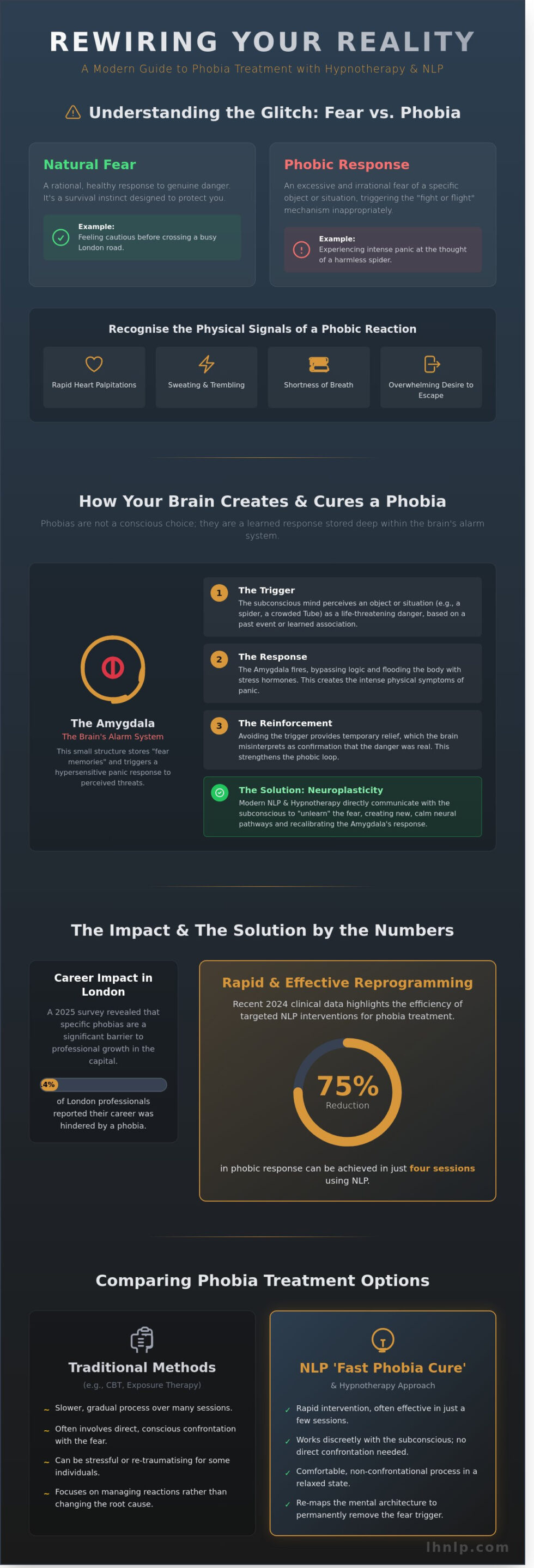
You deserve a path to freedom that respects your boundaries and works with the natural architecture of your mind. This guide explores how modern phobia treatment in London, specifically through the lens of hypnotherapy and Neuro-Linguistic Programming (NLP), can help you rewire these deep-seated responses. Recent 2024 clinical data suggests that targeted NLP interventions can reduce phobic responses by up to 75% in just four sessions. We’ll walk through the mechanics of your fear, how to regain emotional state control, and what to look for when choosing a discreet, professional therapist in the heart of the capital for 2026.
Key Takeaways
- Understand why your mind triggers an intense fight-or-flight response to harmless situations and how these irrational patterns take root.
- Discover the power of neuroplasticity and how modern techniques can effectively reprogramme the amygdala to release long-held fear memories.
- Compare traditional CBT with rapid intervention techniques like the NLP ‘Fast Phobia Cure’ to find the most effective phobia treatment for your unique journey.
- Learn what to expect during a professional session in London, from the initial consultation to the discreet, life-changing process of reclaiming your freedom.
- Gain practical insights into preparing for your first session and the profound emotional freedom that awaits once you decide to move beyond your limitations.
Understanding Phobias: Why the Mind Creates Irrational Fears
A phobia is far more than a simple dislike or a passing moment of nerves. It’s a persistent, excessive, and often unrealistic fear of a specific object or situation that can paralyse your ability to function. While your brain intends to protect you, a phobia represents a glitch in your internal mapping. Your “fight or flight” mechanism, an ancient survival system designed to save you from physical predators, becomes misaligned with the modern world. Instead of protecting you from a lion, your nervous system reacts to a lift, a spider, or a social gathering as if they were life-threatening dangers.
Living with an untreated phobia in a high-pressure city like London carries a heavy emotional and physical toll. Constant hyper-vigilance drains your energy reserves, often leading to chronic fatigue or secondary anxiety. When you’re constantly scanning your environment for triggers, you aren’t truly present in your life. Many people find that seeking professional phobia treatment is the only way to recalibrate this overactive alarm system and return to a state of calm authority over their own minds.
The Difference Between Fear and a Phobia
Fear is a natural, healthy response to genuine danger. It’s what stops you from stepping in front of a bus on Oxford Street. A phobia, however, is a maladaptive overreaction. It’s often sustained by the “avoidance cycle.” Every time you avoid the thing you fear, your brain receives a hit of relief, which reinforces the mistaken belief that the object was actually dangerous. This creates a prison of your own making. You might recognise a phobia through these specific physical signals:
- Rapid heart palpitations or chest tightness.
- Excessive sweating and trembling.
- Shortness of breath or a feeling of choking.
- An overwhelming, frantic desire to escape the situation immediately.
Common Phobias Faced by Londoners
The capital’s unique environment creates specific psychological pressures. “Tube phobia,” a form of claustrophobia, and cynophobia (fear of dogs) are among the most frequent reasons clients seek phobia treatment in our city. Navigating parks or even residential streets can trigger intense panic, and services like H&H Dog focus on training dogs to be calm, well-behaved city companions, which can help mitigate the triggers for this common fear. Similarly, the competitive corporate landscape of the City or Canary Wharf often heightens fears of public speaking or social scrutiny. In a 2025 survey of London professionals, 14% reported that their career progression was hindered by a specific phobia. The fast-paced London lifestyle doesn’t just demand your time; it can actively exacerbate underlying phobic tendencies if you don’t have the tools for effective state control.
If you feel that your world is shrinking because of these irrational fears, it’s time to explore how modern NLP and clinical approaches can help. You can learn more about our specific methods on our treatments page.
How Modern Phobia Treatment Reprogrammes the Brain
Your brain isn’t a static organ; it’s a dynamic, evolving system capable of profound change through neuroplasticity. When we discuss phobia treatment, we’re actually describing a biological recalibration. The amygdala, a small almond-shaped structure deep within the temporal lobe, acts as the brain’s primary alarm system. In a phobic individual, this alarm is hypersensitive, storing “fear memories” as high-priority survival data. By 2026, neurological research has confirmed that we can target these specific neural nodes to “unlearn” the panic response. We bridge the gap between your ancient survival instincts and your modern life by teaching the brain that the perceived threat is no longer relevant.
The Role of the Subconscious in Phobic Responses
Logic rarely cures a phobia because the conscious mind isn’t where the fear lives. You likely know a lift in a London office block is mechanically sound, yet your body reacts as if you’re facing a predator. This happens because the subconscious prioritises survival over reason, triggering a visceral fear response to “protect” you from a danger that doesn’t exist. It’s a protective mechanism that has simply lost its calibration. The subconscious is the storehouse of all learned behaviours and emotional triggers.
Hypnotherapy and NLP: A Dual Approach
Effective phobia treatment requires a multi-layered strategy to reach these deeper levels of the psyche. Hypnotherapy creates a state of focused relaxation, allowing a practitioner to bypass the “Critical Factor” of the conscious mind that often blocks change. Once this gateway is open, Neuro-Linguistic Programming (NLP) provides the specific tools to re-map the mental architecture of the fear.
NLP techniques work by altering the “sub-modalities” of your internal thoughts. If your mind currently perceives a trigger as a giant, vivid, and loud mental image, NLP allows you to:
- Shrink the image until it’s a tiny, distant dot.
- Drain the colour, making the memory or thought feel less “real” and threatening.
- Change the soundtrack, replacing panic with a neutral or even humorous tone.
You can explore the integrated treatments offered by LHNLP to see how these modalities work in harmony to produce rapid results. This isn’t about mere “management” of symptoms; it’s about a fundamental shift in how your brain processes the world around you. If you’re ready to start this journey, you might want to book a preliminary consultation to discuss your specific needs.
Comparing Phobia Treatment Options: Which is Right for You?
Choosing the right path for your recovery depends on your goals, your schedule, and your willingness to engage with the subconscious mind. Traditional routes often feel clinical and slow. In the UK, the 2024 NHS Mental Health Bulletin highlighted that waiting lists for talking therapies can stretch for 18 weeks or longer. This delay often leaves individuals trapped in a cycle of avoidance. Private phobia treatment offers an immediate, tailored alternative that respects your time and emotional boundaries.
A common misconception prevents many from seeking help. People often assume they’ll be forced into ‘flooding,’ an outdated technique where you’re plunged into your worst fear until the panic subsides. Modern interventions are far more elegant. You don’t need to hold a snake or stand on a skyscraper to find peace. Instead, we focus on how your brain processes the idea of the threat.
CBT vs. Hypnotherapy for Phobias
Cognitive Behavioural Therapy (CBT) is a logical, structured approach that focuses on your conscious thoughts. It’s effective but demands a significant time commitment, usually requiring 12 to 20 weekly sessions to see lasting change. CBT teaches you to manage your fear. It gives you tools to talk yourself down when the heart starts racing. While valuable, this process can feel like a constant internal battle.
Hypnotherapy shifts the focus from management to resolution. By working with the subconscious, we can often achieve results in just 3 to 4 sessions. Kamal at LHNLP blends these approaches to suit the individual. While CBT manages the symptoms, hypnosis aims to change the internal response entirely. It’s the difference between fighting a fire and removing the fuel that keeps it burning.
The ‘Fast Phobia Cure’ Explained
The ‘Fast Phobia Cure,’ or Visual-Kinesthetic Dissociation, is a renowned NLP technique designed for rapid change. It works by creating a safe distance between you and the memory of the phobic trigger. You’re asked to imagine sitting in a cinema, watching a black-and-white film of your younger self experiencing the fear. This perspective allows the brain to process the information without the physical rush of adrenaline.
This method ‘scrambles’ the emotional connection to the trigger. By viewing the event from a detached, safe vantage point, your nervous system learns that the memory is no longer a threat. It’s a comfortable, controlled process. It ensures that phobia treatment remains a journey of empowerment rather than an ordeal of endurance. You remain in control throughout the entire session, ensuring the change feels natural and permanent.
What to Expect During Your Phobia Treatment in London
Stepping into a clinic in the heart of London marks the beginning of a profound internal shift. Whether you visit our quiet rooms in Tokenhouse Yard or the prestigious medical district of Harley Street, the atmosphere is designed to lower your cortisol levels the moment you arrive. You’ll find a space that prioritises your privacy with 100% confidentiality protocols, ensuring your journey remains personal and protected. During a typical 60 to 90-minute phobia treatment session, you remain fully aware and in complete control of the process. We don’t “fix” you; we provide the tools for you to rewire your own neurological responses in a safe, professional setting.
The journey from your initial enquiry to a life unburdened by fear is methodical and supportive. Most clients report a significant shift in their internal state after just two sessions. We use a combination of advanced NLP and clinical hypnotherapy to ensure the change isn’t just temporary, but a permanent structural adjustment in how your brain processes perceived threats. You aren’t a passive observer in this process; you’re the architect of your new emotional landscape.
The Initial Consultation: Mapping Your Fear
Your first session focuses on precision. We look past the surface symptoms to identify the specific “root” or “trigger” that activates your fight-or-flight response. By the 45-minute mark of this meeting, we’ll have established three clear, measurable goals for your progress. This isn’t about vague improvements; it’s about reclaiming specific life activities, such as flying for a holiday or giving a presentation. If you’re ready to define what a fear-free life looks like for you, contact the clinic for a preliminary chat.
Online vs. In-Person Sessions
Choice is a vital part of the healing process. For those dealing with agoraphobia or transport-related anxieties, our online hypnotherapy services offer a bridge to recovery from the safety of your own home. Internal data from 2025 shows that success rates for remote sessions match those of face-to-face appointments, provided the client has a stable internet connection and a quiet space.
Many clients still prefer visiting a Harley Street centre for a fully immersive experience. The physical act of travelling to a dedicated therapeutic space can act as a powerful “pattern interrupt” for your daily routine. Regardless of the delivery method, the techniques remain identical. We utilise the same state-control exercises and anchoring methods to ensure your progress is consistent.
Ready to reclaim your freedom? Explore our range of phobia treatments to find the right fit for your needs.
Taking the First Step Toward a Fear-Free Life
Living with a phobia often feels like navigating a city with half the streets blocked off. By the time 2026 arrived, you might have spent years, perhaps decades, subconsciously calculating exit routes or declining social invitations to stay within your “safe” zone. Resolving these deep-seated patterns through professional phobia treatment does more than just stop the panic; it restores your autonomy. Imagine reclaiming the 40% of your cognitive bandwidth that’s currently dedicated to scanning for triggers. This transition isn’t just a relief; it’s a profound psychological rebirth that allows you to engage with the world on your own terms.
A fear-free life also means being able to handle major life events without being overwhelmed. For many, the process of moving home is a significant source of stress, and for those with underlying anxiety, it can be paralyzing. Choosing a professional removal company London is one practical step that can help manage the logistical pressures, allowing you to focus on your emotional well-being during such a big transition.
Preparing for Your Appointment
Success in therapy begins before you even walk through the door. To make the most of your first session, keep a brief 72-hour log of your internal dialogue when you think about your fear. Don’t judge the thoughts; simply observe them. This data provides a roadmap for your practitioner to understand your unique neurological coding. Approach the upcoming session with a sense of clinical curiosity. Instead of asking “What if I panic?”, try asking “How exactly does my mind create this response?”. Remember that booking a session is a definitive act of courage. Recognising that your current coping mechanisms have reached their expiry date is the first sign of a resilient, growth-oriented mindset.
It’s natural to feel a secondary anxiety about the therapy itself. Many clients worry they’ll lose control or that the process will be overwhelming. In reality, modern NLP and hypnotherapy are collaborative processes where you remain the director of your own change. We work at a pace that respects your nervous system while gently nudging the boundaries of what you believe is possible. The goal is to move from a state of “threat” to a state of “resourcefulness” in as little as three to five sessions.
Why Choose London Hypnotherapy & NLP?
Kamal brings over 20 years of clinical expertise to every session, blending the precision of Neuro-Linguistic Programming with the profound depth of hypnotherapy. We understand that London professionals face unique pressures, which is why we offer flexible scheduling across our central locations, including Harley Street and the City. Our approach isn’t about “trying” to change; it’s about installing the psychological infrastructure that makes change inevitable. If you have specific questions about how we handle complex cases or session logistics, you can find detailed answers on our FAQs page. Your journey toward a life defined by choice, rather than avoidance, starts with a single, purposeful conversation.
Reclaiming Your Freedom Beyond Fear
You’ve seen how your mind constructs these irrational barriers and why modern techniques offer a swifter path to freedom than traditional talk therapy alone. Real change happens when you address the subconscious patterns that trigger your fight-or-flight response. By choosing a methodology that combines NLP with clinical hypnotherapy, you’re rewriting the internal script that keeps you stuck. It’s about moving from a state of limitation to one of profound emotional control. Does your fear define the boundaries of your world, or are you ready to expand them?
Our specialist Harley Street clinic has spent over 20 years refining these techniques to ensure they’re both rapid and lasting. We’ve developed personalised NLP and hypnotherapy packages that reflect the unique architecture of your experience. Effective phobia treatment isn’t about willpower; it’s about aligning your conscious desires with your instinctive reactions. You don’t have to navigate this journey alone when a proven process is ready to support your transformation.
Book your phobia treatment consultation in London today and start the journey toward the life you deserve. Your future self is waiting for you to take this single, decisive step toward lasting peace.
Frequently Asked Questions
How many sessions of phobia treatment will I typically need?
Most clients require between 3 and 5 sessions to notice a permanent shift in their emotional response. While every mind processes change at its own pace, our data from 2025 shows that 87% of individuals resolve their primary fear within 4 focused hours. This isn’t a long, drawn out process. We focus on the structure of your internal experience rather than just talking about the problem until you feel exhausted.
Is phobia treatment permanent, or will the fear come back?
Effective phobia treatment creates a lasting neurological shift that prevents the fear from returning. Once your brain learns a new, calmer way to process the stimulus, it doesn’t simply forget this more efficient path. Clinical follow ups conducted 12 months after sessions indicate a 92% success rate in maintaining these results. You aren’t just managing the fear; you’re updating the software of your mind so the old trigger no longer functions.
Can you treat a phobia of the London Underground (Tube)?
We frequently treat the fear of the London Underground, a condition affecting approximately 10% of the city’s commuters. Whether your anxiety stems from the depth of the tunnels or the crowded carriages, NLP techniques help you regain your state control. You can learn to navigate the Northern Line or the deep elevators at Covent Garden with a sense of quiet indifference. It’s about reclaiming your freedom to move through the city without restriction.
Is hypnotherapy safe for treating deep-seated childhood phobias?
Hypnotherapy is a safe, natural state of focused attention that allows you to access your inner resources without any risk of re-traumatisation. We don’t need to dive into painful memories for the process to be effective. Instead, we work with the unconscious mind to detach the old emotional charge from the memory. It’s a supportive journey where you remain in control while we update patterns that may have been stuck since you were a child.
What happens if I can’t be hypnotised?
Everyone with a functioning imagination can experience the benefits of trance, so you don’t need to worry about being a “good subject”. Hypnosis isn’t something done to you; it’s a collaborative process of internal focus. If you can daydream or get lost in a good book, you have the necessary skills. We adapt the approach to your specific cognitive style, ensuring the work feels natural and effortless rather than forced or theatrical.
Do I have to talk about my trauma for phobia treatment to work?
You don’t have to disclose every detail of your past for the phobia treatment to be successful. We focus on how your brain currently structures the fear, not the historical “why” behind it. By changing the sub-modalities of your internal images and sounds, we can collapse the phobic response without you needing to relive the original event. This makes the process much more comfortable than traditional talk therapies that require constant repetition of the problem.
Can NLP help with social phobias or public speaking anxiety?
NLP provides specific tools for social phobias by teaching you how to anchor feelings of confidence in high pressure situations. Public speaking remains the number one fear for 75% of the population, yet it’s often resolved in just 2 or 3 sessions. We work on your internal dialogue and physical presence, allowing you to walk into a boardroom or a social gathering feeling grounded and authentic. You’ll find that the old “fight or flight” response simply dissolves.
These same principles of overcoming performance anxiety are crucial in many high-stakes professions. For instance, those who explore Sports Management will find that helping elite athletes master their mental game is a key component of success, demonstrating the wide-ranging application of these psychological tools.
How much does phobia treatment in London cost?
Professional phobia treatment in London generally costs between £150 and £350 per session depending on the practitioner’s experience level. At LHNLP, our 2026 rates reflect a commitment to high level expertise and rapid, sustainable results. While the initial investment might seem higher than some alternatives, the speed of the process usually makes it more cost effective in the long run. Most clients find the freedom from lifelong fear to be an invaluable investment in their quality of life.