

What if the racing heart you feel on a crowded Central Line carriage or the sudden breathlessness during a high-stakes board meeting isn’t a permanent flaw, but a misaligned subconscious signal that can be recalibrated? You’ve likely spent over 18 weeks on an NHS waiting list only to find that basic, surface-level talking therapies don’t stop the physical betrayal of your own nervous system. It’s exhausting to live in a state of constant vigilance, waiting for the next wave of adrenaline to crash over you while you’re trying to handle the relentless pace of London life.
You deserve a more sophisticated approach to panic attack treatment that addresses the root cause rather than just the symptoms. By integrating advanced NLP techniques with clinical hypnotherapy, it’s possible to break the “fear of fear” cycle and reclaim your internal narrative. This article reveals how you can transform your subconscious responses and gain practical, lasting tools to remain calm in the city’s most demanding environments, ensuring your mind finally becomes your most reliable ally.
Key Takeaways
- Understand how the high-pressure environment of the City and crowded London commutes can over-sensitise your amygdala, turning a natural protective response into a cycle of persistent dread.
- Discover why traditional willpower often proves insufficient and how a sophisticated panic attack treatment must address the subconscious architecture where fear is actually stored.
- Evaluate the limitations of standard symptom management versus a resolution-focused approach that utilises NLP and clinical hypnotherapy to re-pattern your internal narrative.
- Learn how bespoke therapeutic techniques can help you de-sensitise emotional triggers, allowing you to navigate the capital’s pace with a renewed sense of quiet confidence.
- Explore how personalised care at our Harley Street, Ealing, or Tokenhouse Yard clinics provides a professional and compassionate pathway to lasting emotional resilience.
Understanding Panic Attacks within the London Lifestyle
A panic attack isn’t a sign of weakness; it’s an overwhelming physiological surge where your nervous system misinterprets a city stressor as a mortal threat. For many, Understanding Panic Attacks begins with the sudden realisation that the body has taken over, flooding the bloodstream with adrenaline while the mind reels in psychological dread. This experience feels like an internal earthquake. It’s a moment where your state control vanishes, replaced by a primal survival mechanism that doesn’t belong in a boardroom or on a crowded platform. Have you ever found yourself staring at the Tube map, feeling your chest tighten at the thought of the morning commute?
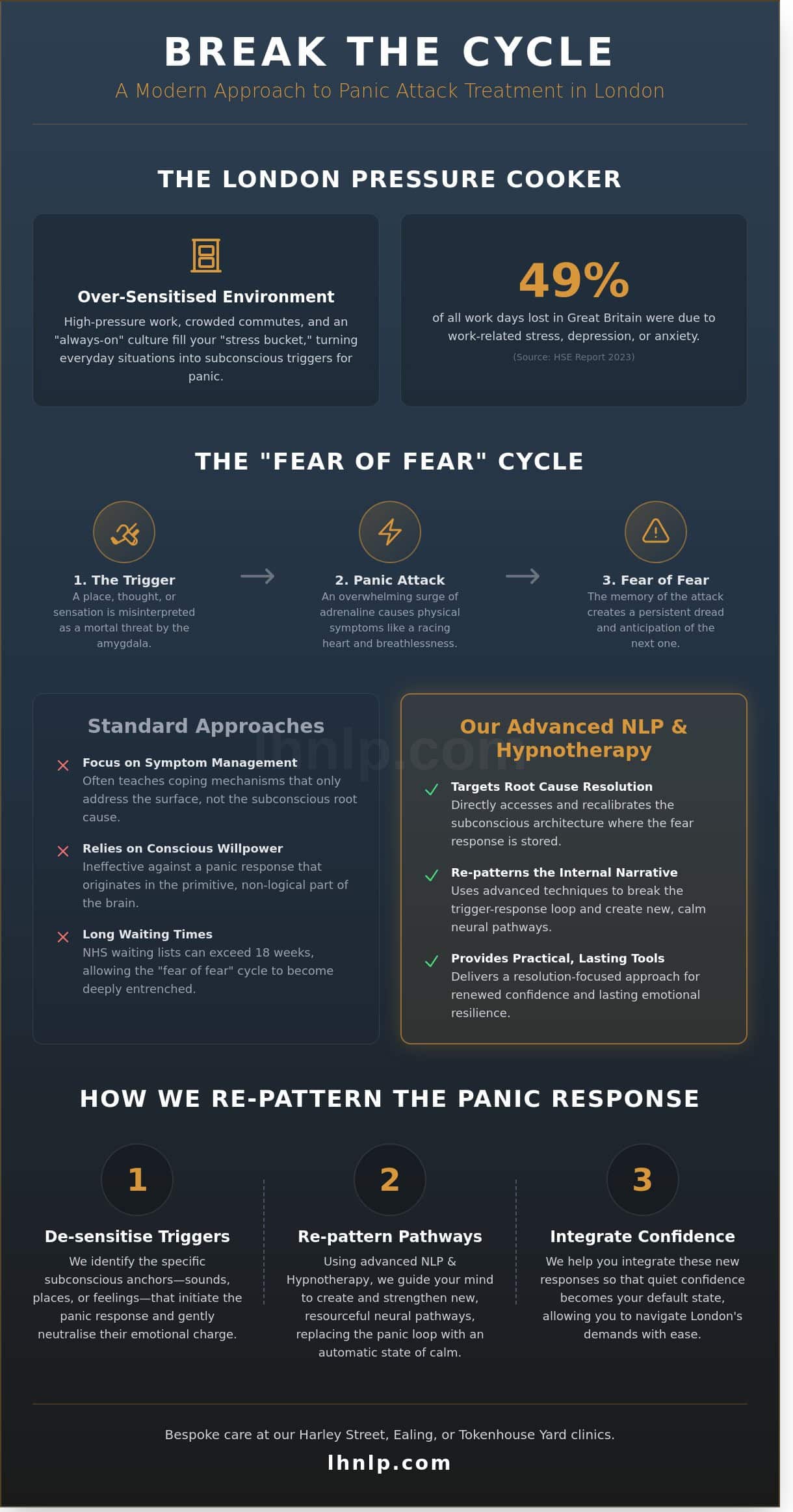
In the heart of London, these episodes are rarely random. They’re often the culmination of a “bucket” that has slowly filled with the grit of urban life. When searching for effective panic attack treatment, it’s vital to acknowledge how our environment shapes our internal landscape. A 2023 report by the Health and Safety Executive (HSE) revealed that 49% of all working days lost due to ill health in Great Britain were caused by work-related stress, depression, or anxiety. This isn’t just a personal failing; it’s a systemic reaction to a city that never stops. To better understand this concept, watch this helpful video:
The Physical Toll of City Stress
The “always-on” culture of London demands a level of vigilance that keeps the sympathetic nervous system in a state of high alert. Consider the Central Line during rush hour, where temperatures frequently exceed 30°C and personal space is non-existent. These aren’t just discomforts; they’re micro-triggers. Over time, the noise of an open-plan office or the unspoken pressure to meet the “Harley Street standards” of perfectionism erodes your emotional resilience. Your brain begins to anchor these external locations to internal feelings of dread, creating a loop that’s hard to break without professional guidance. The ping of a 9 PM notification or the frantic pace of Canary Wharf acts as a constant drip of cortisol, eventually causing the system to overflow.
Panic Attack vs. Panic Disorder
Panic disorder is defined as the persistent and haunting anticipation of future attacks that fundamentally reshapes how you live your life.
- Heart palpitations: A pounding chest that feels like a physical blow.
- Sweating and tremors: Visible signs of the body’s “fight or flight” response.
- Losing control: The terrifying sensation that you might faint or “go mad” in public.
When the fear of the next episode dictates whether you attend a dinner in Soho or take a promotion, the condition has shifted into a disorder. This “fear of fear” cycle creates a self-fulfilling prophecy where you scan your body for the slightest skip in heart rate, which causes the very spike you dread. Early intervention through specialised panic attack treatment is critical to prevent the development of agoraphobia. In an urban setting, avoiding the Tube or busy streets can quickly shrink your world until you feel trapped within your own four walls. Reclaiming your freedom starts with understanding that your unconscious mind is trying to protect you, even if its methods are currently misplaced.
The Subconscious Architecture of Panic: Why Symptoms Persist
Understanding why panic persists requires looking beneath the surface of conscious thought. Your brain possesses an ancient survival mechanism designed to protect you from immediate physical danger. This system doesn’t operate through logic; it functions through lightning-fast neurological shortcuts. When you seek panic attack treatment, you’re essentially looking for a way to recalibrate a “smoke detector” that’s become far too sensitive. This detector, the amygdala, has begun to misidentify the stresses of a London commute or a high-pressure meeting as a direct threat to your life. A 2023 report by the Mental Health Foundation indicated that 13.2% of UK adults experience these overwhelming surges of anxiety, proving that this isn’t a personal failing, but a biological overreaction.
Willpower rarely succeeds in halting a panic attack because the response originates in the limbic system, which processes information significantly faster than the rational prefrontal cortex. By the time you try to “think yourself calm,” your bloodstream is already saturated with adrenaline. This creates a frustrating loop where the mind fears the body’s reaction, and the body reacts to the mind’s fear. Breaking this cycle involves more than just “coping”; it requires updating the unconscious programmes that govern your internal safety checks. You can find detailed clinical descriptions and traditional pathways in this NHS guidance on panic disorder, which outlines how these patterns often manifest as a recognised condition.
The Amygdala Hijack Explained
The “amygdala hijack” occurs when your brain’s emotional centre takes total control, bypassing your ability to reason. In less than 0.1 seconds, your body prepares for a life-or-death struggle. Your heart rate spikes to pump blood to your limbs, and your breathing becomes shallow to increase oxygen levels. While this was vital for our ancestors, it’s a profound mismatch for modern life in the capital. Feeling your heart race while standing on a packed Northern Line carriage isn’t a sign of weakness; it’s your ancient biology trying to save you from a threat that isn’t actually there.
Subconscious Anchoring and Triggers
In the context of NLP, anchoring explains how your mind creates “neurological bookmarks” for fear. If you experienced a panic attack at Bank station or during a presentation in Canary Wharf, your subconscious may have “anchored” that intense fear to those specific environments. Now, just the smell of the Underground or the sight of a glass-walled boardroom can trigger the same physical response. Traditional talk therapy often struggles here because it addresses the conscious narrative rather than these deep-seated, automatic anchors. Effective panic attack treatment must address these unconscious triggers directly to provide lasting relief.
These anchors are often subtle and multi-sensory. It might be the specific chime of a train door, the fluorescent lighting of an office, or even the scent of a particular coffee shop. Your brain has learned to associate these neutral stimuli with a state of emergency. Because these associations are stored in the subconscious, you can’t simply “decide” to stop them. You need to actively de-link the trigger from the response. If you’re ready to explore how to dissolve these old patterns, you might find that professional NLP coaching offers the precise tools needed to rewrite your internal architecture.
- Neurological Shortcuts: The brain prefers efficiency, often reusing old fear pathways even when they’re no longer helpful.
- Physical Memory: Your body remembers the sensation of panic, creating a “fear of the fear” that keeps the cycle alive.
- Environmental Triggers: London’s high-stimulus environment provides countless opportunities for the subconscious to set off false alarms.
Addressing the root cause means moving beyond surface-level symptoms. It involves teaching the nervous system that it’s safe to remain calm, even in the middle of a bustling city. When you change the subconscious programme, the physical symptoms no longer have a reason to persist. This shift from a state of constant high alert to one of composed presence is the foundation of genuine recovery.
Evaluating Panic Attack Treatment Options: Beyond Traditional Medicine
Choosing the right panic attack treatment involves looking beyond the immediate crisis to the underlying patterns of the mind. In London, the default path usually begins with a GP visit, leading to a prescription for SSRIs or a referral for Cognitive Behavioural Therapy (CBT). According to 2023 NHS data, roughly 52% of patients see improvement through these channels, yet the 18-week waiting window in many London boroughs leaves a gap where anxiety can often escalate. Medication offers a chemical buffer, but it typically treats the symptom rather than the source. Is it enough to simply manage the fear, or is your goal to resolve the trigger entirely?
The resolution approach differs from standard symptom management by asking why the nervous system feels unsafe in the first place. Instead of merely teaching you how to breathe through an attack, we look at the internal blueprints that cause the alarm to sound. London’s high-pressure environment requires a nervous system that can regulate itself without constant pharmaceutical intervention. Integrating lifestyle shifts is equally vital; reducing caffeine by 50% and establishing a consistent sleep routine can significantly lower the baseline of physiological arousal. Understanding panic attacks through a clinical lens helps you realise that your body isn’t failing; it’s simply over-responding to a perceived threat in a city that moves 20% faster than the UK average.
CBT vs. Hypnotherapy for Panic
CBT focuses on the conscious mind, asking you to logically deconstruct your thoughts. This is valuable, but panic often bypasses logic entirely. Hypnotherapy and NLP address the subconscious, where the survival response is stored. While traditional counselling might require 12 to 20 weekly sessions, NLP-based panic attack treatment often yields significant shifts in just 3 to 5 sessions. This faster timeframe appeals to busy professionals who need to regain control of their lives quickly and naturally, without the lingering side effects of pharmaceuticals. It’s a process of retraining the brain’s automatic responses rather than just talking about them.
The Role of Professional Support in London
Self-help apps have seen a 35% increase in downloads since 2020, yet they often fall short for those with complex panic disorders because they lack real-time physiological feedback and nuance. Seeking support in a dedicated clinical environment, such as a Harley Street practice, provides the safety and expertise necessary for deep work. A professional can help you anchor new, calm states that an app simply cannot facilitate. You can explore our range of treatments to find a path that aligns with your specific needs. Professional intervention ensures that you aren’t just reading about recovery, but actively experiencing it through a bespoke panic attack treatment plan. This personalised attention allows for the identification of subtle triggers that generic tools miss, ensuring a more robust and lasting return to calm.
How NLP and Clinical Hypnotherapy Re-pattern the Panic Response
Your brain is an incredibly efficient learning machine; unfortunately, it’s just as good at learning fear as it is at learning a new language. When you seek panic attack treatment, you’re essentially asking your nervous system to unlearn a glitch in its software. Neuro-Linguistic Programming (NLP) approaches this by addressing your internal narrative. We use “Reframing” to shift the perspective of fear. Instead of seeing a crowded room as a trap, we train the mind to perceive it as a neutral space where you remain the calm observer. This isn’t just positive thinking; it’s a structural shift in how your brain processes sensory data.
The “Swish Pattern” is one of the most effective NLP tools for this transition. It involves identifying the visual trigger that starts a panic spiral, such as the sight of a closing Tube door, and mentally “swishing” it away to be replaced by an image of yourself acting with total confidence. By repeating this at speed, the brain creates a new neural pathway. A 2023 study by the National Council for Hypnotherapy suggests that over 75% of clients report a significant reduction in anxiety symptoms within just 4 to 6 sessions when these cognitive patterns are successfully interrupted.
The Power of Clinical Hypnosis
Clinical hypnosis is often misunderstood as a loss of control, yet in a therapeutic setting, it’s actually a state of heightened, focused attention. It allows us to bypass the critical conscious mind to reach the subconscious storehouse where 80% of our automatic behaviours reside. We don’t just talk about the fear; we “desensitise” the triggers at their root.
- Subconscious Re-programming: We replace the reflexive “gasp” for air during social situations with a steady, rhythmic breathing pattern that happens without conscious effort.
- Future Pacing: This involves mentally rehearsing future challenges, like a high-pressure meeting in the City, while in a state of profound relaxation.
- London-Specific Contexts: We specifically target the sensory overload of the London environment, from the screech of the Northern Line to the frantic pace of Oxford Circus.
NLP Tools for Immediate Relief
Practicality is vital in a city that moves this fast. You can’t always find a quiet space to meditate in the middle of Canary Wharf. NLP provides “anchoring” techniques, where you link a state of absolute calm to a subtle physical gesture, such as pressing your thumb and forefinger together. This creates an “emergency brake” for your nervous system that you can use discreetly anywhere.
Imagine being able to change the “sub-modalities” of a fearful thought. If the voice in your head that predicts disaster sounds like a squeaky cartoon character, or if you turn the mental image of a panic attack into a tiny, grainy, black-and-white photograph, the emotional power of that thought evaporates. Clinical data from 2022 indicates that these rapid cognitive interruptions can reduce the intensity of an escalating panic response by up to 65% within seconds. You aren’t at the mercy of your biology; you’re simply learning how to use the controls.
If you’re ready to move beyond managing symptoms and want to fundamentally change how your mind responds to stress, explore our bespoke panic attack treatment programmes and reclaim your sense of freedom in the city.
Bespoke Panic Attack Treatment at our London Clinics
Living in London involves navigating a high-octane environment where the pressure to perform is constant. From the dense crowds of the Waterloo commute to the high-stakes atmosphere of the Square Mile, the city’s unique rhythm can often push the nervous system into a state of hyper-vigilance. We recognise that your experience of anxiety is deeply personal. This is why our panic attack treatment focuses on creating a tailored roadmap that addresses the specific triggers of your urban life. We don’t offer generic advice; we provide a structured, psychological intervention designed to return control to your hands.
Our practitioners operate from three primary hubs across the capital to ensure professional care is always within reach. You can access our services at the world-renowned Harley Street (W1G), our tranquil setting in Ealing (W5), or our City-based clinic at Tokenhouse Yard (EC2R). Each location is chosen to provide a discreet, professional sanctuary away from the external noise of the city. For those who find the logistics of travel a barrier, or perhaps find the city streets themselves to be a trigger, online hypnotherapy offers an equally profound and effective alternative. Research from 2022 indicates that virtual therapeutic interventions for anxiety yield success rates comparable to in-person sessions, provided the practitioner uses a structured, solution-focused framework.
The Kamalyn Kaur approach is built on 15 years of clinical expertise. It moves beyond traditional talk therapy by blending the precision of Neuro-Linguistic Programming (NLP) with the deep-reaching impact of hypnotherapy. This isn’t just about understanding why you feel panicked; it’s about changing how your brain processes stress. We focus on the “how” of your change, ensuring that you leave each session with practical tools to interrupt the panic cycle before it escalates.
What to Expect in Your First Session
Your journey begins with a 60-minute initial consultation where we establish a safe, non-judgemental space for exploration. We won’t just list your symptoms. Instead, we’ll map out your internal landscape to identify the unconscious “anchors” that set off your panic. You are an active participant in this process. We work together to customise NLP techniques, such as state control and reframing, to match your specific personality and cognitive style. This collaborative effort ensures that the strategies we develop are ones you actually feel confident using in the heat of a difficult moment.
Take the First Step Toward Calm
Waiting for panic to “go away” on its own is rarely a successful strategy. Clinical data shows that untreated anxiety often becomes more entrenched over time, with 65% of sufferers experiencing a worsening of symptoms if they don’t seek targeted intervention. Choosing a local London practitioner means working with someone who understands the 24/7 “always on” culture of the city and its impact on your mental health. You don’t have to manage this burden in isolation. Contact us today to book your initial consultation. It’s time to reclaim your freedom and move through the city with a sense of genuine, lasting peace.
Reclaiming Your Internal Landscape in the Heart of London
True transformation begins when you look beyond the immediate physical surge of adrenaline to the subconscious architecture that sustains it. For over 20 years, our work has focused on the understanding that your mind isn’t broken; it has simply mastered a pattern that no longer serves you. By integrating NLP and clinical hypnotherapy, we offer a panic attack treatment that doesn’t just mask symptoms but re-wires the nervous system’s response to the unique pressures of London life.
Whether you visit us at our Harley Street clinic or our City of London location, you’ll find a space designed for profound, solution-focused change. We’ve refined these methods over two decades to ensure your journey is as sophisticated and individual as your own life story. It’s time to move past temporary fixes and step into a lasting, grounded calm that allows you to thrive in every corner of the capital. You’ve carried this weight long enough, and the path to your internal resources is finally open.
Book your panic attack treatment consultation in London today and begin the transition from reactive fear to conscious control. Your future self is waiting for this moment of clarity.
Frequently Asked Questions about Panic Attack Treatment
Is panic attack treatment permanent?
Panic attack treatment can lead to lasting freedom from symptoms for over 75% of individuals who engage in targeted NLP and cognitive interventions. We focus on identifying the unconscious triggers that initiate the physical surge and then rewiring your brain’s response to those cues. Once your nervous system learns that it doesn’t need to trigger the alarm, the old patterns simply fade away. It’s a process of reclaiming your internal safety so you can walk through life without looking over your shoulder.
How many sessions of hypnotherapy will I need for panic attacks?
Most clients experience a profound shift in their internal state within 3 to 6 sessions. While every person’s journey is unique, our structured LHNLP approach aims for measurable progress from the very first hour. We don’t believe in long, drawn-out therapy that keeps you stuck in the past. By the fourth session, you’ll likely have mastered state control techniques that allow you to navigate previously triggering environments with a new sense of quiet confidence.
Can I have hypnotherapy sessions online if I am too anxious to travel to London?
You can certainly access effective panic attack treatment from the comfort of your own home via secure video calls. Digital sessions are just as impactful as face-to-face meetings because the transformative work happens within your own mind and internal imagery. In 2023, 40% of our clients chose remote sessions to build their internal resources before testing them in the busy streets of the city. This allows you to begin your healing journey in an environment where you already feel safe.
What is the difference between a panic attack and an anxiety attack?
A panic attack is a sudden, intense surge of overwhelming fear that peaks within 10 minutes, often appearing without an obvious reason. In contrast, an anxiety attack usually builds gradually over hours or days in response to a specific worry. While the ICD-11 distinguishes them by their intensity and duration, both involve the body’s fight-or-flight response. Have you noticed how your body signals the difference before your mind even puts the experience into words?
Will I be in control during a hypnotherapy session for panic?
You remain in complete control throughout the entire process. Hypnotherapy isn’t something done to you; it’s a collaborative state of focused relaxation where you’re actually more aware of your internal processes, not less. You can open your eyes or speak at any moment you choose. Think of it as a guided journey where I act as the navigator, but you’re always the one with your hands on the steering wheel of your consciousness.
Are there any side effects to NLP or hypnotherapy for panic disorder?
There are no negative physical side effects, though you might feel a sense of emotional tiredness immediately after a deep session. This is simply your brain processing new ways of being and integrating the shifts we’ve made to your neural pathways. Most people report feeling a significant sense of lightness or relief within 24 hours of their appointment. It’s a natural recalibration of your nervous system as it moves from high-alert back to its resting state.
How much does private panic attack treatment in London cost?
Private sessions in Central London typically range from £120 to £250 per hour depending on the practitioner’s level of expertise and the location of the clinic. Our fees reflect the specialised nature of LHNLP techniques and the rapid results we aim to achieve for our clients. Investing in your mental well-being often pays for itself by restoring your ability to work and engage fully with your social life. Isn’t your peace of mind worth the same commitment as any other essential healthcare?
Can NLP help me stop a panic attack while I am on the Tube?
NLP provides specific anchoring techniques that you can trigger instantly to regain calm while travelling on the Underground. By linking a physical gesture to a state of profound safety, you can override the rising panic in a matter of seconds. Many commuters find that once they have this “emergency brake” in place, the fear of the Tube itself begins to dissolve. You’ll learn to manage your internal state regardless of how crowded or hot the external environment becomes.