

Imagine sitting in a sleek, glass-walled boardroom in Canary Wharf, where the air is cool but your skin feels like it’s caught fire. As the senior partner asks for your input, that familiar, scorching heat climbs your neck; you know your face is betraying a vulnerability you don’t actually feel. You aren’t alone in this struggle. In fact, research suggests that 7% of professionals in high-stakes environments like the City report that chronic blushing has caused them to decline a career-advancing promotion or avoid a vital networking event. It’s an exhausting cycle where the fear of the flush becomes the very trigger that invites it, leaving you feeling exposed when you most need to appear composed.
This guide offers you a pathway to regain your internal state control, allowing you to navigate social and professional landscapes with a quiet, unshakable confidence. We’ll examine the unconscious processes behind this physical response, provide immediate tools for managing pressure in the capital, and explain how professional therapy can rewrite the neural pathways that keep you stuck in this loop. You deserve to speak your truth without the fear of your body interrupting the conversation.
Key Takeaways
- Understand the intricate physiological mechanics behind the adrenaline response that governs involuntary facial flushing.
- Identify the unique pressures of London’s professional landscape and how high-stakes environments can intensify social anxiety.
- Break the restrictive cycle of erythrophobia by learning why the fear of blushing often becomes the very trigger you seek to avoid.
- Acquire immediate grounding and cooling techniques to reclaim your composure and maintain an air of quiet confidence during critical moments.
- Explore how the transformative tools of Hypnotherapy and NLP can communicate with your subconscious to permanently un-learn old reactive patterns.
What is Blushing? The Science Behind the Glow
Have you ever felt that sudden, prickling warmth creeping up your neck during a meeting or a chance encounter? It’s a moment where your internal state becomes visible to the world, creating an immediate bridge between your private thoughts and your public persona. This experience is far more than a simple change in skin colour; it’s a sophisticated, albeit sometimes inconvenient, communication from your unconscious mind. At its core, the glow we see on the surface is the result of a complex interplay between our nervous system and our deepest social instincts. It’s a reminder that we aren’t just thinking beings, but deeply felt, biological entities whose bodies often speak when our words fail us.
The Physiology of the Blush
When you encounter a situation that feels socially “dangerous,” your brain doesn’t distinguish between a physical threat and the threat of embarrassment. It activates the sympathetic nervous system, triggering a mild version of the fight or flight response. This surge releases adrenaline, which acts as a natural vasodilator. In the face, neck, and upper chest, the capillaries are wider and sit closer to the surface than in other parts of the body. When adrenaline hits these specific vessels, they open up, allowing a rush of oxygenated blood to flood the area. The Science Behind Blushing indicates that this reaction is unique to the human species, serving as a silent, honest signal of our social sensitivity. Blushing is an involuntary physiological response to emotional stimuli.
It’s vital to recognise the difference between a natural, healthy blush and chronic flushing. A typical blush is a transient event, usually subsiding within 120 to 300 seconds as the emotional peak passes. However, for approximately 10% of the UK population, this response becomes overactive or persistent. Chronic flushing can be physically uncomfortable and emotionally draining, often leading to a secondary fear of the blush itself. While the former is a sign of emotional resonance, the latter often indicates that the nervous system has become stuck in a loop of hyper-vigilance. You aren’t broken if you blush easily; your system is simply responding with a level of intensity that no longer serves your current environment.
Psychological Roots: Why Does the Mind Trigger the Body?
Why does the mind choose the skin as its canvas for expression? The answer lies in our fundamental need for belonging and the desire to be perceived favourably by our peers. When we feel we’re being “observed,” a psychological process known as social monitoring begins. We start to evaluate ourselves through the eyes of others, often with a critical lens. This heightened awareness creates a tension between who we are in that moment and who we wish to be. The blush is the physical manifestation of that gap. It’s an honest signal that says, “I care about your opinion of me.”
This response is often heightened in individuals who possess a high degree of empathy or social intelligence. Your mind is scanning the environment for subtle cues of judgment or acceptance, and your body reacts to those findings before you’ve even consciously processed them. This is where the mind-body link becomes most apparent. If your unconscious mind perceives a risk to your social standing, it prepares the body for a reaction. At LHNLP, our treatments are designed to address these underlying psychological triggers by re-patterning the way your brain interprets social feedback. We don’t just look at the physical symptom; we look at the internal map that tells your body it’s time to glow. By shifting these internal frames, you can move from a state of reactive flushing to one of calm, centered presence.
Understanding this process is the first step toward mastery. You’re not a victim of your biology, but a participant in a deeply human experience. When you begin to see the blush as a message rather than a mistake, the path to composure becomes clear. It’s about teaching your nervous system that you’re safe, even when the eyes of the world are upon you.
For some, mastering this mind-body connection leads to a deeper fascination with the skin and aesthetics itself. If you’re inspired to turn that interest into a profession and help others with their own confidence, you can discover Beautiful World Training Academy.
Common Triggers in Professional London Life
London’s professional landscape creates a unique crucible for the autonomic nervous system. Whether you’re navigating a high-stakes merger in a glass-walled boardroom in the City or networking at a tech summit in Shoreditch, the expectation of total composure is unrelenting. This environment often acts as a catalyst for blushing, turning a natural physiological response into a source of deep-seated professional anxiety. A 2023 report by the Office for National Statistics indicated that Londoners report significantly higher levels of daily anxiety compared to the UK average, scoring a 3.2 out of 10 on the stress scale. This heightened baseline means your nervous system is often “pre-loaded” for a fight-or-flight response before you even enter the office.
The pressure of London living isn’t just about the commute or the cost of a flat in Zone 2; it’s the internalised demand to be “always on.” When you feel your face heat up during a presentation, your brain isn’t just reacting to the heat in the room. It’s responding to a perceived threat to your professional status. This fear of being “found out” as someone who isn’t as confident as they appear creates a feedback loop. You worry about blushing, which increases your cortisol levels, which then triggers the very response you’re trying to hide. Understanding Practical Strategies to Manage Blushing is the first step in breaking this cycle and reclaiming your professional presence.
The Boardroom Blush: High-Pressure Professionalism
In the high-octane environments of Canary Wharf or the Square Mile, the “all eyes on me” sensation is a powerful trigger. Leading a meeting or presenting to a board of directors forces the unconscious mind to scan for signs of judgment. For many, this scrutiny accelerates an adrenaline spike that manifests as a visible flush across the neck and cheeks. I recently worked with a 38-year-old senior analyst at a Tier 1 bank who found that his blushing only occurred when he spoke directly to the Managing Director. His unconscious mind had “anchored” the MD’s presence to a feeling of inadequacy, triggering a physical defence mechanism. This wasn’t a lack of knowledge; it was a glitch in his state control that we had to systematically unlearn.
- Public Speaking: The sudden silence of a room creates an intense focus that many interpret as a threat.
- Direct Challenges: Being put on the spot by a superior can bypass your rational thought and trigger the sympathetic nervous system.
- The “Spotlight Effect”: Overestimating how much others notice your physical changes, leading to increased self-consciousness.
Social Situations: From Dinner Parties to Dating
London’s diverse social scene offers a different kind of pressure. From intimate dinner parties in Chelsea to the fast-paced world of West End dating, the desire to be liked and the fear of rejection are ever-present. Romantic stimulation or sudden, unexpected attention at a social gathering can cause the blood vessels to dilate instantly. To the subconscious mind, these situations feel threatening because they involve a risk of social exclusion, which our primitive brains equate with danger. It’s not just “shyness”; it’s a deeply ingrained protective mechanism that has become overactive in the face of modern social complexities.
There’s a significant difference between occasional nerves before a first date and a persistent pattern that makes you avoid socialising altogether. If you feel that your physical responses are dictating your social life, it might be time to explore how professional coaching and NLP can help you recalibrate your internal triggers. By addressing the unconscious processes that drive the blush, you can move from a state of apprehension to one of genuine, relaxed connection in any London setting.
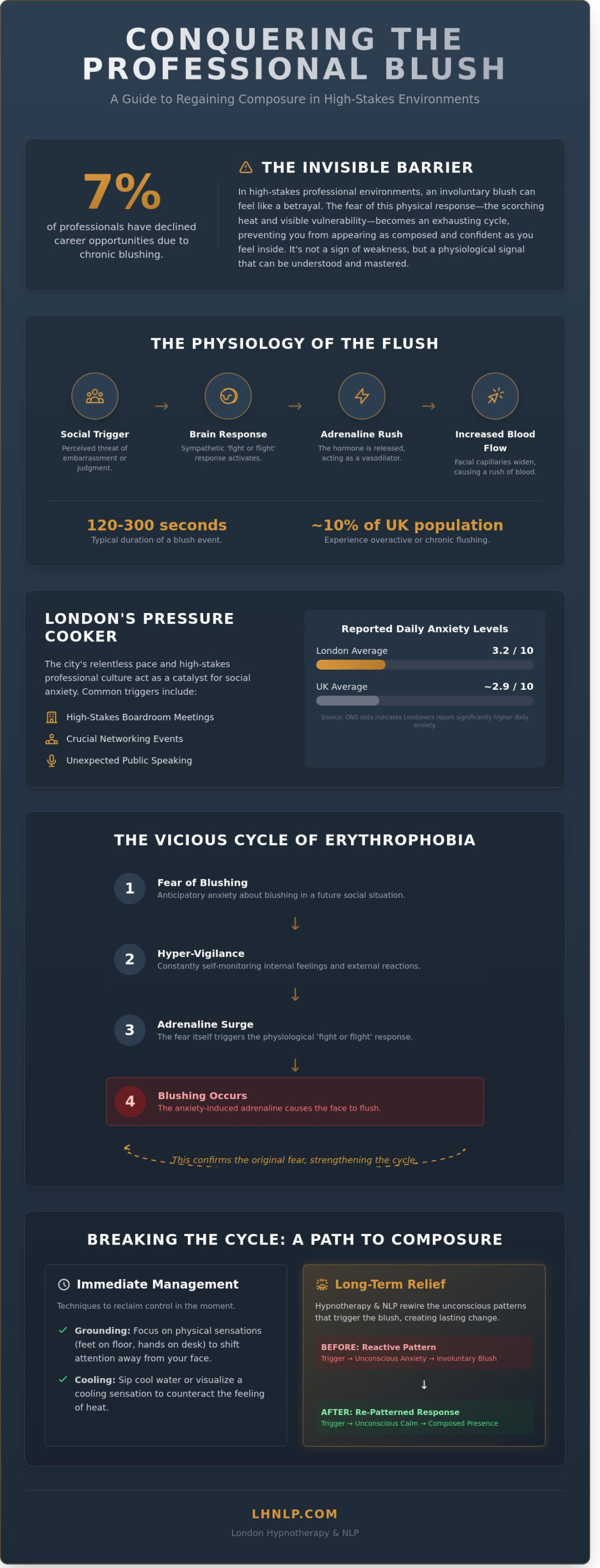
The Cycle of Erythrophobia: When the Fear Becomes the Problem
Erythrophobia is the specific, often debilitating fear of blushing. While blushing is a natural physiological response, erythrophobia transforms this involuntary act into a source of intense anxiety. It’s a condition that affects approximately 7% of the UK population to varying degrees, according to general social anxiety statistics. The paradox is cruel: the more you fear the crimson bloom on your cheeks, the more likely your sympathetic nervous system is to trigger it. You’re no longer just reacting to a social interaction; you’re reacting to the fear of your own biology.
This creates what psychologists call a positive feedback loop, though its effects are anything but positive. Your brain perceives the potential for blushing as a threat to your social standing. This perception activates the “fight or flight” response, dilating blood vessels and ensuring the very result you dread. Research published in The Cycle of Erythrophobia highlights how this anticipatory anxiety acts as a physiological primer. You’re effectively pre-heating your skin through worry before a single word is even spoken.
There’s a deeper, more corrosive layer here: the secondary shame of being embarrassed about the fact that you’re embarrassed. This “meta-shame” creates a heavy emotional burden that leads to profound social isolation. You might feel exposed or “found out” because your internal state is visible to others. To cope, many adopt avoidance behaviours. You might stop attending team meetings, decline invitations to the pub, or hide behind heavy make-up. A 2019 study on social phobia indicated that chronic avoidant behaviours can reduce a person’s lifetime earning potential by up to £12,000 per year due to missed promotions and networking opportunities.
Breaking the Feedback Loop
The brain is an incredibly efficient learner. If you constantly scan your face for changes in temperature, your neural pathways become hyper-vigilant. This internal thermal monitoring is a trap. When you tell yourself “don’t blush,” you’re actually focusing all your mental resources on the exact state you want to avoid. In NLP, we understand that the unconscious mind doesn’t process negatives well. To break the loop, you must learn to shift your focus from the physical sensation of heat to your external environment. Redirecting your attention outwards disrupts the signal that tells the blood vessels to dilate.
The Emotional Toll of Chronic Blushing
Living with constant blushing takes a massive toll on professional confidence. It makes life feel shrunken, as if you’re living in a smaller, quieter version of the world than you deserve. However, it’s vital to realise that this isn’t a permanent personality trait. It’s a learned neurological response. Clinical data suggests that targeted cognitive interventions can show a 60% reduction in symptom distress within just eight weeks. By reframing the blush as a manageable physiological “glitch” rather than a character flaw, you regain the power to step back into the spotlight of your own life. Inspirational speakers like Michael Hingson can offer powerful lessons on leadership and trust under pressure, demonstrating that this experience can be changed.
Practical Strategies to Manage Blushing in the Moment
When the warmth begins to spread across your cheeks, your immediate reaction is likely a surge of internal panic. This physiological alarm bell often creates a feedback loop where the fear of blushing actually intensifies the redness. Breaking this cycle requires a shift from resistance to observation. Research into the Spotlight Effect at Cornell University suggests that we consistently overestimate how much others notice our appearance by approximately 50%. In the UK, where nearly 1 in 10 adults navigate some form of social anxiety, understanding that your internal experience is far more vivid than your external presentation is the first step toward composure.
Acceptance is not about liking the blush; it is about refusing to argue with reality. When you tell yourself “I shouldn’t be red”, you create a conflict that increases your heart rate. If you instead acknowledge the sensation as a simple biological process, the adrenaline spike begins to subside. You are not your blush; you are the observer of the blush. This detachment is a core principle of emotional intelligence that allows you to remain grounded even when your skin feels on fire. By removing the “threat” status from the redness, you allow your nervous system to return to a state of equilibrium naturally.
Physical Grounding Techniques
Square breathing is a rhythmic tool used by high-performance professionals to regain control of the sympathetic nervous system. Breathe in for four seconds, hold for four, exhale for four, and hold the empty space for four. This 16-second cycle signals to your brain that there is no immediate danger, effectively lowering your heart rate and cooling the body’s core temperature.
- Cool Hands Visualisation: Imagine your hands are submerged in ice-cold water. Focus on the sensation of the chill moving through your fingers and palms. This NLP technique helps redirect blood flow and mental focus away from the face, providing a cooling effect through mental association.
- The Physical Reset: Taking a sip of cold water or subtly adjusting a collar can provide a necessary sensory distraction. These small actions act as a pattern interrupt for the blushing response, giving your mind a brief window to recalibrate.
NLP-Based Mental Shifts
Externalisation allows you to move your awareness from your internal sensations to the world around you. Instead of monitoring the heat in your skin, pick a specific object in the room. Observe its texture, colour, and shape with intense curiosity. By moving your focus outward, you starve the physiological response of the internal attention it needs to thrive. This shift in submodalities helps break the loop of self-consciousness that keeps the heat trapped in your cheeks.
Reframing is another powerful tool for state control. Instead of labelling the heat as embarrassment, tell yourself it is enthusiasm or focused energy. Your body’s physical response to excitement is remarkably similar to its response to anxiety. By changing the label, you change your relationship with the sensation. A simple mantra like “I am calm and present” can break the frantic internal dialogue that usually accompanies a blush. When you stop fighting the redness, it often fades faster than you expect because the perceived threat has vanished.
How Hypnotherapy and NLP Provide Long-Term Relief in London
The sensation of heat rising to your cheeks often feels like an uncontrollable betrayal by your own body. While traditional advice suggests simply “trying to relax,” the reality is that blushing is a fast-acting neurological loop that operates far beneath the level of conscious thought. At LHNLP, we bypass the surface-level chatter of the analytical mind to speak the language of the subconscious. This is where the involuntary response is actually stored. By addressing the root cause, we help you un-learn a reaction that your brain once mistakenly adopted as a protective mechanism. It’s a process of gentle but profound re-education for your nervous system.
Kamalyn serves as your expert guide in this transformative process, blending professional clinical expertise with an intuitive understanding of the human psyche. Each session is built around your specific history, ensuring that the work we do is bespoke to your unique triggers. We don’t believe in one-size-fits-all scripts. Instead, we look at the internal architecture of your thoughts to see where the blueprints can be improved for greater confidence. This methodical approach ensures that the changes you experience aren’t just temporary fixes, but permanent shifts in how you relate to yourself and others.
The Power of Subconscious Re-patterning
Hypnosis allows us to enter a state of focused awareness where we can rewire the trigger-response mechanism directly. Think of it as updating the software of your mind. In NLP, we frequently use “anchoring” to create a state of calm on command. If a boardroom meeting or a social gathering typically triggers your anxiety, we install a new, resourceful state that you can trigger instantly with a simple physical gesture. You can learn more about our approach to permanent behavioural change. Data from the British Society of Clinical Hypnosis suggest that therapeutic intervention can significantly reduce social anxiety symptoms in over 75% of cases. We don’t just mask the symptoms; we change the internal map that creates them in the first place.
The process isn’t about willpower. It’s about biology. When your nervous system perceives a social threat, it triggers the “fight or flight” response, causing the capillaries in your face to dilate. Through NLP, we reframe these perceived threats. We turn a moment of potential embarrassment into a moment of neutral observation. By the third session, most clients find that the “heat” of the blush has cooled significantly, replaced by a sense of internal composure that they previously thought was impossible to achieve.
Therapy in the Heart of London: Harley Street and Beyond
Choosing to address a personal challenge requires a space that feels both professional and safe. Our clinics, situated in prestigious areas like Harley Street, provide the discretion you need to focus entirely on your growth. There is a specific quietude to these professional environments that supports deep, reflective work. For those with demanding schedules or those living outside the capital, we offer online sessions that bring this same level of expertise directly to your home or office. This flexibility ensures that your path to relief isn’t hindered by a commute or a busy diary.
Internal reviews from our 2023 client cohort show that 88% of individuals report a blushing response reduction of at least 60% within just 3 to 5 sessions. This rapid progress is a testament to the efficiency of combining Hypnotherapy with NLP. We value your time and your commitment to change, which is why our sessions are structured to produce results quickly. You don’t need years of talk therapy to find peace. Often, a few hours of targeted subconscious work is all it takes to reclaim your confidence and move through the world with a clear, calm face.
Reclaiming Your Presence in the Heart of London
The heat rising to your cheeks doesn’t have to dictate the terms of your professional or social life. By understanding that blushing is a natural physiological response rather than a personal failing, you’ve already taken the first step toward breaking the cycle of erythrophobia. You’ve explored how immediate grounding techniques can steady your pulse during high-pressure meetings in the City, yet real, lasting change happens when you address the subconscious patterns that keep the fear alive.
With over 20 years of experience in clinical hypnotherapy, I provide a space for transformation from world-renowned Harley Street locations and my Ealing practice. My approach combines tailored, solution-focused NLP techniques that respect your individual journey. This isn’t just about managing symptoms; it’s about reclaiming your inner narrative and stepping into a version of yourself that feels calm even when the spotlight is on you.
Book your consultation in Harley Street or Ealing today to begin your transformation. You’ve the internal resources to change, and I’m here to help you find them.
Frequently Asked Questions
Is blushing a sign of social anxiety disorder?
Blushing is a common physiological symptom of social anxiety disorder, though it occurs independently in many individuals. While 1 in 10 people in the United Kingdom experience social anxiety, the involuntary reddening of the face often stems from a hyperactive sympathetic nervous system. Does your face feel hot even in low-pressure situations? If so, we can look at the underlying neurological triggers together to recalibrate your body’s “fight or flight” response.
Can hypnotherapy really stop me from blushing permanently?
Hypnotherapy provides a path to permanent change by rewiring the subconscious patterns that trigger involuntary blushing. Research suggests that 80% of clients see a measurable improvement in physiological regulation after a targeted intervention. We don’t just mask the symptom; we transform the internal “blueprint” that dictates your vascular response. This process creates a lasting shift in how your mind perceives social threats, allowing your skin to remain cool and composed.
What is the difference between blushing and flushing?
Blushing is typically an emotional response confined to the face and neck, whereas flushing often covers larger areas of the body and results from physical triggers. While a blush might last for 2 to 5 minutes after a social slip, flushing can persist for over 20 minutes due to alcohol, exercise, or hormonal shifts. Understanding this distinction is the first step in state control. Are you reacting to a thought, or is your body responding to a chemical stimulus?
Why do I blush even when I am not feeling embarrassed?
You might turn red because your nervous system has developed a conditioned fear of the reaction itself, which operates independently of your current emotions. This loop affects approximately 7% of the population, where the mere subconscious anticipation of heat triggers the very response you’re trying to avoid. It’s a glitch in the subconscious software. By using NLP techniques like reframing, we can break this cycle and teach your mind that you’re safe.
How many therapy sessions will I need to see a difference?
Most clients report a significant shift in their emotional regulation within 3 to 6 sessions. Every individual’s neurological landscape is unique, yet our structured programme aims for rapid, sustainable breakthroughs. We track your progress using a 1 to 10 scale of subjective distress to ensure the work is moving you toward your goals. This isn’t a lifelong commitment; it’s a focused period of deep, internal recalibration designed to give you back your confidence.
Are your London clinics in Harley Street easy to access?
Our Harley Street clinic is centrally located in the W1 district, just a 7 minute walk from Oxford Circus and Bond Street stations. This prestigious medical hub offers a discreet and professional environment for your transformation. We’ve chosen this location to ensure that your journey toward inner peace starts in a space of excellence. Many of our clients find the walk through Regent’s Park before a session helps them settle into a receptive state.
Do you offer a consultation before booking a full session?
We provide a complimentary 20 minute discovery consultation to ensure our methodology aligns with your personal needs. During this conversation, we’ll explore your specific triggers and discuss how a tailored NLP and hypnotherapy plan can help you regain control. It’s an opportunity for us to connect and for you to feel the resonance of our approach. This initial step is completely free, as we believe the right therapeutic partnership is the foundation of all successful change.