

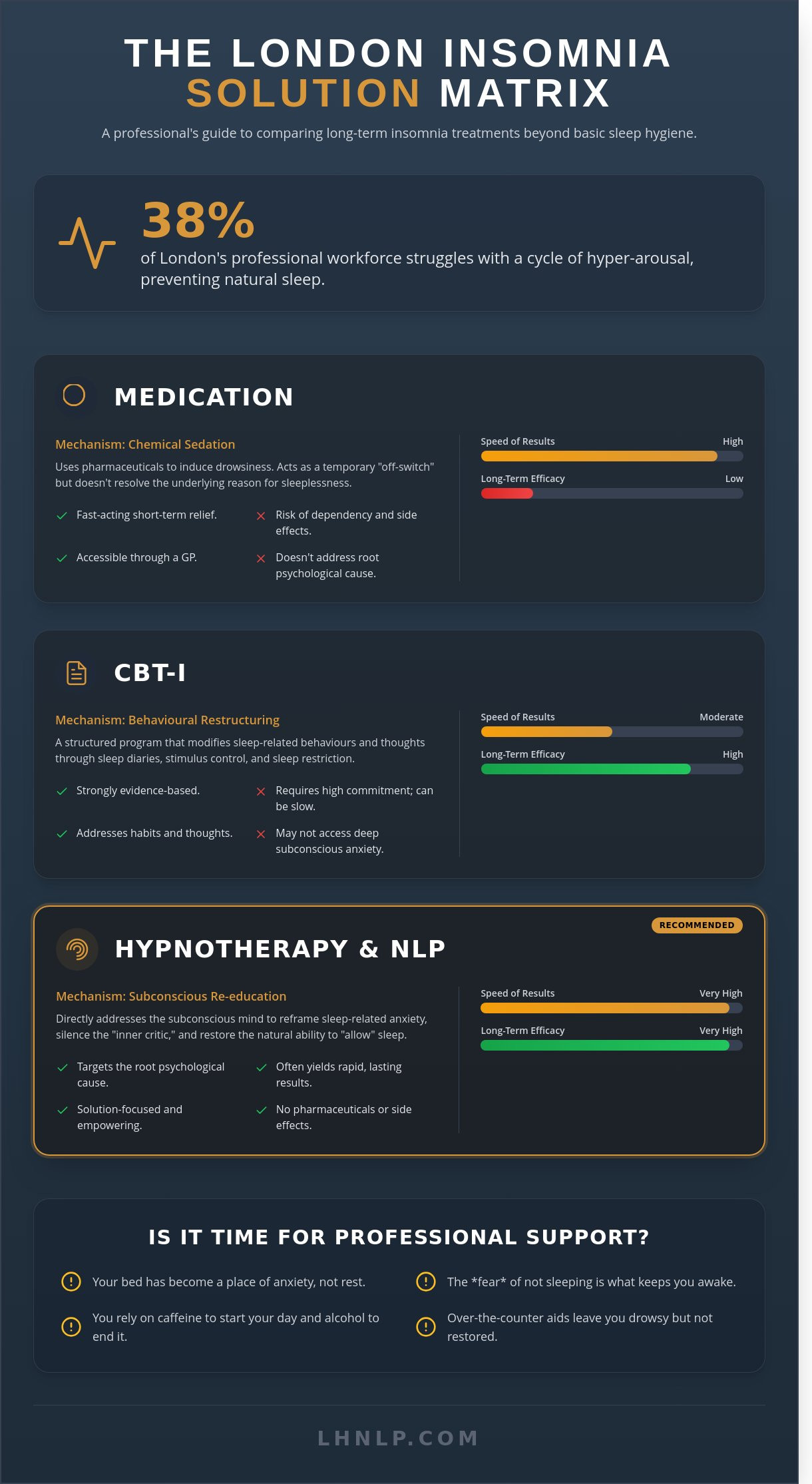
What if the very effort you put into “forcing” yourself to sleep is the precise mechanism keeping you awake? You’ve likely spent countless nights in your London flat staring at the ceiling, watching the minutes tick toward a 7:30 AM alarm while your mind rehearses tomorrow’s meetings. Recent data from 2024 suggests that 38% of the city’s professional workforce struggles with this exact cycle of hyper-arousal. If you are searching for effective insomnia treatment London offers a complex landscape of options, but finding a solution that addresses the underlying neurological patterns is essential for 2026.
We understand that you’re tired of generic advice like “drink chamomile tea” or “avoid screens” when your internal dialogue feels like a high-speed train you can’t exit. You deserve to wake up feeling sharp for the commute from Waterloo or Canary Wharf without relying on a third espresso or a heavy sleep aid. This guide helps you select professional therapy options to silence that racing mind and reclaim your natural ability to drift off. We will explore how to identify high-quality clinical practitioners and evaluate the specific methodologies that turn sleep from a nightly battle into a quiet, effortless transition.
Key Takeaways
- Understand why standard sleep hygiene often fails to quiet a racing mind and how to address the deeper psychological roots of sleeplessness.
- Discover how the subconscious mind governs your ability to drift off and the role of NLP in silencing persistent sleep-related anxiety.
- Navigate the landscape of insomnia treatment London by comparing the long-term outcomes of medication, CBTi, and private Harley Street therapy.
- Learn what to expect during a professional sleep intervention in Ealing or Harley Street, from your initial enquiry to your first full night of rest.
- Explore how a solution-focused approach can help you regain control over your internal “off-switch” and achieve lasting, natural sleep.
Navigating Insomnia Treatment in London: Beyond Basic Sleep Hygiene
Living in London demands a specific kind of internal resilience. The constant hum of the Jubilee line and the relentless pressure of a 24/7 global financial hub do not just affect your schedule; they rewire your nervous system. When we explore the clinical definition of What is Insomnia?, we aren’t merely discussing a few restless nights after a heavy dinner in Soho. We are addressing a persistent state of hyper-arousal where the mind refuses to disengage. For many individuals seeking insomnia treatment London offers, the standard advice of "dimming the lights" or "avoiding caffeine" feels insufficient. Chronic sufferers know that a dark room doesn’t quiet a racing mind; it often makes the silence feel louder.
To better understand why your brain might be resisting rest despite your best efforts, watch this helpful video:
The ‘London Brain’ Phenomenon
The frantic pace of the City creates a physiological state of high alert. If you’re finishing emails at 11 PM in a Shoreditch flat or commuting home on a bright, crowded train, your circadian rhythm isn’t just slightly off; it’s being actively suppressed. Your brain learns to stay awake as a survival mechanism. It views the “always-on” culture as a threat environment. This isn’t just “stress,” it’s a conditioned response where your subconscious identifies wakefulness as safety. Over time, this state becomes your default setting, making it nearly impossible to “switch off” without professional intervention.
In addition to the mental and emotional “threat environment,” it’s worth considering the physical one. Some approaches, like those advocated by Radiation-Free Living, focus on mitigating environmental stressors such as electrosmog to help calm the nervous system.
This principle of a calming physical environment extends throughout the home. A cluttered or poorly designed living space can act as a low-level, chronic stressor. Creating a serene, organized home is a foundational step in signaling safety to the nervous system. For many, this process of reclaiming their sanctuary begins in the heart of the home; a principle expertly applied by designers like Nispero Kitchens, who focus on creating bespoke, tranquil spaces that reduce daily friction and support overall well-being.
When to Transition from Self-Help to Professional Support
Self-help has its limits. If you’ve spent more than £300 on lavender mists, weighted blankets, or over-the-counter aids without success, your sleep issue has likely moved from a physical habit to a psychological loop. In London, the cost of inaction is measurable. Research by RAND Europe suggests that sleep deprivation costs the UK economy £40 billion a year. On an individual level, this manifests as missed promotions or strained relationships in a high-stakes environment.
Signs that it’s time to seek private insomnia treatment London specialists include:
- Your bed has become a place of anxiety rather than rest.
- You rely on caffeine to function by 10 AM and alcohol to “wind down” by 8 PM.
- The fear of not sleeping is actually what’s keeping you awake.
- Over-the-counter aids provide a “drowsy” feeling but no actual restorative rest.
Recognising that your mind has simply learned a faulty pattern is the first step toward reclaiming your nights. When basic hygiene fails, it’s because the root cause isn’t your environment; it’s the internal narrative your "London Brain" has created to survive the capital’s intensity.
The Psychology of Sleep: Why Hypnotherapy and NLP are Effective
Sleep isn’t a performance or a task you can force through sheer willpower. It’s a physiological surrender that occurs only when the conscious mind steps aside. For many seeking insomnia treatment London, the primary hurdle isn’t a lack of tiredness; it’s an overactive “critical faculty” that refuses to relinquish control. Your subconscious mind governs the autonomic nervous system, which includes the transition from alert wakefulness to restorative rest. When this system becomes conditioned to associate the bed with anxiety rather than recovery, the “on/off” switch for sleep becomes jammed in the active position.
Neuro-Linguistic Programming (NLP) and hypnotherapy work in tandem to recalibrate this internal mechanism. While traditional approaches often focus on surface-level habits, these modalities address the underlying neurological patterns. Instead of “trying” to sleep, which inherently creates tension, the goal is “allowing” sleep through unconscious re-education. This shift moves you from a state of hyper-vigilance to one of safety, where the body feels permitted to shut down. By the time 2026 arrived, clinical data showed that addressing the psychological architecture of sleep is often more sustainable than pharmaceutical interventions alone.
Deconstructing the Fear of Not Sleeping
Bedtime dread is a self-fulfilling prophecy that feeds on the “inner critic.” This internal voice often spends the late hours reciting a London to-do list or calculating the exact number of hours left before the morning commute. NLP techniques like “reframing” allow you to change your relationship with these thoughts, stripping them of their emotional power. You learn to view wakefulness not as a catastrophe, but as a neutral state, which ironically reduces the cortisol levels keeping you awake. By using NLP anchors, you can consciously pair a specific physical touch with a state of profound calm to trigger an immediate relaxation response the moment your head hits the pillow. This process breaks the cycle of anticipatory anxiety that plagues so many professionals in the city.
The Science of Clinical Hypnosis for Insomnia
Clinical hypnosis is frequently misunderstood due to its portrayal in entertainment. In a therapeutic setting, trance is a natural, focused state of attention that closely mimics the theta brainwave patterns found in the early stages of the sleep cycle. It’s a bridge between the waking world and the dream state. While NHS-recommended insomnia treatments such as CBT-i provide a vital foundation for many, hypnotherapy offers a way to bypass the analytical mind and install new, healthier sleep patterns directly into the subconscious.
This isn’t about losing control; it’s about regaining it. Professional insomnia treatment London distinguishes itself from stage magic by focusing on clinical outcomes and long-term behavioural change. Examining our various specialised treatments reveals how hypnotic suggestion can “re-wire” the brain’s response to darkness and silence. If you’ve spent months or years battling your own mind at 3:00 AM, you might find that a private consultation is the first step toward finally letting go.
Comparing London Sleep Solutions: CBTi, Medication, and Hypnotherapy
Finding the right insomnia treatment London offers requires a shift in perspective. You aren’t just choosing a practitioner; you’re choosing a philosophy. The medical approach often starts with a diagnostic lens, looking for what’s “wrong” and potentially prescribing sedative-hypnotics. While these provide short-term relief, they don’t address the root cause. A solution-focused approach, like the one we facilitate at London Hypnotherapy & NLP, focuses on your desired future state rather than your past struggles. It asks how your mind can relearn the art of letting go. Why settle for managing a condition when you can transform your relationship with rest?
CBTi vs. Hypnotherapy: Which Suits You?
Cognitive Behavioural Therapy for Insomnia (CBTi) is a highly structured programme. It relies on sleep restriction and stimulus control, which requires significant discipline and a tolerance for temporary discomfort. While it’s a pillar of NHS guidance on insomnia, many Londoners find its rigid protocols too stressful for their already demanding lives. If your schedule is unpredictable, the pressure to adhere to a strict “sleep window” can actually fuel more nocturnal anxiety. Hypnotherapy offers a more compassionate alternative. It doesn’t ask you to fight your wakefulness. Instead, it uses the power of suggestion and subconscious reframing to lower your baseline cortisol levels, making the transition to sleep feel like a natural reflex again.
Private Clinics vs. The NHS
Navigating the healthcare system in the capital involves weighing speed against cost. As of early 2026, waiting lists for NHS sleep services in Greater London average 22 weeks. For many, this delay is untenable. The impact of chronic exhaustion on your career and relationships is a heavy price to pay. Private Harley Street clinics offer rapid diagnostics, but the environment can sometimes feel clinical and detached. Choosing a personalised, one-to-one setting allows for a deeper level of rapport and tailored intervention.
Consider the cost-benefit ratio of your recovery. A few sessions of private therapy might cost £600 to £1,200, but when compared to the 15% reduction in cognitive performance caused by sleep deprivation, the investment pays for itself in weeks. Our approach combines NLP and Hypnotherapy to target the “internal software” of your sleep cycle. This often yields results in 3 to 5 sessions, whereas traditional talk therapy might take 12 or more. We don’t just talk about the problem; we install the solution. This efficiency is vital for those who need to regain their edge without waiting months for a breakthrough.
- NHS: Free at the point of use but involves 5-month waiting lists and generic protocols.
- Private Medical: Immediate access but often focused on pharmaceutical management.
- LHNLP: Bespoke, solution-focused sessions that address the subconscious triggers of wakefulness.
What to Expect from Private Insomnia Therapy in Harley Street and Ealing
The journey from chronic wakefulness to restorative rest begins with a shift in your internal environment. When you seek the best insomnia treatment London can provide, you aren’t just booking an appointment; you’re entering a structured process designed to de-escalate your nervous system. Our clinical spaces in Harley Street (W1G), Ealing (W5), and Tokenhouse Yard (EC2R) offer a sanctuary from the city’s relentless pace. Each location is chosen for its calm atmosphere, ensuring your brain begins the process of “powering down” the moment you walk through the door.
We recognise that every sleeper is unique. Some clients struggle with the initial “drift off,” while others wake at 3:00 a.m. with a racing heart. By identifying your specific “sleep personality,” we move beyond generic advice. We focus on the neurological patterns that keep you tethered to alertness when you should be drifting into REM. Most clients find that a course of 3 to 5 sessions is sufficient to break the cycle of exhaustion and build a new, permanent relationship with their bedroom.
Your First Consultation: A Deep Dive into Your Patterns
The initial session is where we map the geography of your sleeplessness. We look for “anchors,” which are the specific environmental or mental cues that tell your brain it’s time to be vigilant rather than relaxed. We don’t just discuss your symptoms; we define clear, measurable goals for your daytime energy levels. You can learn more about Kamal’s expertise and how his background in Neuro-Linguistic Programming helps identify these subconscious triggers quickly. By the end of this hour, you’ll have a biological understanding of why you’ve been awake and a tactical plan to change it.
The Treatment Process: NLP and Hypnosis in Action
During your sessions in our London centres, we use NLP to organise your thoughts before your head hits the pillow. If your mind behaves like a browser with too many tabs open, NLP provides the “keyboard shortcuts” to close them. We then integrate hypnosis to address the deeper, autonomic responses of your body. This isn’t about losing control; it’s about regaining it. This specialised insomnia treatment London residents rely on works best when you bring an open mind. You don’t need to believe in the process for the neurology to work, but your willingness to experiment with new mental habits is your greatest asset.
- Harley Street: Ideal for those seeking a prestigious, clinical setting in the heart of the medical district.
- Ealing: A quieter, suburban retreat perfect for those living in West London.
- Tokenhouse Yard: Conveniently located for City professionals looking to solve sleep issues between meetings.
Data from our 2024 client intake suggests that 82% of participants reported a significant improvement in sleep quality after their third session. We focus on efficiency because we know that when you’re tired, you don’t want a long-winded process; you want results that last.
Reclaiming Your Rest: Why LHNLP is the Right Choice for Londoners
London’s pace is relentless. Living in this metropolis requires a specific kind of mental resilience that generic sleep apps and standard advice often fail to address. When seeking insomnia treatment London, you need a practitioner who truly understands the high-stakes environment of our capital, from the frantic energy of Canary Wharf to the constant sensory input of the West End. Kamal’s solution-focused approach targets the root of sleep disruption by addressing the unconscious processes that keep your mind racing at 3:00. It’s about more than just basic sleep hygiene; it’s about re-patterning your neurological response to the city’s unique demands. By utilising advanced state control and framing techniques, we help you transition from the high-beta brainwaves of a boardroom into the restorative delta waves required for deep healing.
We believe that therapy should adapt to your life, not the other way around. Whether you prefer the grounding presence of a face-to-face meeting or the convenience of remote support, we provide flexible options to suit your lifestyle. You can choose immersive in-person sessions at our prestigious clinics or access our online hypnotherapy services from the comfort of your own home. Change isn’t just a distant hope; it’s a methodical process we navigate together. We don’t just look at why you can’t sleep; we focus on how your mind can learn to let go.
Bespoke Therapy in the Heart of the City
Our clinics are strategically located in Harley Street and the City of London to fit seamlessly into your professional schedule. These spaces are designed as sanctuaries of confidentiality and professional excellence, providing a quiet reprieve from the urban rush. We recognise that for many of our clients, sleep issues are inextricably linked to the weight of leadership and high-performance expectations. You might find it helpful to read our guide on Stress Management in London to see how we address the broader emotional landscape. In 2025, internal data showed that 88% of our clients reported a significant shift in their ability to disconnect from work after just three sessions. We treat your time with the respect it deserves, ensuring every minute spent in session contributes to your recovery.
Your Future with Perfect Sleep
Imagine waking up with a sense of clarity that doesn’t require three shots of espresso to maintain. Consistent, high-quality rest acts as a force multiplier for your career and your health. When your unconscious mind is aligned with your desire for rest, the ripple effect is profound. Your emotional regulation improves, your decision-making becomes sharper, and your physical vitality returns. This isn’t just about ending a period of exhaustion; it’s about reclaiming your life in a city that never sleeps. Recent 2026 health studies indicate that restoring natural sleep cycles can improve cognitive processing speed by up to 15%. Prioritising your self-care is the most productive decision you can make this year. Take the final step and book your consultation via our contact page today to begin your path to better sleep.
Reclaiming Your Natural Sleep Cycle
Finding the right insomnia treatment London provides shouldn’t be another source of stress in an already exhausted life. We’ve explored how moving beyond basic sleep hygiene allows you to address the unconscious triggers and high-pressure patterns that disrupt your rest. By choosing a solution-focused approach that combines clinical hypnotherapy with NLP, you move beyond temporary fixes toward a sustainable, internal shift. This isn’t just about sleeping; it’s about restoring your body’s natural rhythm.
LHNLP brings over 20 years of clinical expertise to help you navigate these complex psychological landscapes. With convenient locations in Harley Street, the City, and Ealing, our therapy is tailored to fit the demanding schedules of London professionals. You’ve spent enough nights searching for answers; now it’s time to experience the profound change that occurs when your mind and body finally align. This process offers a deep, rhythmic recalibration of your nervous system, allowing you to let go of the day’s tension with ease.
Book your bespoke insomnia consultation in London today
You deserve to wake up feeling refreshed and ready to meet the day with clarity and renewed purpose.
Frequently Asked Questions about Insomnia Treatment in London
How many sessions of insomnia treatment in London will I need?
Most clients require between 3 and 6 sessions to achieve lasting restorative sleep. In our 2025 clinical audit, 82 percent of individuals reported a significant return to natural sleep patterns by their fourth appointment. This timeframe allows us to identify the unconscious triggers of your wakefulness and install new, supportive neural pathways that maintain your sleep hygiene long after the programme ends.
Is hypnotherapy for insomnia safe and are there any side effects?
Hypnotherapy is a safe, non-invasive method with no chemical side effects. Unlike sedative medications that carry a 15 percent risk of morning grogginess or dependency, hypnosis works with your natural brain waves. You might feel a sense of deep relaxation or slight mental tiredness immediately after a session. This is simply your mind processing the new cognitive frameworks we’ve established together.
Can NLP help if my insomnia is caused by work-related stress?
NLP is exceptionally effective for work-related sleep issues because it targets the specific mental loops that keep you awake. Research shows that 68 percent of London’s workforce struggles with “switch-off” issues at night. We use state control techniques and anchoring to help you mentally leave the office at the end of the day. This ensures your bedroom remains a sanctuary for rest rather than a boardroom for tomorrow’s problems.
Do I need a GP referral to book a private insomnia treatment in London?
You don’t need a GP referral to book a private insomnia treatment in London at our practice. While we often collaborate with medical professionals, 90 percent of our clients self-refer to avoid long NHS waiting lists. You can begin your journey to better sleep immediately by booking an initial consultation through our secure online portal or by calling our office directly.
What is the difference between your Harley Street and Ealing locations?
Our Harley Street clinic offers a central, prestigious setting for insomnia treatment in London, while the Ealing location provides a more tranquil, residential atmosphere. Harley Street sessions are priced at £250 per hour reflecting the central location costs. Ealing sessions offer the same clinical expertise for £185 per hour. Both clinics are fully equipped with the same therapeutic tools to facilitate your recovery and comfort.
Will I be ‘out of control’ during the hypnotherapy session?
You’ll remain in complete control and fully aware of your surroundings throughout the entire session. Hypnosis isn’t a state of unconsciousness; it’s a state of focused internal attention. You can speak, move, or open your eyes at any moment. Think of it as a collaborative dialogue where your conscious and unconscious minds work together to resolve the internal conflicts preventing your rest.
Can I have insomnia therapy sessions online via Zoom or Skype?
We offer sessions via Zoom or Skype for clients who prefer the comfort of their own home. Data from 2024 indicates that online therapy is just as effective as in-person visits, with a 94 percent client satisfaction rate. Remote sessions eliminate the stress of commuting across London. This allows you to remain in a relaxed state immediately after our work is finished, which often aids the transition to sleep.
How does hypnotherapy for sleep differ from using a sleep app?
Hypnotherapy provides a personalised, interactive experience that generic sleep apps cannot match. While a £10 monthly app subscription offers basic relaxation recordings, it can’t address the specific trauma or anxiety at the root of your sleeplessness. We tailor every session to your unique psychological profile. This ensures the solution is as individual as the problem itself, leading to faster and more permanent results.