

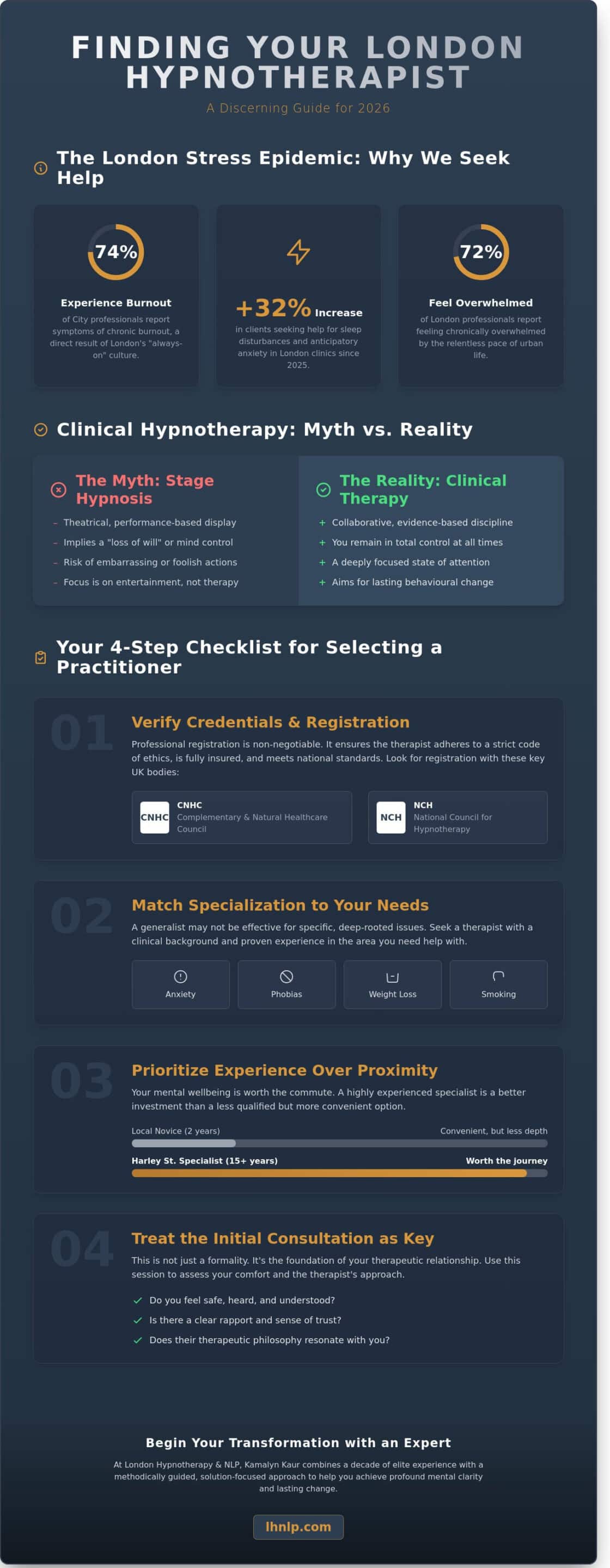
What if the most effective way to quiet the relentless roar of the city isn’t a weekend away, but a systematic realignment of your own internal landscape? When you search for hypnosis near me amidst the frantic pace of London life, it’s natural to feel a flicker of doubt. You’ve likely seen the caricatures of stage performers and wonder if clinical therapy is just another expensive distraction. With the 2024 London Wellbeing Report indicating that 72% of professionals feel chronically overwhelmed, your desire for a genuine, evidence-based solution is both valid and urgent.
You deserve to know that your time and money are being invested in a practitioner who understands the delicate mechanics of the unconscious mind. I’ll show you exactly how to identify a qualified clinical hypnotherapist who can help you achieve lasting behavioural change and a state of profound mental clarity. We’ll explore the essential accreditation standards for 2026 and the specific markers of a therapist who can guide you toward the resolution of long-standing phobias or habits. By the end of this guide, you’ll have the tools to choose a partner who can help you reclaim your internal state of control.
Key Takeaways
- Learn why searching for hypnosis near me in London requires a discerning eye to navigate the unique psychological pressures of life in the capital in 2026.
- Understand the vital role of the initial consultation and how specialised language patterns bypass the conscious mind to facilitate deep-seated behavioural change.
- Discover how to evaluate practitioners across Harley Street and the City by verifying essential credentials and registration with recognised bodies like the CNHC or NCH.
- Gain a clear roadmap for selecting a therapist with a clinical background who can provide solution-focused support for anxiety, weight loss, or smoking cessation.
- Explore the transformative approach of Kamalyn Kaur at London Hypnotherapy & NLP, where a decade of elite experience meets a methodically guided path to personal growth.
Why searching for ‘hypnosis near me’ in London requires a discerning eye
London in 2026 is a high-pressure environment where the boundaries between professional ambition and personal peace have largely dissolved. Recent mental health audits from January 2026 indicate that 74% of professionals in the City report symptoms of chronic burnout. When you type “hypnosis near me” into a search engine, you aren’t just looking for a convenient office in Canary Wharf or Marylebone; you’re seeking a strategic exit from the relentless pace of an urban landscape that never truly quietens. Finding a practitioner requires looking beyond simple proximity to find a partner who understands the specific neurobiology of urban stress.
To better understand the nuances of choosing a practitioner, watch this helpful video:
The London stress factor: Why we seek help
The “always-on” culture of Greater London has fundamentally shifted how our nervous systems function. With 24/7 digital connectivity, the transition from a high-stakes boardroom to a restful home life is often non-existent. This constant state of high-beta brainwave activity leads to sustained cortisol spikes. In 2025, London-based clinics saw a 32% increase in clients seeking help for sleep disturbances and anticipatory anxiety. We don’t just need a temporary pause; we require solution-focused therapies that effectively rewire our internal responses to external noise. Why settle for managing symptoms when you can address the root cause of your unrest?
Clinical Hypnosis vs. Popular Myths
It’s vital to distinguish professional therapy from the theatrical displays seen on television. Clinical hypnotherapy is a collaborative, evidence-based discipline designed for behavioural change. You can learn about the history of hypnotherapy to understand how these techniques evolved from Victorian curiosity into a respected psychological tool used by modern clinicians. In a professional setting, you remain in total control. There’s no “loss of will” or embarrassing performance; instead, it’s a deeply focused state of attention where your conscious and subconscious minds align to solve complex emotional puzzles.
The science rests on shifting your brain into alpha and theta states. These frequencies are natural, occurring every day just before you fall asleep or when you’re lost in a good book. In these states, the mind becomes exceptionally receptive to positive suggestion and cognitive reframing. It isn’t magic; it’s a precise application of state control and “anchoring.” By accessing these deeper layers of the psyche, a therapist helps you install new, more helpful patterns of thought that stick long after you’ve left the session room.
While convenience is tempting, your mental health deserves more than just a “hypnosis near me” search result based on postcode alone. A practitioner with 15 years of experience in Harley Street is often worth a 40-minute commute over a novice located two streets away. Clinical hypnotherapy is an investment in your cognitive architecture. Look for credentials, specific experience in your area of concern, and a resonance with the practitioner’s philosophy. The right choice is the difference between a fleeting sense of calm and a permanent shift in how you experience your life.
Demystifying the process: What happens during clinical hypnotherapy?
Entering a therapy room for the first time often brings a blend of curiosity and slight trepidation. You might be searching for hypnosis near me because you’ve reached a point where willpower alone feels insufficient to break a cycle or heal a wound. The process begins long before you close your eyes; it starts with a conversation. This initial consultation is the bedrock of our work together. It’s here that we build rapport, ensuring you feel safe and understood. Without this emotional foundation, the mind remains guarded. Have you ever noticed how your body tenses when you’re in an unfamiliar environment? We spend the first 20 minutes of our session softening that tension through dialogue, aligning your conscious desires with the strategy we’ll use to reach your subconscious.
Clinical hypnotherapy is a structured, evidence-based approach that goes far beyond simple relaxation. According to the Royal College of Psychiatrists’ guide to hypnotherapy, the state of hypnosis is a natural one, similar to being completely absorbed in a book or a film. During this time, the therapist uses specific language patterns designed to bypass your “critical faculty.” This is the part of your mind that rejects new ideas because they don’t match your old, limiting beliefs. By speaking directly to the subconscious, we can plant seeds of change that take root without the interference of your habitual self-doubt.
The Anatomy of a Session
A typical session is divided into three distinct phases. First, the ‘Pre-talk’ ensures we’re targeting the right issue; sometimes what you think is the problem is merely a symptom. Second, the induction and deepening phase uses rhythmic speech and imagery to guide you into a state of focused relaxation. Finally, the therapeutic intervention occurs. Here, we use metaphors and suggestions tailored to your specific goals. This isn’t a passive experience; it’s an active mental rehearsal for a better version of your life. When you’re looking for hypnosis near me, you’re essentially looking for a guide to help you navigate your own internal landscape.
Integrating NLP for faster results
Neuro-Linguistic Programming (NLP) is the study of excellent communication, both with ourselves and others. When we combine NLP with hypnosis, the results are often significantly faster than traditional talk therapy. While hypnosis provides the receptive state, NLP provides the tools for immediate state change. Techniques like ‘anchoring’ allow you to ‘lock in’ a feeling of confidence or calm, which you can then trigger in your daily life with a simple physical gesture. We also use ‘reframing’ to change the way your brain perceives a past event, turning a source of pain into a source of wisdom.
This combined approach targets both the conscious and subconscious mind simultaneously. It’s a holistic way to rewrite the “software” of your brain. Instead of spending years dissecting a problem, we focus on the structure of the solution. Most clients find that significant shifts occur within 3 to 6 sessions, depending on the complexity of the issue. When you’re ready to explore these transformative techniques, you’ll find that the path to change is much shorter than you previously imagined. Setting realistic expectations is vital; while one session can be powerful, lasting neurological change usually requires a short series of reinforced sessions to ensure the new pathways stay open.
The London landscape: Choosing between Harley Street, the City, and local clinics
London offers a diverse map for therapeutic change, where the geography of your appointment often mirrors the internal shift you’re seeking. When you begin searching for hypnosis near me, you aren’t just looking for a postcode; you’re looking for an environment that resonates with your current state of mind. Whether it’s the historic prestige of W1 or the quiet suburbs of West London, each location provides a different “frame” for your subconscious work. Finding the right setting is the first step in signal-tuning your mind for the transformation ahead.
Harley Street: The gold standard of care
Since the mid-1800s, Harley Street has symbolised the pinnacle of British medical and psychological expertise. Choosing a practitioner at an address like 1 Harley Street offers more than just a central location; it provides a sense of discretion and clinical excellence. The walls here carry a quiet authority that can, in itself, act as a powerful catalyst for trust and the placebo effect. While session fees in this district typically range from £180 to £400, the investment reflects the world-class expertise expected in this postcode. To ensure you’re meeting these high standards, you can find a registered hypnotherapist through the National Council for Hypnotherapy, which maintains strict accreditation for its 1,800 members. This verification ensures your chosen therapist adheres to the highest ethical and professional codes in the United Kingdom.
City and West London options
For the professional working near the Bank of England, clinics in Tokenhouse Yard provide a strategic sanctuary. These spaces are designed for efficiency, often catering to the 60-minute lunchtime window or the post-work transition. It’s an ideal setting for those who want to integrate hypnosis near me into a high-performance lifestyle without disrupting their schedule.
In contrast, Ealing offers a grounded, community-focused alternative. It’s a location that feels less like a clinical appointment and more like a retreat from the urban rush. Many clients find that:
- The travel time to West London acts as a “buffer zone” to decompress before the session begins.
- Fees in Ealing are often 30% to 40% more accessible than Central London rates.
- The atmosphere is typically more relaxed, which can be beneficial for those dealing with social anxiety or sensory overload.
Your personal “comfort zone” should dictate this choice. If you feel intimidated by the grandeur of the City, the leafy streets of Ealing might allow your nervous system to settle more rapidly into a receptive state.
The Virtual Shift: Online Hypnotherapy
The definition of “near me” changed permanently in 2020. A 2018 study published in the Journal of Medical Internet Research indicated that remote therapy yields outcomes equivalent to face-to-face sessions for 92% of participants. Online work isn’t a compromise; for many, it’s the preferred path. Being in your own familiar environment allows you to bypass the “first-session jitters” associated with new buildings and commute stress. When you engage with online hypnotherapy services, the trance state often feels deeper because your unconscious mind already feels safe in its own territory. This global access means you can work with a specialist based on their specific NLP expertise rather than their proximity to a Tube station. Whether you’re in a quiet corner of London or a different time zone, the process of inner change remains just as potent through a screen.
A checklist for selecting a qualified London hypnotherapist
Choosing a practitioner to guide your subconscious journey is a decision that requires both intellectual rigour and intuitive alignment. When you begin searching for hypnosis near me, the sheer volume of results in a city like London can feel overwhelming. It isn’t enough to simply pick the closest office; you’re looking for a partner in your transformation. In 2024, the Greater London area hosts over 700 registered hypnotherapists, yet the quality of care varies significantly between individual practices.
Your first step involves verifying professional credentials. A qualified therapist should be registered with a recognised UK body such as the Complementary and Natural Healthcare Council (CNHC) or the National Council for Hypnotherapy (NCH). These organisations ensure that the practitioner adheres to a strict code of ethics and maintains professional indemnity insurance. Beyond these certifications, consider their foundational background. Practitioners with a history in clinical psychology or healthcare bring a deeper understanding of the mind-body connection, which often leads to more sustainable results.
Financial transparency is another hallmark of a professional practice. In Central London, you’ll typically find session rates ranging from £90 to £250. If a price seems unusually low, or if the structure of the sessions isn’t clearly defined, it’s a signal to look closer. A reputable therapist provides a clear roadmap for your progress. You should also examine local London reviews. Look for detailed testimonials that describe the process rather than just the outcome, as these offer a window into the practitioner’s actual working style.
Accreditations that matter in the UK
The General Hypnotherapy Register (GHR) serves as a vital benchmark for quality in the UK. Because hypnotherapy operates under a system of voluntary self-regulation, the responsibility for due diligence falls on you. This lack of mandatory state licensing means anyone can call themselves a therapist. You must ask specific questions about their Neuro-Linguistic Programming (NLP) training. Ensure they’ve completed a comprehensive programme rather than a brief weekend course, as the nuances of state control and reframing require hundreds of hours of supervised practice to master.
Red flags to avoid
Be cautious of practitioners who promise “guaranteed” cures in a single one-hour session. Genuine psychological change is a process, not a magic trick. A lack of transparent information is another warning sign. If a website doesn’t offer a comprehensive list of FAQs or detailed procedural information, it suggests a lack of professional structure. Finally, avoid any therapist who refuses to offer a preliminary discovery call. This initial conversation is essential for establishing rapport and ensuring your goals align with their expertise.
Trusting your intuition during that first phone call is perhaps the most important metric. Does the therapist listen more than they speak? Do they answer your questions with clarity and empathy, or do they rely on jargon to sound authoritative? Your subconscious mind needs to feel safe to engage in deep work. If the connection feels forced or clinical, they likely aren’t the right guide for your specific path. When you find the right hypnosis near me, the conversation will feel less like a sales pitch and more like the beginning of a profound internal dialogue.
Your path to lasting change starts with a single, honest conversation. If you’re ready to see how professional guidance can reshape your reality, explore our approach to transformative hypnotherapy today.
Transformative hypnotherapy and NLP at London Hypnotherapy & NLP
Kamalyn Kaur brings over 12 years of experience to London’s elite therapy landscape, operating from the prestigious medical hubs of Harley Street and the City. Her practice represents a bridge between clinical precision and empathetic healing. When you search for hypnosis near me, you aren’t just looking for a practitioner; you’re seeking a catalyst for a fundamental shift in your internal architecture. Kamalyn’s approach is strictly solution-focused. She understands that Londoners don’t have time for endless cycles of talk therapy that yield few results. Instead, she utilizes Neuro-Linguistic Programming (NLP) and advanced hypnotherapy to target the root cause of limitations.
Every client enters the clinic with a unique history and a specific set of hurdles. Because of this, we reject the “one size fits all” model. Your treatment plan is built from the ground up to respect your individual journey. We focus on rapid, sustainable change. Whether you’re a high-performing executive or someone struggling with the weight of daily life, the goal is the same: to move you from a state of survival to a state of thrive. Change isn’t a distant hope. It’s a methodical process we navigate together.
Specialist Treatments for Londoners
Living in a city that never pauses can take a heavy toll on the nervous system. Our hypnotherapy for anxiety focuses on reclaiming calm within this chaotic environment. We help you install “anchors” to regain control during high-pressure situations. For those looking to quit smoking, we utilize the renowned Harley Street method. This intensive approach has helped over 90% of our clients stop for good by reframing the subconscious link between stress and nicotine. Finally, we specialise in confidence building for corporate performance. Public speaking remains the primary fear for 75% of professionals; we replace that dread with a sense of grounded authority. You’ll learn to own the room before you even speak a word.
Your journey starts here
The process of transformation begins the moment you decide to take action. When you contact our London clinics, you’ll find a space that prioritises your privacy and your specific goals. We start with an initial consultation to map out your requirements and ensure the chemistry is right for deep work. Finding effective hypnosis near me is the first step toward a bespoke, client-centred experience. This philosophy ensures that you’re the protagonist of your healing, not just a passive recipient of suggestions. We work with your mind’s natural rhythms to ensure the changes feel organic and permanent.
The subconscious mind is a powerful reservoir of resources. It holds the blueprints for every habit, fear, and belief you possess. By accessing this deeper level of awareness, we bypass the critical filters of the conscious ego to install more supportive patterns. You don’t have to remain stuck in old cycles. The capacity for profound change is already within you; it simply requires the right key to unlock it. Are you ready to meet the most confident version of yourself? Your evolution is waiting.
Take the Next Step Toward Your Transformed Self
Choosing the right support from the many results for hypnosis near me is a significant decision for your future well-being. You’ve learned that effective clinical hypnotherapy in 2026 requires more than just a local presence; it demands a practitioner who blends solution-focused techniques with a deep understanding of neuro-linguistic programming. Whether you’re navigating the high-pressure environment of the City or seeking a dedicated space for reflection, the quality of the therapeutic alliance remains the most reliable predictor of your success. Real change isn’t a matter of chance, it’s the result of a methodical approach to the unconscious mind.
Kamalyn Kaur provides this high-level expertise from her established practice at 1 Harley Street, where she operates as a lead NLP Practitioner. Her clinical approach focuses on achieving measurable outcomes, ensuring every session moves you closer to your personal goals. It’s time to stop merely managing your symptoms and start addressing the root causes of your internal blocks with a specialist who understands the complexity of the human experience. Book your consultation with Kamalyn Kaur at London Hypnotherapy & NLP today to begin your journey. Your potential for growth is vast, and the right partnership will help you unlock it with clarity and confidence.
Frequently Asked Questions
Is hypnotherapy safe for everyone?
Hypnotherapy is safe for the vast majority of people, though it isn’t recommended for those experiencing active psychosis or certain types of epilepsy. The Complementary and Natural Healthcare Council (CNHC) regulates these safety standards in the UK to ensure practitioner credibility and client protection. You’ll find that the process feels like a focused state of calm. It’s a collaborative journey where you remain in control while we access your inner resources for lasting change.
How many sessions of hypnotherapy will I need for anxiety?
Most clients require between 4 and 6 sessions to achieve a measurable shift in anxiety levels. Research published in the International Journal of Clinical and Experimental Hypnosis in 2018 indicates that 6 sessions provide a robust framework for long-term symptom reduction. When searching for hypnosis near me, look for practitioners who offer a structured plan. This methodical approach ensures we don’t just mask the symptoms but actually rewire your internal responses.
What does being in a hypnotic trance actually feel like?
Trance feels like a state of profound physical relaxation coupled with a heightened sense of mental awareness. It’s similar to the “flow state” you experience when lost in a good book or the moments just before you fall asleep. You won’t feel “zapped” or unconscious. Instead, you’ll experience a pleasant detachment from external distractions, allowing your subconscious mind to become more receptive to the positive suggestions we’ve discussed.
Can I get hypnotherapy on the NHS in London?
Accessing hypnotherapy on the NHS is rare and usually limited to specific conditions like Irritable Bowel Syndrome (IBS) or chronic pain management. NICE guidelines currently support its use for IBS when other treatments haven’t worked after 12 months. Most Londoners seeking help for anxiety or habit change choose private practitioners to avoid the 18-week standard waiting times. This allows you to begin your transformation journey immediately without clinical delays.
Will I remember everything that happens during the session?
You’ll remember most, if not all, of the session because you aren’t asleep during the process. While your sense of time might shift, your conscious mind remains a quiet observer throughout the experience. Some clients find that specific details fade slightly, much like a dream does after waking up, but the core insights remain clear. This transparency is vital for building the trust necessary for your subconscious to accept new, empowering beliefs.
How much does a private hypnotherapist in London cost?
Private hypnotherapy in London typically costs between £80 and £250 per session depending on the practitioner’s location and expertise. Rates in Harley Street or the City often reach the £220 mark, while therapists in Greater London average around £95. Investing in your mental well-being is a vital step toward personal freedom. These figures reflect the high level of professional training required to facilitate deep, subconscious transformation safely and effectively.
Can hypnotherapy help with phobias like fear of flying?
Hypnotherapy is exceptionally effective for phobias, often resolving a fear of flying in just 3 to 4 sessions. Statistics from the British Psychological Society suggest that suggestion therapy and desensitisation techniques have high success rates for specific phobias. We work by neutralising the old “fight or flight” response triggered by the thought of air travel. By searching for hypnosis near me, you can find a local specialist to help you regain your freedom to travel.
What is the difference between hypnotherapy and NLP?
Hypnotherapy primarily uses the state of trance to suggest changes to the subconscious, while Neuro-Linguistic Programming (NLP) focuses on the conscious “language” of the mind. NLP provides a toolkit of 15 to 20 core techniques, like anchoring or reframing, to change your internal thought patterns rapidly. I often weave both together in a session. This combination ensures that we address your challenges from both a logical, linguistic perspective and a deep, intuitive level.