

What if a food craving isn’t a failure of willpower, but a pattern worth understanding? Stress, mood, routines and familiar food cues can all shape how eating feels, so simply deciding to “stop” may not bring the clarity you want. If “hypnosis for food cravings London” is what you’re searching for, personalised hypnotherapy can offer a way to explore the thoughts, feelings and habits connected with cravings, without promising to erase appetite or cravings.
In one-to-one sessions, the focus is on your experience and goals. You remain involved throughout, with space to discuss the patterns you’ve noticed and what you’d like to change. People respond differently, so it’s important to keep expectations realistic and consider whether this approach suits your needs.
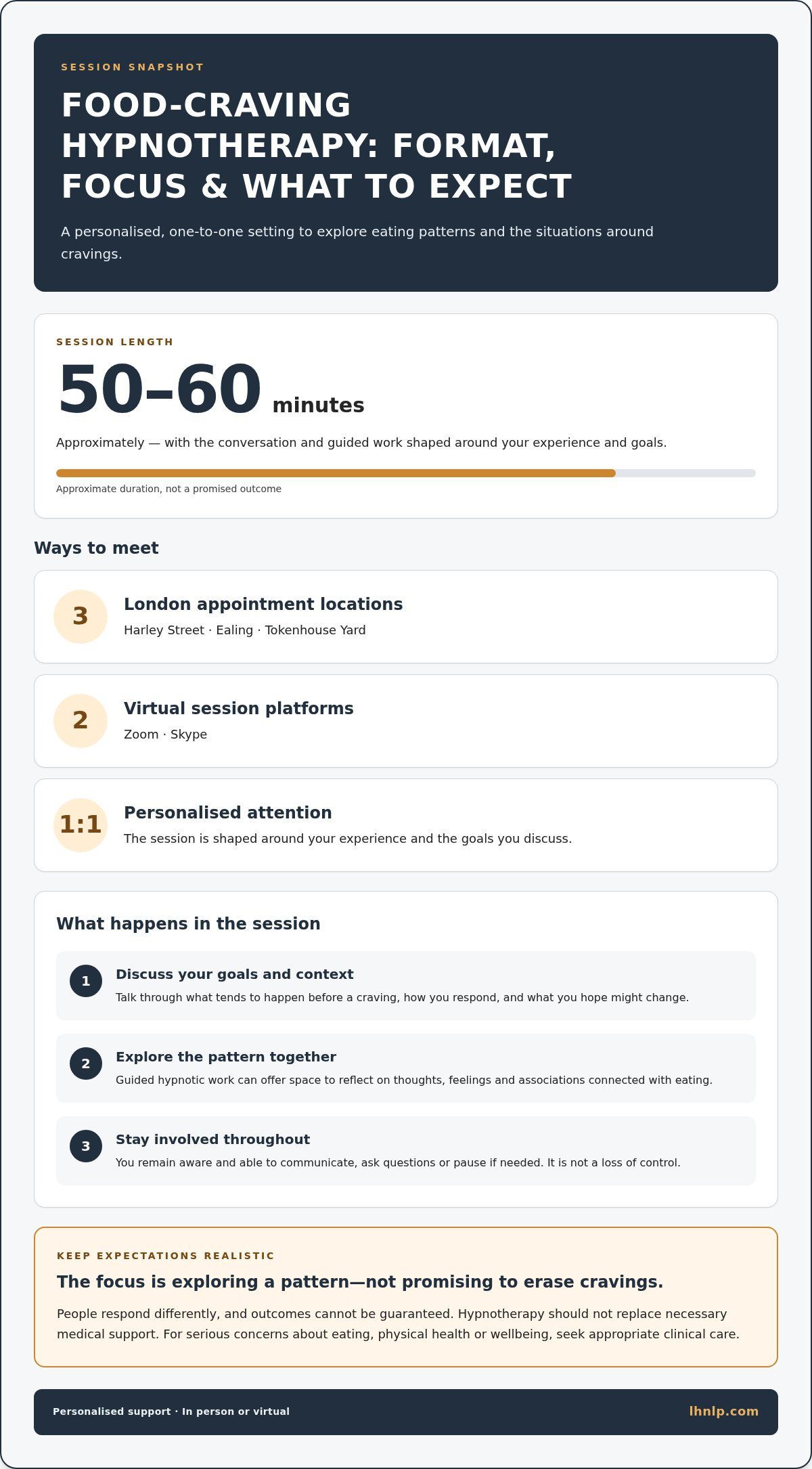
This guide explains what may sit behind recurring cravings, what to expect from sessions lasting approximately 50 to 60 minutes, and how to choose between in-person appointments at Harley Street, Ealing or Tokenhouse Yard and virtual sessions on Zoom or Skype. It also offers practical ways to prepare, so you can make a considered choice at your own pace.
Key Takeaways
- Distinguish a strong desire for a particular food from physical hunger, and notice what may be influencing the craving.
- Explore how hypnosis for food cravings London may support reflection on eating patterns, without promising to remove appetite or control behaviour.
- Compare self-guided reflection with personalised, one-to-one hypnotherapy to decide what kind of support fits your goals.
- Prepare by noting your goals, recurring situations, questions and preferred appointment format.
- Consider whether an in-person appointment in London or a virtual session is a more comfortable way to explore your goals.
Food Cravings in London: What They Can Mean and When to Seek Support
A craving can be frustrating, especially when your attention keeps returning to a particular food. Wanting something strongly isn’t proof of weak character or a lack of discipline. A craving is a strong desire for a specific food, and noticing when it appears can be more useful than responding with blame.
Cravings may arise alongside hunger or when you’re already full. Food cues, daily routines, emotions, what’s readily available and your individual circumstances may all play a part, but no single cause explains everyone’s experience. This section offers general information, not a diagnosis or nutritional advice. If you’re considering hypnosis for food cravings London, start by identifying the pattern you want to understand, rather than assuming you already know its cause.
For a brief introduction to the method discussed later in this guide, see What is hypnotherapy. The video below also explores hypnotherapy in relation to emotional eating.
How are cravings different from hunger or food noise?
When might someone consider professional support?
How Hypnosis for Food Cravings May Help You Explore Eating Patterns
Hypnosis is commonly described as a focused, guided state of attention. It isn’t sleep or a loss of control: you remain aware, can respond and can communicate during the session. In a therapeutic setting, it may provide a structured opportunity to reflect on thoughts, feelings and associations connected with eating. It doesn’t mean someone else takes control of your choices.
For someone considering hypnosis for food cravings London, the important distinction is between exploring a pattern and promising to eliminate it. A craving might feel more compelling in particular situations, such as during stress or when a familiar food cue appears. Hypnotherapy may help you examine your responses and clarify what you’d like to do differently, but people respond in different ways and outcomes can’t be guaranteed.
What may happen during a craving-focused session?
The conversation begins with your goals and the context around the pattern: what tends to happen before a craving, how you respond and what you hope might change. Guided hypnotic work can then be shaped around the individual and the goals discussed. It’s collaborative, not a script designed to override your preferences. You remain present and able to speak up, ask questions or pause if needed.
You might find it useful to notice the circumstances around a craving, such as the time or situation in which it tends to arise and what you do next. This isn’t about proving that every urge has a hidden psychological explanation. It can simply help you describe your experience and consider whether you’d like to respond differently.
Can hypnosis remove food cravings completely?
No responsible approach should promise to remove cravings completely or permanently. Hypnotherapy may support some people in exploring their reactions and practising a different response, but whether it feels helpful varies. Personal circumstances, the nature of the pattern and any wider support can all matter.
It’s important to be clear about the evidence. Hypnosis for food cravings shouldn’t be presented as a proven treatment or a substitute for healthcare. NICE guidance on eating disorders describes care for those conditions; it should not be read as an endorsement of hypnosis for cravings. If eating-related concerns are serious or affect your health, seek appropriate clinical care and consult the NICE guidelines for eating disorders as relevant information.
If you’re weighing up whether this approach fits your goals, explore the practice’s hypnotherapy and coaching treatments. Hypnotherapy for weight management can provide a personalised setting to discuss eating patterns in the context of your own aims.
Choosing Hypnotherapy for Food Cravings: Compare Fit, Approach, and Expectations
There isn’t one right way to respond to food cravings. Self-guided strategies, such as making brief notes about when urges arise, can help you spot routines and reflect at your own pace. One-to-one hypnotherapy offers a different kind of support: a guided conversation shaped around your experience and goals. Neither option guarantees change. You can consider them separately or alongside one another where appropriate.
If you’re exploring hypnosis for food cravings London, focus less on finding a universally “best” technique and more on whether the approach feels relevant, respectful and manageable for you.
What makes an approach feel relevant to your needs?
Start by identifying what you’d like to understand. It might be cravings that tend to arise during stress, after a particular routine or in response to certain situations. In personalised one-to-one sessions, those goals can guide the discussion instead of forcing your experience into a standard explanation. No single technique or interpretation is suitable for everyone.
- Personalisation: Self-guided reflection lets you choose what to notice; one-to-one sessions centre the conversation on your goals.
- Format: Self-guided strategies happen in your own time. Hypnotherapy involves working with a practitioner in a session.
- Goals discussed: You might focus on understanding a recurring craving, changing your response or exploring broader weight-management aims.
- Expectations: Either approach may support reflection, but neither should be treated as a guaranteed fix or a substitute for appropriate healthcare.
What should realistic progress look like?
Progress doesn’t have to mean cravings disappear. Depending on your circumstances, it might involve noticing a trigger sooner, understanding your response more clearly or finding more room to choose what to do next. Change can take effort, and the pace and experience vary from person to person.
As you consider hypnosis for food cravings London, ask yourself whether the process feels collaborative, respects your choices and is manageable alongside your wider needs. A useful approach should leave space for your questions and personal goals, not pressure you with promises of effortless change.
Preparing for a London Hypnotherapy Session About Food Cravings
A little reflection beforehand can help you use your session to explore what matters most. You don’t need a complete explanation or a perfect record of your eating habits. For hypnosis for food cravings London, the aim is to bring useful context and questions, not to judge yourself or prove that a pattern has a particular cause.
What should you note before your first appointment?
Keep your preparation simple and descriptive. A few brief notes can give the conversation a helpful starting point:
- Your goal: Write down what you hope to understand or change, such as feeling less distracted by a recurring craving.
- Patterns you’ve noticed: Note when cravings tend to arise and any relevant situations, routines or feelings. You don’t need to track every meal or detail.
- Your questions: Jot down anything you’d like to know about the session, the process or how the work might relate to your personal goals.
- Your preferred format: Consider whether you’d feel more comfortable meeting in person or remotely.
Keep the notes neutral. “I often want a snack after a stressful day” is more useful than labelling yourself as lacking willpower. This is reflection, not a plan for food restriction. Bring the notes with you or use them simply to organise your thoughts.
In-person or online: which session format suits you?
Individual appointments last approximately 50 to 60 minutes. In-person sessions are available at Harley Street, Ealing and Tokenhouse Yard. Meeting face to face may suit you if you prefer a dedicated setting away from home or find it easier to focus in person.
Virtual sessions are available through Zoom or Skype. They may fit your routine if travelling across London is inconvenient or if you’d rather join from a familiar, private space. Consider where you can feel settled and give the conversation your attention. For more detail about the remote format, read about online hypnotherapy services.
Both formats offer space to discuss your goals and the patterns you want to explore. You don’t need to have everything worked out in advance. A clear starting point is enough.
If you’re ready to discuss your goals and preferred session format, get in touch with London Hypnotherapy & NLP.
Explore Food-Craving Hypnotherapy with London Hypnotherapy & NLP
If food cravings are affecting your day-to-day choices, a helpful first step is to consider what you want to change and what you’ve noticed so far. London Hypnotherapy & NLP provides personalised, one-to-one hypnotherapy and weight-management support. When cravings relate to weight-management goals, sessions can focus on your individual aims and experiences without assuming that everyone’s pattern has the same cause.
What can you expect from a personalised approach?
Practitioner Kamal leads the practice. Sessions focus on your aims and relevant experiences, giving you room to explain what concerns you, what you’d like to be different and what feels realistic. The intention is to explore your goals collaboratively, not to impose a standard plan or promise a particular result.
For a broader overview before deciding what to explore, read the London hypnotherapy and NLP guide. You can also explore hypnotherapy and NLP treatments to understand the types of support available.
Appointments can take place in person at Harley Street, Ealing or Tokenhouse Yard, or virtually through Zoom or Skype. Individual sessions last approximately 50 to 60 minutes. Your preferred format may depend on your routine, travel across London and where you feel most comfortable having a focused conversation.
How can you take the next step in London?
To begin, consider the goals you’d like to discuss, any patterns you’ve noticed and whether you’d prefer an in-person or virtual appointment. You don’t need a complete explanation before getting in touch. A conversation gives you space to describe your aims and consider whether this approach feels suitable.
If you’re considering hypnosis for food cravings London, you can contact the London practice to discuss your goals and arrange a first conversation. Take the next step at your own pace, with realistic expectations and room to decide what feels right for you.
Take a Thoughtful Next Step Towards Change
Food cravings aren’t a verdict on your character. Noticing when they arise and what may influence them can offer a more compassionate starting point than blame. Hypnotherapy may help you explore your responses and goals, but it can’t promise to remove cravings, and each person’s experience is different.
If you’re considering hypnosis for food cravings London, choose an approach that feels respectful and collaborative. London Hypnotherapy & NLP offers personalised one-to-one sessions lasting approximately 50 to 60 minutes, with in-person appointments at Harley Street, Ealing and Tokenhouse Yard, as well as virtual consultations through Zoom or Skype. A conversation can help you discuss the patterns you want to address and decide whether the approach feels suited to your needs.
You can take your time, keep your expectations realistic and decide what feels right for you. To explore the available support, explore hypnotherapy and NLP treatments.
Frequently Asked Questions
Is hypnosis for food cravings effective?
Some people use hypnotherapy to explore habits, food cues and responses associated with cravings, but individual outcomes vary. It shouldn’t be treated as a guaranteed cure or a substitute for medical care, and claims about effectiveness should be considered carefully. Think about whether a personalised approach fits your goals and expectations. If you have concerns about your eating, health or wellbeing, discuss them with an appropriate clinician.
Can hypnosis stop food cravings completely?
No responsible practitioner should promise to eliminate cravings for everyone. Sessions may offer an opportunity to explore possible triggers and practise different responses, but cravings can be influenced by several factors, and hypnosis doesn’t override appetite. Progress differs between people and may depend on personal circumstances and wider support. A realistic aim is to explore whether you can relate to cravings differently, not to expect them to disappear permanently.
How does hypnotherapy for food cravings work?
Hypnotherapy for cravings can begin with a collaborative discussion of your goals and the situations, associations or habits you’d like to explore. Hypnosis involves guided, focused attention, not losing control; you remain aware and can communicate. The approach is tailored to the individual, and people may respond differently. Claims about how hypnosis works or its effectiveness should be cautious and supported by reliable evidence, rather than presented as a guaranteed outcome.
How many hypnotherapy sessions are needed for food cravings?
There’s no set number of sessions that suits everyone. The amount of support may depend on your aims, circumstances and how you respond to the work. In one-to-one sessions, you can discuss your goals and review them as you go, helping you decide whether the approach remains useful for you. No fixed timeline or result should be promised, so you can make an informed choice without pressure.
Can I have hypnotherapy for food cravings online in London?
Yes. London Hypnotherapy & NLP offers virtual consultations through Zoom and Skype. You can consider a remote appointment alongside in-person sessions, depending on your preferences, routine and circumstances. Online work isn’t necessarily the right fit for everyone, so think about where you feel comfortable having a focused conversation. Read more about the practice’s online hypnotherapy services to understand the virtual option.
What happens in a first hypnotherapy session for food cravings?
A first one-to-one session gives you space to discuss your goals, relevant patterns, questions and what you hope might change. You can share only what feels comfortable. The practitioner can use that conversation to shape a personalised approach, rather than assume one explanation fits everyone. Sessions last approximately 50 to 60 minutes. The first appointment is not a guarantee of a particular result; it’s a chance to explore your needs.
Where can I have hypnotherapy for food cravings in London?
In-person appointments are available at Harley Street, Ealing and Tokenhouse Yard. Virtual consultations through Zoom and Skype are another option. Consider which location or format best fits your routine and where you’d feel comfortable talking about your goals. If you’re considering hypnosis for food cravings London, you can contact the practice to discuss your goals.