

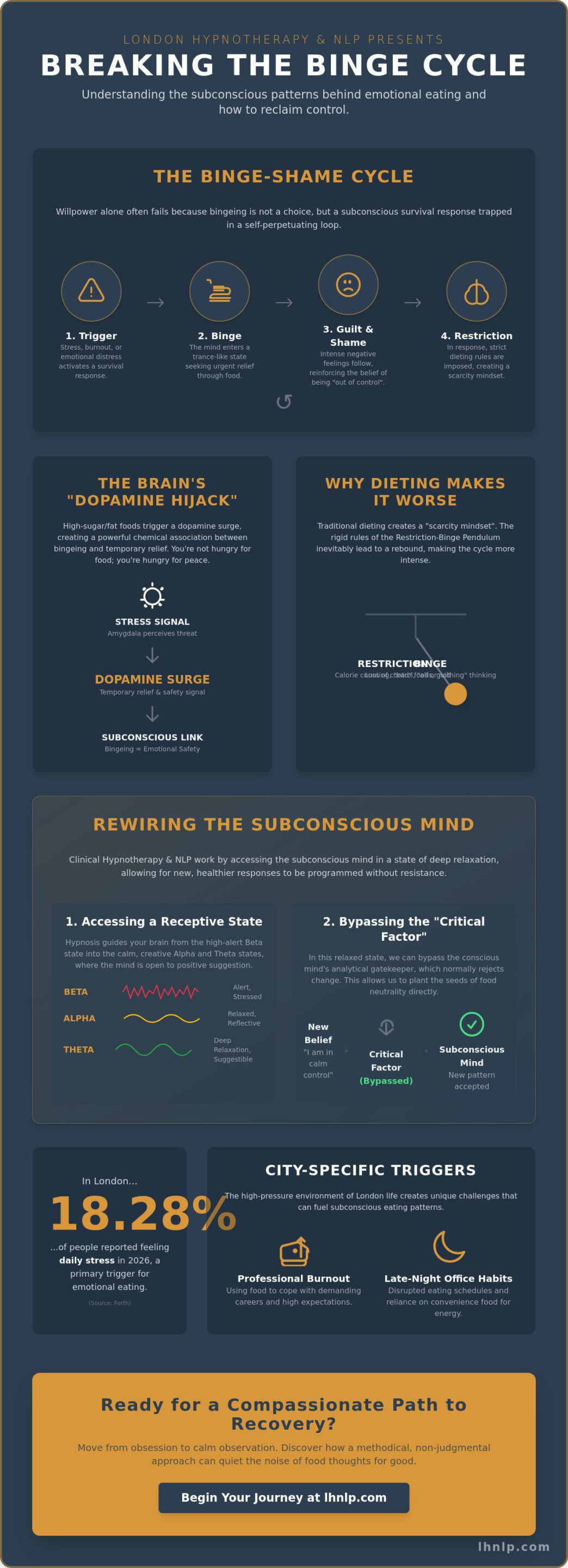
What if the overwhelming urge to binge isn’t a failure of character, but a sophisticated survival signal from a mind that simply hasn’t learned a safer way to cope? If you’ve spent years trapped in the exhausting cycle of planning, hiding, and then drowning in the guilt that follows a binge, you know that willpower is rarely enough to break the chains. With 18.28% of people in the capital reporting daily stress in 2026 according to Forth, it’s no wonder so many are seeking hypnosis for binge eating London to find a deeper, more permanent sense of control. This isn’t about more discipline; it’s about shifting the internal landscape where those urges are born.
You likely feel that if you could just try harder, the shame would vanish, yet the emotional triggers remain as loud as ever. We understand that this behavior is often a subconscious safety mechanism rather than a lack of strength. This article explores how clinical hypnotherapy and NLP can rewire your relationship with food, allowing you to move from a place of obsession to one of neutral, calm observation. We’ll examine how to identify the emotional roots of your behavior and how a guided, methodic approach can finally quiet the noise of food thoughts for good.
Key Takeaways
- Understand why willpower alone isn’t enough to break the binge cycle and how identifying the trance-like state is the first step toward regaining control.
- Discover how hypnosis for binge eating London utilizes Alpha and Theta brainwaves to bypass the conscious mind’s resistance and suggest healthier responses to stress.
- Learn how the combination of NLP and clinical hypnotherapy creates a multi-modal approach that reframes your perception of food more effectively than talk therapy alone.
- Identify how the specific pressures of London life, such as professional burnout and late-night office habits, fuel subconscious emotional eating patterns.
- Explore a compassionate, non-judgmental path to recovery where lasting change is treated as a methodical process rather than an overnight event.
Understanding the Binge Eating Cycle: Why Willpower Isn’t Enough
Many people mistakenly believe that their struggles with food are merely a lack of discipline or a failure of character. In reality, Binge Eating Disorder is a complex psychological challenge where the brain seeks emotional regulation through consumption. Have you ever noticed how, in the moments leading up to a binge, your surroundings seem to fade away and your focus narrows entirely onto the food? This trance-like state isn’t a coincidence; it’s a profound shift in consciousness where the logical mind is sidelined by more primitive survival instincts.
When stress levels peak, the amygdala triggers a “fight or flight” response that demands immediate relief. For many, the brain misinterprets this emotional distress as a biological emergency, leading to an urgent, frantic search for high-calorie fuel to “survive” the perceived threat. This is why hypnosis for binge eating London is so effective; it addresses these deep-seated neurological responses at their source rather than fighting the surface-level symptoms. The Binge-Shame Cycle is a self-perpetuating loop where the emotional distress caused by the behavior becomes the primary trigger for the next episode.
To better understand this concept and begin the process of calming your nervous system, watch this helpful video:
The Dopamine Loop: How Your Brain Gets “Hijacked”
High-sugar and high-fat foods act as a chemical bandage, triggering a surge of dopamine that provides temporary relief from emotional turmoil. Over time, your brain creates a powerful association between bingeing and safety. You aren’t actually hungry for food; you’re hungry for the peace that the dopamine provides. Distinguishing between physical hunger and “head hunger” requires a level of awareness that is often difficult to access when your brain feels hijacked by these chemical rewards. Through a methodical approach, we can begin to untangle these associations and restore your natural sense of balance.
Why Traditional Dieting Often Makes Bingeing Worse
Traditional dieting often acts as the catalyst for the very behavior it seeks to cure. When you count every calorie or label foods as “good” or “bad,” you swing the “Restriction-Binge” pendulum, forcing the mind into a scarcity mindset that eventually breaks. This all-or-nothing mentality tells you that a single mistake justifies a total collapse of control. It’s a exhausting way to live. By choosing hypnosis for binge eating London, you remove the need for these rigid, restrictive rules and instead foster a natural, intuitive relationship with your body. True freedom comes when you no longer need the rules to feel safe around food.
How Hypnosis for Binge Eating Rewires Your Subconscious Mind
To understand how lasting change takes root, we must look at the specific frequency of the mind during a clinical session. When you engage in hypnosis for binge eating London, your brain moves out of the fast-paced Beta waves of everyday stress and into the rhythmic flow of Alpha and Theta states. These are the same states you experience just before falling asleep or when you are deeply lost in a creative project. In this receptive space, the mind is no longer defensive. It becomes a fertile ground for new perspectives, allowing suggestions to bypass the “Critical Factor” of the conscious mind. This gatekeeper usually rejects anything that contradicts your current self-image, but in hypnosis, the gate opens, letting us plant the seeds of food neutrality directly into your subconscious.
Often, the urge to binge is tied to an “Initial Sensitizing Event,” a moment in your past where food first became a shield against pain. Using a technique called “Regression to Cause,” we can revisit these original emotional wounds without re-traumatising the self. We don’t just look at the behavior; we look at the reason the behavior exists. Through the deliberate practice of mental rehearsal, neuroplasticity allows the brain to create entirely new neural pathways that foster food neutrality, effectively silencing the old, loud signals of compulsion.
The Role of Suggestion Therapy in Food Neutrality
Many traditional approaches try to create an “aversion” to trigger foods, making you feel disgusted by what you once craved. However, aversion is often brittle and can lead to new forms of restriction. True freedom lies in neutrality. Through post-hypnotic suggestions, we train your mind to view trigger foods with the same indifference you might feel toward a bowl of plain crackers. You begin to notice the subtle signals of satiety that your body has been sending all along. By vividly visualising a future self who is calm and indifferent to old triggers, you provide your subconscious with a blueprint for a new way of being. If you are ready to explore these internal dynamics, our specialised treatments offer a structured path to resolution.
Addressing the Root Cause: Beyond the Symptom
The part of you that urges a binge isn’t your enemy. In the framework of Parts Therapy, we recognize this urge as a “protector” part of your personality. It emerged at a time when you lacked other tools to manage intense emotions, and it chose bingeing as a way to soothe your nervous system. By negotiating with this part, we can acknowledge its positive intent while teaching it more constructive ways to provide comfort. We move beyond the symptom to heal the underlying anxiety or trauma. When the internal pressure is released, the need for the “protection” of a binge simply evaporates, leaving you with a sense of quiet, inner confidence.
NLP and Hypnotherapy: A Multi-Modal Approach to Lasting Change
While traditional talk therapy often dwells in the “why” of a problem, it can sometimes leave the “how” of change untouched. You might understand your past perfectly but still find yourself standing in front of an open fridge at midnight, feeling powerless. This is where combining Neuro-Linguistic Programming (NLP) with hypnosis for binge eating London creates a vital bridge between understanding and action. NLP focuses on the structure of your experience; it examines how you represent food in your mind. By changing these internal “maps,” we can shift your response to triggers in real time. This multi-modal strategy ensures that you aren’t just managing symptoms but are actively installing new, healthier patterns. You can view our full range of integrated treatments to see how these methods work together.
Reframing is a cornerstone of this work. It involves shifting the context of a thought so its meaning changes entirely. Is it possible that the very images you hold of food are what keep you trapped? Instead of seeing a binge as a shameful loss of control, we reframe it as a misguided attempt by the brain to seek safety. Once the “intent” is understood, the brain no longer needs the “behavior.” This shift allows you to move away from the battle of willpower and toward a state of natural, effortless choice.
NLP Techniques Specifically for Binge Eating
To provide you with immediate relief, we use specific tools that address the urgency of a craving. The Swish Pattern, for instance, allows us to take the mental image you have of a binge and “swish” it away, replacing it instantly with a picture of your empowered, healthy self. This happens so fast that the brain begins to automatically skip the craving and jump straight to the feeling of confidence. Anchoring is another powerful tool. Have you ever felt a wave of panic in a supermarket aisle? Anchoring allows you to “set” a physical trigger, such as pressing two fingers together, that instantly floods your system with a state of calm and resourcefulness. Finally, Timeline Therapy helps you go back and release the emotional charge of past guilt, ensuring that yesterday’s mistakes don’t dictate tomorrow’s success.
Building Self-Image and Confidence
Bingeing often creates a corrosive identity where you begin to believe “I am a failure.” NLP helps dismantle this label by separating your behavior from your worth. We work on creating a compelling future where food is simply fuel, not an emotional crutch. This process of desensitising the mind to old triggers is remarkably similar to how we approach phobia treatment, where we uncouple a specific stimulus from an intense emotional reaction. When you change how you see yourself, the need to hide behind food simply disappears.
The London Context: Managing Stress and Triggers in the City
Life in the capital carries a unique psychological weight. With 18.28% of Londoners reporting daily stress in 2026 according to Forth, the city itself can become a primary trigger for emotional eating. The relentless pace of the corporate world often leads to “Desk Bingeing,” a phenomenon where the boundaries between professional duty and personal well-being dissolve into late-night office meals. This environment is further complicated by the frictionless access to high-calorie comfort through delivery apps like UberEats or Deliveroo. These platforms turn a fleeting emotional impulse into a delivered reality in minutes, bypassing the natural “pause” that might otherwise prevent a binge. Curating your digital environment by disabling notifications from these apps after a certain hour is a vital step in setting boundaries for your mind. Choosing hypnosis for binge eating London provides a way to recalibrate your response to this specific urban pressure, ensuring that the city’s demands don’t dictate your relationship with food.
Integrating Therapy into a Busy London Schedule
For many busy professionals, the logistics of self-improvement can feel like another item on an already overflowing to-do list. This is why Virtual Hypnotherapy has become an essential tool, offering the same clinical depth as in-person work from the privacy of your own home or office. If you prefer a physical “reset” away from your daily environment, sessions are available at prestigious locations including Harley Street, Ealing, and Tokenhouse Yard. These 50-minute sessions are methodically structured to provide maximum psychological impact, respecting the value of your time while facilitating deep, inner change. Each session acts as a sanctuary where the noise of the city fades, allowing you to focus entirely on your internal transformation.
Practical Tools for the Commute and Workplace
The transition from the office to the home is often the most vulnerable time for a binge. Using simple breathing techniques on the Tube can help lower cortisol levels before you even step through your front door, breaking the link between work stress and the kitchen pantry. In the high-pressure corporate world, social eating and drinking can also feel like a minefield where the fear of judgment triggers old habits. By integrating Stress Management tools with your hypnotherapy, you learn to navigate these events with a sense of internal authority. If you’re ready to reclaim your evenings from the cycle of stress and food, you can book a consultation to begin your journey.
Your Journey with Kamalyn Kaur: What to Expect
Embarking on a path toward recovery requires more than just clinical expertise; it demands a sanctuary where you feel truly seen and understood. When you seek hypnosis for binge eating London, you aren’t just engaging a service. You’re entering a partnership rooted in deep empathy and professional integrity. Kamalyn’s philosophy is built on the profound understanding that “Change is a process, not an event.” There are no rigid, one size fits all scripts in this practice. Instead, every session is a bespoke exploration of your unique internal landscape, designed to honor your individual pace and the specific nuances of your history. This non-judgmental environment is the fertile ground where true transformation begins to take root.
We recognize that the journey is as much about unlearning old patterns as it is about installing new ones. By moving away from the “quick fix” mentality, we allow space for a more permanent shift in your identity. This methodical approach ensures that the changes you experience aren’t just temporary patches, but a fundamental rewiring of how you perceive yourself and your needs. You’re not just a client; you’re an individual with a unique story that deserves a tailored roadmap to freedom.
The Initial Consultation and Assessment
The first step is a thorough discovery process where we peel back the layers of the behavior to understand its origin. Is your bingeing a response to the quiet hum of boredom, the sharp edges of city stress, or perhaps a form of childhood programming that once served as a protective shield? We’ll identify these triggers with precision. During this initial meeting, we set clear, achievable goals that define what a healthy, neutral relationship with food looks like for you. We also include a “pre-talk” to demystify the process, ensuring you feel entirely comfortable and informed before we begin the deeper work. This clarity is essential for building the trust required for subconscious change.
A Typical Session Structure
A session is a methodically designed experience that respects both the mind and the spirit. It typically begins with the “Induction,” where you’re guided into a state of deep, restorative relaxation. Once the conscious mind is at rest, we move into the “Work.” This is where we apply the NLP and hypnosis for binge eating London techniques to address the specific goal of the day, whether that’s neutralizing a trigger or building internal confidence. Finally, the “Emergence” brings you back to full alertness. You’ll leave the session feeling refreshed, empowered, and equipped with a new sense of internal authority. If you’re ready to break the cycle and reclaim your peace of mind, you can book your consultation with Kamal to start your journey today.
Step Into a New Relationship With Yourself
Breaking the cycle of binge eating is rarely about finding more discipline; it’s about finding the courage to look beneath the surface of the urge. We’ve explored how the subconscious mind uses food as a protective shield and how a multi-modal approach can finally quiet the noise of obsessive thoughts. By addressing the specific pressures of the city, you can move from a state of constant reaction to one of deep, internal calm. If you’re ready to reclaim your life from these patterns, choosing hypnosis for binge eating London offers a path that respects both your journey and your time.
With clinical expertise dating back to 2005, Kamalyn Kaur specializes in helping individuals navigate the complexities of weight management and anxiety. Whether you visit our locations in Harley Street or Ealing, or connect through a virtual session, you’ll find a supportive space dedicated to your growth. You don’t have to carry the weight of the past into your future. Change is waiting for you to simply step forward and embrace a new way of being.
Begin your recovery with a professional hypnotherapy session in London and discover the freedom of a mind at peace.
Frequently Asked Questions
Is hypnosis for binge eating safe?
Hypnosis is a completely safe, non invasive, and natural state of focused attention that feels very similar to being deeply absorbed in a book or a daydream. You remain fully aware of your surroundings and in total control throughout the process. It is a collaborative experience where your mind only accepts suggestions that align with your personal values and goals for health and well-being.
How many sessions of hypnotherapy will I need for binge eating?
The number of sessions varies depending on the complexity of your relationship with food, but most clients see significant shifts within four to six sessions. Since change is a methodical process rather than a single event, we tailor the duration to ensure the new neural pathways are fully integrated. Some individuals may require more time to address deep seated emotional wounds or long standing habits.
Can I be hypnotised if I have a busy mind?
A busy or analytical mind is actually an asset in hypnotherapy, as it often indicates a high level of intelligence and a vivid imagination. You don’t need to “quiet” your thoughts to be successful; instead, we use that mental energy to fuel the creative visualisations required for change. The process is designed to work with your mind’s natural rhythm, not against it, allowing even the most active thinkers to reach a state of receptive calm.
What is the difference between binge eating and overeating?
Overeating is simply consuming more food than your body requires, often during social events, whereas binge eating involves a distressing sense of loss of control. Bingeing is usually driven by emotional triggers rather than physical hunger and is often followed by intense feelings of guilt, shame, or secrecy. While overeating is a behavior, binge eating is a psychological cycle used to regulate difficult emotions or stress.
Will I lose control or say things I don’t want to during hypnosis?
You will never lose control or reveal secrets against your will during a clinical session. The idea that a hypnotist can “make” you do things is a myth perpetuated by stage performances; in a therapeutic setting, you are an active participant. You can speak, move, or open your eyes at any time if you wish, as the state of hypnosis is simply a heightened form of internal focus.
How much does hypnotherapy for binge eating cost in London?
The cost of hypnosis for binge eating London varies across the city based on the practitioner’s expertise and the location of the clinic. Many therapists offer discounts for block bookings, which encourages the commitment needed for a lasting transformation. It’s best to view this as an investment in your long term mental health and freedom from the exhausting cycle of food obsession.
Can hypnotherapy help with sugar addiction specifically?
Hypnotherapy is exceptionally effective for sugar addiction because it addresses the dopamine reward loop at a subconscious level. We work to neutralise the intense pull of sweet triggers, helping your brain view sugar with indifference rather than as a necessary source of comfort. By using hypnosis for binge eating London, we can break the chemical and emotional grip that sugar holds over your daily choices.
Does virtual hypnotherapy work as well as in-person sessions for eating disorders?
Virtual sessions are just as effective as in person therapy and offer the added benefit of allowing you to remain in a comfortable, familiar environment. As long as you have a stable internet connection and a quiet space, the neurological process of entering hypnosis remains identical. Many professionals find that being in their own home helps them relax more deeply, facilitating faster breakthroughs in their recovery journey.